Crossbreeding sheep breeds: which ram to put on local ewes and how much a crossbred lamb adds
Commercial crossbreeding in Uzbekistan: which ram to put on Jaydara and Karakul ewes, why a crossbred lamb is 4–6 kg heavier by seven months, and why crossbred ewe lambs must never be kept for breeding. The math for a flock of 100 ewes at September 2026 prices.
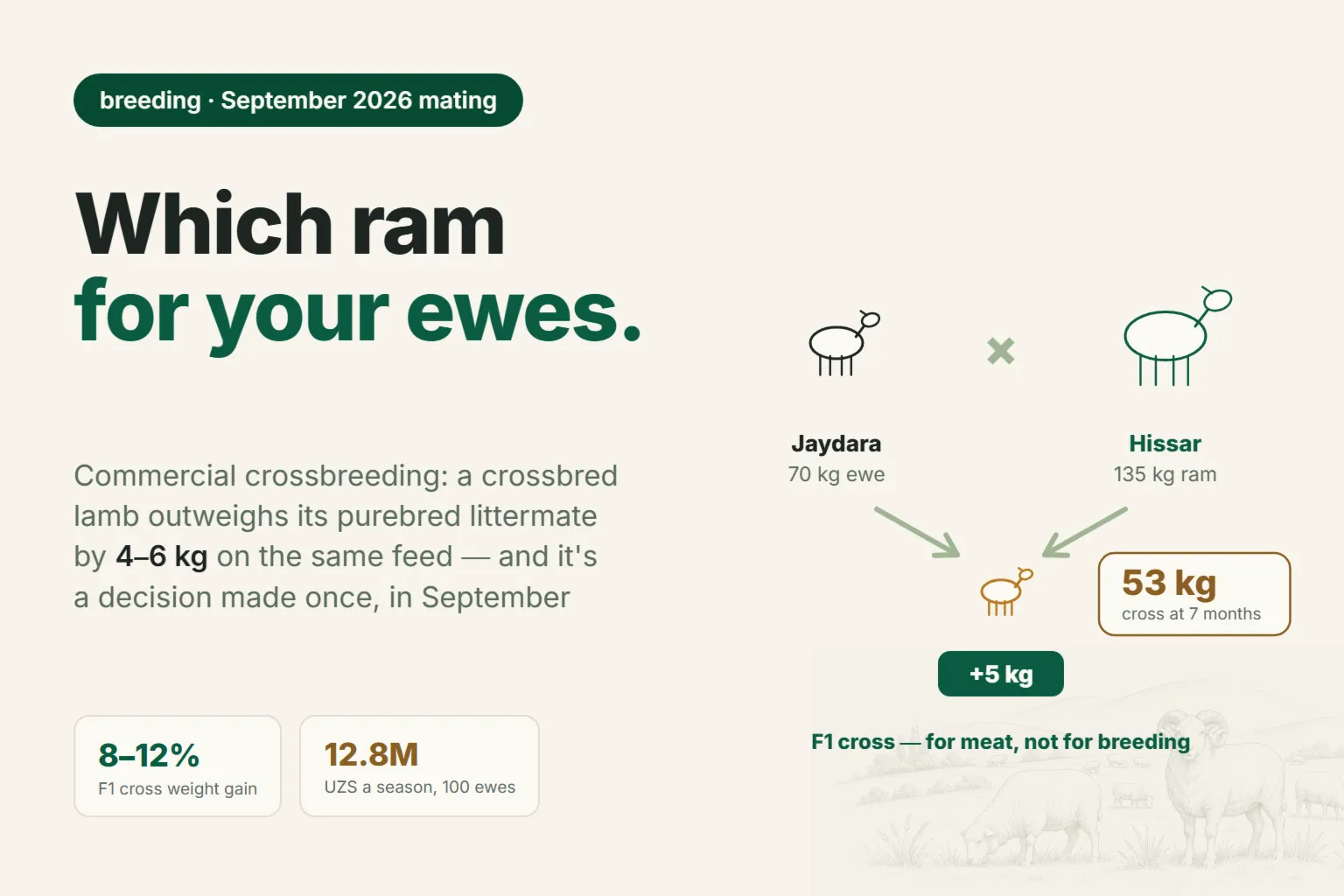
Crossbreeding sheep breeds means putting local ewes to a ram of a different, bigger breed, then selling the entire crossbred crop for meat instead of keeping it for breeding. Two schemes work in Uzbekistan: Jaydara ewes under a Hissar ram, and Jaydara or Karakul ewes under an Edilbay ram. By seven months a crossbred lamb comes out 4–6 kg heavier than a purebred littermate on the same feed — a gain that needs no new shed and no extra hand, just the right ram in September.
Below are the breed pairs that work in Uzbekistan, how much money a crossbred lamb brings at September 2026 prices, and the rule that trips up the most farmers: crossbred ewe lambs must never be kept for breeding.
What commercial crossbreeding is
Commercial (industrial) crossbreeding is a one-time mating of ewes from one breed with a ram from another, where the entire crop is sold for meat and the flock is rebuilt from purebred ewe lambs.
It's often confused with breed improvement. With improvement (absorptive, or grading-up, crossbreeding) the crosses are kept instead and mated back to the same breed generation after generation, until the flock becomes nearly a new pure breed. That's a long road: 4–5 generations, eight to ten years, and the whole time the farm lives with a mixed flock.
Commercial crossbreeding works differently and pays in the very first season. Two things create the gain at once. The first is half the sire breed's genes: a Hissar ram is roughly twice the weight of a Jaydara ewe, and his lamb inherits part of that extra size. The second is heterosis: first-generation crosses (F1) grow and survive better than the average of both parents. According to zootechnical data, heterosis on its own adds about 5% to weight traits and 3–5 percentage points to lamb survival to weaning. Combined with the sire breed's own size effect, that's what produces the 8–12% live-weight gain in young stock the whole scheme is built around.
One detail worth remembering from the start: heterosis lasts exactly one generation. In the second generation it breaks down, and the flock turns patchy and unpredictable.
Which ram to put on local ewes in Uzbekistan
The choice of ram is set by the weight of your ewes, not by which breed sounds more impressive. Here are the breed standards for adult live weight:
| Breed | Ram, kg | Ewe, kg | Lamb at birth, kg |
|---|---|---|---|
| Hissar | 130–140 | 80–90 | 5–6 |
| Edilbay | 110–120 | 65–70 | 5–6 |
| Jaydara | 95–110 | 60–84 | 5–5.5 |
| Karakul | 65–70 | 45–50 | 3.5–4.5 |
Birth weight depends heavily on the ewe's condition and litter size, so handbooks give it as wide ranges: for fat-tailed breeds it averages 5–6 kg. The difference between breeds here is small — what decides the outcome isn't birth weight but the ram's mass relative to the ewe's.
That's where the working pairs for meat production come from:
| Ewes on the farm | Ram | What it gives | What to watch for |
|---|---|---|---|
| Jaydara, 60–84 kg | Hissar | The biggest cross: +10–12% lamb weight, a heavy fat tail | Difficult births in ewes below standard and in first-lambing ewe lambs |
| Jaydara or Karakul | Edilbay | +8–10% weight; the ram is closer in size to the ewe than a Hissar | Almost nothing: the pair is balanced by mass |
| Karakul, 45–50 kg | Hissar | Skip this pair | The ram is almost three times the ewe's weight — a big fetus, a dead lamb, and a real risk of losing the ewe too |
| Any local breed | Dorper | Early maturity: crosses gain faster to weaning and shed their own wool | Almost no stock in Uzbekistan; a breeding animal is expensive and has to be shipped in, and local shepherds have no experience with the breed |
| Any local breed | Romanov | High fertility: 2–3 lambs per ewe | Romanov handles heat poorly; the scheme is unreliable in southern Uzbekistan |
Rule of thumb: don't put a Hissar ram on ewes lighter than 55 kg, and never on first-lambing ewe lambs at all. A Hissar lamb is born a kilogram to a kilogram and a half heavier than a Jaydara lamb, and for a ewe below breed standard that's the difference between an ordinary lambing and calling the vet in the middle of the night.
If you run a Karakul operation, crossbreeding has a different point to it. Pelt sales no longer pay a sheep farmer's bills, and karakul pelts barely find a buyer these days — while the ewes themselves stay a healthy flock, well suited to the desert. An Edilbay ram shifts such a farm onto meat income without replacing the flock: the ewes stay the same, the lambs sell as meat stock.
Where to find the sire itself is a separate question. You can see what's currently on offer for the breed in listings for the Hissar breed, and how to check a specific animal by hand — teeth, testicles, conformation — is covered in how to choose a breeding ram.
Whether an expensive Dorper ram is worth putting on local ewes, and why a crossbred lamb with no fat tail may fetch less at the livestock market, is covered in the Dorper breed: what a ram costs and when it pays off.
How much money a crossbred lamb brings: the math on 100 ewes
Let's run the numbers for a real farm: 100 Jaydara ewes, September 2026 prices, live weight in meat condition at a conservative 55,000 UZS/kg (the low end of the 55,000–65,000 range; ≈ $4.66 at the Central Bank of Uzbekistan rate of 11,813 UZS to the dollar on 3 September 2026).
The scheme: keep 30 ewes under your own Jaydara ram — that's the purebred core you draw next year's replacement ewe lambs from. The other 70 ewes go under a Hissar sire, and their entire crop is sold.
| Metric | Purebred Jaydara | Hissar × Jaydara cross |
|---|---|---|
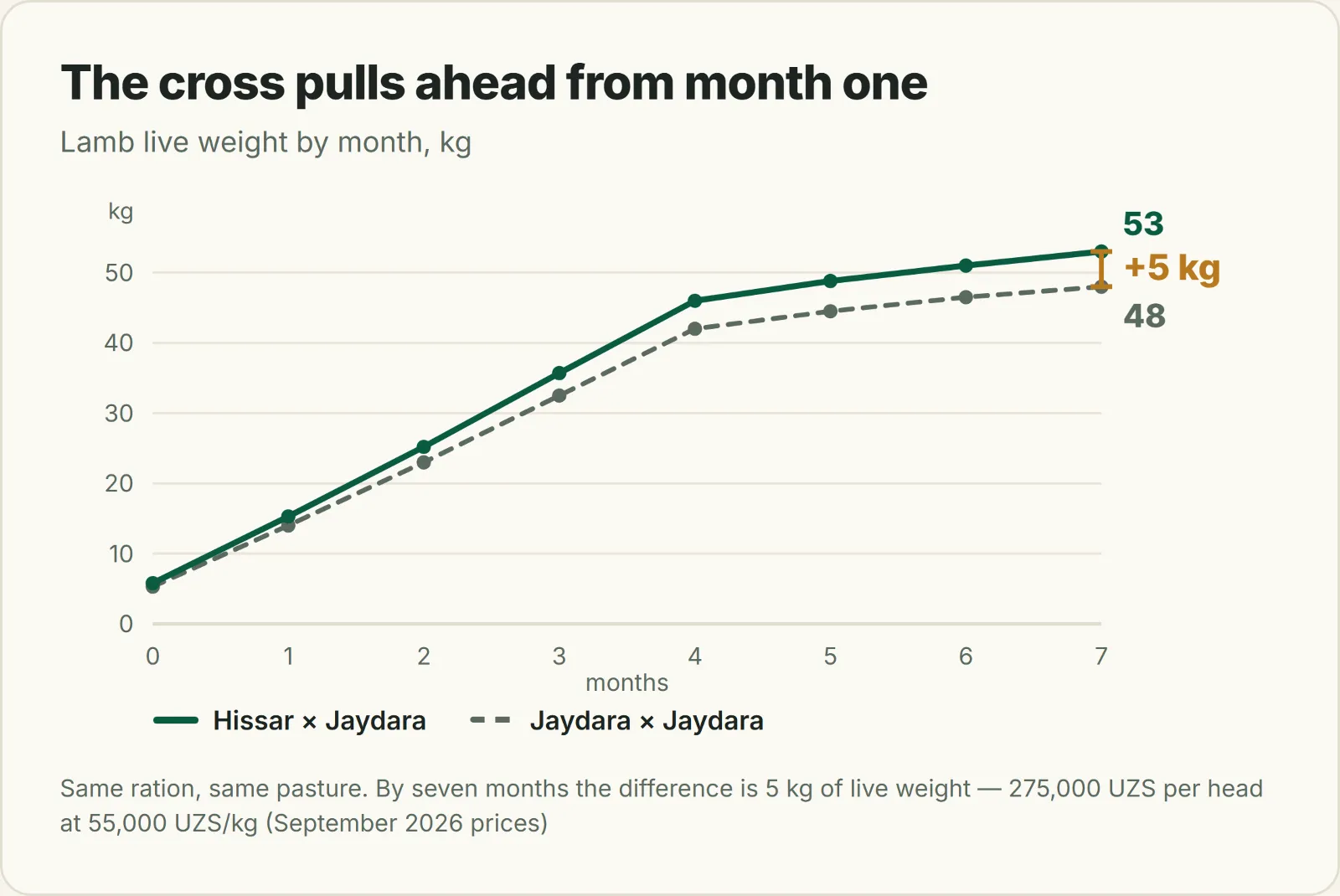
| Ram lamb weight at 7 months | 48 kg | 53 kg |
| Revenue per head | 2,640,000 UZS (≈ $223) | 2,915,000 UZS (≈ $247) |
| Difference | — | +275,000 UZS (≈ $23) |
The gain isn't free: some of it you buy back in feed. Being conservative, let's allow feed for half the extra growth — 2.5 kg out of five, at a gain cost of around 40,000 UZS per kilo, or 100,000 UZS. That leaves about 175,000 UZS net per head (≈ $15).
From 70 ewes, at a lambing rate of 105 lambs per 100 ewes (that's the birth rate — some will be lost before sale), you get roughly 73 crossbred lambs:
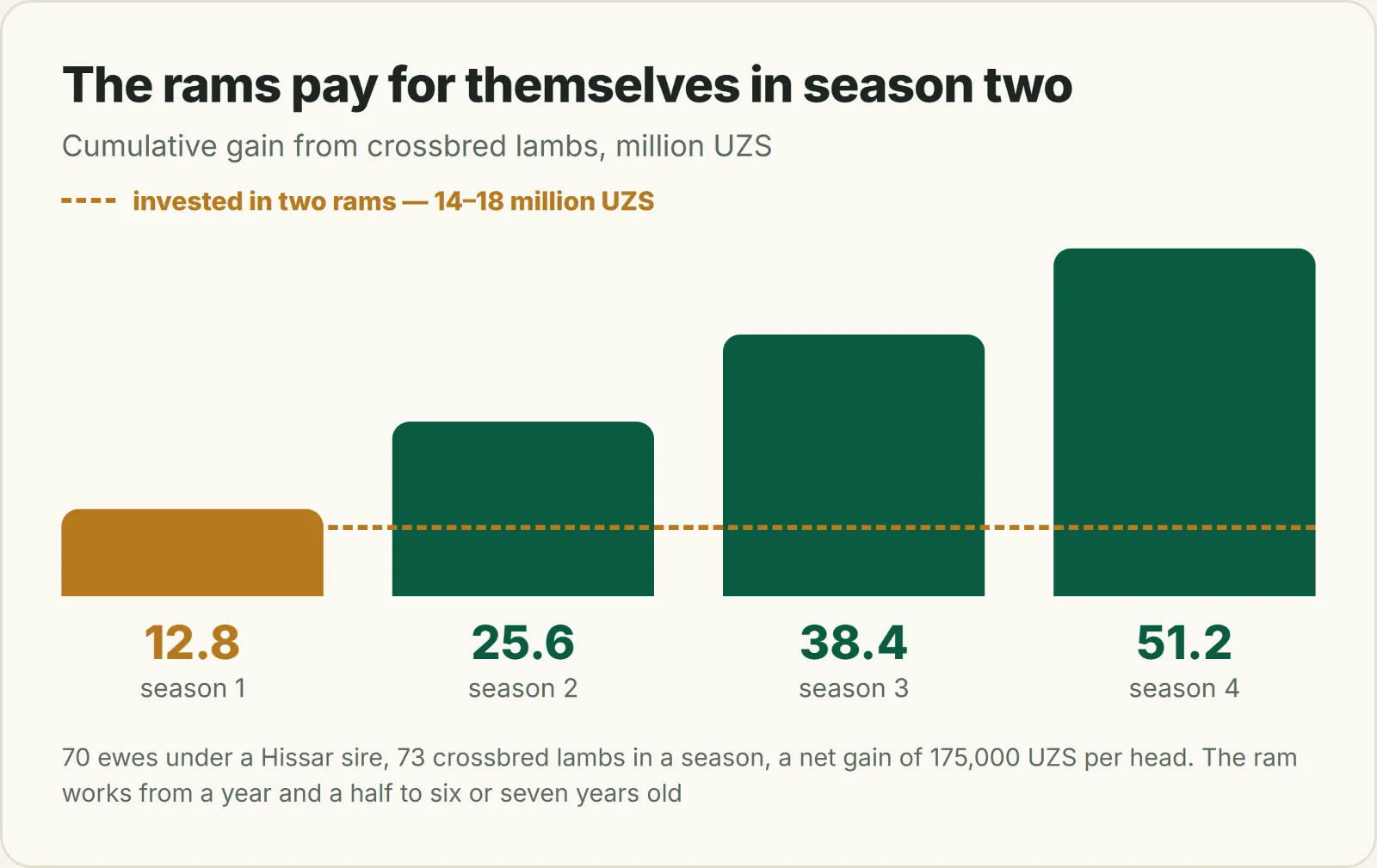
- 73 × 175,000 = 12.8 million UZS (≈ $1,081) of extra profit for the season.
Now the cost of getting started. Under natural mating, one ram covers 30–40 ewes a season, so 70 ewes need two sires. A breeding Hissar ram costs 7–9 million UZS (≈ $593–762); two will run 14–18 million UZS (≈ $1,185–1,524).
| Year the ram works | Cumulative gain | Result |
|---|---|---|
| Season 1 | 12.8 million UZS | More than half the investment returned |
| Season 2 | 25.6 million UZS | Rams fully paid for themselves |
| Season 4 | 51.2 million UZS (≈ $4,334) | 33–37 million UZS net |
A ram works in the flock from a year and a half to six or seven years old; the calculation above conservatively assumes four seasons, after which he goes to slaughter — which returns part of the money too. And this leaves out survival: if heterosis adds those same 3 percentage points of lamb survival, the result gains another two live heads a season, worth about 5.3 million UZS (≈ $450).
Why crossbred ewe lambs must never be kept for breeding
This is the main mistake that turns a good scheme into a mongrel flock within three years.
The temptation is obvious: a crossbred ewe lamb is big, grows fast, and looks better than her purebred littermates. Keeping her instead of an old ewe seems logical. But heterosis is a first-generation effect. In the second generation the parent breeds' genes reshuffle again, and the offspring scatters: some lambs come out big, some smaller than the original Jaydara, with no consistency at all. Planning sales off a flock like that is impossible.
The rule is simple: all crossbred young stock goes to feedlot and sale; replacement ewe lambs come only from the purebred core. That's why 25–30% of ewes stay under your own ram — it's not a loss, it's insurance for the future flock.
A caveat for anyone who has read about Western breeding schemes: there, crossbred ewes are in fact kept — but they're mated to a third, separate breed, and that only works with full pedigree records behind it. The moment a cross is mated to another cross, or back to the same Hissar ram, the flock unravels within two generations. As long as you're working with two breeds, not three, the rule stays simple: all crossbred young stock goes to the feedlot.
This is also where the record-keeping requirement comes from: you need to know at any moment which ewe lambs are crossbred and which are purebred. By eye, a year after weaning, you can no longer tell them apart.
How this three-breed scheme works with a Romanov ram, and what lamb survival it needs to pay off, is covered in our breakdown of Romanov sheep in Uzbekistan.
When a big ram costs you money
Crossbreeding fails for one of three reasons, and all of them are predictable.
Difficult births. A big lamb on a small ewe means a lost lamb, often along with the ewe. A 60 kg Jaydara ewe is worth around 3.3 million UZS by live weight; one such loss eats the gain from a dozen lambs.
Underfeeding pregnant ewes. A crossbred fetus grows faster even in the womb and demands more from the ewe in the last six weeks of pregnancy — that's when it puts on most of its mass. Feed her the same ration as always through that window, and you'll get weak lambs and worn-down ewes instead of a gain.
A mixed flock with no records. If crossbred and purebred lambs graze together and nobody is marked, six months on you can neither judge the effect nor pick the right replacement ewe lambs.
What to decide in September 2026
Ewe gestation runs 145–150 days, and the mating date locks in everything downstream:
| Mating | Lambing | Weaning (3.5–4 months) | Sale at 7 months |
|---|---|---|---|
| Early September 2026 | Late January 2027 | Mid-May 2027 | Late August 2027 |
| October 2026 | March 2027 | Late June – July 2027 | October 2027 |
A September mating brings lambing in late January: the lambs get strong before the summer heat and go up for sale at the end of August. An October mating pushes lambing to March, onto green grass — cheaper on feed, but the seven-month mark doesn't arrive until October. Neither option lands crossbred ram lambs on the spring 2027 demand peak: Qurban Hayit falls on 16 May 2027, and lambs from either lambing are still too young by then. If you're aiming specifically for the spring peak, you'll need to hold the ram lambs until Qurban Hayit on 5 May 2028, at around 13–14 months old, and budget feed for the extra half-year.
What to do before you turn the ram loose with the flock:
- weigh the ewes and pick only those over 55 kg for the Hissar;
- separate first-lambing ewe lambs — they need a ram of their own breed;
- mark the groups differently (paint, different-colored tags) so you can tell them apart in spring;
- build a feed bump for the last six weeks of pregnancy into the ration plan.
What to record to find out a year later whether it worked
Commercial crossbreeding is the one farm decision made once a year, with the result showing up ten months later. The only way to check it is with numbers: lamb weight at birth, at weaning and at seven months, tracked separately for the crossbred group and the purebred one.
Keeping that in a notebook is hard going: records for individual animals sit mixed together, and comparing two groups means copying out fifty lines by hand and adding them up on a calculator. A year on, patience usually runs out, and next season's ram gets picked by the feel of "they looked bigger this time."
QoyHunter is a CRM for sheep record-keeping plus the bazar.qoyhunter.com marketplace. In the record-keeping side, every weighing is logged against a specific animal, and the system works out average daily gain on its own. Analytics breaks results down by breed: enter the crossbred lambs under a separate breed — say, "Hissar × Jaydara" — and a season on, the table shows two rows with the average weight and average daily gain for each. The gap between them is your answer to whether the Hissar ram was worth the money.
If you don't have the right sire on the farm, you can browse sheep and rams for sale in Uzbekistan before mating — September is the last easy month for it.
FAQ
Can you put a Hissar ram on Karakul ewes?
Better not to. A Hissar ram weighs 130–140 kg against 45–50 kg for a Karakul ewe — almost three times as much, and the fetus from that pairing runs too big for her. An Edilbay sire (110–120 kg) is closer in size, and the share of difficult births among Karakul ewes under him is noticeably lower. But even here, first-lambing ewe lambs don't go under an Edilbay ram — only mature ewes in good condition.
What should you do with crossbred ewe lambs — keep them or sell them?
Sell them along with the ram lambs. A crossbred ewe lamb looks bigger than her purebred littermates, but her offspring will be inconsistent: heterosis only works in the first generation. Draw replacement ewe lambs from the purebred group instead — that's exactly why 25–30% of ewes stay under your own ram.
How much more does a crossbred lamb cost in feed?
It eats more, but it pays back the feed better too — that's the whole point of heterosis. A conservative estimate allows feed for half the extra gain: 2.5 kg out of five, around 100,000 UZS at a gain cost of roughly 40,000 UZS per kilo. Revenue from all five kilos comes to 275,000 UZS at 55,000 UZS per kilo of live weight, so the gain stays positive even on a cautious count.
How many ewes does one breeding ram cover in a season?
Under natural mating, 30–40 ewes a season. A flock of 100 ewes needs three rams if you cover them all with a Hissar, or two Hissar rams plus your own Jaydara sire if 30 ewes go toward flock replacement. A young ram under two years isn't given a full load: 20–25 ewes a season.
Does crossbreeding ruin the fat tail?
No, not if both parents are fat-tailed. Hissar, Edilbay and Jaydara are all fat-tailed breeds, and the cross inherits the fat tail, usually bigger than the mother's. Crossing fat-tailed ewes with a Dorper or a Romanov, though, does shrink the fat tail: those breeds aren't fat-tailed, and the bazaar will value that carcass lower.
Manage your flock in QoyHunterCRM for sheep farmers: livestock, health, weighing, finance and analytics — in the app and a Telegram bot.All features →