How to Choose a Breeding Ram: Age, Conformation, and Payback
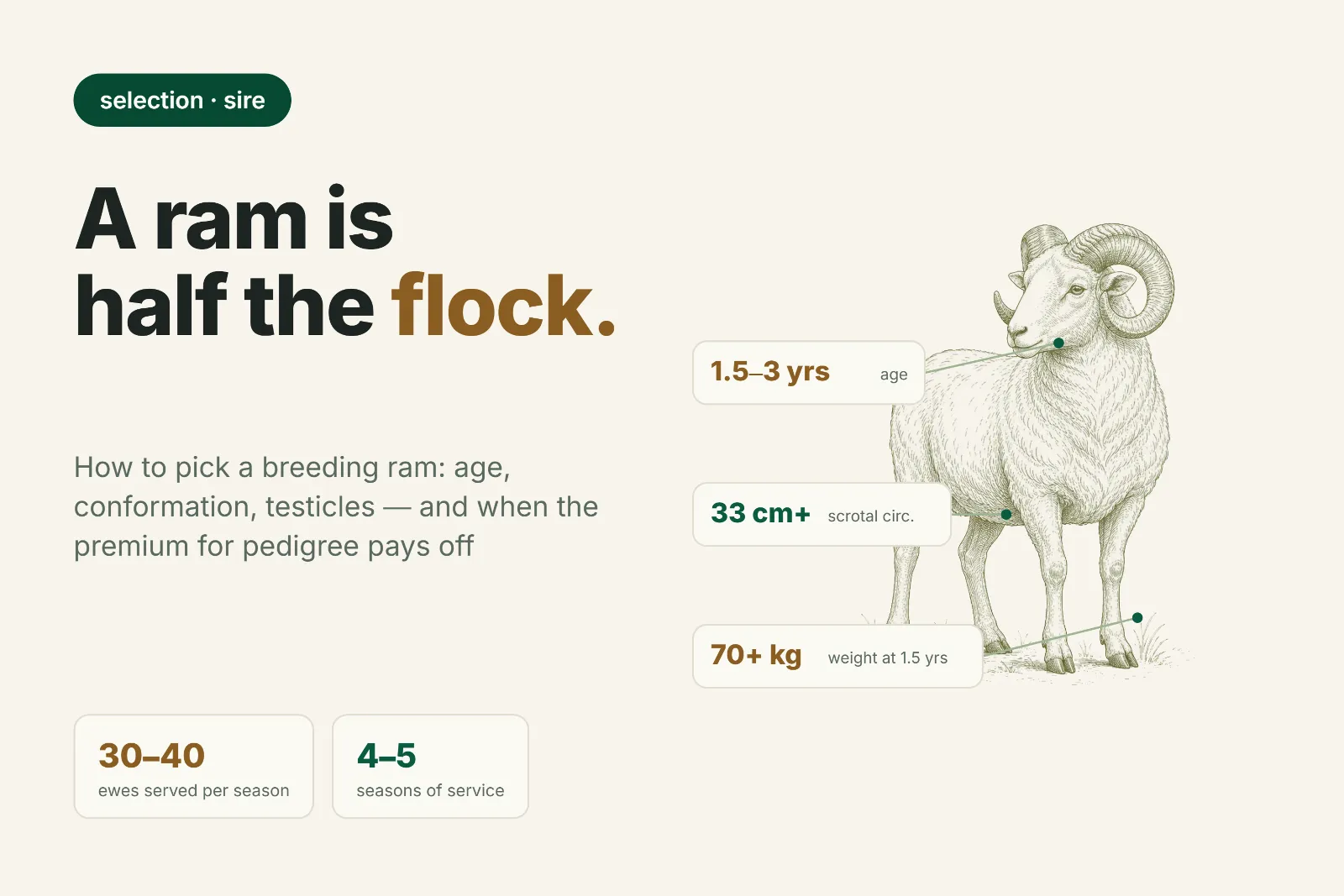
One ram covers 30–40 ewes per season and passes his genes on to the entire lamb crop. Here's how to choose a breeding ram: aging by teeth, a hands-on conformation checklist, must-do lab tests — and the math on how many seasons it takes for the premium on a purebred ram to pay for itself.
Shepherds have a saying: "The ram is half the flock." That's not an exaggeration — it's arithmetic. A ewe gives you one or two lambs a year, while a ram covers 30–40 ewes in a season, and every one of those lambs carries half his genes. Pick the wrong ewe, and you lose out on one lamb. Pick the wrong ram, and you lose weight and money across the whole lamb crop — year after year.
Here's a step-by-step look at choosing a breeding ram: what to look for, what to check by hand, which tests to demand, and how to work out whether the premium for a purebred ram will actually pay off.
Why the Ram Matters More Than the Ewes
Livestock specialists estimate the heritability of growth rate in sheep at roughly 20–30%. In practice, that means: if a ram is noticeably bigger and faster-growing than the average ram in your flock, his lambs come out to market weight 2–3 kg heavier on average — with the same ewes and the same feed.
Sounds like a small difference. But multiply it across the lamb crop: 40 ewes in a season give you around 35 lambs. An extra 2–3 kg on each one adds up to 70–100 kg of extra live weight in a single season. At around 55,000 soums/kg ($4.6) for live weight, that's **an extra 4–5.5M soums ($330–460)** in revenue every year the ram is working — and he'll work for 4–5 years.
That's why breeders don't cut corners on the ram: he's the one animal in the flock where the extra money you pay comes back many times over.
Age: Check the Teeth, Not the Seller's Word
The best age to buy a breeding ram is 1.5 to 3 years old. A ram younger than a year and a half is still growing himself — too early to put him to full work. A ram older than 5–6 is already past his prime: activity and semen quality decline.
A sheep's age shows in the eight lower incisors — the milk teeth get replaced in pairs by permanent teeth as the animal ages (the permanent ones are noticeably bigger and wider):
| Incisors | Age |
|---|---|
| All eight are milk teeth, small | under 1 year |
| 1 pair of permanent teeth (center) | 1–1.5 years |
| 2 pairs of permanent teeth | 2–2.5 years |
| 3 pairs of permanent teeth | around 3 years |
| All 4 pairs permanent ("full mouth") | 3.5–4 years |
| Teeth worn, yellowing, gaps appearing | 5–6 years and older |
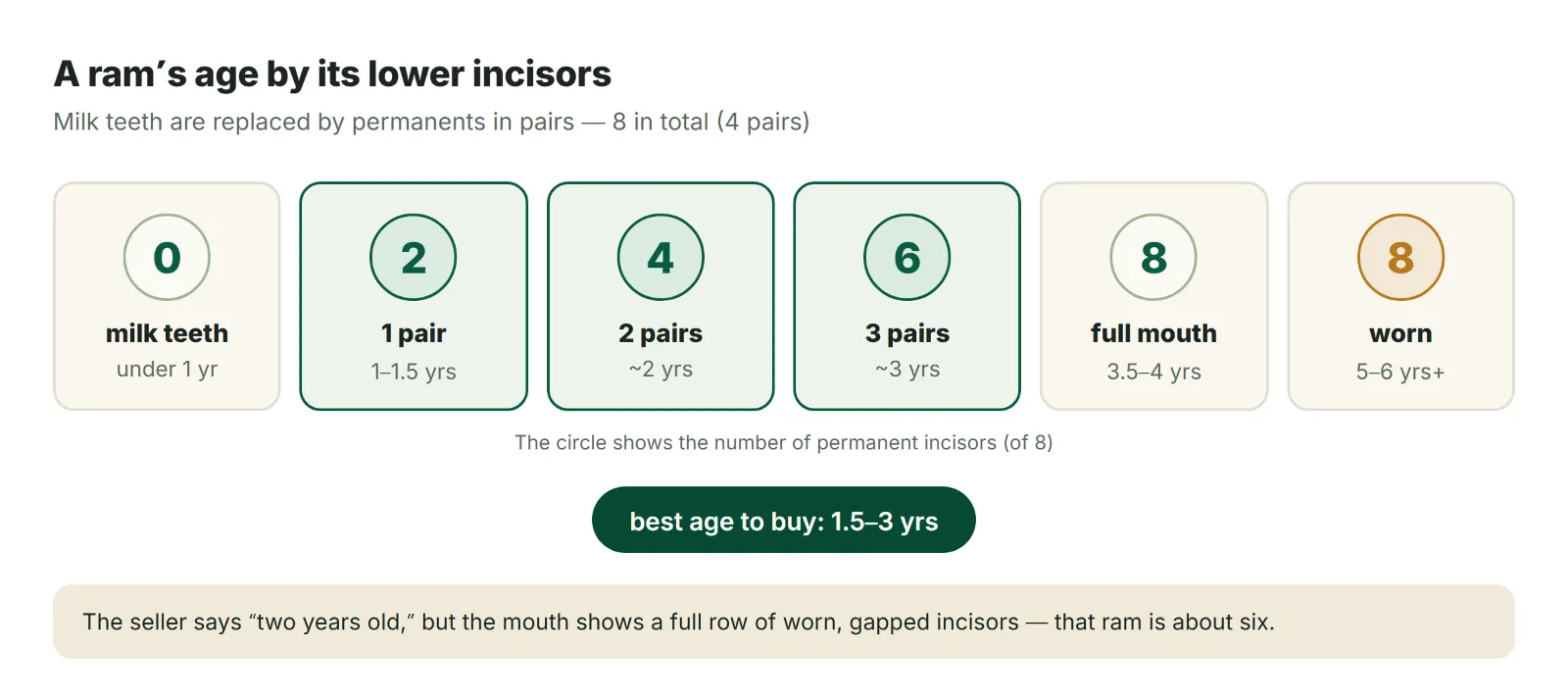
If the seller tells you "he's two years old," but his mouth shows a full row of worn permanent incisors with gaps between them, you're looking at a six-year-old animal. This kind of age fraud at the market is the most common trick used when selling breeding rams.
Conformation Checklist: What to Check by Hand
You don't evaluate a ram from ten feet away — you check him with your hands, feeling the back, legs, and testicles. Here's what to check:
| What to check | Normal | Fault — don't buy |
|---|---|---|
| Frame and legs | Legs strong, set wide and straight, hooves firm and odor-free | Knock-kneed or close-set legs, cracked or rotten hooves, lameness |
| Back and chest | Straight topline, chest wide and deep | Swayed back, narrow chest, sharp withers |
| Bite | Incisors meet the upper dental pad evenly | Overbite or underbite — grazes poorly, and the fault passes to offspring |
| Testicles | Both descended in the scrotum, symmetrical, firm; scrotal circumference from 33 cm in an adult, from 30 cm in an 18-month-old | One testicle, asymmetry, hardened lumps, flabbiness |
| Fat tail (for Hissar, Edilbai, Jaidara breeds) | Well-shaped, firm, symmetrical | Sagging like a bag, lopsided |
| Body condition | Average to above average, but not obese | Emaciated or overly fat — both cover ewes poorly |
Scrotal circumference isn't some exotic measurement — it's a real working indicator: it directly correlates with semen volume and, importantly, it's heritable. Daughters of rams with larger scrotal circumference reach puberty earlier and have higher fertility. You can measure it with an ordinary tape measure at the widest point.
As a weight benchmark for fat-tailed meat breeds: a good Hissar or Edilbai ram at 18 months weighs 70–90 kg, and an adult weighs 110 kg or more. If an 18-month-old barely reaches 55–60 kg, he's average at best — no "champion" genetics are coming out of him.
Pedigree: Look at the Dam and the Lambs
Conformation is what you can see. But you're buying a ram for what he'll pass on, so ask about his pedigree:
- The dam — is she prolific (twins), how much milk did she give, were her lambs large? Fertility is passed down mostly through the maternal line.
- The sire — his weight, and which farm he came from.
- His lambs — if the ram has already been used for breeding, ask to see his offspring. Uniform, large lambs out of different ewes tell you more about a ram than any pedigree paper.
And the golden rule for years ahead: a ram should never breed his own daughters. Inbreeding shows up fast as weak, undersized lambs. In practice, that means either replace your ram every two years, or keep track of which of his daughters stayed in the flock. Keeping that straight in your head with a flock of fifty head isn't realistic — it's easier to write it down: in a notebook, in Excel, or in a flock-management app like QoyHunter, where every animal has a record card with its pedigree.
The simplest way is to keep it where the rest of your records live: an animal card with pedigree stores which ram each ewe lamb came from, so two years on the question "whose daughter is this" never comes up.
Health: Never Buy Without a Brucellosis Test
A handsome build isn't worth anything if the ram brings disease into your flock. The minimum checklist:
- A brucellosis test is non-negotiable. The disease is dangerous to humans too, and a ram carrying brucellosis will infect ewes and cause mass abortions. Demand a current certificate from the veterinary service, or have the test done yourself before closing the deal.
- Feel the testicles once more — hardened lumps or tenderness can signal epididymitis, which leaves a ram infertile.
- Check on the spot for coughing, discharge from the nose or eyes, skin lesions, or lameness.
- Quarantine for 30 days after purchase, separate from the flock. Use this time for deworming, hoof trimming, and any vaccinations recommended by your vet.
Better to put the certificate and test date straight into the animal’s records: logging test results and vaccinations over the 30-day quarantine removes any question of what was done and when.
Skipping quarantine is a classic mistake: a new ram can look perfectly healthy, and a month later half the flock is coughing or limping.
What a Breeding Ram Costs and When He Pays Off
Prices as of July 2026, based on listings and markets across Uzbekistan:
- an ordinary commercial ram — 2.5–4M soums (~$210–330);
- a good purebred Hissar or Edilbai breeding ram — 6–12M soums (~$500–1,000);
- elite rams from breeding farms and shows — tens of millions of soums and up, with essentially no ceiling.
Let's run the numbers for a typical flock of 40 ewes. Say your choice is: keep your own ordinary ram (worth about 3.5M soums if you sold him) or buy a purebred one for 9.5M soums. The premium is 6M soums (~$500).
Here's what that premium buys you in a single season:
- 40 ewes → about 35 lambs;
- lambs from the purebred ram come to market 2–3 kg heavier on average;
- 35 × 2–3 kg = 70–105 kg of extra live weight;
- at 55,000 soums/kg, that's 3.9–5.8M soums (~$320–480) in extra revenue.
With this arithmetic in hand the search gets concrete: it is worth starting to buy a breeding ram with papers and measurements two or three months before mating.
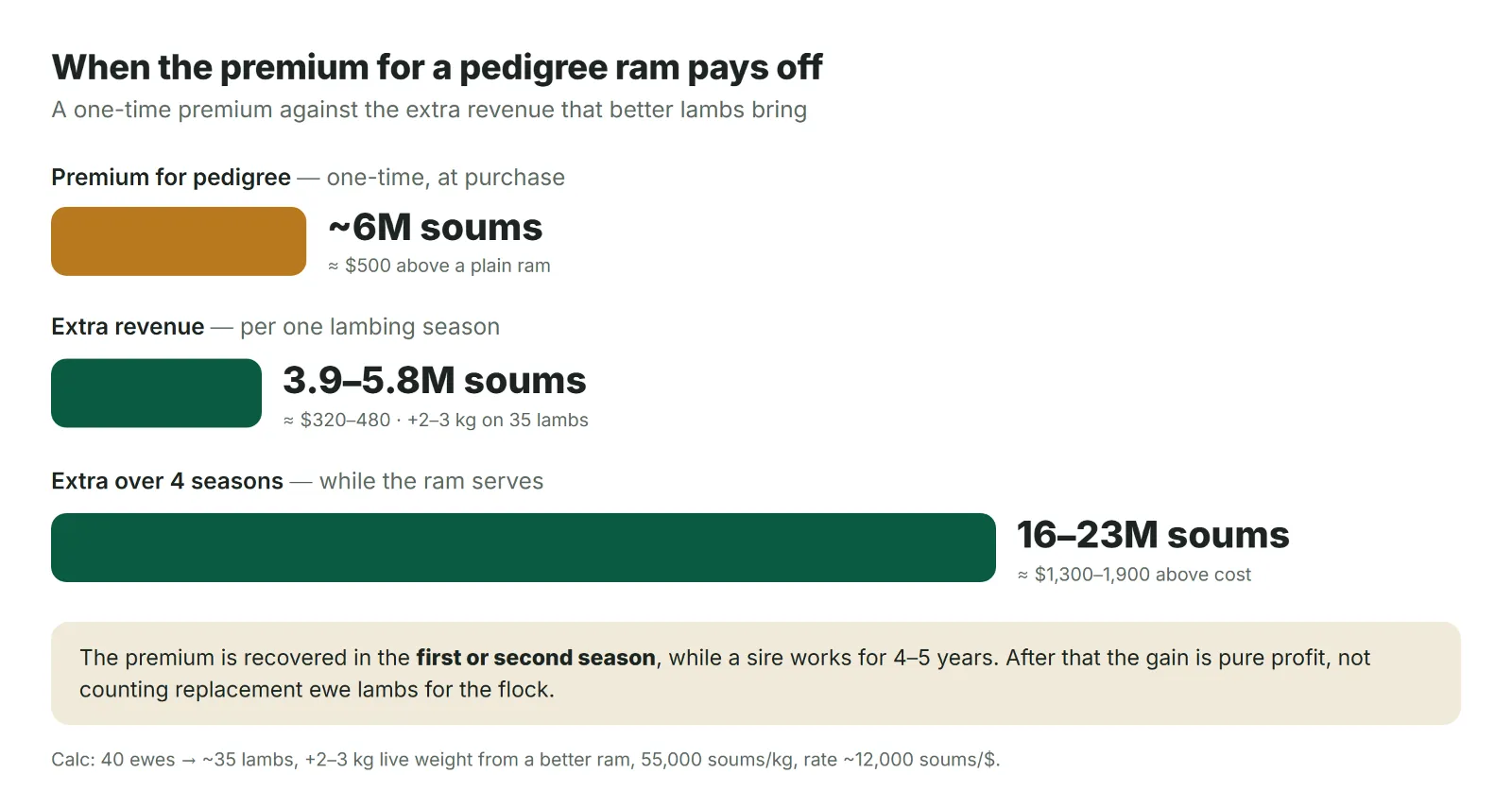
In other words, the premium for a purebred ram pays for itself within the first or second season, and he'll keep working for 4–5 years. After that, it's pure profit — not counting that his ewe lambs will go into flock replacement and carry the improvement forward another generation.
There's an extra bonus too: Uzbekistan offers a subsidy of 400,000 soums per head for purchasing purebred sheep — we covered all the state support programs in our article on government support for sheep farming.
There is a separate scheme — taking a ram not of your own breed but of a larger one, and selling the whole crossbred lamb crop for meat: two Hissar rams on 70 Jaydara ewes pay for themselves in two seasons. The full arithmetic is in the article on crossbreeding sheep breeds.
Getting Ready for Breeding: Bought Doesn't Mean Ready
Even the best ram will only work at half his potential if you put him to breeding unprepared:
- 1.5–2 months before breeding, switch him to a boosted diet: add 0.5–0.8 kg of concentrate feed a day (barley, a bit of oilcake) on top of pasture or hay.
- Body condition at the start of breeding should be well-fleshed but not fat. An overweight ram is lazy and breeds poorly.
- Trim his hooves ahead of time — a lame ram will miss covering half the ewes.
- Workload: with pasture (natural) breeding, 30–40 ewes per ram per season; with hand-mating (ewes brought to him), up to 60–80.
Buyer's Checklist: The Short Version
- Age by teeth: 1.5–3 years, no age fraud.
- Legs, hooves, back, bite — check by hand and eye.
- Testicles: both present, firm, circumference from 30 cm at 18 months and from 33 cm as an adult.
- Fat tail well-shaped (for fat-tailed breeds).
- Weight for age: an 18-month-old of a fat-tailed meat breed should weigh 70 kg or more.
- Pedigree: prolific dam, uniform offspring if he's already been used.
- Brucellosis certificate — no certificate, no deal.
- 30-day quarantine and 1.5–2 months of pre-breeding conditioning.
A breeding ram is one purchase where being cheap costs you more than being generous: the price difference comes back with the very first lamb crop, while a bad choice drags down your flock's income for years. Choose with your hands, your eyes on his teeth, and a calculator — and half the flock will be working for you.
Manage your flock in QoyHunterCRM for sheep farmers: livestock, health, weighing, finance and analytics — in the app and a Telegram bot.All features →