Dorper Sheep in Uzbekistan: What a Ram Costs and Whether It Pays Off on Local Ewes in 2026
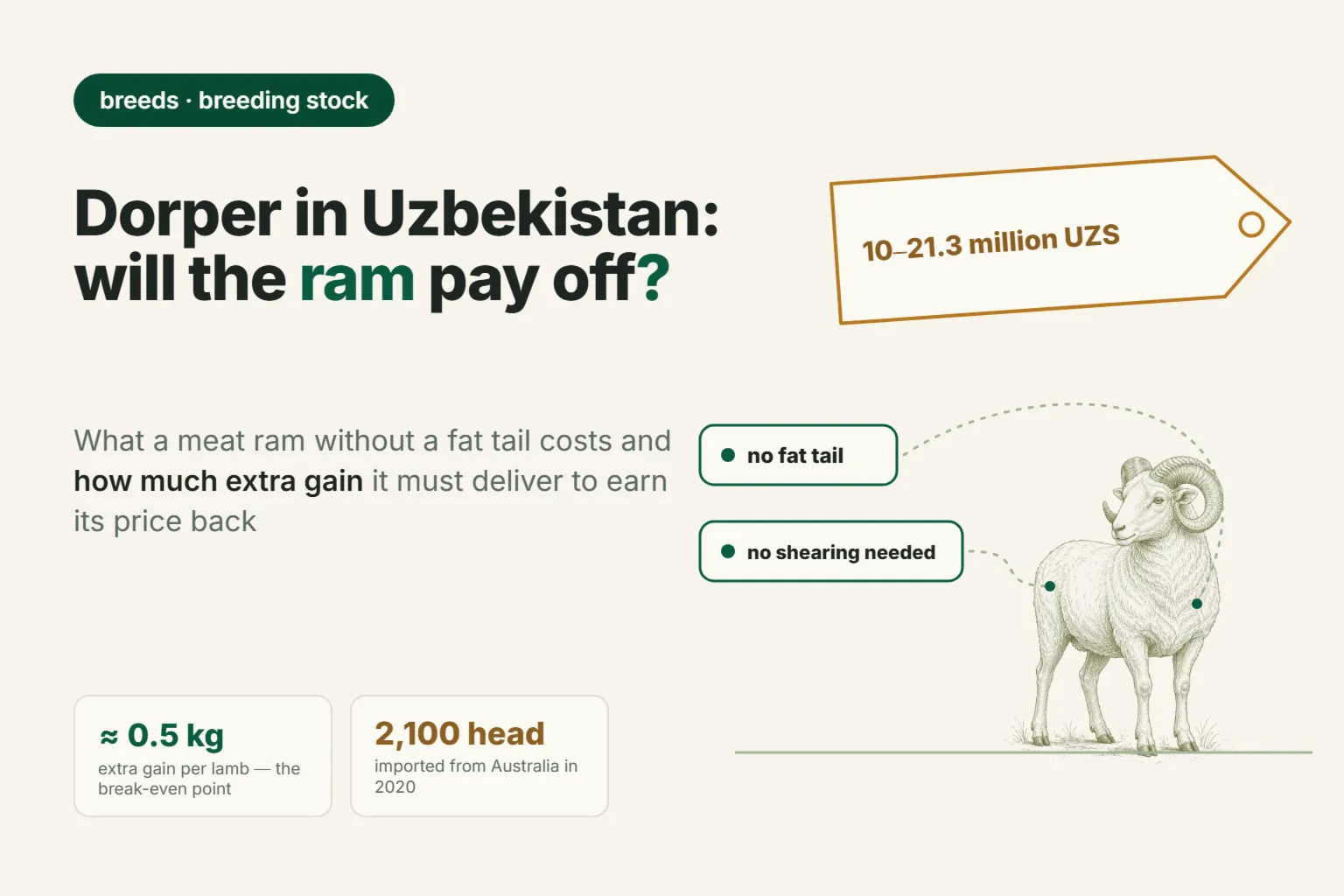
The Dorper is a South African meat sheep with no fat tail and no need for shearing. Dorper ram prices in Uzbekistan as of October 2026 (10–21.3 million soum, ≈ $850–1,800), the ram cost per lamb, and the break-even point: +0.5 kg per crossbred lamb. Who the breed suits and who is better off with Hissar.
The Dorper breed in Uzbekistan is a South African meat sheep with short hair-wool, no fat tail, and no need for shearing. In listings in early October 2026, a Dorper ram costs 10 to 21.3 million soum (≈ $850–1,800), as a rule more than a breeding Hissar ram. On local ewes, such a ram pays for itself only if the crossbred lambs reach sale at least 0.5 kg heavier in live weight and the buyer doesn't knock down the price for the missing fat tail.
Below: what a Dorper is, what it really costs in Uzbekistan, how to work out whether a ram pays back on your own flock, and who this breed is not for.
What is the Dorper breed?
The Dorper is a meat sheep breed developed in South Africa in the 1930s–1940s by crossing the Dorset Horn with the Blackhead Persian. The name is built from the first syllables of the parent breeds: Dorset + Persian. The breed was created for dry regions, so it handles heat and sparse pasture well.
How the Dorper differs from the sheep Uzbekistan is used to:
- No fat tail. Fat is laid down evenly across the carcass, not in the tail. According to breeders, the meat has no sharp smell.
- No shearing needed. The short coat of wool and hair sheds by itself in spring and summer. On a farm that saves paying a shearer, but it also means no wool to sell.
- Fast lamb growth. According to South African research (Cloete et al., 2000), Dorper lambs gain 240–280 g per day across very different management conditions, and with good feeding reach about 36 kg by 3.5–4 months.
- Frequent lambing. The American Dorper and White Dorper Sheep Breeders' Society (ADSBS) reports 150 lambs per 100 ewes on pasture and up to 180 with good feeding. Under intensive management, ewes lamb three times in two years.
| Indicator | Dorper | Hissar |
|---|---|---|
| Fat tail | none | large, set high |
| Shearing | not needed, sheds by itself | needed |
| Ram, live weight | 104–122 kg (per ADSBS) | 130–140 kg |
| Lambs per 100 ewes | 150–180 | 105–115 |
| Ram price, October 2026 | 10–21.3 million soum (≈ $850–1,800) | 7–9 million soum (≈ $590–760) |
The Dorper figures come from foreign sources, where the breed is well fed. There are no published local Dorper data for Uzbekistan, and on pasture without supplementary feed it will do less.
Are there Dorpers in Uzbekistan and where can you buy one?
There are, but not many. There was one large import: in November 2020, the Jizzax Organic cluster brought 2,100 Dorper ewes and rams from Australia to Jizzakh region, as reported by Podrobno.uz. Australian animals were chosen over South African ones because Australia has changing seasons, closer to our climate.
Today Dorpers are sold by private sellers. On OLX.uz in early October 2026, a search for "dorper" showed 7 listings — in Tashkent (Sergeli district), Tashkent region, Jizzakh, Fergana, and Bukhara region:
| What is sold | Price, soum | ≈ $ |
|---|---|---|
| Dorper lambs (Fergana, the same seller also has a ram at $1,200) | 5,903,750 | 500 |
| Dorper ewes | 8,855,625 – 9,446,000 | 750–800 |
| Dorper ram | 10,000,000 – 14,169,000 | 850–1,200 |
| Dorper rams, the most expensive listing | 21,253,500 | 1,800 |
The rate in the table is about 11,800 soum per dollar: this is how the platform converted sellers' prices set in dollars. Age and weight are not given everywhere: for example, in Kagan a three-year-old ram of 80–85 kg is sold for 10 million soum. So prices can't be compared directly: a yearling ram and an adult sire with papers are different money.
Before buying a Dorper, ask the seller three things: where the parents came from (the import or local breeding), whether there is a breeding certificate, and whether the animal is a crossbred or purebred. A crossbred looks like a Dorper but will give your flock less.
What does a Dorper ram cost per lamb?
A ram's price alone says nothing. What matters is how many lambs he gives over his life. Let's count the same way as in the breakdown of commercial crossbreeding of sheep breeds:
- one ram in free mating covers 30–40 ewes per season, we take 35;
- the yield is 105 lambs per 100 local ewes, which is about 37 lambs per season;
- the ram works 4 seasons, about 147 lambs in total;
- we don't count the money from selling the ram for meat at the end — that is a safety margin.
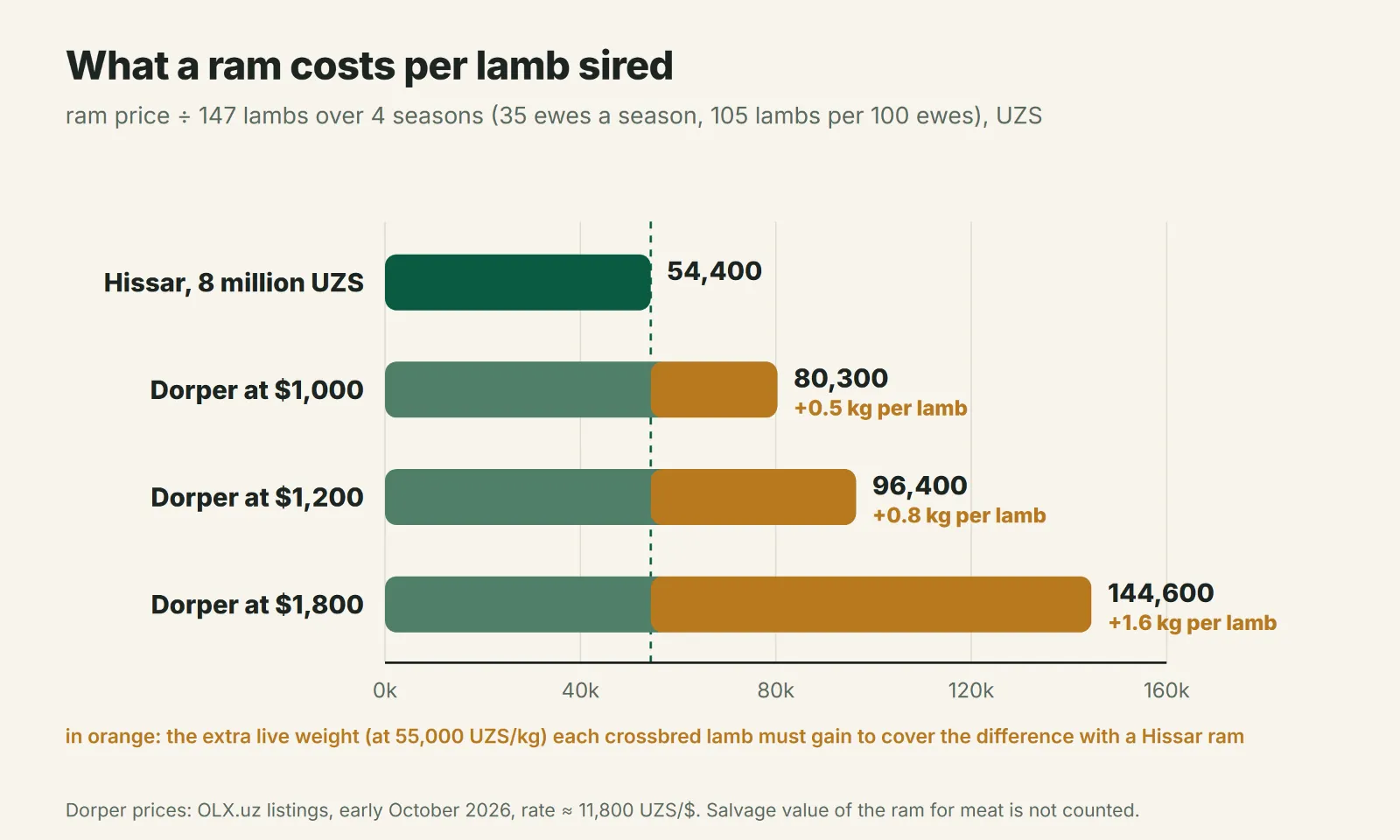
| Ram | Price, soum | Per lamb, soum | More than Hissar, per lamb |
|---|---|---|---|
| Hissar, breeding | 8,000,000 | 54,400 | — |
| Dorper at $1,000 | 11,807,500 | 80,300 | +25,900 |
| Dorper at $1,200 | 14,169,000 | 96,400 | +42,000 |
| Dorper at $1,800 | 21,253,500 | 144,600 | +90,200 |
Now let's turn this into kilograms. Live weight of a meat lamb in September 2026 cost about 55,000 soum/kg (≈ $4.66). So a $1,000 Dorper makes up the difference against a Hissar ram if each crossbred lamb is about 0.5 kg heavier at sale (25,900 : 55,000). A $1,800 ram must already give +1.6 kg on every lamb.
Half a kilogram over 6–7 months is not much: that is under 3 g of extra gain per day. So the ram's price itself is not the main risk. The main risks are elsewhere.
Why might a Dorper not pay off in Uzbekistan?
The fat tail. At the mal bozori (the weekend livestock market) and at Qurbon Hayit, buyers in Uzbekistan look for a fat-tailed ram. A Dorper cross with a Hissar or Jaydara has a smaller fat tail than the dam. If a dealer knocks even 2,000 soum per kilogram off for that, on a 45 kg lamb it is a loss of 90,000 soum — more than the extra price of a $1,000–1,200 ram, and almost as much as for a $1,800 ram, in the calculation above. This is not market data but an example: check with your own buyers before mating how they take crossbreds.
Feed. Purebred Dorper lambs give a gain of 240–280 g per day in South Africa, where the breed was developed and selected for local conditions. At the cluster in Jizzakh they spoke of rams gaining up to 700 g per day, but that is fattening on purchased feed, not distant-pasture grazing. On dry foothills without supplementary feed, a crossbred grows only slightly faster than a local lamb, and you buy the extra gain with feed.
Few animals. There are few purebred Dorpers in the country, and a crossbred is often sold as a Dorper. If you bought a crossbred ram, you get weaker heterosis (the first-generation boost from crossing), and the offspring will be mixed.
No wool is a plus, not a minus. Wool in Uzbekistan is worth almost nothing, and a Dorper shedding by itself saves on shearing. But a cross with a fat-tailed ewe does not shed fully, so you will still have to call a shearer.
Who should buy a Dorper ram?
| Your situation | Dorper? | Why |
|---|---|---|
| Distant pasture, selling at the mal bozori and for Qurbon | more likely no | you lose the fat tail, and the gain without supplementary feed is small |
| Fattening on purchased feed, selling to a meat plant or restaurant | yes | the buyer pays for meat, not the fat tail, and feed lets the Dorper show its growth |
| You want to breed purebred Dorpers to sell as breeding stock | with caution | you need to buy ewes with papers, and demand for breeding stock is still narrow |
| Small flock of up to 30 ewes | no | an expensive ram can't spread his price over enough lambs |
If your buyer is the mal bozori and Qurbon Hayit, a fat-tailed sire pays better: Hissar or Edilbay. What is being sold now across breeds can be seen in the listings of rams and ewes for sale in Uzbekistan — you can compare sire prices there before paying for a rare breed. And we compared the strengths and weaknesses of four breeds side by side in the article which sheep breed to choose: Hissar, Edilbay, Jaydara or Dorper.
How do you check that a Dorper paid off on your farm?
Bought a ram — test him in the very first season. Split the ewes into two groups: some for the Dorper, some for your local ram. Weigh the lambs of both groups at birth, at weaning, and before sale. If the crossbreds are less than 0.5 kg heavier at sale or sell for less — the Dorper doesn't work on your farm, and it is better to learn that after one year than after four.
Doing such a comparison in a notebook is hard: you have to remember which lamb is from which ram and calculate the group gains by hand. QoyHunter, a CRM for sheep records and the bazar.qoyhunter.com marketplace, records every weighing against a specific animal, the lamb's sire and breed, and calculates the average daily gain of lambs itself. For a flock of 20–30 ewes, a notebook is enough if you weigh carefully.
FAQ
How much does a Dorper ram cost in Uzbekistan?
In early October 2026, in OLX.uz listings, Dorper rams cost from 10 to 21.3 million soum (≈ $850–1,800), ewes 8.9–9.4 million soum (≈ $750–800), and lambs about 5.9 million soum (≈ $500). Sellers don't always give age and weight, so the price must be checked against the specific animal.
Does a Dorper have a fat tail?
No. The Dorper is a breed without a fat tail; its fat is spread across the carcass. A Dorper cross with a Hissar, Edilbay, or Jaydara gets a smaller fat tail than the dam, and at the mal bozori such a ram may be bought for less.
Does a Dorper need shearing?
A purebred Dorper doesn't need shearing: the short coat of wool and hair sheds by itself in spring and summer. A cross of a Dorper with Uzbekistan's fat-tailed breeds usually doesn't shed fully and is sheared like ordinary sheep.
How much does a Dorper ram weigh?
According to the American Dorper and White Dorper Sheep Breeders' Society (ADSBS), adult rams average 104–122 kg and ewes 82–95 kg. That is less than a Hissar ram (130–140 kg), but Dorper lambs grow fast: 240–280 g per day and about 36 kg by 3.5–4 months with good feeding.
Will a Dorper ram pay off on local ewes?
It will, if the crossbred lambs are at least 0.5 kg heavier at sale (for a $1,000 ram) and the buyer doesn't cut the price for a small fat tail. That is easier to achieve in fattening on purchased feed and selling for meat than on pasture with sales at the mal bozori and Qurbon Hayit.
Manage your flock in QoyHunterCRM for sheep farmers: livestock, health, weighing, finance and analytics — in the app and a Telegram bot.All features →