Karakul: The World Stopped Buying Pelts. What Should a Farm Earn Now
Uzbekistan has roughly 6 million karakul sheep, yet the pelt the breed was raised for over a hundred years — the karakul pelt — now sells for $20–35 and barely finds a buyer: the global fur market has collapsed. We look at how the karakul market died, and what a karakul farm should be earning from now on.
Uzbekistan has around 6 million karakul sheep out of a total sheep and goat population of 25 million. For a hundred years the breed was kept for its pelt — the skin of a newborn lamb with that famous tight curl. Karakul was called the desert's "black gold," and entire districts of the Bukhara and Navoi regions were built on it.
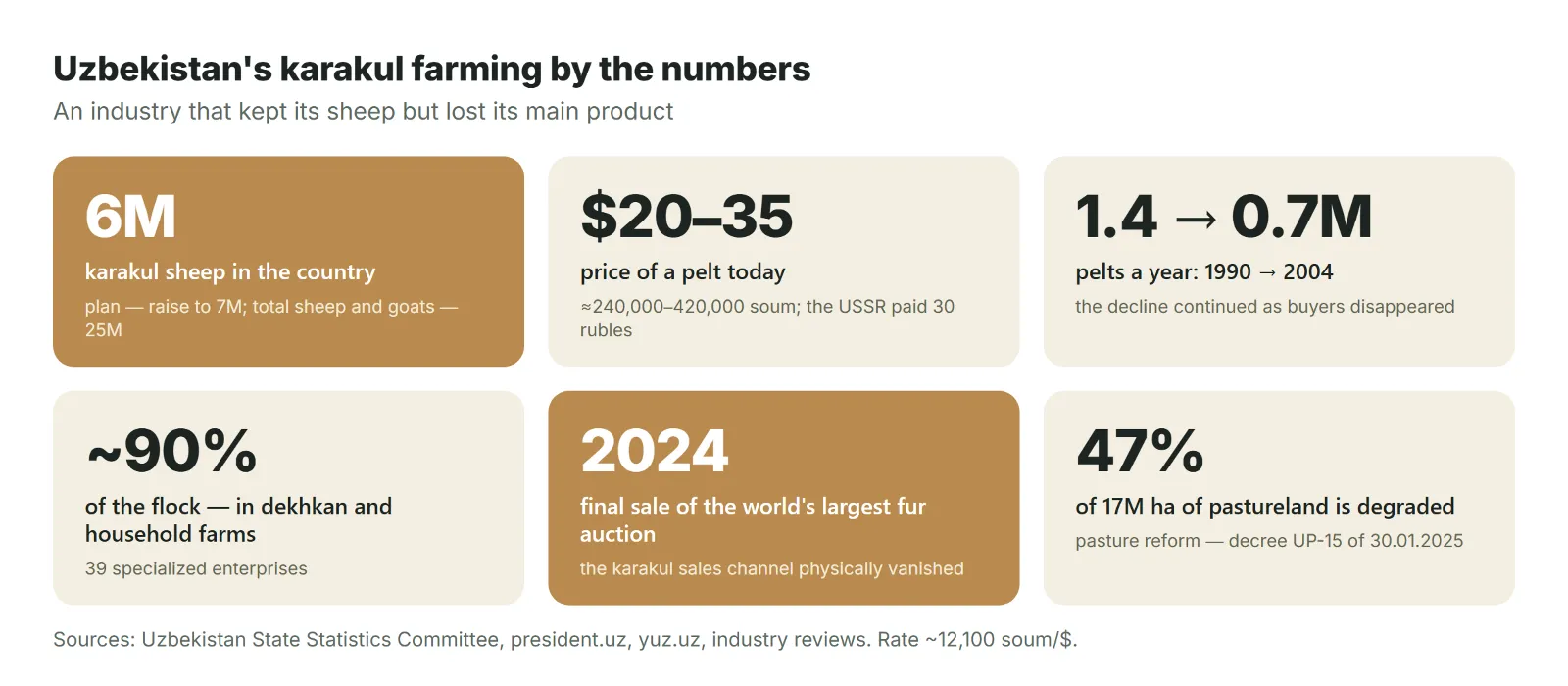
Today a karakul pelt sells for $20–35 (roughly 240,000–420,000 soum at the ~12,100 exchange rate), and even at that price, finding a buyer is no sure thing. Over the past decade the global fur market has effectively disappeared, and the planet's leading auction house, through which karakul reached buyers, held its final sale and shut down. The breed is still here, the people are still here, 6 million head still graze the Kyzylkum — but nobody buys the product the whole business was built around anymore.
We look at what happened and, more importantly, at what a karakul farm should be earning from now on.
How Karakul Fed Half the Country
Uzbekistan is the historical homeland of the karakul breed — the Bukhara district, the Zarafshan valley. By the end of the Soviet era, the Uzbek SSR was the largest karakul producer in the Union, with Kazakhstan supplying another 36–37%. By the early 1980s the Kazakh SSR alone kept 5.7 million karakul sheep and delivered more than 2.5 million pelts a year — and Uzbekistan's industry was larger still.
The economics were rock-solid. The state paid 30 rubles per pelt — a meaningful slice of a month's wage for a single skin, and a flock would hand over hundreds of them. About a third of the karakul output went to export: pelts traded on international fur auctions and reliably brought in hard currency. The karakul state farms in the desert districts were wealthy operations.
In 1990, Uzbekistan produced around 1.4 million pelts. From there the curve went down: by 2004 it was roughly 700,000, and the decline had nothing to do with sheep. The sheep never went anywhere. The buyers did.
Where the Market Went
Over the past decade the global fur market didn't go through a downturn — it was dismantled.
Fashion turned its back on fur. One after another, the biggest fashion houses announced they were done with natural fur — Gucci, Prada, Armani, Calvin Klein, and dozens more. The pelt that was the core material of "karakul" coats and collars lost its showcase: there was no one left to sew it into anything.
Ethics became a buyer's argument. A karakul pelt is the skin of a lamb in the first days of its life, and for a Western buyer that stopped being acceptable no matter how beautiful the finishing. Israel became the first country in the world to ban fur sales, followed by individual US states and cities.
The sales infrastructure died, physically. Kopenhagen Fur — the world's largest fur auction house, through which karakul was sold among other pelts — announced it was closing after Denmark's Covid-era mink cull, and held its final auction in 2024. Even its buildings are being sold off now. For karakul that meant something simple: the places where pelts were bought in bulk at world prices no longer exist.
Namibia, the second-largest karakul producer, sold its pelts through that very auction — around 140,000 a year. That channel collapsed along with the auction house. Uzbekistan, with its own karakul, ended up in the same spot.
What's Left of the Industry in Uzbekistan
What's left is surprisingly substantial — because the karakul sheep in Uzbekistan was never just a "pelt factory."
The country now has around 6 million karakul sheep, and the government plans to raise that to 7 million. More than half graze in the Navoi region, with around 2 million head in the Bukhara region. There are 39 specialized karakul enterprises at work, but the bulk of the flock — roughly 90% — is held by dekhkan farms and household smallholdings. Estimates of pelt output run as high as a million a year, but far fewer actually get sold: "Bukhara Karakul," one of the industry's major enterprises, sells around 25,000 pelts a year.
The state backs the industry: under the "Korakulchilik" association, a karakul-breeding development fund has been set up, and there have been export subsidies for pelts, plus preferential loans and subsidies for breeding work. In January 2025, a decree on pasture reform (UP-15) was signed — a key document for karakul farming, since around 47% of Uzbekistan's 17 million hectares of pastureland is degraded, and the karakul sheep lives off pasture, full stop.
But a subsidy is no substitute for a buyer. The real question for a farm is simple: if the pelt no longer pays, why keep karakul sheep at all?
Pelt vs. Lamb: Doing the Math
The answer starts with arithmetic any farm can check against its own flock.
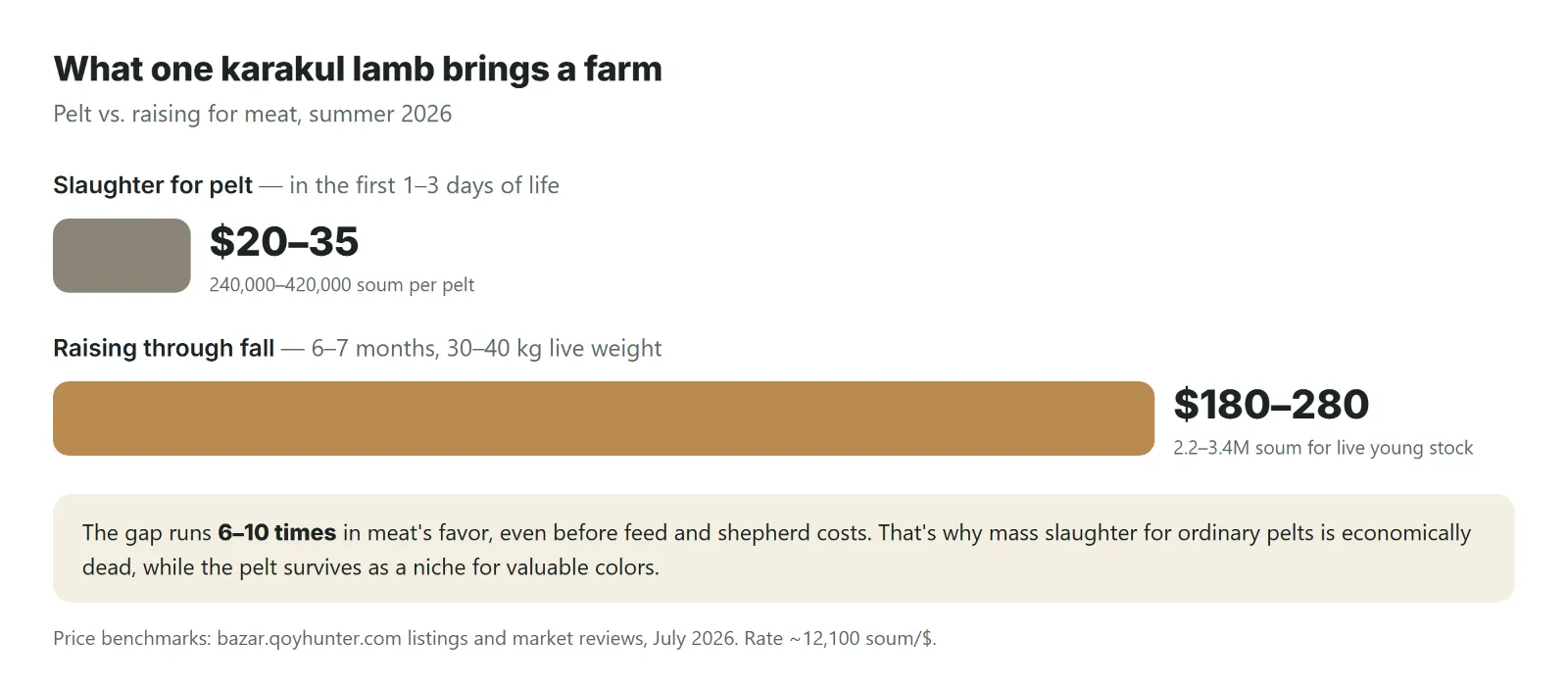
To get a pelt, a lamb is slaughtered in its first 1–3 days of life. The farm gets a skin — today that's $20–35, or 240,000–420,000 soum, and only if a buyer can even be found.
If that same lamb isn't slaughtered but raised on pasture through the fall instead, it weighs 30–40 kg live by 6–7 months. In the summer of 2026, lambs and young sheep in Uzbekistan are going for 2.2–3.4 million soum ($180–280) — we rounded up live ram prices in a separate breakdown. Yes, raising it has its own costs: supplemental feed, veterinary care, a shepherd's labor. But even after those, the revenue gap runs 6–10 times in meat's favor.
It is worth comparing against today’s market before deciding: sell lambs and young stock in the listings goes by live weight, and the gap against a pelt is immediately visible.
Mutton, meanwhile, keeps getting pricier: in June 2026 it was up 23.1% year over year (we covered this in detail). Uzbekistan's meat market runs short, demand is steady, and karakul lambs are accepted on it every bit as readily as any other. Karakul mutton has always been prized: the breed has spent centuries on wormwood rangeland, and the meat has a distinctive, "steppe" flavor.
The industry has already drawn the conclusion from this arithmetic: today a karakul farm's main income is meat, and the pelt is a niche product — reserved for the share of the lamb crop kept for breeding and for preserving color lines. Slaughtering the whole lamb crop for $25 pelts means operating at a loss next to the neighbor who's raising lambs for sale.
Why You Can't Just Swap Karakul Sheep for Hissars
The logical question: if the money is in meat, why not just switch the flock to a meat breed — Hissar or Edilbay? An adult Hissar ram weighs twice as much as a karakul one.
It's not that simple, and here's why. Karakul is one of the few breeds able to live year-round on desert and semi-desert rangeland that gets only 100–200 mm of rainfall a year. The Kyzylkum, the steppes of the Navoi and Bukhara regions, Karakalpakstan — that's its home: it gets by on sparse wormwood-and-saltbush forage, and shrugs off heat, lack of water, and long treks. A Hissar on that kind of pasture will never put on its famous bulk — it needs foothills and a real feed base. You can't switch a desert district over "to Hissars": it's either karakul sheep or empty pastureland.
So the strategy that actually works looks different:
- A purebred karakul core, run for meat: lambs are raised and sold live or as meat.
- Ewes not kept for breeding, in areas with a better feed base, go into industrial crossbreeding with meat rams: the crossbred offspring grow faster and heavier.
- Pelts only from culled lambs of valuable colors (sur, shirazi), where buyers actually pay above the base $20–35. Mass slaughter for ordinary black pelts is economically dead.
- Wool and milk as a side line: the breed's fleece is modest (2.5–3.5 kg of coarse wool), but across a flock of hundreds of head, it still adds up to a line of income.
What This Means for a Farm: A Short Plan
| Direction | What to do | What it delivers |
|---|---|---|
| Meat | Raise the lamb crop through the fall, sell young stock live or as carcasses | Main income: $180–280 per lamb instead of $20–35 for a pelt |
| Breeding | Keep a purebred core, track lines and coloring | Access to subsidies; breeding stock sells for more than meat stock |
| Pelts | Keep only elite colors, sold to a specific buyer | A made-to-order niche, not stock for a warehouse |
| Pasture | Formalize pasture-use rights under the new UP-15 rules | Legal access to the breed's core resource |
All of this comes down to record-keeping. Once a flock runs into the hundreds of ewes, decisions like who goes to breeding, who to fattening, who to crossbreeding turn into guesswork without records. Lambing, weight gain, lines, culling — that's exactly what's easy to track in large-flock record software: a free flock-record app that a shepherd fills in right out on the pasture.
Karakul as a mass export fur is dead, and there's no reason to expect it back: the market was dismantled along with the auction houses. But a karakul sheep isn't a pelt. It's 6 million head that know how to live where no other breed can survive, plus a meat market running short of supply that's ready to take their lambs at rising prices. Farms that have already shifted from pelt to meat can feel it.
Manage your flock in QoyHunterCRM for sheep farmers: livestock, health, weighing, finance and analytics — in the app and a Telegram bot.All features →