
Romanov Sheep in Uzbekistan: Twins and Triplets vs. the Heat — Is It Worth Getting Them in 2026
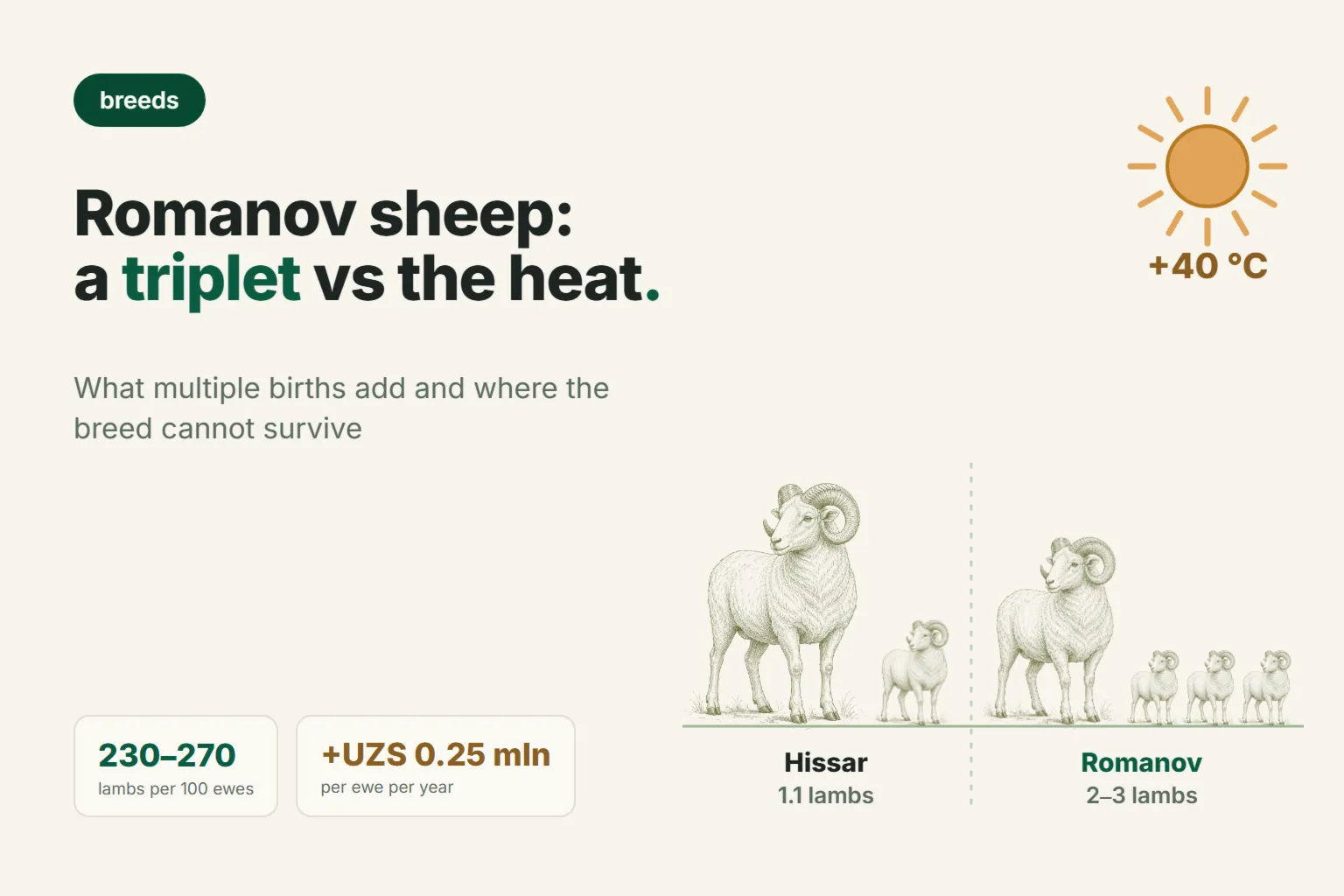
The Romanov ewe produces 230–270 lambs per 100 ewes against 105–115 for the Hissar, but handles heat poorly. Breed characteristics, income per ewe at autumn 2026 prices (+0.25 million UZS ≈ $21 with 2 lambs to sale, break-even at 1.8), and why a Romanov ram adds extra lambs only through crossbred ewes.
The Romanov sheep breed in Uzbekistan produces 230–270 lambs per 100 ewes that lamb, against 105–115 for the Hissar, Edilbay and Jaydara — in other words, twins or triplets on average instead of a single lamb. It is worth bringing in only where you have a shaded barn in summer, plenty of water and hands for lambing: if fewer than 1.8 lambs per ewe survive to sale, a Romanov flock in Uzbekistan earns less than a local fat-tailed one. Below is the math per ewe at autumn 2026 prices, at ≈ 11,800 UZS per dollar.
What the Romanov breed is and where it comes from
The Romanov is a northern fur-coat (sheepskin) sheep bred in the Upper Volga region and named after the Romanov-Borisoglebsk district of Yaroslavl Governorate (today the Tutayev district of Russia's Yaroslavl Oblast). It is adapted to a cold climate and the feeds of the Russian non-black-earth zone, not to steppe and heat. The Romanov has no fat tail: its tail is short and thin.
The breed's key numbers (from animal-husbandry reference books):
| Metric | Romanov | Hissar (for comparison) |
|---|---|---|
| Ewe, live weight | 45–55 kg | 80–90 kg |
| Ram, live weight | 65–75 kg | 130–140 kg |
| Lambs per 100 ewes that lamb | 230–270 | 105–115 |
| Lamb at 100 days | 20–22 kg | 35–45 kg at weaning at 4 months |
| Young stock at 8–9 months | 35–40 kg | noticeably heavier |
| Heat (breeding) season | year-round | seasonal, autumn |
| Fat tail | none | large |
The lambing distribution of Romanov ewes is as follows: a single lamb from 6–8% of ewes, twins from 38–40%, triplets from 44–46%, four or more from 8–10%. Twins are a rarity in a Hissar ewe; in a Romanov, singles are the rarity.
Why multiple births are a strong income lever
Sheep farm income is counted not in ewes but in lambs that live to be sold. Keeping one adult ewe in Uzbekistan costs about 1.02–1.20 million UZS a year (≈ $87–101) — we broke this figure down in the article on how much it costs to keep a sheep for a year. A ewe with one lamb barely pays for her feed; a ewe with two lambs gives almost twice as much marketable young stock for the same fixed costs.
With extra feed and flushing you can raise a fat-tailed flock by 15–20 lambs per hundred ewes, but not by double. You can't outargue the breed on twins — which is why the Romanov and its crosses remain the only truly strong lever for lamb output.
How much a Romanov ewe earns compared with a Hissar
Let's compare one ewe over a year. The assumptions are in the list, so plug in your own prices.
- Hissar ewe: 110 lambs per 100 ewes to sale, a lamb weighs 40 kg at 6–7 months, price 55,000 UZS/kg live weight.
- Romanov ewe: 250 lambs per 100 ewes are born, 200 live to sale (triplets lose more), a lamb weighs about 30 kg at 6–7 months.
- A fat-tailless Romanov lamb sells for less at the market in Uzbekistan: we assume −10%, that is 49,500 UZS/kg.
- Feeding a lamb up to sale costs about 200,000 UZS per head in both breeds; a Romanov ewe nursing 2–3 lambs needs more feed in the suckling period — +125,000 UZS per ewe.
| Per ewe per year | Hissar | Romanov |
|---|---|---|
| Lambs to sale | 1.1 | 2.0 |
| Revenue from lambs | 1.1 × 40 kg × 55,000 = 2.42 million UZS | 2.0 × 30 kg × 49,500 = 2.97 million UZS |
| Feeding lambs | −0.22 million UZS | −0.40 million UZS |
| Extra feed for a nursing ewe over the fat-tailed breed | — | −0.13 million UZS |
| Result | 2.20 million UZS (≈ $186) | 2.45 million UZS (≈ $207) |
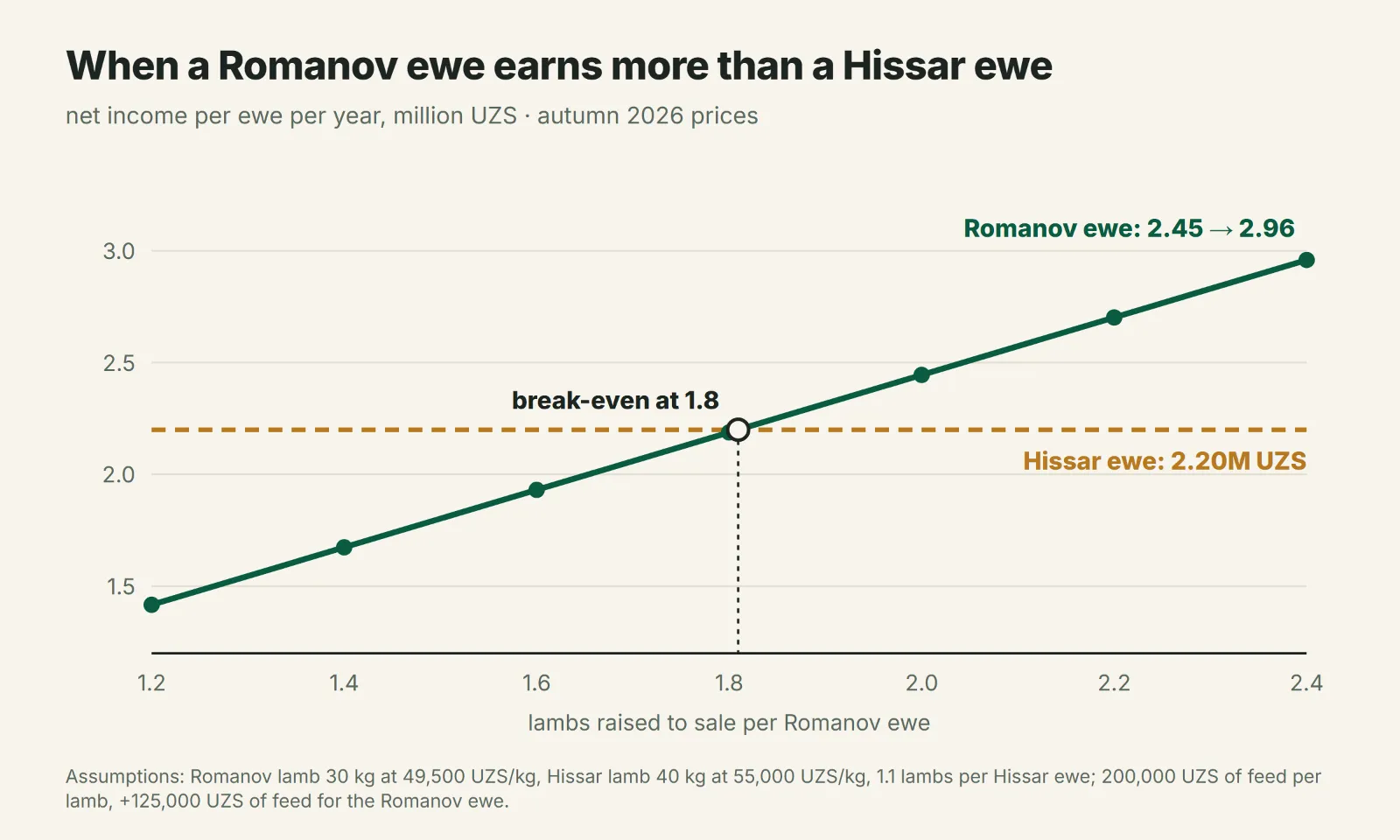
The difference is about 0.25 million UZS (≈ $21) per year in favor of the Romanov ewe; for a flock of 100 ewes that is ≈ 24.5 million UZS (≈ $2,080). But the calculation rests on one number — lamb survival. Each Romanov lamb that lives to sale brings in about 1.29 million UZS net, and the break-even point against a Hissar ewe is 1.8 lambs to sale per ewe. The margin is thin: lose some of the triplets at lambing or in the heat, and the Romanov flock performs worse than the local one, with more work. And if your Hissar lambs weigh 45 kg at sale rather than 40, the Romanov ewe loses even at 2 lambs to sale: 2.50 million UZS for the Hissar against 2.45 million.
One more line that is usually forgotten: the size of the ewe herself. A Romanov ewe weighs almost half as much as a Hissar and eats roughly a third less feed for maintenance. But a culled 45 kg ewe is worth about 2 million UZS at the market (at 45,000 UZS/kg), while an 85 kg Hissar is worth about 3.8 million. Over 5–6 years these two lines roughly cancel each other out.
How the Romanov sheep handles the heat in Uzbekistan
Badly — this is the main argument against the breed. The Romanov was bred for a cold climate, with a dense fleece of down and guard hair, the down longer than the guard hair, and Uzbekistan's summer heat above +40 °C gives it heat stress: the sheep eats less, young stock grow worse, conception drops. In the south of the country — Surkhandarya, Kashkadarya and Bukhara regions — a flock driven in summer over scorched pasture without shade will not show multiple births.
What helps:
- Shearing. Romanovs are sheared up to three times a year — around March, June and October; a summer shearing before the heat is a must.
- Shade and water. A shelter or barn with ventilation, water in plenty, grazing in the morning and evening, and shade during the day.
- Lambing not at the peak of the heat. A Romanov ewe comes into heat year-round, so lambing can be shifted to the cool months — spring or late autumn.
What a farm needs for a Romanov flock to pay off
Multiple births demand more of the farmer than of the sheep. Without these four conditions the breed will not pay off:
- Feed for ewes with twins and triplets. In the last 6 weeks of pregnancy and during suckling, a ewe carrying two or three needs more concentrates than a fat-tailed ewe with one, otherwise — ketosis (at the first signs, call a vet), weak lambs and little milk. Work out barley and meal for winter in advance: look for barley and cottonseed meal for ewes in feed for sale listings.
- A person at lambing. The third or fourth lamb is often born weak, and a ewe has two teats — extra lambs are fostered onto other ewes or bottle-fed. Without night watch at lambing, triplets die within the first day.
- A barn and shade. In summer — a shelter and ventilation, in winter — dry bedding for small lambs.
- Selling without the fat tail. The buyer at the mol bozor (the weekend livestock market) values the fat tail; the carcass of a Romanov lamb is taken more readily by kebab shops, cafés and meat-processing shops that need lean meat.
If even one of these conditions is missing, it is wiser to stay with a local breed and raise lamb output through breeding-season preparation.
Crosses: a Romanov ram on local ewes
For most farms in Uzbekistan the honest path is not a purebred flock but a cross. But there is a trap here that sellers of Romanov rams usually keep quiet about: the number of lambs per lambing is set by the ewe, not the ram. A Romanov ram on local ewes (Jaydara, Karakul, Edilbay) will not turn their singles into twins — in the first year lambing will be the same as with a local ram.
Multiple births appear only in crossbred ewes — the daughters of a Romanov ram. Their fertility usually lands roughly midway between the parents, and twins become the norm for such a ewe. So the scheme is planned for at least three years and looks like this:
- Year one: a Romanov ram covers part of the local ewes.
- Year two: crossbred ewe lambs are kept in the flock, ram lambs are fattened for sale.
- Year three: the crossbred ewes are covered by a large meat ram of a third breed — an Edilbay, if the original ewes are not Edilbay; a Hissar — only for ewes heavier than 55 kg. All their offspring go to fattening, not breeding.
This is exactly the three-breed scheme that requires full pedigree records. As soon as a crossbred ewe is covered by a crossbred ram, within two generations the flock drifts into no breed at all — we covered why in the article on crossbreeding sheep breeds. If nobody is there to keep such records, Romanov blood in the flock will not pay off.
This path has a price too: the fat tail in crosses is smaller, and at the market such a carcass is valued lower than a fat-tailed one. On the other hand, a crossbred ewe tolerates heat better than a pure Romanov.
Purebred Romanov sheep for sale in Uzbekistan are few: as of October 1, 2026, the Romanov breed section on bazar.qoyhunter.com has not a single listing. So when buying a breeding ram, check the pedigree and age on the spot, and look for local ewes for the cross in sheep and rams for sale listings.
How to tell whether multiple births pay off on your farm
Whether a Romanov or crossbred flock pays off shows only in the records: how many lambs each ewe produced, how many lived to sale, and how much each weighed at weaning. The flock average deceives here — one ewe steadily raises triplets, another loses two of three every time, and it is the second one you should cull.
A notebook with tag numbers copes with this while you have two or three dozen ewes. Beyond that, electronic records are more convenient. QoyHunter is a CRM for sheep record-keeping and the bazar.qoyhunter.com marketplace; in it, an animal profile card with offspring and pedigree stores each ewe's lambs, weights by date and status.
FAQ
How many lambs does a Romanov ewe have per lambing?
Two or three on average. According to animal-husbandry references, the Romanov's fertility is 230–270 lambs per 100 ewes that lamb: a single lamb from 6–8% of ewes, twins from 38–40%, triplets from 44–46%, four or more from 8–10%. The Hissar, Edilbay and Jaydara have 105–115 lambs per 100 ewes, usually a single lamb.
Can you keep Romanov sheep in southern Uzbekistan?
You can, but only in a shaded barn, with plenty of water and summer shearing; on open scorched pasture at +40 °C a Romanov suffers heat stress and loses its multiple births. For Surkhandarya, Kashkadarya and Bukhara regions, crossbred ewes — daughters of a Romanov ram and local ewes — are more reliable; keep in mind that multiple births will appear only in them, not in the local ewes themselves in the first year.
Is the Romanov breed more profitable than the Hissar?
By the autumn 2026 calculation, a Romanov ewe earns about 2.45 million UZS a year against 2.20 million for a Hissar — 0.25 million UZS (≈ $21) more, if 2 lambs per ewe live to sale and the Hissar lamb weighs 40 kg at sale. With survival below 1.8 lambs per ewe the advantage disappears, because a Romanov lamb is lighter and sells for less without a fat tail.
How much does a Romanov ram and lamb weigh?
An adult Romanov ram weighs 65–75 kg, an ewe 45–55 kg. A lamb at 100 days weighs 20–22 kg, young stock at 8–9 months 35–40 kg. That is almost half the Hissar, so the Romanov wins on the number of lambs, not on the weight of a single animal.
How many times a year does a Romanov ewe lamb?
A Romanov ewe comes into heat year-round, so with good feeding three lambings in two years are possible. But for a farm in Uzbekistan one lambing a year, shifted away from the summer heat, is more reliable; tightly spaced lambings exhaust the ewe and pay off only with a strong feed base.
Manage your flock in QoyHunterCRM for sheep farmers: livestock, health, weighing, finance and analytics — in the app and a Telegram bot.All features →