
How Often Do Sheep Lamb? Once a Year vs Three Lambings in Two Years
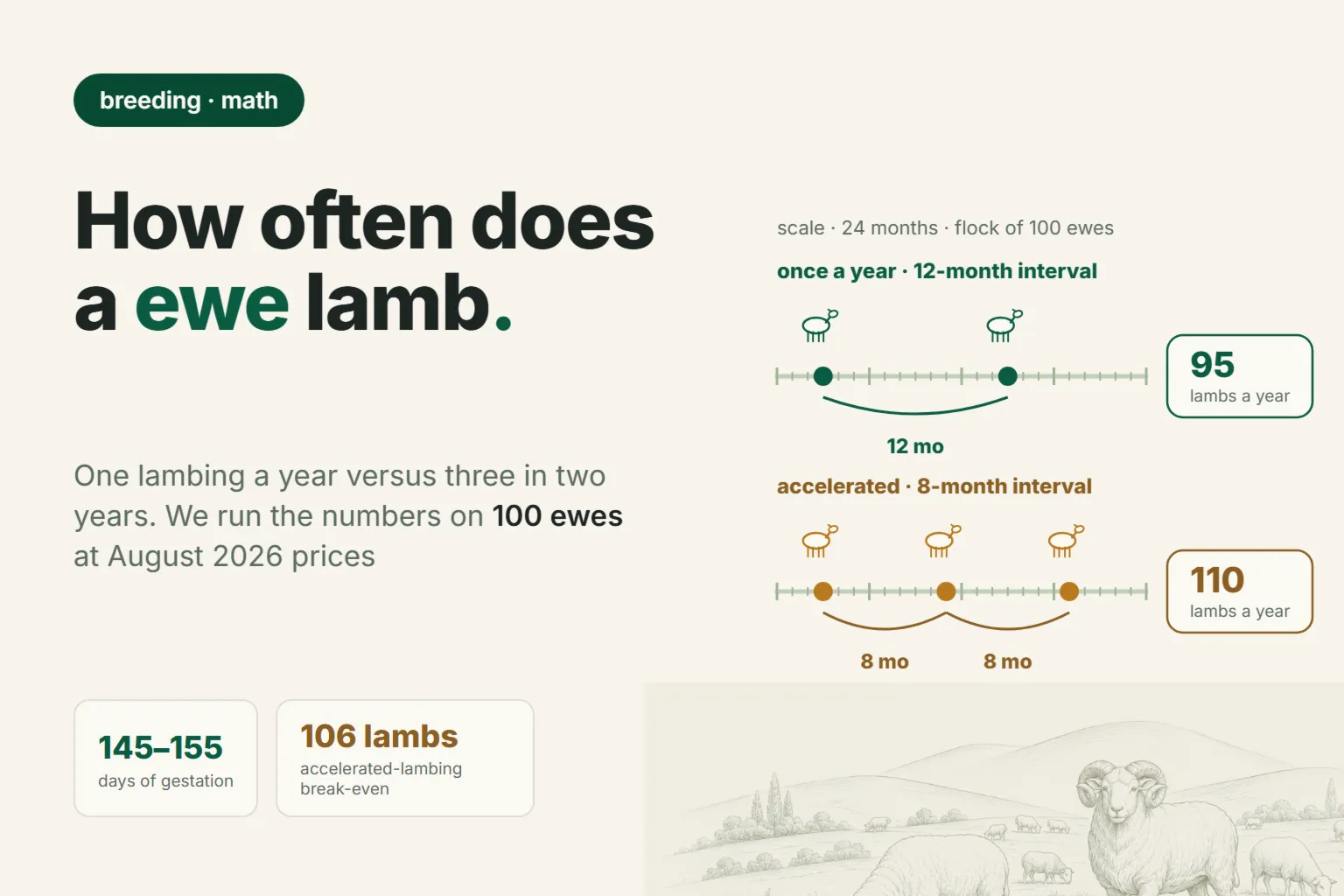
A ewe lambs once a year, with 145–155 days of gestation. See when accelerating to three lambings in two years pays off: break-even is 106 lambs per 100 ewes, worth about 7.9 million UZS (≈$667) a year on a 100-ewe flock.
A ewe lambs once a year: gestation runs 145–155 days, and fat-tailed breeds in Uzbekistan — Hissar, Edilbay, Jaydara — come into oestrus in autumn, as daylight shortens. Two lambings a year for these breeds is a myth that costs the owner money.
Technically you can reach three lambings in two years: an 8-month interval instead of 12. The math below, for a flock of 100 ewes at August 2026 prices, shows where the line falls: accelerated lambing pays off only if it delivers at least 106 lambs per hundred ewes instead of the usual 95. Less than that, and you worked the year at a loss. Here's what a ewe's year is made of, what accelerated lambing costs, and what gets you more lambs for the same money.
Why a ewe lambs once a year
The ewe is a seasonally polyoestrous animal. Seasonally polyoestrous means the oestrous cycles run one after another, but only during a specific part of the year. The trigger is shortening daylight: in Uzbekistan, oestrus in fat-tailed breeds begins in August–September and holds through November–December. In summer, with long days, most ewes are in deep anoestrus, and the ram means nothing to them.
From there it's arithmetic, not the owner's wishes:
| Phase in a ewe's life | Duration |
|---|---|
| Oestrous cycle (oestrus to oestrus) | 16–17 days |
| Oestrus itself | 24–36 hours |
| Gestation | 145–155 days (about 5 months) |
| Nursing to normal weaning | 90–120 days (3–4 months) |
| Recovery and return to oestrus after weaning | 30–60 days |
| Biological minimum for one cycle | 9–11 months |
Notice that the phases add up to nine to eleven months, not twelve. For the rest of the time the ewe is simply waiting for the next oestrus season — it's seasonality, not the length of pregnancy, that makes lambing an annual event. While the lamb is nursing, the ewe is in lactational anoestrus: suckling itself suppresses the hormones that trigger oestrus, so she won't conceive a second time that year no matter how many rams are around.
How many lambings a year are really possible: three schemes
| Scheme | Interval between lambings | Lambings per ewe per year | Best suited to |
|---|---|---|---|
| Once a year | 12 months | 1.0 | Range and pasture-based farms, fat-tailed breeds — Uzbekistan's baseline scheme |
| Three lambings in two years | 8 months | 1.5 in theory, 1.0–1.2 in practice | Barn housing, year-round feed, early weaning, veterinary oestrus synchronisation |
| Twice a year | 6 months | 2.0 | Practically unreachable: 5 months of gestation leave the ewe no time to recover. Isolated cases occur in the Romanov breed and its crosses |
The "three lambings in two years" scheme rests on one trick: early weaning at 45–60 days instead of three to four months. Wean the lambs, suckling stops, and a ewe in good condition is ready for a new mating within 30–45 days (30–60 overall). The eight-month cycle breaks down as: 5 months gestation + 2 months nursing + 1 month to recover and be mated.
What it takes to pull off three lambings in two years
- Early weaning at 45–60 days. Without it, the scheme doesn't work at all. But this is the lower limit, and it only holds in a barn with a full starter feed ration: on pasture without supplementary feeding, the safe minimum is 60–75 days. A two-month-old lamb's rumen is still developing, so starter feed is introduced not at weaning but from 2–3 weeks — how to set up lamb starter feed and when to wean is covered separately.
- A year-round feed supply. With accelerated lambing, lambings spread out across the calendar, and the ewe's boosted ration stops lining up with green pasture. You end up buying feed where grass used to do the job.
- Off-season oestrus synchronisation. Mating fat-tailed ewes in spring without preparation gets you little: the ewes simply don't come into oestrus. The protocol and hormones are a vet's call — improvising here ends with the whole group barren. There's also a non-hormonal trick, the "ram effect": keep rams a kilometre or two from the ewes, out of sight, hearing, and smell, for at least a month (six weeks is safer), then introduce them into the flock abruptly, and a share of the ewes will cycle into oestrus together. It works at the edge of the season, when the ewes are already almost ready to cycle; in the depths of summer dormancy there's almost no response. It doesn't replace a veterinary protocol, but it costs nothing.
- Body condition score of 3.0–3.5 on the 5-point scale before every mating. A thin ewe coming out of an accelerated cycle won't conceive — and if she does, she'll produce a small lamb.
- A reserve of breeding rams. An adult ram covers 30–40 ewes under free mating and up to 60–80 under hand mating. In an accelerated scheme a ram is working more than one season a year, so you need more rams than for the usual autumn cycle.
- Date tracking for every ewe. In an accelerated scheme the flock splits into groups on different schedules, and there's no keeping that in your head: miss one mating date and the whole group slips four months. Mating, lambing, and weaning dates for every ewe are easy to track in sheep record-keeping software — it also reminds you of upcoming dates. QoyHunter is a CRM for sheep record-keeping and the bazar.qoyhunter.com listings marketplace.
The money: a flock of 100 ewes, August 2026
The Central Bank of Uzbekistan rate on August 26, 2026 was 11,779 UZS to the dollar. We price a 4–5-month lamb at 2.0 million UZS a head — about 35 kg live weight at 55,000–58,000 UZS/kg, the price at which young stock goes for further fattening.
Scheme A, one lambing a year. Out of 100 ewes put to the ram, about 95 lambs make it to weaning, accounting for barren ewes and losses. Gross revenue from the lamb crop: 95 × 2.0 million = 190 million UZS (≈ $16,130).
Scheme B, three lambings in two years. It's important not to treat 1.5 lambings as a given result. Out of season, results are noticeably worse: without treatment, only a minority of ewes come into oestrus, and with synchronisation, conception rates run from 55–70% on an average farm up to 85–90% with a precisely followed protocol — against 90–95% in season. In practice this works out to about 1.0–1.2 lambings per ewe per year, around 1.1 in the middle of the range. Fertility in fat-tailed breeds runs 105–115 lambs per 100 ewes put to the ram (reference figures give 115–120 per 100 that actually lamb), and early weaning trims survival by a couple of percentage points. The result: roughly 110 lambs a year instead of 95.
| Item | Scheme A (1 lambing) | Scheme B (3 lambings in 2 years) |
|---|---|---|
| Lambings per ewe per year | 1.0 | 1.1 (1.0–1.2) in practice |
| Lambs for sale per year | 95 | 110 |
| Revenue from lamb crop | 190 million UZS (≈ $16,130) | 220 million UZS (≈ $18,680) |
| Extra feed for ewes | — | 12.9 million UZS (≈ $1,095) |
| Extra starter feed for lambs | — | 9.2 million UZS (≈ $785) |
| Oestrus sync, vet work, barn | — | at vet-service rates, not included |
| Net gain for the year | — | +7.9 million UZS (≈ $667) |
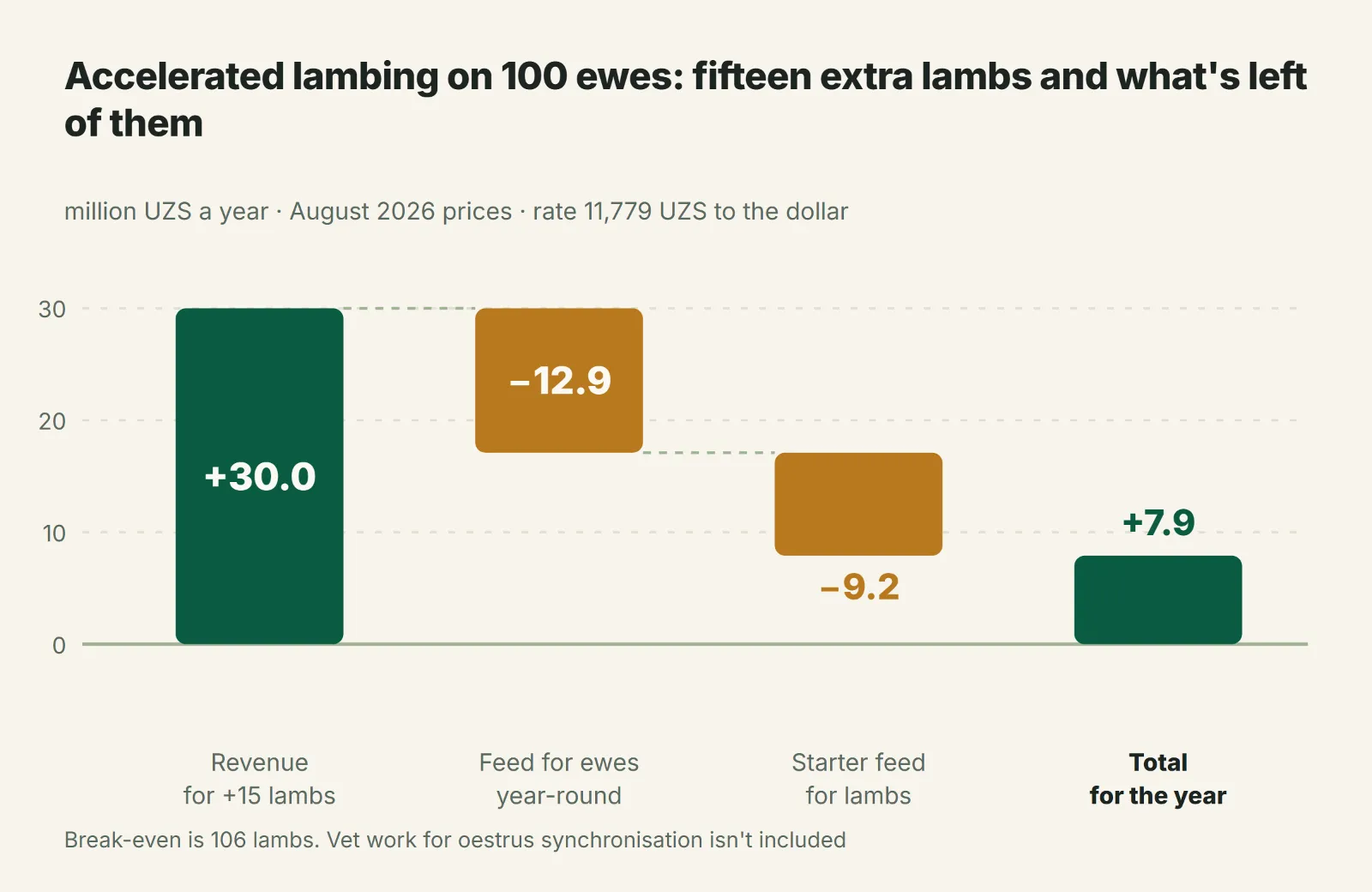
Where the extra costs come from. It isn't that the ewe is pregnant longer: with accelerated lambing, her boosted ration stops landing on green pasture, and for roughly 60 days a year she needs purchased feed where grass used to feed her under a single-lambing schedule. That's +0.4 kg of concentrates and +0.5 kg of hay a day above maintenance; we price concentrates at 4,000 UZS/kg (barley and corn run cheaper, at 3,800), and alfalfa hay at 1,100 UZS/kg at hay-harvest prices. That comes to 129,000 UZS per ewe, or 12.9 million UZS for the flock. A lamb weaned at two months keeps growing without milk and eats about 40 kg of starter feed before sale, against roughly 22 kg with normal weaning: at 4,000 UZS/kg, the difference adds another 9.2 million UZS for the flock. Live prices on grain, meal, and ready-mixed feed are in feed and compound feed listings, and you should plug in your own numbers, not averages.
Two caveats without which the math lies in your favour. First: we're assuming the farm feeds starter to lambs under both schemes. If under standard lambing the lambs grow on nursing and pasture alone, the entire cost of starter feed falls on the accelerated scheme — the threshold rises to 110 lambs, and the gain disappears completely. Second: the hay is priced at hay-harvest rates. If it has to be bought in over winter at 1,700–2,100 UZS/kg, feed for the ewes climbs to 14.7–15.9 million, and the gain shrinks to 4.9–6.1 million UZS.
The key number isn't the gain, it's the break-even point. Extra feed for the ewes gets spent regardless of how many lambs you end up with. Setting the added revenue equal to the added costs puts break-even at 106 lambs: accelerated lambing pays off only if it delivers at least +11 head per hundred ewes. Land at 100–105, and you fed the flock on a boosted ration all year for free. The second sensitivity point is feed: if purchased rations replace pasture for more than 97 days a year per ewe, the whole gain is eaten up.
The 7.9 million UZS gain is less than 4% of revenue from the lamb crop, and the calculation includes neither veterinary synchronisation, nor the barn the accelerated scheme requires, nor extra labour. That margin disappears after one bad season: ewes that didn't cycle in spring, an extra dozen lambs lost to early weaning, compound feed that got more expensive.
When acceleration pays off, and when it's just a risk
The scheme comes out reliably ahead only where the denominator of the calculation itself changes. There are three such cases, and they differ a lot in strength.
A prolific breed — the only genuinely strong lever. The gain is counted in lambs, not lambings. Romanov ewes and their crosses have a fertility rate of 230–270 lambs per 100 ewes: the same 1.1 lambings then give not 110 lambs but around 245, against 207 under the standard scheme. The gain isn't fifteen head but nearly forty. The break-even point here is its own too — around 220 lambs — and the margin above it comes out several times larger than for fat-tailed breeds. One caveat: Romanov is a northern breed with a dense double fleece, and it handles Uzbekistan's summer heat worse than local fat-tailed breeds, so this usually means crosses, kept in a barn with shade and water.
Growing your own feed — less about being cheaper than being predictable. Your own irrigated alfalfa hay runs about 900 UZS/kg against 1,100 at the market in summer and 1,700–2,100 in January. In our calculation, hay accounts for 3.3 million of the 12.9 million: your own field hay shaves off about 600,000 of that, and homegrown on your own plot (around 300 UZS/kg) — up to 2.4 million. That doesn't flip the math, but it insulates you from the January price, and accelerated lambing is exactly what makes a farm dependent on buying winter feed. How many tonnes a hectare yields and when planting pays for itself is worked out in growing your own alfalfa versus buying hay.
Selling outside the main season. All of Uzbekistan's spring lambs hit the market at roughly the same time, and the price at that moment is pinned down by supply. An autumn lambing delivers a market-ready lamb when your neighbours don't have one. The price premium here isn't guaranteed and varies by year, but it — not the second lambing itself — is usually what makes the scheme pay.
What gets you more lambs for the same money
Before accelerating lambing, it's worth squeezing more out of a single one. The gap between a weak flock and a strong one within the same scheme is 95 versus 115 lambs per hundred ewes — twenty head against the fifteen that accelerated lambing is chasing — with no hormones and no extra tonne of feed.
- Flushing before mating. Six weeks of supplementary feeding before the ram — 300–500 g of concentrates per ewe — lifts output by 15–20 lambs per hundred. The full cost breakdown is in how to prepare a flock for mating.
- Culling barren ewes. A ewe that fails to produce a lamb two years running eats like a working animal and gives nothing back. Replacing her with a young ewe lamb is cheaper than keeping her. Browse young stock and breeding rams in sheep and rams for sale in Uzbekistan, where your enquiry goes straight to the animal's owner.
- Lamb survival in the first three days. Most lamb losses come not from disease but from the first few days: cold, lack of colostrum, lambs crushed by ewes. A warm corner in the barn and watching the first feeding save more head than any accelerated scheme.
- Enough rams for mating. If you're short on breeding rams, some ewes will stay barren under any scheme, and no synchronisation will fix that.
How much a prolific ewe really earns in Uzbekistan and why the Romanov breed struggles in the heat is worked out separately: Romanov sheep in Uzbekistan — are they worth keeping.
FAQ
How many times a year does a ewe lamb in Uzbekistan?
Once a year. Fat-tailed breeds — Hissar, Edilbay, Jaydara — come into oestrus in autumn, gestation lasts 145–155 days, and lambing falls in February–April. With barn housing, year-round feed, and early weaning, you can reach three lambings in two years — 1.5 lambings a year in theory, 1.0–1.2 in practice.
Can a ewe lamb twice a year?
In Uzbekistan's fat-tailed breeds — practically not. Gestation takes 5 months, nursing needs another 2, and recovery a month more, so the real minimum interval is 8 months. Twice-a-year lambing occurs in the Romanov breed and its crosses under intensive management, but even there it's more of an exception than a scheme for the whole flock.
How soon after lambing can a ewe be mated again?
As long as a ewe is nursing a lamb, there's no oestrus: suckling suppresses the hormones that trigger it. After weaning, a ewe typically comes into oestrus within 30–60 days. With early weaning at 45–60 days and good body condition, it's closer to 30 days; if she's thin or it's hot, it's later — sometimes not until autumn.
How many lambs does one ewe produce per lambing?
In Uzbekistan's fat-tailed breeds — 105–115 lambs per 100 ewes put to the ram, meaning usually a single lamb, with twins the exception. In the Romanov breed and its crosses, twins and triplets are the norm, at 230–270 lambs per 100 ewes. You can't out-manage a breed's litter size: flushing before mating lifts output by 15–20 head per hundred, not double.
Is it worth switching a flock to accelerated lambing?
You need to run the numbers against your own feed base. On a flock of 100 fat-tailed ewes, the break-even point is 106 lambs a year against the usual 95: below that, extra feed for ewes and starter feed for lambs eat up the whole gain. At 110 lambs, you're left with about 7.9 million UZS (≈ $667) a year — less than 4% of revenue from the lamb crop — and that's before the cost of veterinary synchronisation and a barn. The scheme gives a real margin with a prolific breed, your own feed supply, or selling lambs outside the main season.
Manage your flock in QoyHunterCRM for sheep farmers: livestock, health, weighing, finance and analytics — in the app and a Telegram bot.All features →