Own Alfalfa vs. Bought Hay: How Many Tons a Hectare Gives and When Planting Pays Off
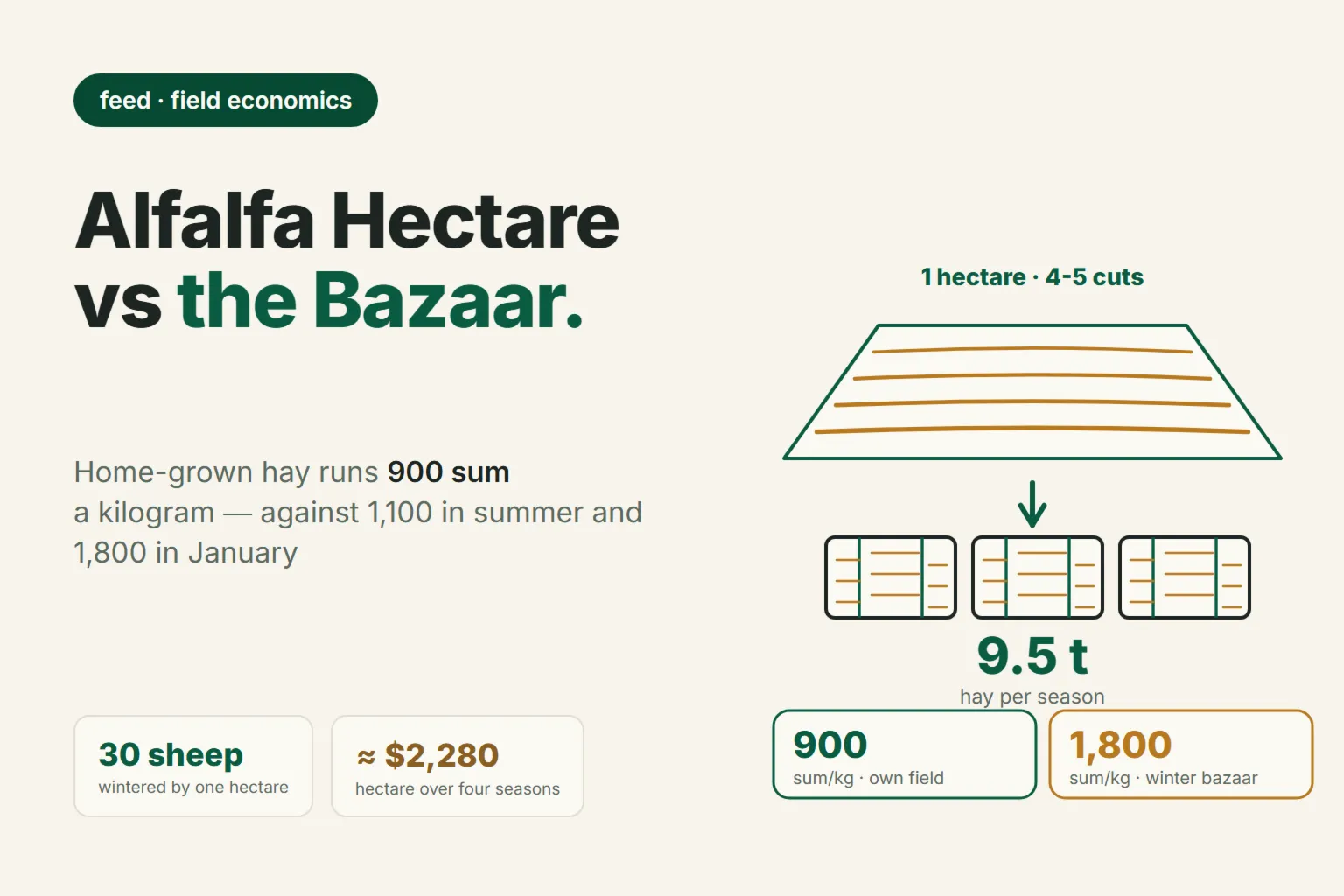
A hectare of irrigated alfalfa gives 8–12 tons of hay and covers winter for a flock of 30 head. We work out planting, water and harvesting costs: your own hay comes out at 900 sum per kilogram against 1,100 at the bazaar in summer and 1,800 in January. Who should plant, and who's better off just buying.
In winter hay gets 1.5–2 times more expensive, and every January a farm pays for the same bale as if it were one and a half. Which raises an obvious question: why not plant your own alfalfa? You've got the land, you've got water, and seed costs next to nothing next to a year's feed bill.
The idea is sound, but the arithmetic isn't obvious. A hectare of irrigated alfalfa gives 8–12 tons of hay a season and covers winter for a flock of thirty head. But your own hay isn't free — it comes out at roughly 900 sum per kilogram, against 1,100 at the bazaar in summer. The difference shows up in a different place than you'd expect. We work through a hectare from seed to haystack. Prices are benchmarks for August 2026, converted at ≈ 12,000 sum to the dollar.
What a Hectare Gives You
Irrigated alfalfa stays productive on the same plot for three to four years and gets cut 4–5 times a season, with 28–35 days between cuts. The planting year doesn't count toward this: the young stand only manages two to three cuts and about half the normal yield, and by year four the stand thins out and yield drops again.
| Year | Cuts per season | Hay per hectare |
|---|---|---|
| Year 1 (planting) | 2–3 | 4–5 t |
| Years 2–3 (peak) | 4–5 | 8–12 t |
| Year 4 (stand thins) | 3–4 | 6–8 t |
Now let's convert tons into sheep. An adult ewe needs about 300 kg of hay for a 135-day winter, a young animal about 200 kg (we worked out the stock calculation in the article How Much Hay Does a Sheep Need for Winter).
So a 9.5-ton hectare covers the full winter for a flock of 30 ewes, or that mixed flock of 31 head we used for the stock calculation: 20 ewes, 10 young animals and a ram.
A homestead plot of 25 ares gives about 2.3 tons — enough to winter eight sheep. That's no abstraction: plenty of dehkan farms have exactly that much land.
What Planting Costs
Planting is a one-off cost that pays off over three to four years. The seeding rate for hay is 14–20 kg of seed per hectare (the recommendation for top-grade seed is 14 kg/ha; on homestead plots people sow 150–200 g per are). We'll use 18 kg: alfalfa doesn't like a thin stand, and denser planting gives a finer stem and more leaf.
| Item | Calculation | Amount |
|---|---|---|
| Seeds | 18 kg × 80,000 sum | 1.44 million sum ($120) |
| Plowing, leveling, harrowing, sowing | contractor services | 3.0 million sum ($250) |
| Starter phosphorus (ammophos) | 150 kg × 9,000 sum | 1.35 million sum ($113) |
| Total for planting | ≈ 5.8 million sum ($485) |
Rates for machine work vary noticeably between regions — plug in your own contractor's numbers; the ones here are meant to give you the order of magnitude.
Seed is the one line item not worth skimping on. A cheap unmarked bag from the bazaar gives a patchy stand with wormwood showing up in the first cut, and you'll end up reseeding anyway — the same 3 million sum for machine work, just a second time.
A farm with a flock gets its pre-sowing fertilizer almost free: a hundred sheep produce 20–25 tons of well-rotted manure over a winter — roughly the rate for one hectare. What that manure is worth at mineral-fertilizer prices, and why it is worth less under alfalfa than under corn, is covered in the article on sheep manure.
What a Hectare Costs Every Year
This is where the real money goes. The biggest line item isn't water or fertilizer — it's harvesting: mowing, wilting, raking, baling and hauling, four to five times a season.
| Item | Calculation | Per season |
|---|---|---|
| Water | 8,000 m³ × 107 sum/m³ | 0.86 million sum ($72) |
| Top-dressing (phosphorus, potassium) | per cut | 0.9 million sum ($75) |
| Harvesting: mowing, tedding, raking, baling, hauling | 4–5 cuts | 4.0 million sum ($333) |
| Ditch cleaning, weeding, hand labor | 0.6 million sum ($50) | |
| Total per year | ≈ 6.4 million sum ($533) |
A word on water. Since 2026, the water-use tax rate for irrigating farmland — for dehkan and farmer households alike — is 107 sum per cubic meter within the approved limit; where the field hasn't been laser-leveled, a surcharge factor of up to 1.2 applies. Alfalfa needs 6,000–10,000 cubic meters per hectare a season: 900–1,200 m³ per irrigation, one or two irrigations between cuts. Water isn't the main expense, but it isn't nothing either, and going over the limit hits your pocket twice.
Add up four seasons: 8.8 million sum in year one (planting plus harvesting two cuts), 6.4 million each in years two and three, 5.8 million in year four, when there are fewer cuts. Total: 27.4 million sum (≈ $2,280) for 30.5 tons of hay.
Cost per kilogram of your own hay — about 900 sum (≈ $0.08).
 )
)
Your Own Hay vs. Bought Hay
Now the comparison this whole exercise was for. Alfalfa hay costs about 1,100 sum/kg at haymaking time, and by January a bale gets 1.5–2 times more expensive — up to 1,700–2,100 sum/kg (we worked that out in the article What to Replace Expensive Feed With).
| Hay source | Price per kilogram | 30.5 tons over 4 years |
|---|---|---|
| Own hectare (contractor's work) | 900 sum | 27.4 million sum ($2,280) |
| Own hectare with your own mower and baler | ≈ 700 sum | 20.9 million sum ($1,740) |
| Bought in summer, at haymaking | 1,100 sum | 33.6 million sum ($2,800) |
| Bought in winter, in January | 1,800 sum | 54.9 million sum ($4,575) |
| 25 ares by hand, no machinery | ≈ 300 sum | — |
The difference against timely summer buying is modest: about 6 million sum over four years, or 1.5 million (≈ $128) a year. The hectare only pulls ahead of the bazaar in the second season — before that it's still paying off the planting costs.
 )
)
But against someone who buys hay in winter, the picture is different: over four years the gap reaches 27.5 million sum (≈ $2,290). And that's the main takeaway: your own hectare doesn't beat the neighbor who stocked up in time — it beats your own habit of buying feed only after it runs out.
Which gives us an honest way to put it. Alfalfa isn't cheap hay — it's a locked-in price. A farm with its own field doesn't depend on what January turns out to be, what the exchange rate does, or what resellers will charge after a dry summer. Even if a contractor charges a third more than budgeted, your own hay still ends up cheaper than the winter bazaar.
Where the Payoff Is Biggest
A homestead plot of 20–30 ares. No contractor, no baler here: you cut with a brushcutter, dry the hay and stack it. The cash costs are seed (4.5 kg, one-time), water and a bit of fertilizer — everything else is your own hands. A kilogram comes out to about 300 sum, four times cheaper than the summer bazaar. Twenty-five ares feed eight sheep through winter.
Your own machinery. A mower and a baler cut harvesting costs roughly in half and bring the cost down to 700 sum/kg. If you already have the equipment for other work, a hectare of alfalfa is almost a free extra load for it.
Surplus. A hectare is too much for a flock of 15: half the hay will be left over. But the leftover isn't "extra" — it's merchandise that gets more expensive by winter: 5 tons held back until January are worth about 9 million sum, against 5.5 million in July. A hay shed pays for itself faster than you'd think.
You do not have to hold the surplus until spring: in winter hay for sale listings move fast, and the January price is nearly double July’s.
Green feed. Part of the plot doesn't have to become hay at all: cut and wilted green mass is the cheapest protein on the farm, because you're not paying a baler for it. Just don't graze sheep directly on alfalfa — that's a direct path to bloat, which we covered in the article An Hour on Alfalfa — Minus One Sheep.
When It's Cheaper to Just Buy
- Land leased for a year or two. Alfalfa pays off the planting cost by the second season and starts turning a profit in the third or fourth. A short lease is a guaranteed loss.
- No water of your own, or the limit gets cut in July. Without irrigation the third and fourth cuts simply won't grow: instead of 9.5 tons you'll get 4–5, while costs stay the same.
- Saline soil, high groundwater. Alfalfa on such plots thins out within a year or two, and the planting never lives to pay for itself.
- A flock of under ten head and no one to sell the surplus to. It's simpler to buy three tons of hay at haymaking for 3.3 million sum than to start a field.
- First winter. The planting year gives half the normal yield, and you'll have to buy extra feed for that winter anyway — factor that into the plan too.
If you decide to buy, count kilograms and protein, not bales: how to choose hay when buying and not overpay for underweight bales.
What Eats Into the Harvest
Even on your own field, hay is easy to ruin, and when that happens the whole economics collapse: coarse, overgrown hay is closer to straw in feed value, yet you paid for it as alfalfa.
- Overgrowing. Cut at the budding stage or right at the start of flowering: at that point the grass has about 18% crude protein, dropping to 15.5% by full bloom, and after that protein falls by roughly 0.25–0.3% a day. A week's delay and it's already a different feed.
- Leaf shatter. Leaves have 2–2.5 times more protein than stems, and they're the first to fall off. Tedding and raking over-dried alfalfa in the midday heat means leaving half the protein on the field; do that work early in the morning or in the evening.
- Rain on the windrow. Rain-soaked hay browns and loses nutrition. Checking the forecast for cutting week is as much a part of the job as fuel for the mower.
- Storage in the open. A haystack without cover loses its top layer over winter and gets damp from below. A shed and a pallet base cost less than the tons you'd lose.
- Feeder losses. Then the hay still has to be fed out: up to a third of a bale ends up trampled underfoot if the feeder is the wrong design — we worked that out in the article A Third of the Hay — Trampled Underfoot.
There's a separate benefit you won't see in any table: after three to four years of alfalfa, the field moves on to another crop with nitrogen banked in the soil and its structure restored. In cotton crop rotation, that's historically been alfalfa's whole job.
How to Work This Out for Your Own Farm
You only need three numbers: how many head go into winter, how much hay each one needs, and the price you're currently paying for it. After that it's simple: a hectare covers 30 head, 25 ares covers eight, and the rest you either buy in or sell off.
These three numbers do not need to live in your head: feed consumption tracking by group will show how many tons you will get through by spring and when to buy more.
Most farms only know the first two numbers roughly, which is exactly why feed either runs short by March or leaves you with extra tons. In QoyHunter, your flock is tracked animal by animal from your phone: how many head, and what age, are going into winter shows up right away — and with it, how many tons of hay you need to put up.
In Short
- A hectare of irrigated alfalfa gives 8–12 tons of hay over 4–5 cuts and feeds about 30 sheep through winter; the planting year gives half the normal yield.
- Planting costs ≈ 5.8 million sum ($485) and lasts three to four years; upkeep runs ≈ 6.4 million sum ($533) a year, two-thirds of which goes on harvesting.
- Cost of your own hay is about 900 sum/kg, against 1,100 at the bazaar in summer and 1,800 in January.
- Against summer buying, the gain is modest — 1.5 million sum a year. Against winter buying — 27.5 million over four years.
- The biggest payoff comes from 20–30 ares by hand (about 300 sum/kg) and your own machinery (700 sum/kg).
- Don't plant if the land is on a short lease, you don't have reliable irrigation, or your flock is under ten head: it's cheaper to buy hay at haymaking.
Check planting dates, fertilizer rates and irrigation schedules with your own agronomist: soil, water and quotas differ from farm to farm, and what works for your neighbor might not work for you.
Manage your flock in QoyHunterCRM for sheep farmers: livestock, health, weighing, finance and analytics — in the app and a Telegram bot.All features →