Monthly Farm Work Plan: How to Assign Tasks to a Shepherd and Check They're Done
A ready-made October work plan for a 100-ewe farm: every job has a due date, one assignee, and a mark for done. What one overdue job actually costs, and what to run the plan on — notebook, whiteboard, Telegram, or app.
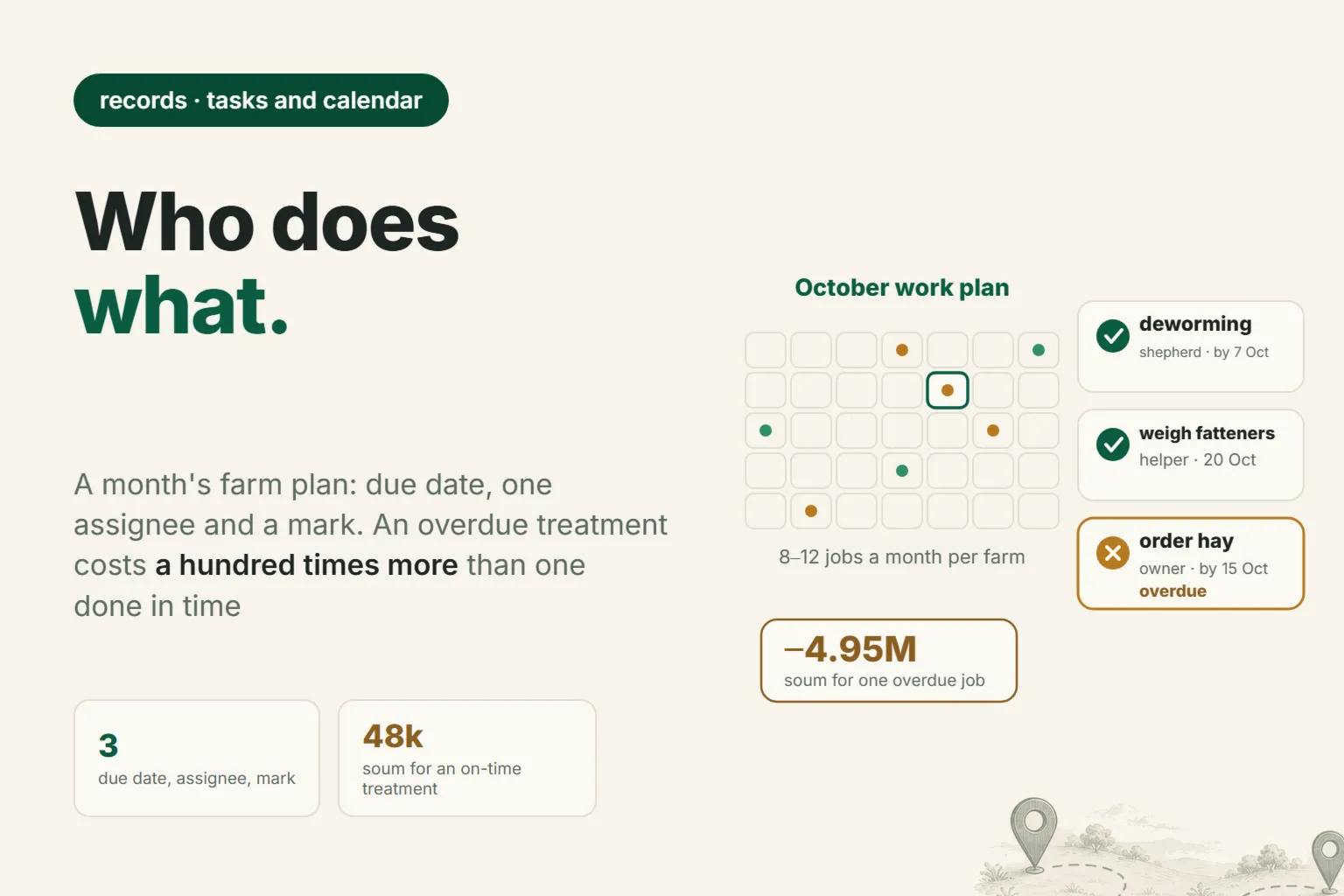
A farm work plan is a list of jobs for the month where every job has three things: a due date, one assignee, and a mark for done. Everything else is decoration. A job with no assignee gets done by nobody: the owner thinks the shepherd handled the treatment, the shepherd thinks the owner drove the drug out himself. A job with no due date slides to "after mating." A job with no completion mark can't be checked without walking the pens yourself.
Below is a ready-made work plan for October for a 100-ewe farm, a calculation of what one overdue job actually costs, and an honest comparison of ways to run such a plan: a notebook, a whiteboard in the shed, a Telegram chat, a spreadsheet, and an app. Exchange rate used — 11,783 soum per dollar (Central Bank of Uzbekistan, September 11, 2026).
Why a spoken order on the farm doesn't work
A farm with 100 ewes, one hired shepherd and a helper is not an office where everyone sits together. The owner is off buying feed, the shepherd is out with the flock, the helper is at the shed. Orders get handed out on the move, by voice, and they break down for three reasons.
- Two assignees means zero. Say in front of everyone "we need to treat the flock" and each one assumes it's about the other. This is the most common way a job gets lost: not cancelled, not forgotten, just nobody's.
- A due date that sounds like "this week." A job due "this week" slides into next week with no bad intent at all, and keeps sliding until it's too late.
- No check. "Did you do it?" — "Did it." A month later it turns out only the animals that were easy to pen got treated, and thirty head from the far pen were missed.
An ordinary farm racks up about 50 deadlines a year that can't be skipped — vaccinations, two deworming rounds, mating, lambing, weaning, shearing, weigh-ins, feed purchases, settling up with the worker. That's 4–5 mandatory dates a month, and together with day-to-day jobs — fix the waterer, deliver wool for pickup, recount the flock after lambing — it adds up to 8–12. You can hold that in your head, right up until the first illness, trip, or lambing.
What a monthly farm work plan looks like
Here's the plan for October for a farm in Tashkent region: 100 ewes, a breeding ram, 60 head of young stock on feed, a hired shepherd and a helper. October means the move to barn feeding and the end of mating, so the month is packed.
| Job | Due date | Assignee | What happens if it slips |
|---|---|---|---|
| Autumn deworming of the whole flock | October 1–7 | shepherd | young stock's weight gain drops 20–40% |
| Hoof trimming before barn housing | October 8–12 | shepherd and helper | lameness in the barn, ewes lose condition |
| Buying hay and barley for winter | by October 15 | owner | winter prices are higher, you take what's left |
| Control weigh-in of the feeding group | October 20 | helper | no baseline to compare gain against, you're feeding blind |
| Mark bred ewes, work out lambing dates | by October 25 | shepherd | lambing catches you off guard, shed isn't ready |
| Fix the roof, ventilation and bedding in the shed | by October 30 | helper | damp and drafts — pneumonia in lambs |
| Settle up with the shepherd for the month | October 30 | owner | distrust, which costs more than money |
A plan like this is useful on its own, even kept in a notebook. What matters isn't the list of jobs — it's the third column: on a farm where every line has a name on it, jobs don't disappear.
What one overdue job actually costs
Take the first line of the plan — autumn deworming — and push it back a month. Not forgotten, just postponed: the drug wasn't bought in time, then lambing happened, then guests came.
| Measure | Treated October 5 | Treated November 5 |
|---|---|---|
| Young stock weight gain | 200 g/day | 150 g/day |
| Per head over a month | 6 kg | 4.5 kg |
| Across 60 head on feed | 360 kg | 270 kg |
| Difference in money at 55,000 soum/kg live weight (autumn 2026 prices) | — | −4.95 million soum (≈ −$420) |
With a heavy worm burden, weight gain in infested young stock drops 20–40% — a figure we covered in the sheep vaccination and treatment calendar; here we've taken a cautious middle figure, 25%. Treating 160 head would have cost about 48,000 soum (≈ $4) in ivermectin at listing prices — meaning the overdue job costs a hundred times more than the completed one. Dosage should always be calculated by the animal's actual weight, per the drug's instructions and a vet's guidance.
The second line works the same way, only slower: a lame ewe eats less, comes into lambing thin, and the lamb is born weak. And feed purchases pushed from October to January hit your wallet directly: in winter a bale costs more, choice is thinner, and you're no longer bargaining on your own terms. It's worth checking current prices for barley, compound feed and other feeds ahead of time, while the job is still on the plan — not when the barn is already empty.
Notebook, whiteboard, Telegram, or app: what to run your work plan on
An honest look at each option — for a farm where two or three people work.
| What the plan needs to do | Notebook | Whiteboard in the shed | Telegram chat | Spreadsheet | App |
|---|---|---|---|---|---|
| Assign a job to a specific person | written down, but the worker doesn't see it | visible to everyone at once | drowns in the conversation | if access is set up | yes, with a name |
| Show what's overdue | flip back through pages | gets erased | no | if colored by hand | yes, automatically |
| Mark a job done | by hand, by the owner | with chalk | by message | by hand | one tap, by the assignee themself |
| Works when the owner isn't on site | no | yes, at the shed | yes | yes | yes |
| Sits next to animal events | no | no | no | by hand | yes, in one shared calendar |
| Cost | a few thousand soum | 0 soum | 0 soum | 0 soum | from 0 soum (free up to 30 head and one worker) |
The honest conclusion: if you work alone and keep 10–20 head, a notebook is enough — you're setting tasks for yourself anyway, and you remember them. A whiteboard in the shed is underrated: for a two-person crew it solves half the problem, because the list hangs right where the work happens. A Telegram chat is the worst of the lot: an order lives there for half a day before it scrolls up under photos and voice messages. An app starts winning once a second worker shows up and a third deadline lands in the same week.
What a task needs to actually get done
Five fields — no matter where you're writing it down.
- What to do, as one verb. "Deworm the flock," not "worms." A job should read as an action.
- A due date with an actual date. Not "this week," but "by October 7." A date is what separates a task from a wish.
- One assignee. Exactly one. If a job needs two people, that's two jobs, or one lead and one helper.
- A completion mark. Set by whoever did the work, not by whoever gave the order — otherwise checking falls back on the owner again.
- Visible overdue status. A job nobody mentions the day after its due date should be counted as not done.
How tasks and the calendar work in QoyHunter
QoyHunter is a CRM for sheep record-keeping, plus the marketplace bazar.qoyhunter.com. The Tasks and calendar section covers exactly what's described above — nothing more.
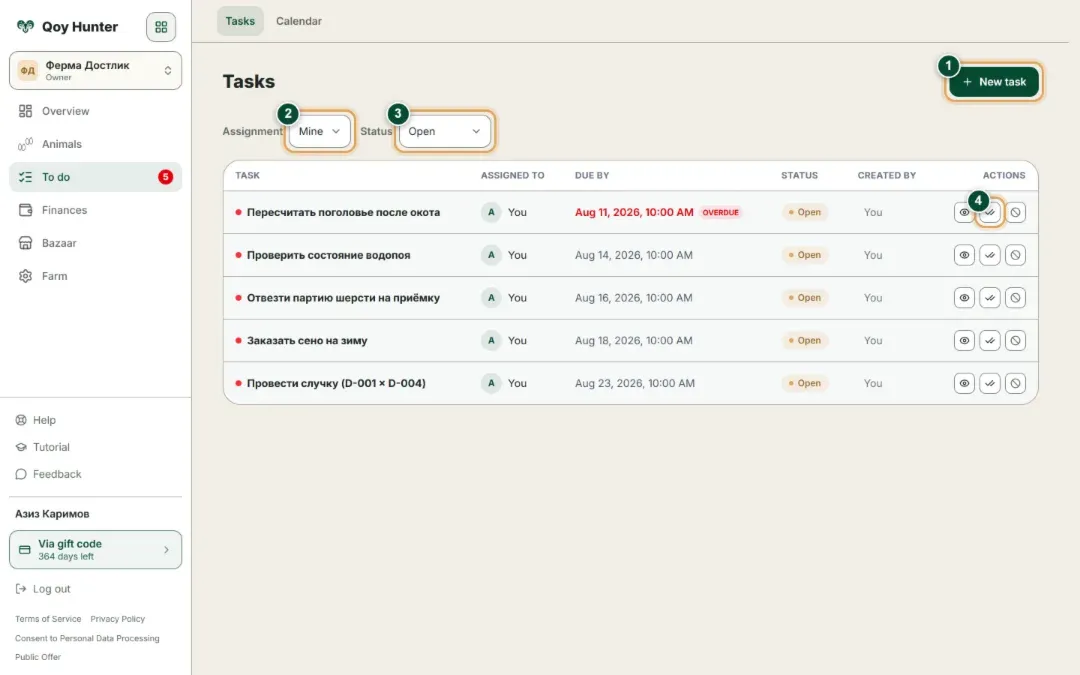
In the task list, every job shows a title, due date, assignee, and status. Tasks filter by assignee — you can view just your own jobs or the whole farm team's — and by status: open, completed, cancelled. Overdue jobs stand out on their own: the date shows red with an "Overdue" tag next to it, so you don't need to go looking for them, they show up on their own. Marking a job done takes one tap, right from the list.
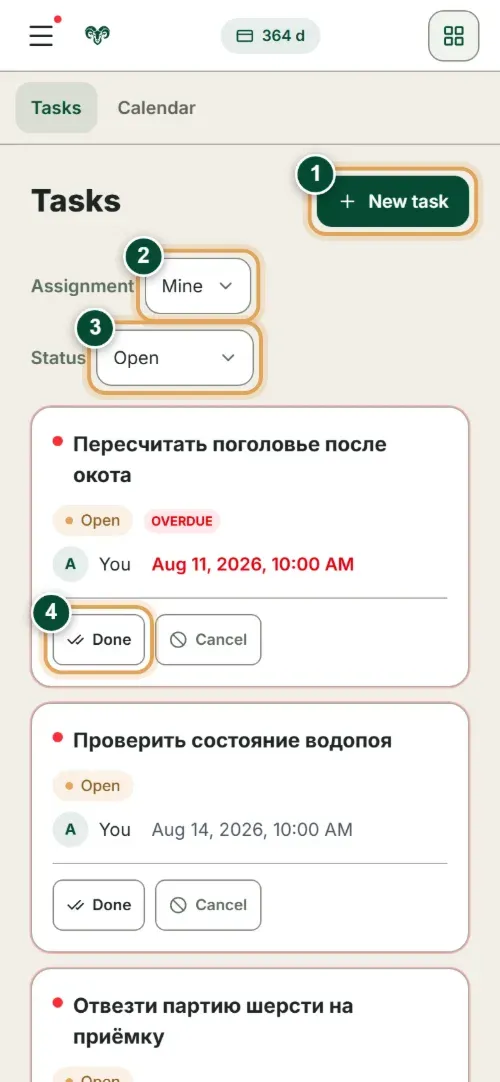
The phone matters more than the computer here: a task is set and closed right where a person is standing — in the pen, at the feeder, at the bazaar. The shepherd doesn't have to recap his day in the evening.
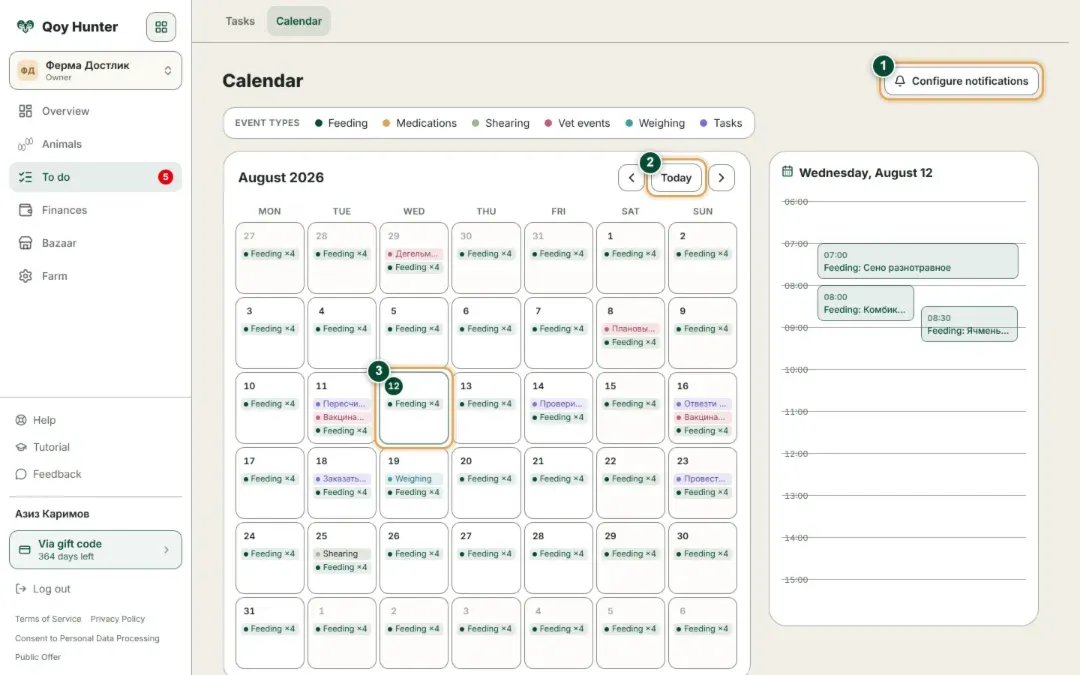
The monthly Calendar brings together everything happening on the farm by date: feedings, medications, shearing, vet events, weigh-ins, and the tasks themselves — each type with its own colour mark. Arrows flip through months, the "Today" button jumps back to the current date, and tapping a day opens its hour-by-hour schedule. That's also where you turn on Telegram reminders — "Configure notifications" — and how to set them up so they don't turn into noise is covered in a separate piece on deadline reminders.
What's not in this section: it doesn't calculate the assignee's pay and it doesn't set tasks for you. If you need to work out pay for a worker, that's a separate conversation — how much to pay a shepherd and what to give a bonus for.
A separate question is who on the farm sees what in the records. How to split access between the shepherd, the vet and the bookkeeper, and what to do with the records when a worker leaves, is covered in farm records with employees: roles and access.
FAQ
I have 30 sheep and I work alone. Do I need tasks on my phone?
Probably not. As long as there's one worker on the farm — you — a notebook and memory hold up fine, and a five-job list for the week is simpler written on paper. Tasks start paying off once a second person joins: jobs get lost exactly at the point where two people overlap.
How do you get a shepherd to actually mark jobs done?
Don't force it — make marking it worth doing. A marked job is proof of work: at month's end you can see the treatment happened, hooves were trimmed, the flock was recounted. On farms where pay is tied to results rather than presence, marks start showing up without reminders.
What about jobs that repeat every month?
Set up recurring work as a schedule, not a task: feeding, shearing, and vet treatments in QoyHunter can be set with a recurrence and they return to the calendar on their own. One-off jobs are easier to create ahead of time, for several months out. A flock has about 50 recurring deadlines a year, and those are the ones most often missed — because they seem too obvious to write down.
How much does one forgotten farm job actually cost?
The math is simple: take the consequence and multiply by head count. Deworming pushed back a month for 60 head of young stock costs around 4.95 million soum (≈ $420) in lost weight gain at 55,000 soum per kilogram live weight. The treatment itself would have cost 48,000 soum.
Can you run a work plan for free?
Yes. A whiteboard in the shed and a notebook cost a few thousand soum, a spreadsheet on your phone is free. Basic record-keeping in QoyHunter is free — up to 30 animals and one worker. Once a second person joins and the flock passes thirty head, you need a paid plan — which is exactly the point where tasks start paying off.
Manage your flock in QoyHunterCRM for sheep farmers: livestock, health, weighing, finance and analytics — in the app and a Telegram bot.All features →