Farm Record-Keeping With Workers: Who Logs What, Who Sees What, and How Not to Lose Records When a Shepherd Leaves
How two or three people run farm records together: a shared log instead of personal notebooks, roles for a shepherd, vet, and bookkeeper, the cost of one lost vaccination record, and what to do the day a worker leaves.
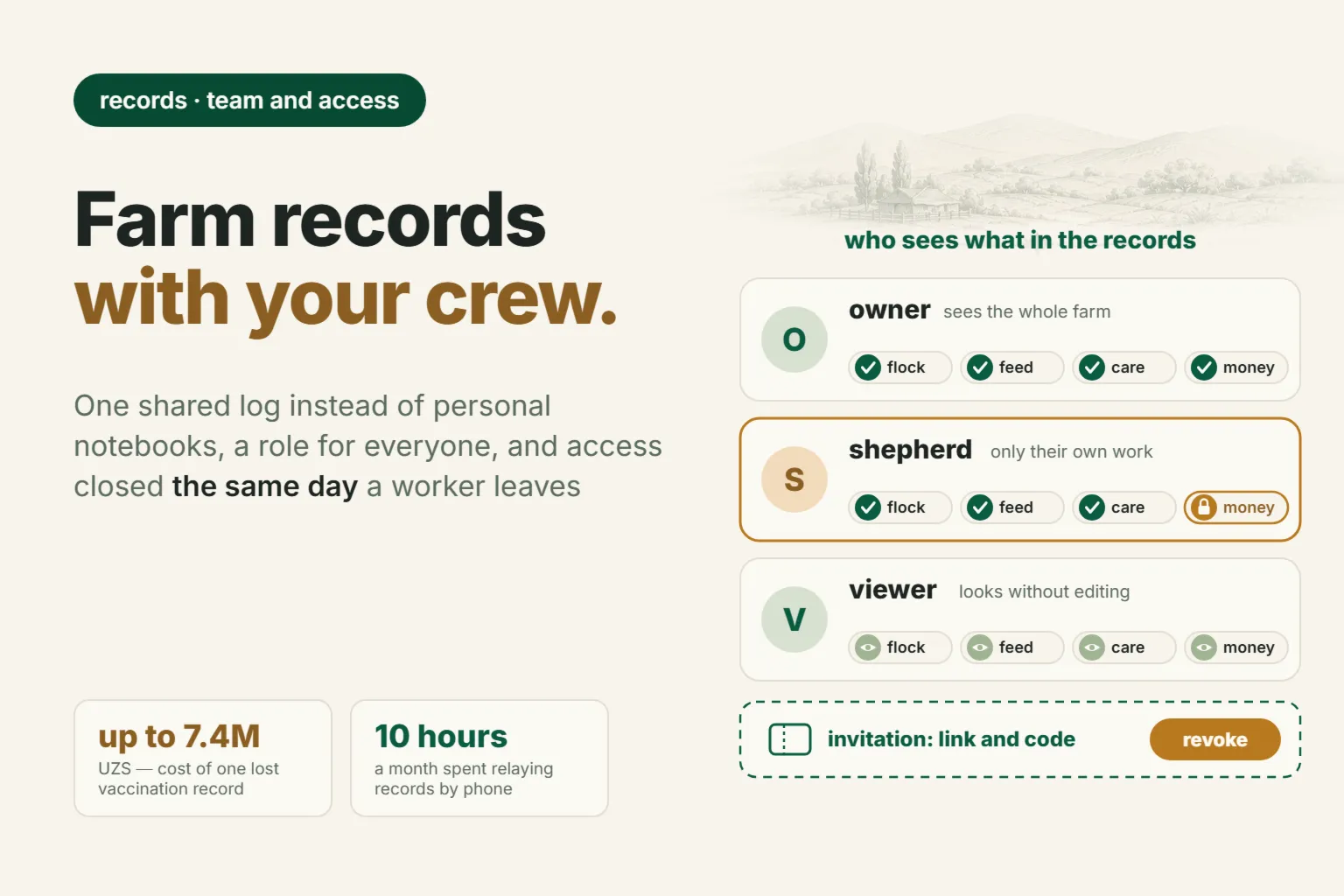
A farm with workers keeps its records in one shared log: everyone logs their own part of the work themselves, and sees only what that work requires. The shepherd notes lambing, feeding, and treatments; the vet notes treatment; the bookkeeper notes money; the owner sees the whole farm. Record-keeping like this rests on three rules: records stay with the farm, not in a worker's personal notebook; every person has their own login and their own role; and access is cut off the same day a person leaves.
Below: where farm record-keeping breaks down as soon as a second person joins, how much one lost vaccination record costs, who should see what on the farm, and what to use for shared record-keeping — a notebook, a chat, a spreadsheet, or an app. The rate for conversion is 11,766 UZS per dollar (Central Bank of Uzbekistan, September 14, 2026).
Why Does Farm Record-Keeping Break Down Once There's More Than One Worker?
As long as the owner works alone, the records live in one head and one notebook. The confusion starts with the second person, and the reasons are almost always the same.
- Everyone has their own notebook. The shepherd logs lambing in a notepad at the pen, the owner logs vaccinations in a notebook at home, and the helper doesn't write anything down. No one has the full picture of the farm — you can only piece it together by talking to people.
- The records travel by word of mouth. An evening phone call — "how many lambed, who got treated" — and copying it into the farm's notebook. Twenty minutes a day is 10 hours a month, more than a full workday, and every retelling loses either an ear tag number or a date.
- One password for everyone. If a shared spreadsheet or app is opened under a single login, there's no way to tell who entered a record and who deleted a row. A worker who quit keeps access until the password is changed.
- The records leave with the person. The shepherd's personal notepad stays with the shepherd. He leaves in November — and breeding dates, lamb numbers, and vaccination notes leave with him.
The last point is the most expensive one, and it can be put in numbers.
How Much Does One Lost Vaccination Record Cost?
Take a feedlot group of 100 lambs in the Tashkent region. The shepherd gave the group its first dose of the enterotoxemia vaccine and wrote the date in his own notepad. Two weeks later he quit, and the notepad left with him. The owner doesn't know whether the lambs were vaccinated, whether all of them were, or when.
The vaccination schedule is: two doses 3–4 weeks apart, with grain starting no sooner than 10–14 days after the second dose. One dose alone doesn't give reliable protection. Without a date for the first dose, the owner is left with two options, and both cost money. The figures come from our breakdown of vaccinating lambs against enterotoxemia before the feedlot: the vaccine runs 5,000 UZS a dose, and a dead feedlot lamb weighs 45 kg at 55,000 UZS per kg of live weight (autumn 2026). Per New Mexico State University, unvaccinated feedlot groups lose at least about 1% of lambs to enterotoxemia, 2–3% on average.
| What the owner does without a record | Direct cost for a group of 100 lambs | What else it costs |
|---|---|---|
| Starts the vaccination course over | 500,000 UZS (≈ $42) for the extra dose | grain is pushed back by about two weeks |
| Counts the group as vaccinated and starts grain | 0 UZS on vaccine | at 1% deaths — 2,475,000 UZS (≈ $210); at 3% — 7,425,000 UZS (≈ $631) |
| The record stayed with the farm | 0 UZS | second dose and grain — on schedule |
One line in someone else's notepad costs the farm anywhere from 500 thousand to 7.4 million UZS. That same line in a shared log that stays on the farm after the person leaves costs nothing.
Who Sees What on the Farm: What Roles Should Workers Get?
A role in the records is what a person can see and what they can change. Splitting up access isn't about distrust. The less there is on screen that doesn't concern someone, the fewer accidental edits there are — and wages and sale prices are exactly the topic that most often sours relationships on a team.
| Who's on the farm | What they record themselves | What they need to see | What you can keep closed |
|---|---|---|---|
| Owner | purchases, sales, settling up with people | the whole farm | — |
| Manager or an elder son | everything current on the flock | almost the whole farm | service payments and deleting the farm |
| Shepherd, helper | lambing, deaths, weigh-ins, feeding, treatments | the animals, feed, treatment deadlines | money, sale prices, wages |
| Visiting vet | diagnoses, treatment, vaccinations | animal records and medical history | farm finances |
| Bookkeeper | income and expenses | finances and reports | editing animal records |
| Relative co-owner | nothing | a farm summary | the right to change anything |
The main rule of shared record-keeping: the person who did the work enters the record, on the same day. That way the owner doesn't have to rewrite anything, and the shepherd's bonus is calculated from records, not from memory. If a shepherd's pay depends on how many lambs survive, honest records of lambing and deaths are the basis for that calculation; how to set up a scheme like that is covered in how much to pay a shepherd and what to give a bonus for.
It's better to keep the farm's money in one pair of hands. Whoever handles the finances should be the one buying hay and barley — otherwise two people can easily buy the same thing twice. It's more convenient for the owner to compare prices on hay, barley, and feed mixes from suppliers ahead of time, before sending a worker out for feed.
Notebook, Chat, Spreadsheet, or App: What Should Two or Three People Use to Run Farm Records?
| What you need from shared record-keeping | A notebook at the pen | A Telegram chat | Google Sheets | An app with roles |
|---|---|---|---|---|
| Anyone can log an entry | yes, if everyone's at the same pen | yes | yes, from a phone | yes, from a phone |
| Records stay with the farm | if the notebook belongs to the farm and stays put | they drown in the chat history | yes, the file is the owner's | yes |
| Show a worker only their part | no | no | awkward: access is granted to the whole file | yes, by role |
| Cut off access for someone who left | take back the notebook | remove them from the chat | remove them from file access | revoke access |
| Find a record six months later | flip through pages | search, if entries were worded the same way | with a filter | by animal or by date |
| Price | a few thousand UZS | 0 UZS | 0 UZS | depends on the plan |
The honest conclusion: a family of two or three people at the same pen can comfortably keep records in one farm notebook, as long as the notebook doesn't go home with any one of them. A shared spreadsheet works well as long as everyone writing in it is family, people who can be trusted to see everything. Separate roles become necessary once a hired shepherd, a visiting vet, or a bookkeeper shows up, or once the farm is split across two sites — say, a pen in the village and a distant pasture. A Telegram chat is handy for photos and urgent questions, but not for record-keeping: a vaccination note gets buried under voice messages within a week.
What Should You Do on the Farm the Day a Worker Leaves?
- Check the head count together with them. Recounting the flock by ear tags with the departing person there settles the question of how many head were in their care.
- Copy over their records. If the worker kept their own notepad, copy the breeding, lambing, vaccination, and treatment dates out of it while they're still there to explain their own notes.
- Cut off access that same day. Remove them from the shared file and chat, and change the shared password if there was one. Where everyone has their own login, it's enough to revoke access for that one person — no one else needs to change anything.
- Hand off the open deadlines. The vaccine's second dose, deworming, weighing the feedlot group — hand everything that was on the departing person's plate to the new one, with the date.
- Settle up from the records. If part of the pay depended on lamb survival or weight gain, calculate it from the records, not from memory — that way no dispute starts.
How Do You Build a Team and Assign Access Rights in QoyHunter?
QoyHunter is a CRM for sheep record-keeping and the bazar.qoyhunter.com marketplace. In the app, farm record-keeping with workers and access rights is built like this: the owner gathers a family or crew into one farm, and each member gets their own role and rights. The owner sees everything, a worker sees only the sections they need, and a viewer looks without editing.
How to add a person to the farm:
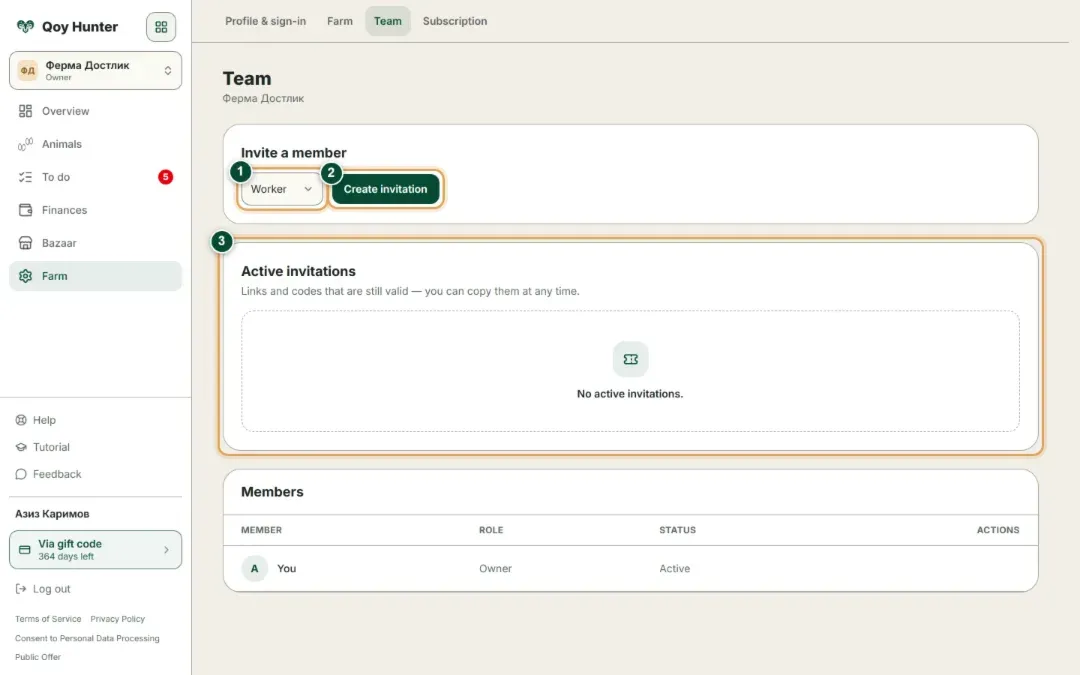
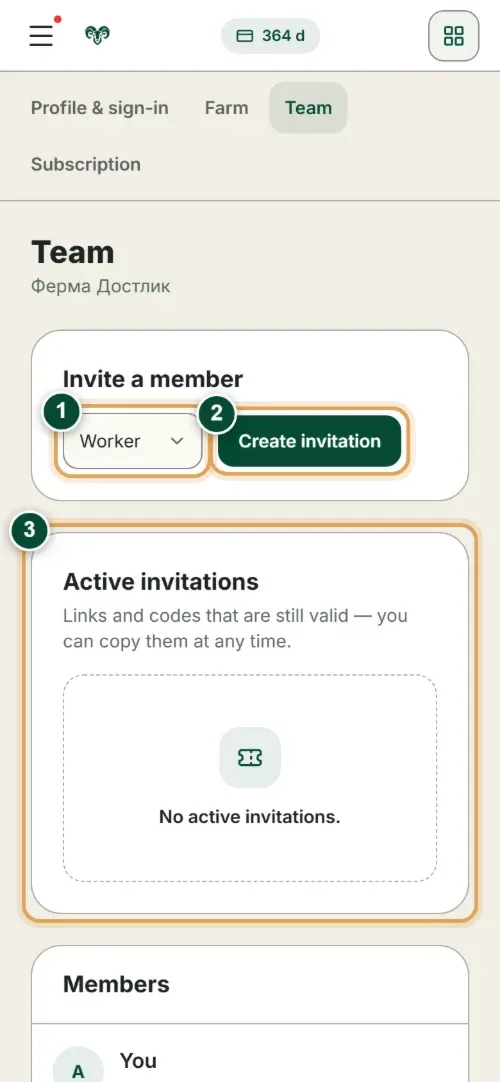
- On the Team screen, pick a role for the future member — Manager, Worker, or Viewer. Each role has its own set of rights.
- Click Create invitation — QoyHunter issues a link and a short code. Send them to the person via Telegram or SMS.
- Every invitation issued is collected in the list of active invitations: you can copy the link or code again, or revoke access at any moment.
The whole farm roster shows up in one list: each member has their own row with a name, role, and access status. If you have several farms — say, your own and your father's — you can run them on one account and switch between them.

What it costs to work as a team — per the qoyhunter.com pricing page as of September 14, 2026:
| Plan | Price per month | Animals | Members per farm |
|---|---|---|---|
| Free | 0 UZS | up to 30 | 1 |
| Pro | 49,000 UZS (≈ $4) | up to 500 | up to 5 |
| Farm | 149,000 UZS (≈ $13) | unlimited | no limit |
The Free plan is built for one person: to invite a worker into the farm, you need Pro or Farm. The first month of full access is free, and no card is required.
What this section doesn't do: it doesn't calculate wages or hand out tasks — tasks and the calendar in QoyHunter are set up separately.
FAQ
How Do You Give a Shepherd Access to the Records Without Showing Them the Money?
You need record-keeping where every person has their own login and their own role. In a shared notebook or spreadsheet, that's almost impossible: a worker sees either everything or nothing. In QoyHunter, the owner picks a role when sending the invitation — Manager, Worker, or Viewer; the owner sees the whole farm, while a worker sees only the sections they need.
What Do You Do With the Records When a Farm Worker Quits?
Check the head count against ear tags together with them, copy the breeding, lambing, and vaccination dates out of their notebook, and cut off their access to the shared file, chat, or app that same day. A lost record of the first vaccine dose on a 100-lamb group costs the farm anywhere from 500,000 UZS (≈ $42) for an extra dose to 7.4 million UZS (≈ $631) in deaths, if an unvaccinated group gets counted as vaccinated.
Can You Keep Farm Records With Relatives for Free?
Yes, if everyone works at the same pen: one farm notebook or a shared spreadsheet on a phone is free, and it works for a family of two or three. QoyHunter's Free plan is built for one member and up to 30 animals. To invite other people into the farm, you need the Pro plan at 49,000 UZS a month (≈ $4, up to 5 members) or the Farm plan at 149,000 UZS a month (≈ $13, no limit); prices are as of September 2026, and the first month of full access is free.
How Do You Invite a Worker Into a Farm in QoyHunter?
On the Team screen, pick a role, click Create invitation, and send the resulting link and short code to the person via Telegram or SMS. Every invitation you issue shows up in the list of active invitations — you can copy it again or revoke access there.
Can You Run Two Farms on One Account in QoyHunter?
Yes. Several farms can be run on one account, and you can switch between them. That's handy when a family has two farms in different districts.
Manage your flock in QoyHunterCRM for sheep farmers: livestock, health, weighing, finance and analytics — in the app and a Telegram bot.All features →