
Wheat for sheep: can you feed it, how much per day, and at what price it beats barley
Wheat has 5% more energy and 6% more protein than barley, but its starch ferments in the rumen faster than any other grain. How much wheat to feed rams, ewes and lambs, at what price it beats barley in autumn 2026, whether to crush it, and why wheat stubble is dangerous.
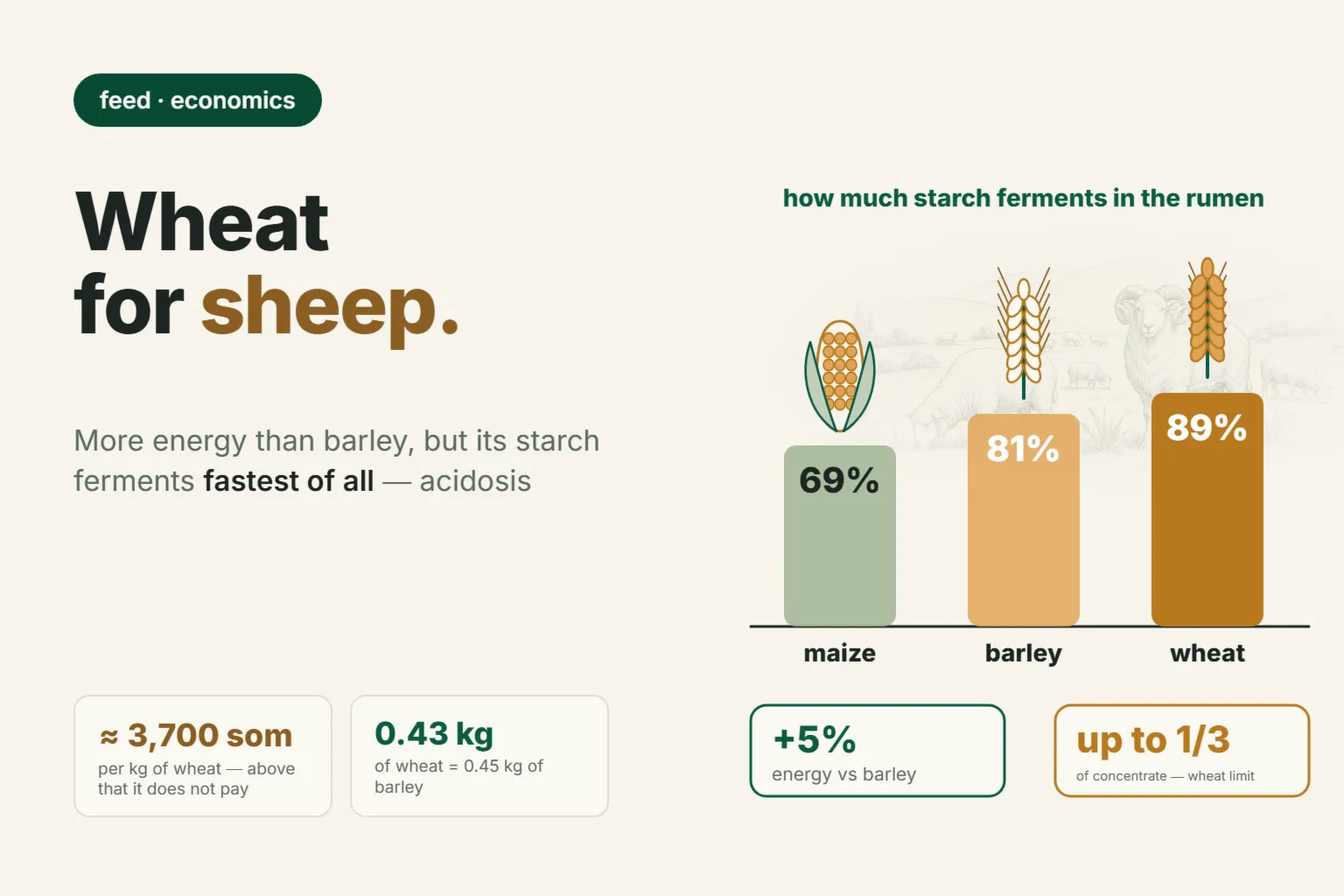
Sheep can eat wheat: a kilogram of wheat grain has about 5% more energy and 6% more protein than a kilogram of barley, so 0.43 kg of wheat replaces 0.45 kg of barley. But wheat is the most dangerous grain for acidosis: its starch ferments in the rumen faster than any other. That is why wheat should make up no more than a third of the concentrate and be introduced over 3–4 weeks. With barley at 3,500 UZS per kilogram, wheat is the better buy as long as it costs less than ≈ 3,700 UZS/kg (≈ $0.31).
Below: how much wheat to feed each group of sheep, at what price wheat beats barley in autumn 2026, how much that saves when fattening 100 rams, and why wheat stubble is dangerous. The Central Bank of Uzbekistan rate on 17 October 2026 is 12,055.90 UZS per dollar.
Can sheep be fed wheat?
Yes. Wheat grain is a concentrate just like barley and maize: mostly starch, that is, energy for weight gain and milk. In Uzbekistan wheat is the main grain crop: it is harvested in June–July, and feed-grade grain that did not make the cut for flour is sold as livestock feed.
Wheat has one limitation, but a serious one. Wheat starch ferments in the rumen faster than barley starch, and much faster than maize starch: according to the German researchers Lebzien and Engling, about 89% of wheat starch is fermented in the rumen, against 81% of barley starch and 69% of maize starch. Too much wheat at once means rumen acidosis: acid buildup, diarrhoea, refusal to eat, and deaths among the heaviest rams. So wheat works as part of a grain mix, not as the only grain.
How much energy and protein does wheat have compared with barley?
According to the international feed database Feedipedia (INRAE, CIRAD, AFZ and FAO), wheat grain contains about 87% dry matter, 13.1 MJ of metabolisable energy and 12.6% crude protein per kilogram of dry matter, with starch at about 69%. Barley, in the same database, has 87.1% dry matter, 12.4 MJ and 11.8% protein. Metabolisable energy is the part of a feed's energy that the sheep actually uses for maintenance, growth and milk.
| Per 1 kg of feed as fed | Wheat | Barley | Maize |
|---|---|---|---|
| Metabolisable energy | 11.4 MJ | 10.8 MJ | 11.7 MJ |
| Crude protein | 110 g | 103 g | 81 g |
| Starch, % of dry matter | about 69% | about 60% | about 73% |
| Starch fermentation speed in the rumen | fast | medium | slow |
Hence the ratio: 0.43 kg of wheat gives the same energy as 0.45 kg of barley. With this swap you even get slightly more protein, so, unlike maize, wheat does not need a meal supplement. Its weak spot is not protein but fermentation speed.
At what price is wheat cheaper than barley?
Compare the price of energy, not the price of a kilogram. Barley in olx.uz listings in October 2026 costs 3,100–4,000 UZS per kg, and we use 3,500 UZS (≈ $0.29) for the calculation. That is 324 UZS per megajoule of energy. So wheat beats barley as long as a kilogram costs less than ≈ 3,700 UZS (≈ $0.31).
| Wheat, UZS/kg | Price of 1 MJ | Against barley at 3,500 UZS |
|---|---|---|
| 3,200 ($0.27) | 281 UZS | 13% cheaper |
| 3,400 ($0.28) | 298 UZS | 8% cheaper |
| 3,600 ($0.30) | 316 UZS | 2.5% cheaper |
| 3,700 ($0.31) | 325 UZS | about equal |
| 4,000 ($0.33) | 351 UZS | 8% more expensive |
Compare wheat and barley from the same seller: prices differ more between sellers than between the grains themselves. For example, one seller in the Tashkent region listed barley at 3,800 UZS and wheat at 4,000 UZS per kilogram in August 2026. In price per unit of energy that is 352 and 351 UZS per MJ, practically the same, even though wheat is 200 UZS more per kilogram.
How much wheat per sheep per day?
It is easiest to work from your usual barley ration: for every kilogram of barley, 0.95 kg of wheat. Our recommendation for Uzbek rations is that wheat should cover no more than a third of the concentrate, with barley and maize making up the rest. That is more cautious than for maize, whose limit is half: wheat has the fastest starch.
| Group | Wheat per day | Rest of the concentrate | Condition |
|---|---|---|---|
| Fattening rams and lambs | 0.25–0.3 kg | 0.6 kg of barley, or barley with maize | at least 1 kg of alfalfa hay |
| Weaners 3–5 months old | 0.05–0.1 kg | barley + 50–80 g of meal | at least 14% protein in the ration |
| Pregnant ewes, last 6 weeks | 0.1–0.15 kg | 0.2–0.3 kg of barley | start 3–4 weeks before the full ration |
| Breeding rams before mating | 0.1–0.15 kg | 0.3 kg of barley | do not overfeed: excess fat lowers activity |
Sheep are never fed pure wheat with no other grain and no hay. If there is no barley at all, mix wheat with maize: the slow starch of maize tempers the fast starch of wheat.
How do you get sheep used to wheat without acidosis?
Agriculture Victoria, the agriculture department of the Australian state of Victoria, advises starting with 50 g of grain per adult sheep per day (25 g per weaner) and reaching the full ration over 3–4 weeks. With wheat, this period must not be shortened. Increase every 3–4 days and take out the same amount of barley by energy.
Rules that matter more for wheat than for any other grain:
- Hay first, grain second. A hungry ram that gets wheat first eats it far too fast.
- A trough long enough for the whole group. Otherwise the strong rams eat others' share and overeat.
- No gaps. If the sheep got no grain for a day or two, do not give the full ration at once: the rumen has time to lose its adaptation.
- Sacks under lock. A sheep that gets into an open sack of wheat can eat a lethal dose in half an hour.
If a ram stops eating after grain, lies down, its rumen stops working or diarrhoea starts, take the grain away and call a vet. What happens in the rumen when sheep overeat grain and what to do in the first hours is covered in detail in the article why rams die on grain fattening.
Should wheat be crushed for sheep?
For adult sheep, no. A sheep chews whole grain well and grinds it again when ruminating. The Australian industry body Meat & Livestock Australia (MLA), in its sheep feeding guide, treats wheat precisely as whole grain. Fine milling of wheat is especially harmful: flour ferments in the rumen even faster than whole grain, and sheep eat dust poorly. Wheat is coarsely cracked only for old ewes with worn teeth and for supplementary feeding of small lambs.
Why is wheat stubble dangerous?
After the wheat harvest in June–July, sheep are often turned out onto the stubble. It is cheap feed, but spilled grain is left in the field, and a hungry flock that goes onto such stubble for the first time eats wheat until it gets acidosis. The New South Wales Department of Primary Industries (NSW DPI) advises getting sheep used to grain beforehand and not putting hungry animals onto untouched stubble. In practice: before going onto the stubble, feed the flock hay to fill, graze them 1–2 hours for the first days, and only then leave them all day.
How much does this save when fattening 100 rams?
Take a fattening ram on a ration of 1.0 kg of alfalfa hay and 0.9 kg of barley per day. A third of the barley, 0.3 kg, is replaced with 0.28 kg of wheat, which gives the same energy. The saving or overspend on 100 rams over 90 days of fattening depends on the wheat price, with barley at 3,500 UZS:
- wheat at 3,200 UZS/kg: saving of ≈ 1.26 million UZS (≈ $105);
- wheat at 3,400 UZS/kg: saving of ≈ 0.75 million UZS (≈ $62);
- wheat at 3,700 UZS/kg: almost zero (≈ 0.02 million UZS overspend): no benefit;
- wheat at 4,000 UZS/kg: overspend of ≈ 0.79 million UZS (≈ $65).
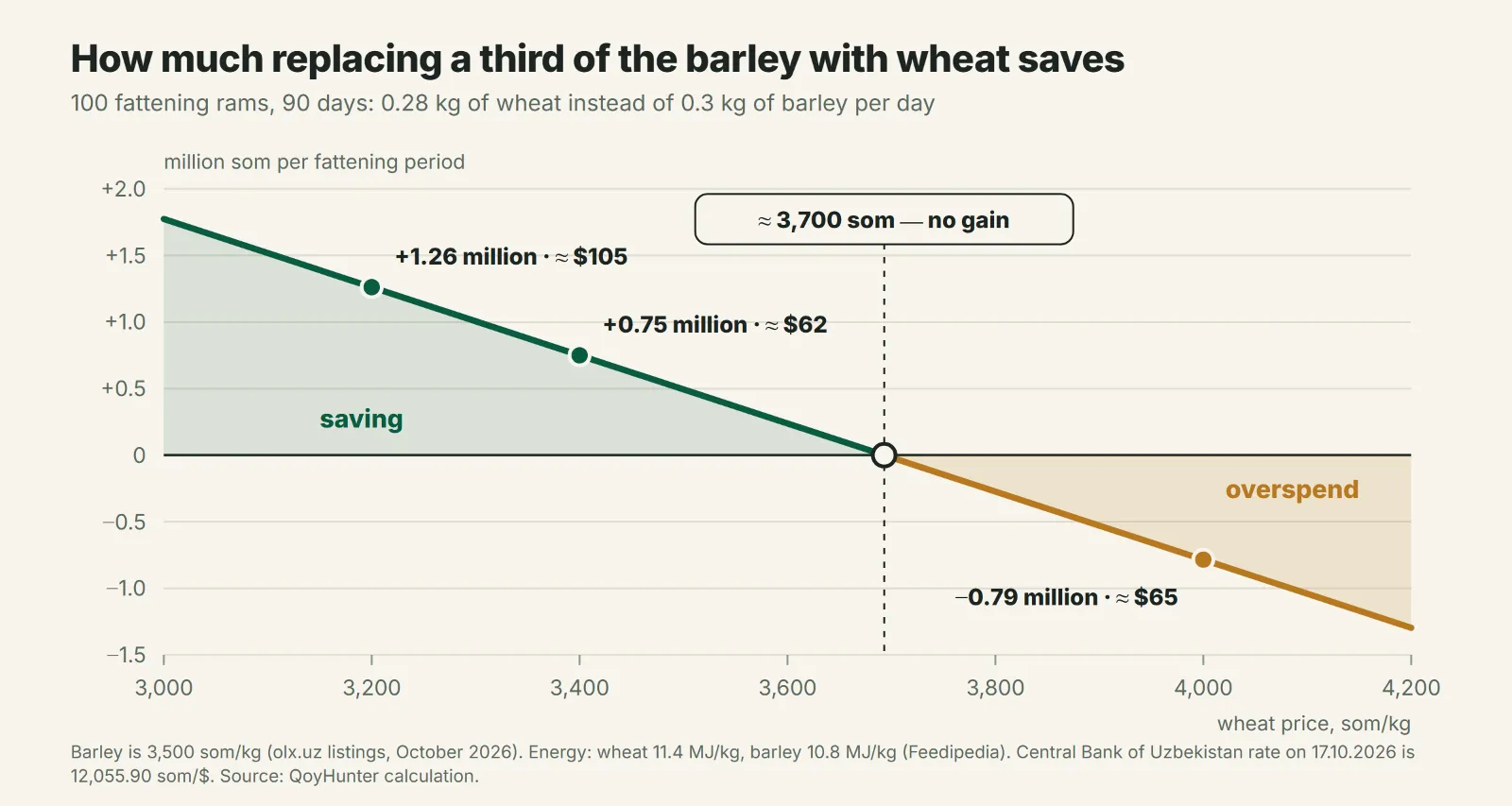
The calculation is illustrative: it ignores delivery and storage, and weight gain is assumed equal because the energy in the ration is the same. The takeaway: wheat pays off when it is at least 5–10% cheaper than barley per unit of energy, otherwise the acidosis risk is not worth the money saved. It is worth comparing grain prices from different sellers before buying, for example in listings of wheat, barley and maize for livestock feed for sale. How to compare maize with barley using the same logic, we covered in the article maize for sheep.
Why do rams get stones on wheat?
Wheat, like any grain, is low in calcium and high in phosphorus. If fattening rams and wethers eat a lot of grain and little alfalfa, the calcium-to-phosphorus ratio drops below normal, and stones form in the urinary tract. Signs: the ram strains, urinates in drops or does not urinate at all. Without a vet, such a ram dies.
Prevention is the same as for barley and maize. The ration should have at least twice as much calcium as phosphorus: alfalfa hay usually evens out the balance on its own. On a straw diet, add feed chalk to the grain, about 1.5% of the concentrate weight, that is 15 g per kilogram of grain; this dose for fattening lambs is recommended by NSW Local Land Services, the New South Wales agriculture service. And water without limits, warm in winter.
What wheat must never be fed to sheep?
- Treated seed wheat. Sowing grain is treated with pesticides and usually dyed pink, red or green. Never feed this wheat to livestock, not even a little.
- Mouldy, musty, or with black horns. Grain that sat damp grows fungi with mycotoxins, which drying does not remove. Black-violet horns among the kernels are ergot, which is poisonous. Do not accept such a batch.
- Wet, undried. Grain with moisture above 14% heats up in the sack and goes mouldy. Dry it until it flows freely and only then pour it into storage.
How do you keep the benefit of wheat?
The benefit of wheat is 5–13% of the price of energy, and it is easy to lose if you do not know what each batch cost and how much of it has been used. If you buy grain once a season, a notebook is enough.
If there are many batches and prices differ, it is easier to keep them in a farm feed management program. It is a section of QoyHunter (a CRM for sheep records and the bazar.qoyhunter.com marketplace): a purchase goes straight into the farm's expenses, feeding deducts the stock from the store, and when stock is low you get a reminder to buy.
FAQ
Can sheep be given wheat instead of barley?
Yes, but not entirely. Wheat has about 5% more energy than barley (11.4 MJ against 10.8 MJ per kilogram), and 110 g of protein against 103 g. But its starch ferments in the rumen faster than any other grain, so wheat should cover no more than a third of the concentrate, with the rest left to barley or maize.
How much wheat can a ram get per day?
A fattening ram gets 0.25–0.3 kg of wheat per day, together with 0.6 kg of barley and at least 1 kg of alfalfa hay. Introduce wheat over 3–4 weeks, starting at 50 g per head and increasing every 3–4 days, otherwise rumen acidosis is possible.
At what price is wheat better value than barley?
With barley at 3,500 UZS per kilogram, wheat is the better buy as long as it costs less than about 3,700 UZS (≈ $0.31), as of autumn 2026. The benefit is noticeable when wheat is at least 5–10% below this threshold: at 3,400 UZS, replacing a third of the barley saves about 0.75 million UZS (≈ $62) on 100 rams over 90 days of fattening.
Does wheat need to be crushed for sheep?
Not for adult sheep: they chew whole grain well, while finely milled wheat ferments in the rumen even faster and raises the risk of acidosis. Wheat is coarsely cracked only for old ewes with worn teeth and for small lambs.
Why do sheep die on wheat stubble?
Spilled grain is left on the stubble after harvest, and a hungry flock let into the field for the first time eats wheat until it gets rumen acidosis. Before going onto the stubble, feed the sheep hay to fill, graze them 1–2 hours for the first days, and only then leave them in the field all day.
Manage your flock in QoyHunterCRM for sheep farmers: livestock, health, weighing, finance and analytics — in the app and a Telegram bot.All features →