Ram Prices in Uzbekistan: What Drives Them and How Not to Undersell
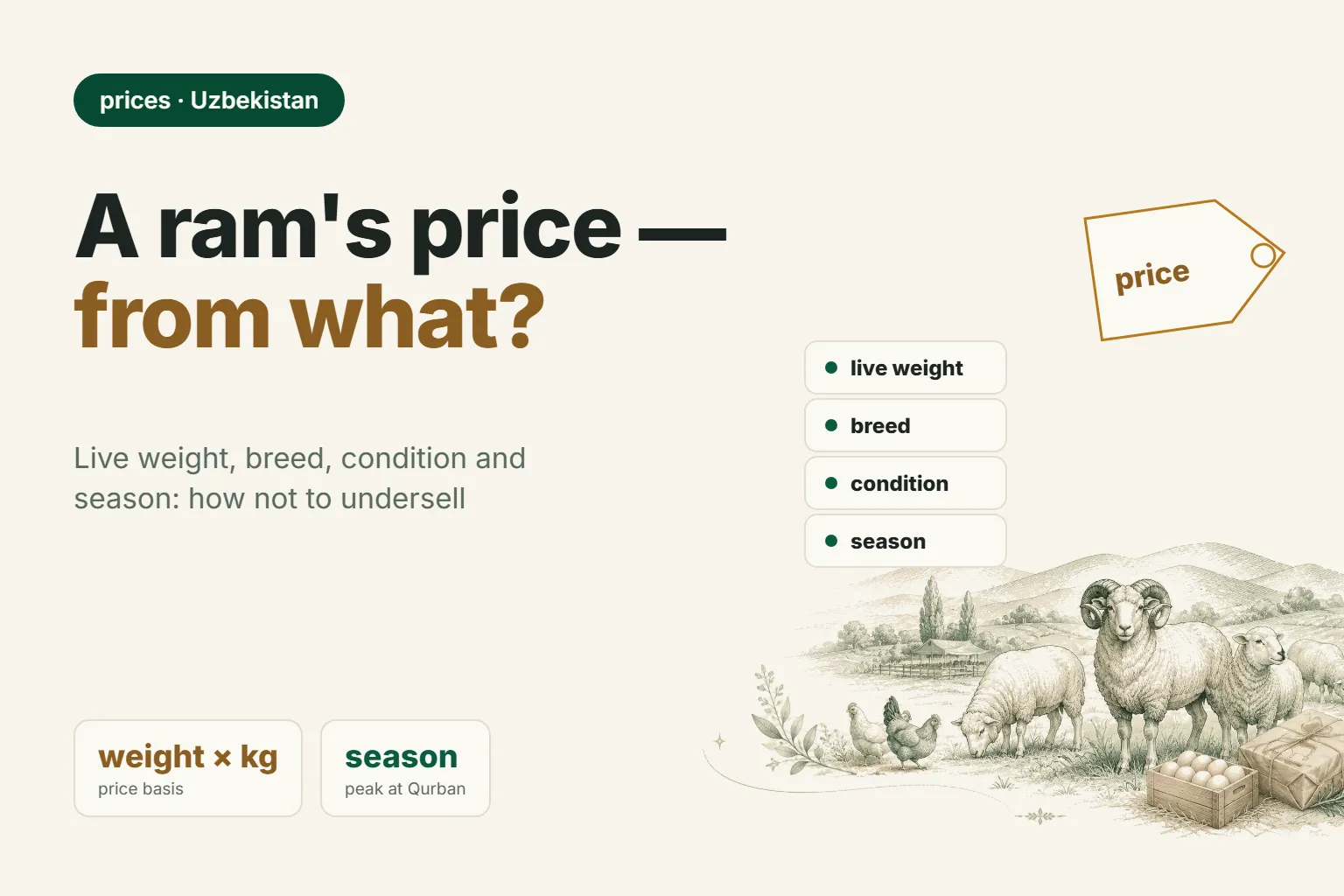
We break down how a ram's price is set: live weight, breed, body condition, season. Benchmark figures in sum for 2026, plus a simple way to evaluate your own animal so you don't sell below market.
Every sheep farmer has stood at the market at least once and heard, “Eh, you're asking too much.” Meanwhile a neighbor sold a ram that looked just the same for half a million more. The price can seem like a matter of luck and haggling skill — but in reality it comes down to a few understandable things: weight, breed, body condition, and season. Once you understand how the price is calculated, you become much harder to talk down in a conversation, and it's almost impossible to make you undersell.
This breakdown isn't a price list (exact market figures shift every week) — it's a map: what the price is made of, what benchmarks to keep in mind for 2026, and how to evaluate your own ram before selling.
What a Ram's Price Is Made Of
At the core is a simple formula:
Price = live weight (kg) × price per kilogram.
The nuances start after that, because “price per kilogram” comes in two forms:
- Per kg of live weight — the buyer assesses the whole animal (on a scale or by eye) and multiplies by their rate. This is the more common approach among resellers.
- Per kg of meat (mutton) — calculated from the carcass instead. A live ram doesn't yield meat from its entire weight: some of it is bone, hide, and internal organs. The share of meat and fat in live weight is called the dressing percentage (carcass yield); for our fat-tailed breeds it runs roughly 50–55% (well-fattened young animals can go even higher). So a 60 kg live ram yields about 30 kg of meat.
Both paths lead to the same sum. A 60 kg ram: by live weight at 60,000 sum/kg, that's about 3.6 million sum; through meat — 30 kg × 120,000 sum/kg = the same ~3.6 million. When a buyer quotes a price “per kilogram,” always ask which one — live weight or meat. The difference is nearly double, and that's exactly where most money gets lost.
Price Benchmarks for 2026
Exact figures depend on the region, the market, and quality, so treat them as an order of magnitude and always check them against your own local market. As of mid-2026 (exchange rate — roughly 12,000 sum per dollar):
- Mutton at the market — around 100,000–150,000 sum/kg (≈ $8–12/kg). Most expensive in Tashkent, cheaper in the regions.
- A ram's live weight — roughly 55,000–65,000 sum/kg (≈ $4.5–5.5/kg).
- An average whole ram — often 2.5–5 million sum (≈ $200–420); large, well-fattened, and pedigree animals — Hissar sheep especially — cost noticeably more.
Over the past year, mutton has gotten more than 20% more expensive. That means haggling “like last year” no longer works — the benchmarks have shifted upward, and that works in your favor as a seller.
Seven Factors That Determine the Price
| Factor | How It Affects the Price |
|---|---|
| Live weight | The main multiplier: the heavier the ram, the higher the final price. Weight matters more than everything else combined. |
| Breed | Large meat-and-fat breeds (Hissar, Edilbay, Jaidara) cost more; pedigree animals with a documented lineage carry a premium. |
| Body condition | A well-filled fat tail and good muscling raise both the dressing percentage and the price per kg; a thin ram at the same weight sells for less. |
| Season | Peak demand comes before Qurban Hayit; after the holiday and in summer, both demand and price drop. |
| Age and sex | A young, well-fed ram lamb is valued higher; old and culled animals sell for less. |
| Region and sales venue | Tashkent is pricier than the regions; the market, a private sale, and online listings each yield a different price. |
| Health and appearance | A healthy, clean, well-groomed animal sells for more and faster. |
Seasonality: Why Prices Rise Before Qurban Hayit
The year's main pricing season is Qurban Hayit (Eid al-Adha). In 2026 it fell on May 27, and, as always, demand for rams rose sharply in the weeks before the holiday — and prices along with it. This is the best window to sell a well-fattened animal at a premium.
After the holiday comes a slump: in summer, in the heat, demand is lower, and holding a ram “for later” means continuing to feed it — and feed costs money. Closer to autumn, with wedding season and toi celebrations, demand picks back up. The takeaway for planning is simple: time your ram's weight gain so it reaches the right condition right at the demand peak, not after it.
How to Evaluate Your Ram Before Selling
Almost everything comes down to two numbers: weight and body condition.
- Find out the weight. A scale is the most accurate way. No scale? Estimate from chest girth and oblique body length (measurement tables exist for this), or compare against an animal of known weight. Eyeballing it almost always errs against you.
- Assess body condition. Feel the loin, ribs, base of the tail, and the fat tail itself: the better filled out and muscled the ram, the higher both its weight and its price per kilogram.
- Calculate it two ways. Live weight × the live-weight rate per kg gives you your price floor. Live weight × dressing percentage (~50%) × the price of meat gives you a check from above. The actual deal will land somewhere between the two.
- Compare against today's market, not last year's. Check the market or online listings and see what similar animals are actually selling for.
The quickest way is to open what similar rams are selling for right now and filter by weight: that is today’s market, not last year’s memory.
Keeping records helps enormously here. If you regularly weigh your animals and log their weight gains (convenient to do right in a herd-management app), by the time you sell you'll know each ram's exact weight and its growth trend — and you won't hand over a heavy animal for the price of a light one.
For that argument to be in your hands rather than the buyer’s, weight has to be recorded: a weight and gain tracking app keeps the history of every ram, so in the haggling you name a figure, not "about".
Where to Sell So You Don't Undersell
- The market (mol bozori). Face-to-face contact, haggling, cash on the spot — but resellers know how to talk the price down, and you pay in travel and time.
- Directly to a private buyer. Neighbors, acquaintances, an order for a toi or Qurban Hayit — usually the best price, since there's no middleman. This runs on reputation and word of mouth.
- An online listing. More and more rams are sold through apps and classifieds: you post the animal with photos, weight, and price, and buyers come to you. This widens your pool of buyers beyond your own village and helps you hold your price — an animal with fresh photos and a clearly stated weight inspires more trust.
A listing only works with a proper card: how to post a ram for sale — photos, weight, age and price — takes five minutes and answers half the buyer’s questions.
Seller's Quick Checklist
- Know the exact weight — don't sell by eye.
- Ask the buyer to clarify: price per live weight, or per meat.
- Keep today's benchmarks in mind, not last year's.
- Time the sale to the demand season (Qurban Hayit, toi celebrations, autumn).
- Show off body condition and health — that's your markup.
- Compare against the market via both the bazaar and online listings.
A ram is worth exactly what it weighs and how good it is — not whatever the buyer manages to haggle it down to. Keep these benchmarks handy, track weight consistently, and underselling becomes almost impossible.
Manage your flock in QoyHunterCRM for sheep farmers: livestock, health, weighing, finance and analytics — in the app and a Telegram bot.All features →