Scours in Lambs: How to Treat Newborn Lambs, How to Rehydrate Them and How to Find the Cause by Age
Scours in newborn lambs: causes by age, how much solution to give, why you must not withhold milk, when a lamb needs an antibiotic or a vet, and a loss estimate for 100 ewes.
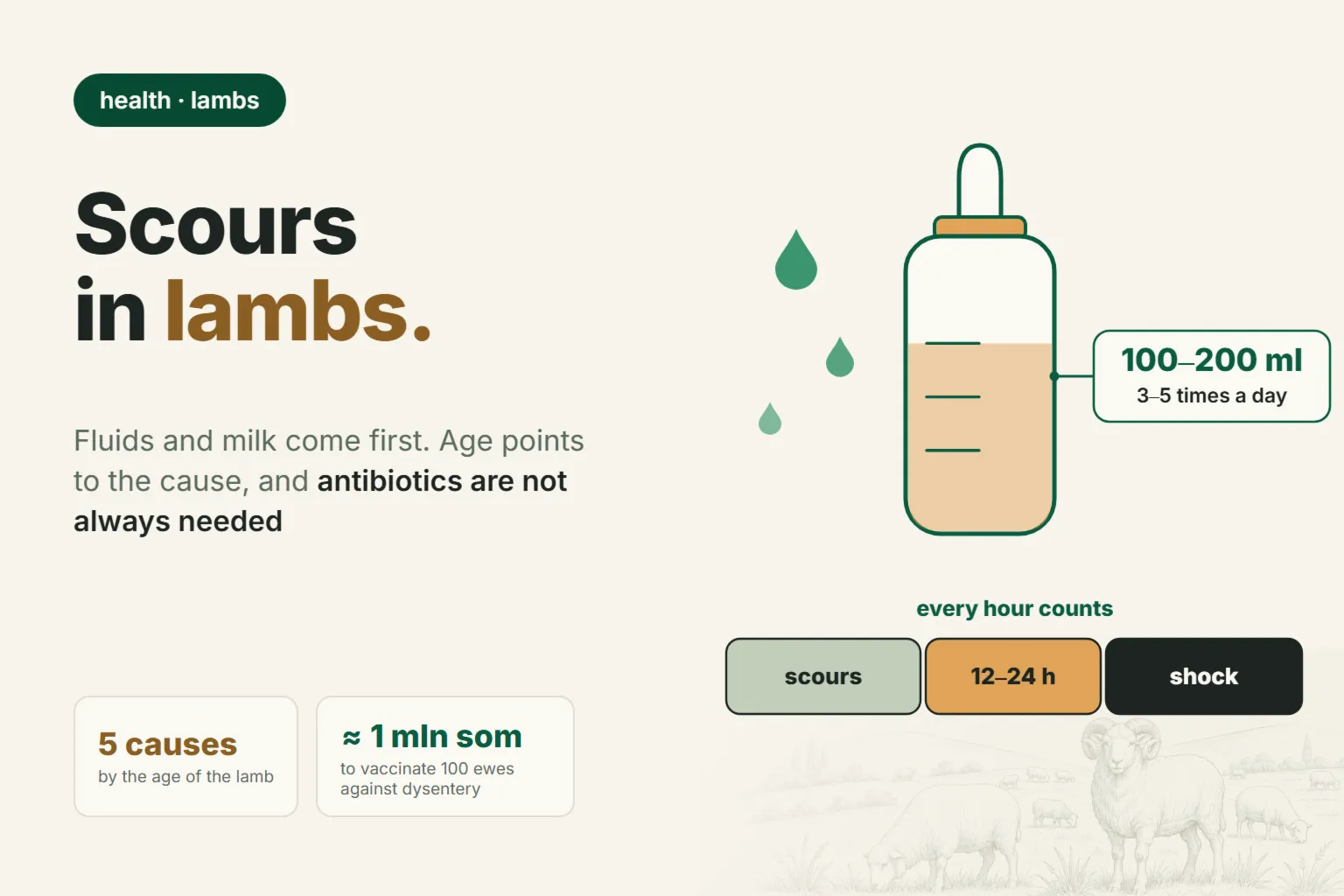
Scours in newborn lambs is treated first with oral rehydration: what kills the lamb is the loss of water and salts, so warm electrolyte solution goes in right away, between feeds, and the milk is never taken away. The lamb's age points to the cause: in the first days it is more often E. coli, from the second week cryptosporidia and rotavirus, from the fourth week coccidia. Not every case of scours needs an antibiotic, and the drug and dose are for the veterinarian to decide.
Below you will find a table of causes by age, how much to give, the signs that mean home treatment is not enough, and a loss estimate for a flock of 100 ewes in Uzbekistan. It is November now: if your lambing is in February–March, the main decision against lamb gut diseases falls between the end of November and January. Prices are autumn 2026, and the conversion rate is 12,055.90 som per dollar (Central Bank of Uzbekistan, October 17, 2026).
Why does scours kill a newborn lamb so fast?
A newborn lamb dies from scours because of dehydration: water and salts leave with the watery feces, the blood thickens and turns acidic, and the lamb goes into shock. According to the MSD Veterinary Manual, a calf with E. coli loses more than 12% of its body weight in fluid within hours and can die in 12–24 hours. The manual gives no separate figures for lambs, but notes that lambs carry the same types of E. coli and are treated the same way.
So the clock runs in hours. A lamb with scours spotted in the morning gets its first drink in the morning, not after an evening trip to the vet pharmacy.
What is the likely cause of scours at your lamb's age?
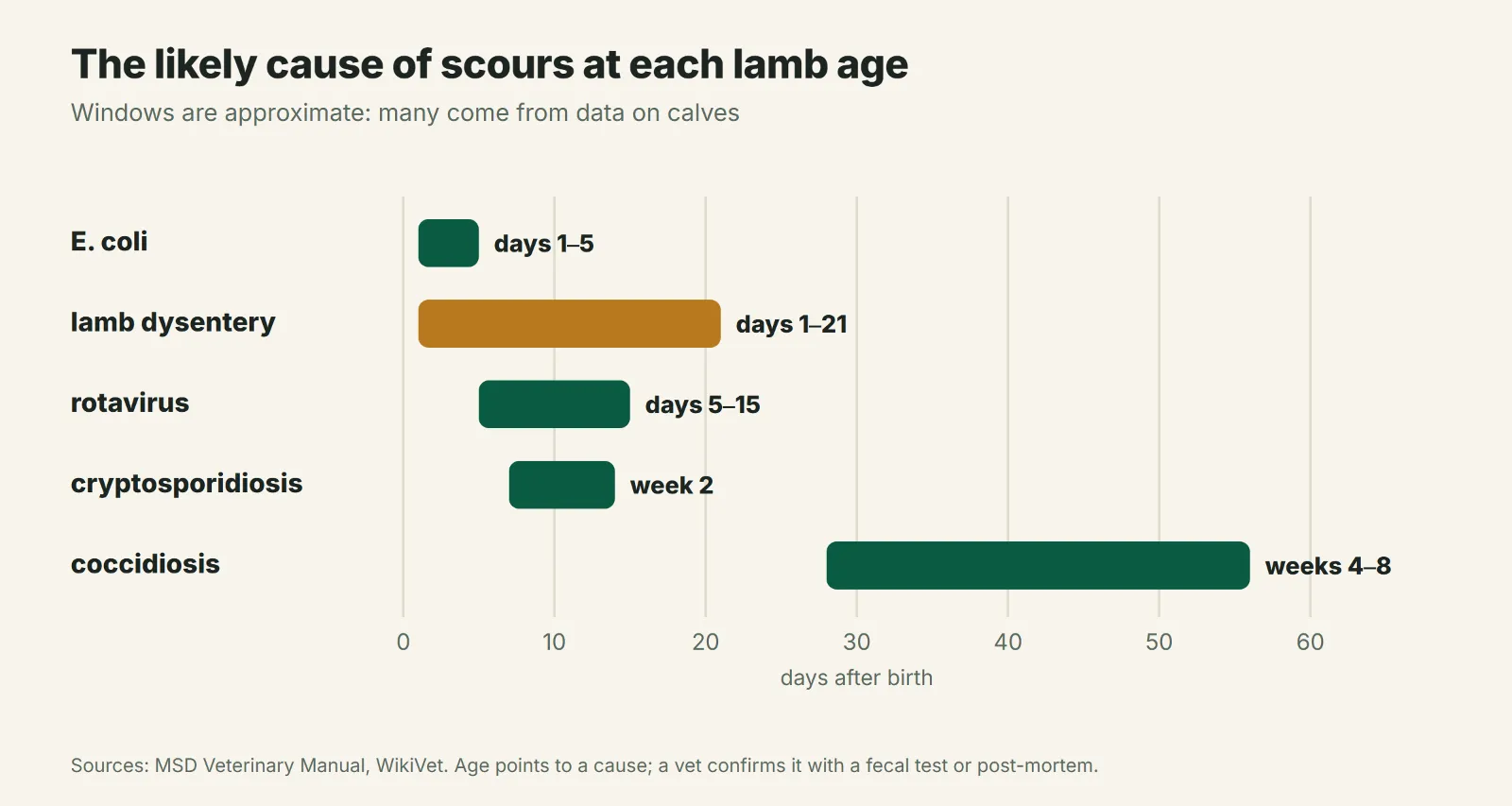
The lamb's age is a first clue, not a diagnosis. The timings below come mostly from MSD data on calves, and the dysentery window from the WikiVet veterinary reference: for lambs the references give fewer figures, and the windows shift from farm to farm. Often one lamb has two causes at once. A fecal test and a post-mortem on a dead lamb give the exact answer.
| Lamb's age | Likely cause | What stands out | What helps |
|---|---|---|---|
| 1–5 days | E. coli (colibacillosis) | sudden heavy watery scours, weakness, normal or low temperature | oral fluids; antibiotic at the vet's decision |
| 1–21 days, most often 1–3 days | lamb dysentery (Clostridium perfringens type B) | a strong lamb found dead, belly pain, bloody feces | treatment rarely comes in time; vaccinating the ewes protects |
| 5–15 days | rotavirus | watery feces with mucus, lamb is dull but still sucks | oral fluids, milk; antibiotics do nothing against a virus |
| second week | cryptosporidiosis | stubborn yellow watery scours in many lambs of the same age | oral fluids and hygiene; the vet prescribes the drug |
| 4–8 weeks and after weaning | coccidiosis | scours with mucus and sometimes blood, straining, poor growth | anticoccidial drugs |
We covered coccidiosis in detail separately: why weaned lambs have scours and do not gain weight on finishing.
Scours is often confused with watery mouth. Watery mouth is a disease of lambs in the first days, when E. coli passes from the gut into the blood. The lamb stops sucking, drools, and has a bloated belly, and it does not have scours at all. According to MSD, up to 30% of lambs can fall ill and mortality can top 80%, so such a lamb goes straight to the vet.
What and how much should you give a lamb with scours?
A lamb with scours is given a ready-made electrolyte solution for young stock: the powder is mixed strictly by the instructions and given warm, around 37–39 °C. The label of one such powder (Revive, Virbac) gives for lambs 100–200 ml per feeding, 3–5 times a day, that is 300 ml to 1 L a day; another (Vytrate) says 150 ml three times a day. Different powders are mixed and dosed differently, so check the exact volume on your own label. This solution is given on top of milk.
Four rules for oral rehydration:
- Do not take away the milk. According to MSD, electrolytes do not cover a calf's energy needs, so milk should not be withheld. The lamb stays with its ewe and sucks, and gets the solution between feeds.
- Alternate the solution and milk, do not mix them. A mixture that is too concentrated causes scours itself: MSD calls it osmotic.
- No home mixes made by eye. We found no home recipe for lambs checked by veterinary services, and the wrong concentration does harm. Buy a pack of powder in advance, before lambing. If you have none, ask your vet by phone, that same hour, what to use instead.
- Clean water within reach. For an older lamb that already drinks on its own, free access to water helps avoid taking too much salt.
Do not pour the solution into the mouth of a lamb that is down: without a swallowing reflex it goes into the lungs. The Revive label says outright: do not give the solution by mouth in shock.
When does a lamb with scours urgently need a veterinarian?
Home rehydration is not enough if the lamb is down and not sucking. According to MSD, calves that are down or not drinking with dehydration of 8% of body weight get fluids intravenously, and that is a vet's job. The logic is the same for a lamb.
Call the veterinarian at once if you see even one of these signs:
- the lamb will not stand, suck, or swallow;
- the eyes are sunken, a skin fold on the neck flattens slowly, the mouth is cold;
- temperature below 37 °C: if the lamb cannot hold its head up or is older than 5 hours, go straight to the vet, because glucose is needed first; if it holds its head up and is under 5 hours old, warm it first and then feed, as described in the article on why newborn lambs die;
- there is blood in the feces;
- several lambs fell ill within a day, or a strong lamb died suddenly;
- the scours does not ease despite rehydration, or the lamb is getting weaker.
Show a dead lamb to the vet, do not throw it away: a post-mortem and tests will show what threatens the rest. Do not open a lamb that died suddenly yourself until the vet has ruled out anthrax.
Does a lamb with scours need an antibiotic?
Scours by itself is not a reason for an antibiotic: the MSD manual says so directly. An injected antibiotic is indicated when the infection has gone into the blood: the lamb is dull, does not suck, and has a fever or, on the contrary, a cold body. For calves MSD gives a figure: at least 30% of calves with scours and systemic illness have bacteria in the blood. An antibiotic does not treat rotavirus or cryptosporidia, and viral scours usually passes in a few days on oral fluids.
The choice of drug, the dose, and the withdrawal period before slaughter are the veterinarian's decision. An "all-purpose" antibiotic by mouth can only harm a newborn lamb: it hits the normal gut flora too, and against viruses and cryptosporidia the money is simply wasted.
For cryptosporidiosis, halofuginone lactate helped in a field trial on lambs: it lowered the frequency of scours and the shedding of the parasite, and a seven-day course prevented scours better than a three-day one, although it did not affect weight gain. Whether the drug is available in your district and whether it is needed is for the vet to say.
How much does a scours outbreak cost a flock of 100 ewes?
Late rehydration during a scours outbreak in a flock of 100 ewes in Uzbekistan, at a price of 55,000 som per kg of live weight, can cost 14–17 million som in losses, while early rehydration saves 11–14 million som (≈ $950–1,130) of that. The calculation is hypothetical: these are assumptions for the example, not disease statistics.
We take the same figures as in our breakdown of lamb deaths: 110 lambs per 100 ewes, a weaned lamb weighing 26–31 kg, that is worth 1.43–1.71 million som (≈ $119–142).
| Indicator | Rehydrated from the first hour | Noticed by evening |
|---|---|---|
| Lambs sick | 20 | 20 |
| Died (assumption) | 2 | 10 |
| Loss at 1.43–1.71 million som per head | 2.9–3.4 million som | 14.3–17.1 million som |
The difference between the columns is eight lambs, or 11.4–13.7 million som. A lamb that recovers may also lag in growth, so weigh it at weaning and do not count it as a full-value animal right away.
Vaccinating the same 100 ewes with a vaccine whose instructions list lamb dysentery (Clostridium perfringens type B), at about 5,000 som per dose and two doses, costs roughly 1 million som (≈ $83). That is less than the price of one weaned lamb. But it covers lamb dysentery, not E. coli, rotavirus, or cryptosporidia: against those, colostrum and cleanliness do the work.
It is best to write down the same day which lamb fell ill, at what age, and how it was treated. In QoyHunter, a CRM for sheep records, and the bazar.qoyhunter.com marketplace, the sheep treatment and vaccination log keeps the date, drug, and withdrawal period on the animal's card, so by the next lambing you can see from which day your scours period starts. For a small flock you can also keep this in a notebook, as long as the records do not get lost.
How can you prevent scours in lambs before lambing?
Scours in lambs is prevented with colostrum, vaccinating the ewes, and a clean place to lamb. Drugs are not the main item on this list: if the infection is already circulating in the lambing shed, not every lamb can be saved.
- Colostrum in the first hours. The norm is 50 ml per kg of weight in the first 2 hours (6 hours at the latest) and 180–210 ml per kg over the first day. A lamb without colostrum is almost unprotected against gut infections.
- Vaccinate the ewes. A polyvalent vaccine does not always cover lamb dysentery: check that it is listed in the instructions. The timing also depends on the vaccine: per the instructions of one CIS polyvalent vaccine that lists dysentery, pregnant ewes on infected farms are vaccinated 1.5–2 months before lambing, two doses 20–25 days apart, while other vaccines are given closer to lambing. For lambing in February–March this schedule means starting from the end of November through January. Protection reaches the lamb through colostrum. Vaccines against E. coli also exist, but whether they are available in your district and on what schedule, ask your vet.
- Well-fed ewes before lambing. A thin ewe gives little colostrum. It is better to gather feed for the last six weeks of pregnancy in advance, along with the lambing kit: where to buy barley, bran and farm supplies.
- Dry bedding in the lambing shed. According to the vidal.ru reference, E. coli survives in manure, soil, and indoor water for 1–2 months. Change the bedding often and clean the lambing pens between ewes.
- Keep older animals apart from newborns. The MSD manual advises separating lambing areas, groups of young stock, and the sick pen, and not mixing older animals with newborns. Move a sick lamb with its ewe to a separate pen.
- Hands and boots. Feed the healthy lambs first, then the sick ones. Cryptosporidium oocysts resist chlorine, so bleach will not save you: steam cleaning and active-oxygen products work, for example 3% hydrogen peroxide.
Cryptosporidiosis passes to humans: according to the MSD manual, it has no strict host specificity. After handling lambs with scours, wash your hands with soap, especially if children help with feeding.
None of this replaces an examination: always agree on a lamb's treatment with your veterinarian.
FAQ
How do you treat scours in a newborn lamb at home?
First with oral rehydration: warm electrolyte solution for young stock, mixed by the instructions, about 100–200 ml per feeding, 3–5 times a day, between feeds. The ewe's milk is not taken away. Do not give an antibiotic at home "just in case": the vet prescribes it if the infection has gone into the blood. If the lamb is down and not sucking, do not pour anything into its mouth and call the vet right away.
Should you take the lamb away from its ewe when it has scours?
No. According to the MSD Veterinary Manual, electrolytes do not cover young stock's energy needs, so milk is not withheld. Leave the lamb to suck from the ewe, and give the solution between feeds without mixing it with milk. It is better to move the sick lamb with its ewe to a separate pen so it does not infect the others.
Why did a strong lamb suddenly die with almost no scours?
In a strong lamb in its first days, this is how lamb dysentery can show up, caused by Clostridium perfringens type B: often it is seen only as sudden death, sometimes with blood in the feces. Treatment rarely comes in time, and what protects is vaccinating pregnant ewes with a vaccine whose instructions list lamb dysentery, on the schedule in those instructions. Show the dead lamb to the vet and do not open it yourself.
Can you catch something from a lamb with scours?
Yes, cryptosporidia pass from lambs to humans, and you cannot tell the cause of scours by looking. So wash your hands with soap after working with sick lambs, especially before eating, and keep an eye on children who help with feeding. Bleach has almost no effect on cryptosporidium oocysts.
How much does vaccinating ewes against lamb dysentery cost?
About 1 million som (≈ $83) per 100 ewes at roughly 5,000 som per dose and two doses of a vaccine that lists lamb dysentery, at autumn 2026 prices and a rate of 12,055.90 som per dollar. Check the price at the vet pharmacy. For comparison, one weaned lamb weighing 26–31 kg at 55,000 som per kg of live weight is worth 1.43–1.71 million som.
Manage your flock in QoyHunterCRM for sheep farmers: livestock, health, weighing, finance and analytics — in the app and a Telegram bot.All features →