Why Do Newborn Lambs Die? The First 72 Hours After Lambing, Colostrum and Hypothermia
Most lamb deaths happen in the first three days after birth — from cold, missed colostrum or navel infection. How much colostrum a lamb needs by weight, what to do hour by hour with a chilled lamb, and what lamb mortality costs a 100-ewe flock in 2026.
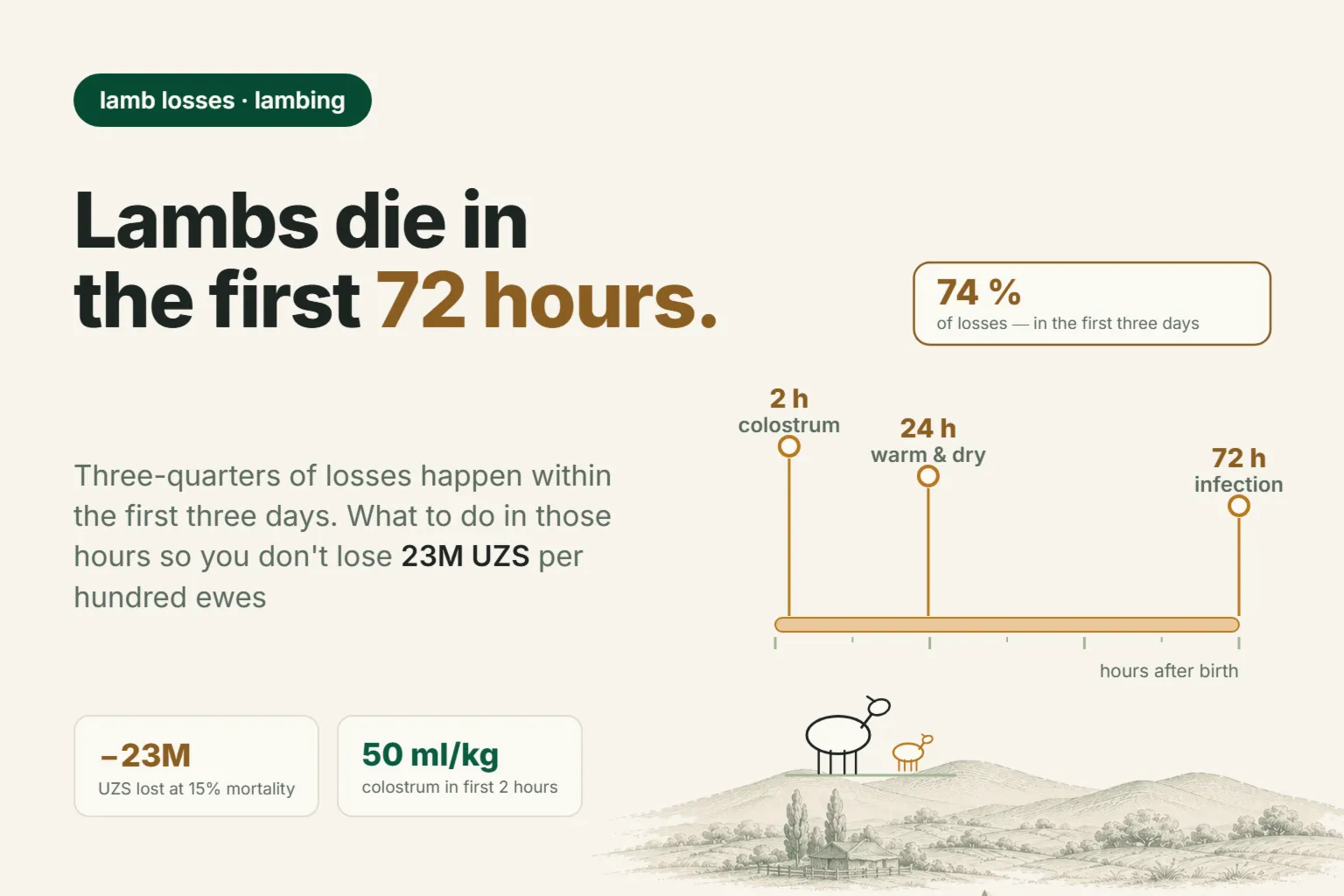
Newborn lambs die in the first three days after lambing, and there are almost always three causes: hypothermia, starvation from missed colostrum, and infection through the navel. Veterinary reviews put pre-weaning mortality at 10–15% of lambs (Merck Veterinary Manual), and in extensive flocks losses can reach a third of the lamb crop. Ireland's Teagasc found that 74% of all losses happen in the first three days: 43% are stillbirths and deaths during lambing itself, another 31% in the first 72 hours of life. In other words, lambs aren't saved by injections on day five — they're saved by dry bedding, warm colostrum in the first two hours, and a thermometer in the shepherd's pocket.
Below: why the first three days are so dangerous, what lamb mortality costs a 100-ewe flock in Uzbekistan in 2026, how much colostrum a lamb needs by weight, and what to do for a chilled lamb, hour by hour.
Why do newborn lambs die specifically in the first 72 hours?
A newborn lamb arrives wet, with a body temperature around 39 °C, and starts losing heat immediately — its fleece is soaked, its surface area is large relative to its weight, and in February the barn can drop to 0 °C at night. It has almost nothing to warm itself with: a lamb carries a reserve of brown fat good for roughly five hours of life, and that reserve burns faster the colder and windier it gets.
Second: a lamb is born with no antibodies at all. The ewe's placenta doesn't let maternal antibodies cross over — a lamb gets its entire immune protection from colostrum in the first hours of life. Miss that window, and it goes through the whole nursing period unprotected against clostridial disease, pneumonia, and gut infections.
Third: the door is wide open for infection. For the first day, the navel is a direct line into the bloodstream, and dirty bedding leads to navel-ill (umbilical sepsis) and joint infections — usually showing up in the first or second week of life.
All three add up to one vicious loop: the lamb gets cold → doesn't get up → doesn't nurse → gets even colder. The only way to break it is by hand, in the first few hours — which is why lambing season is the one time of year when night checks pay for themselves directly.
What does lamb mortality cost a 100-ewe flock?
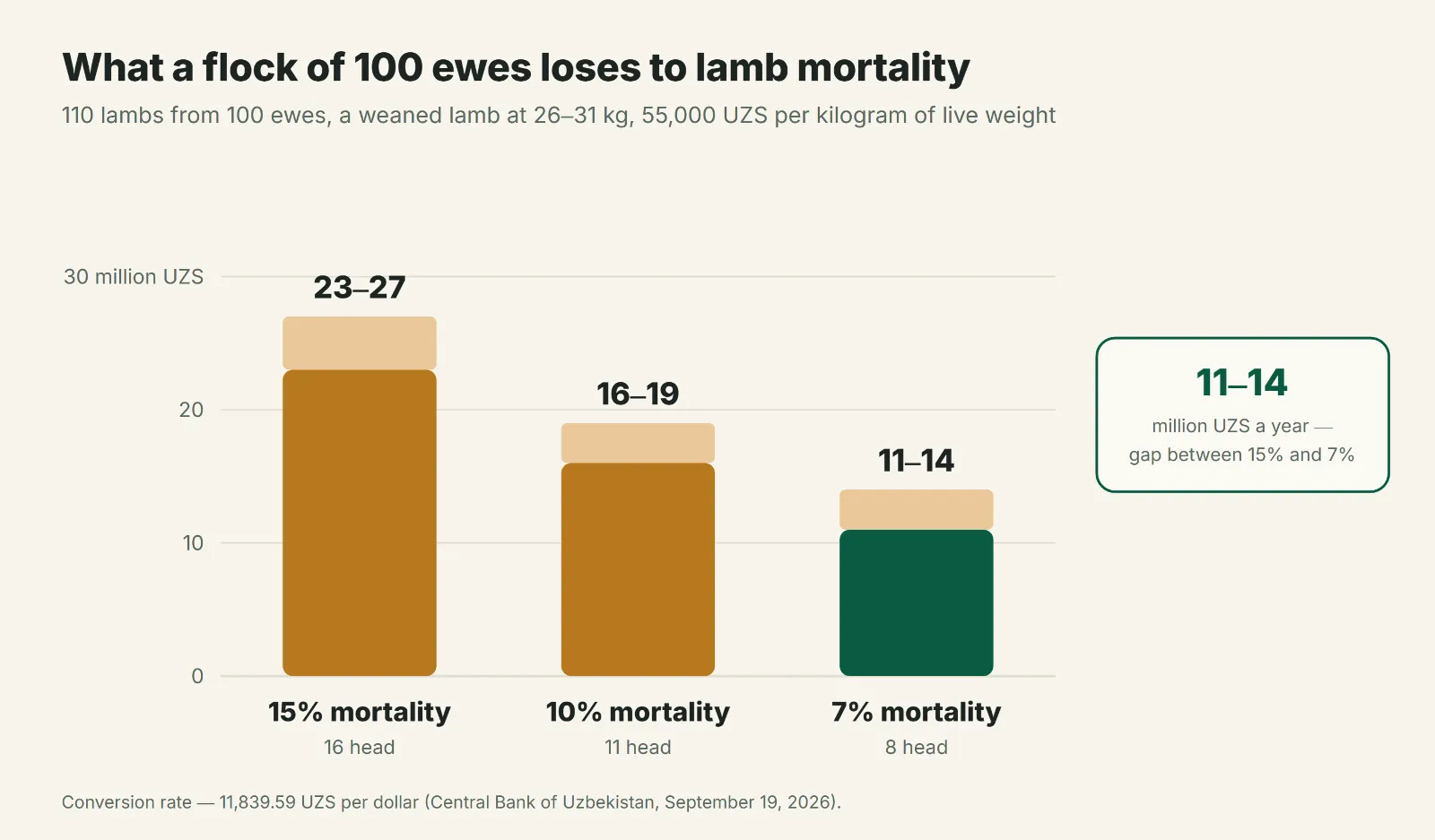
Let's run the numbers for a 100-ewe flock of fat-tailed breeds in Uzbekistan in autumn 2026. A good operation gets 105–115 lambs per 100 ewes put to the ram. We'll take 110 live lambs.
By weaning at 3.5–4 months, a lamb weighs 26–31 kg. At a conservative live-weight price of 55,000 UZS per kilogram (in 2026, live sheep weight in Uzbekistan runs 55,000–65,000 UZS/kg; we take the lower end), one weaned lamb is worth 1.43–1.71 million UZS. Exchange rate used: 11,839.59 UZS per dollar (the Central Bank of Uzbekistan, September 19, 2026).
| Lamb mortality before weaning | Head lost out of 110 | Revenue lost, million UZS | In dollars |
|---|---|---|---|
| 15% (no night checks) | 16 | 23–27 | $1,900–2,300 |
| 10% (typical farm) | 11 | 16–19 | $1,330–1,600 |
| 7% (attended lambing) | 8 | 11–14 | $950–1,150 |
The gap between 15% and 7% is eight lambs — that's 11–14 million UZS ($950–1,150) a year on a hundred-ewe flock. All it takes to close that gap: a thermometer, iodine, a bottle with a nipple, dry bedding, and one person sleeping near the lambing pen for the two weeks of lambing. Cheaper than a single lost lamb.
How much colostrum does a lamb need, and by when?
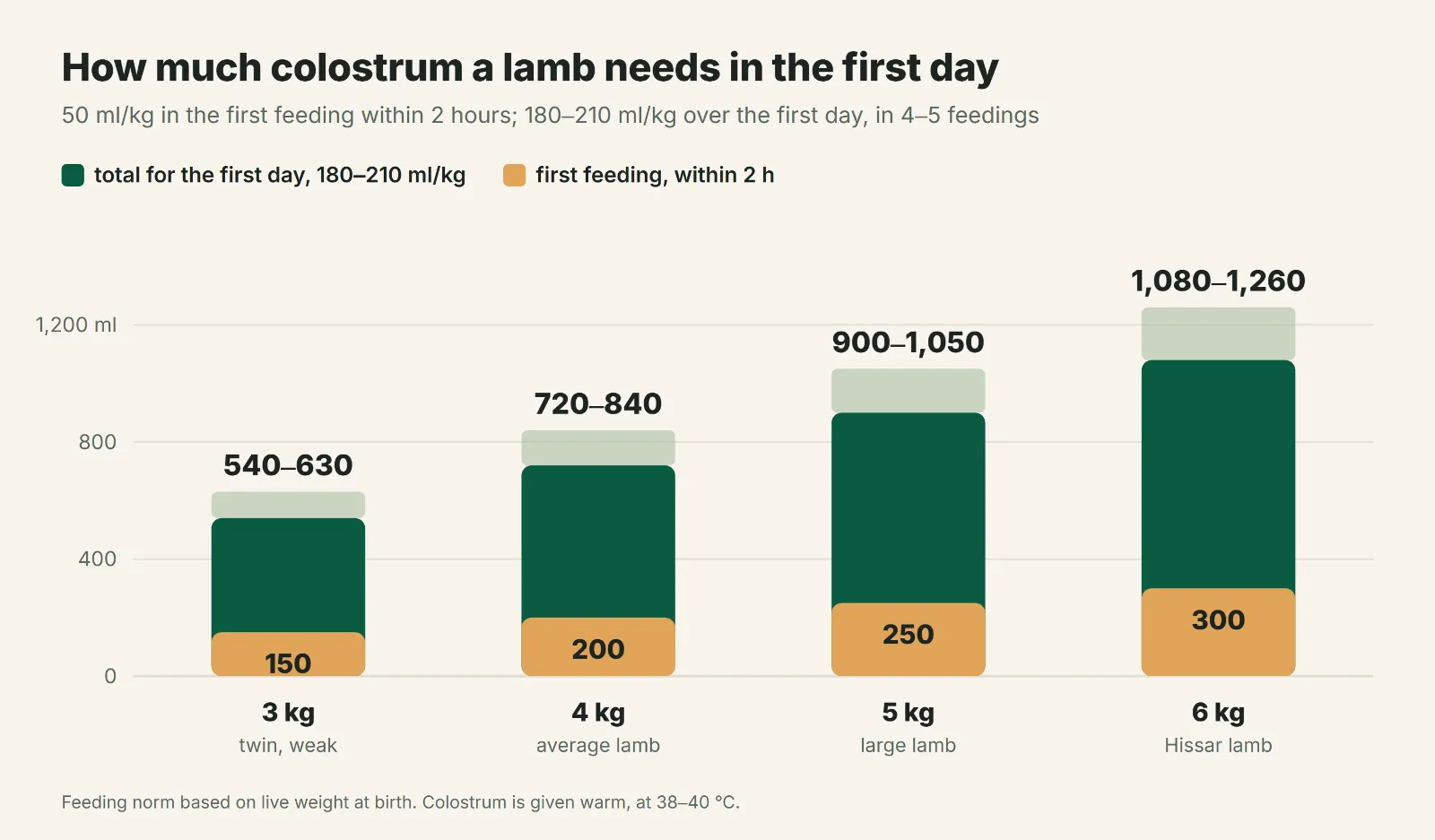
Colostrum is the ewe's first, thick milk: it carries antibodies that ordinary milk doesn't carry at all, almost twice the fat, and four times the protein. The standard sheep producers work to: 50 ml of colostrum per kilogram of body weight in the first feeding, within two hours of birth (six hours at the absolute latest), and 180–210 ml per kilogram over the first 24 hours, split into 4–5 feedings. The lower figure is for lambing in a warm barn; the higher one is for a lamb born in the cold, since it burns more energy there.
| Birth weight | First feeding (within 2 hours) | Total over first 24 hours |
|---|---|---|
| 3 kg (twin, weak) | 150 ml | 540–630 ml |
| 4 kg | 200 ml | 720–840 ml |
| 5 kg | 250 ml | 900–1,050 ml |
| 6 kg (large Hissar lamb) | 300 ml | 1,080–1,260 ml |
Timing matters more than volume. The gut wall only absorbs antibodies in the first few hours: absorption peaks in the first 2–4 hours, drops off noticeably after 6–12 hours, and by 24 hours the gut has effectively "closed" — after that, colostrum works only as food. A lamb that first nurses by the evening of the next day is technically alive, but it never got its immunity, and it's the first one that ends up coughing later.
What to do if the ewe has no colostrum:
- milk out colostrum from another ewe that lambed the same day;
- keep a frozen reserve: freeze colostrum in 150–200 ml portions and thaw it in warm water (never in a microwave or with boiling water — that denatures the antibodies);
- cow colostrum from a healthy cow works as a substitute, but increase the volume by about a third — it's less concentrated. Better to use a pooled mix from several cows: some individual cows carry antibodies against sheep red blood cells in their colostrum, which can cause hemolytic anemia in the lamb;
- a commercial sheep colostrum replacer from the vet pharmacy is the last resort — it carries fewer antibodies, and products vary a lot in quality.
Feed it warm, 38–40 °C, from a bottle with a nipple. A stomach tube is for a lamb that's already warmed up and swallowing but won't take the nipple, and only someone trained by a veterinarian should use one. Never tube-feed a chilled lamb that has no swallowing reflex: the colostrum goes into the lungs and the lamb dies.
How do you tell a lamb is getting chilled, and what do you do?
Signs of hypothermia in a newborn lamb: a cold mouth inside (slip in a clean finger — if the mouth feels cold, the lamb has chilled), a drooping head, a hunched back, no interest in the udder, standing apart from the ewe. Only a rectal thermometer gives you a real answer, and during lambing season it's as essential as iodine.
| Lamb's body temperature | What it means | What to do |
|---|---|---|
| 39–40 °C | normal | check that the lamb is actually nursing, not just standing at the udder |
| 37–39 °C | mild hypothermia | dry it off, feed 50 ml/kg of warm colostrum, return it to the ewe in a dry corner |
| below 37 °C, but holds its head up, under 5 hours old | chilled, but still has some energy reserve | warm it to above 37 °C first, then feed colostrum |
| below 37 °C, can't hold its head up, over 5 hours old | hypothermia plus low blood sugar | this is a job for a vet: glucose first, warming only after — otherwise the lamb dies in convulsions during rewarming |
Warm the lamb in a closed box with warm air at 37–40 °C, after drying it off, and check its temperature every half hour: above 40 °C the air itself becomes dangerous — overheating kills just as effectively as cold. What not to do: dunking it in hot water, putting it right up against a stove, or under a hair dryer — that gets you a burned lamb, not a saved one; a heat lamp only warms one side. As soon as the lamb has warmed to 38 °C and regained some strength, return it to the ewe — the longer the separation, the higher the risk she won't accept it back.
Navel infection, twins, and crushed lambs — what else takes the lamb crop?
Navel. Within the first fifteen minutes after birth, dip the navel in a 7–10% iodine solution — dip it in a small cup, don't dab it with a brush or spray it — and repeat in 2–4 hours. An undisinfected navel leads to navel-ill and purulent joint infection, usually in the first or second week of life, sometimes as late as a month old. A lamb that gets this never catches up on weight gain.
Twins. Twin lambs are born lighter than singles and get less milk each, so they die more often. The rule is simple: treat twins as at-risk from minute one — tag the ewe, check weights, and feel both lambs' bellies once a day. If one is clearly falling behind, foster it onto a ewe that lost her own lamb, or bottle-feed it. Fat-tailed breeds — Hissar, Edilbay, Jaidara — don't throw many twins, so every twin pair is realistically worth the extra hands-on effort.
Crushed lambs. In a crowded pen, a ewe can lie down on top of her own lamb. That's what lambing (jugging) pens are for: roughly 1.5×1.5 m (about 2.2 m²) per fat-tailed ewe with her lambs, one pen for every 8–10 ewes, keeping them in it for the first day or two so the ewe bonds with her lambs and doesn't crush them. In a crowded barn with no pens, some of these losses are purely mechanical, and no medicine fixes that.
Ewe rejection. More common in first-time mothers: they're slower and less reliable at recognizing their own lamb than experienced ewes. Restrain the ewe in a pen or on a halter and let the lamb nurse twice a day for 10–15 minutes — usually for 3–5 days, until the bond takes hold.
If the ewe dies or rejects her lamb, a separate job begins after the first day: fostering onto another ewe or bottle-rearing until weaning. Milk amounts by week and the cost breakdown are in our guide on how to raise an orphan lamb without its mother.
What gets decided before lambing, back in the fall?
September–October is breeding season, which means lambing falls in February–March. A strong lamb at birth is the result of work done months earlier:
- Ewe body condition at breeding. A thin ewe produces small lambs and little colostrum. For how to boost lambing rates before breeding, see how to prepare a flock for breeding.
- Feeding in the last 6 weeks of pregnancy. In these six weeks the fetus puts on about 70% of its birth weight, so underfeeding the ewe means a small lamb and an empty udder straight away. For timing and ration details, see the breakdown on ewe pregnancy. Buy barley, bran, and cottonseed meal for this period ahead of time, before winter prices climb: where to buy barley and cottonseed meal — listings with prices and district.
- Vaccinating ewes 4–6 weeks before lambing. A clostridial and enterotoxemia vaccine given to the ewe in this window has time to build antibodies into her colostrum and pass them on to the lamb — protecting it for roughly the first 12 weeks of life, before it has any immunity of its own. Check the exact timing on the specific vaccine's label and confirm it with a veterinarian.
- Crutching — shearing wool around the udder and tail before lambing: the lamb finds the teat, not a clump of dirty wool.
- A dry barn and lambing pens. Dry bedding, no draft at floor level, and pens built before lambing starts — not on the night of the first birth.
Which ewe raised how many lambs, which one lost hers, and which ewe's losses repeat for the second year running — that's the data culling decisions are made from. Keep it in an app instead of a notebook, and by the next breeding season you'll see which ewes reliably raise lambs and which are just taking up space in the flock. QoyHunter is a CRM for sheep record-keeping and a marketplace at bazar.qoyhunter.com; vaccination and treatment schedules for each group are tracked in the flock vaccination and treatment log, and in the fall, the grown lambs get listed in the same place as sheep and rams for sale in Uzbekistan.
Underfeeding twin-bearing ewes in the last six weeks hurts more than the lambs: it triggers pregnancy toxaemia, which puts the ewe down before she even lambs. Signs, treatment and week-by-week barley rates are in our piece on pregnancy toxaemia in sheep.
FAQ
How much colostrum does a newborn lamb need?
About 50 ml per kilogram of body weight in the first feeding within two hours of birth (six hours at the latest), and 180–210 ml per kilogram over the first 24 hours, split into 4–5 feedings. For a 4 kg lamb, that's 200 ml right away and 720–840 ml over the day. Feed it warm, at 38–40 °C.
What do you do if a lamb is born weak and won't stand up?
Dry it off, take its temperature with a rectal thermometer, and act on the reading. Above 37 °C — feed 50 ml/kg of warm colostrum and return it to the ewe. Below 37 °C and the lamb can still hold its head up — warm it in a warm box first, then feed it. Below 37 °C, can't hold its head up, and more than five hours have passed — call a vet: that lamb needs glucose first, and warming without it can kill.
How many lambs normally die after lambing?
Veterinary reviews put pre-weaning mortality at 10–15% of lambs (Merck Veterinary Manual), and noticeably higher in extensive flocks. Ireland's Teagasc found that 74% of all losses happen in the first three days, 43% of them stillbirths and deaths during lambing itself. An operation with night checks during lambing, a dry barn, and colostrum management keeps losses in the 5–8% range — the level of the best flocks abroad (AHDB data shows the top quarter of British farms lose around 6% in the first three weeks).
What should you treat a lamb's navel with?
Right after birth, dip the navel in a 7–10% iodine solution and repeat the treatment in 2–4 hours. Dipping it in a small cup works better than dabbing it on top: what matters is getting the solution inside the stump. It's the cheapest insurance against navel-ill and purulent joint infection, which usually shows up in the first or second week of life.
Can you feed a lamb cow colostrum?
Yes, colostrum from a healthy cow is a workable substitute when ewe colostrum isn't available. It's less concentrated and carries fewer antibodies against sheep-specific diseases, so increase the volume by about a third above the sheep norm. It's better to use a pooled mix from several cows: some individual cows carry antibodies against sheep red blood cells, which can cause hemolytic anemia in the lamb. A commercial colostrum replacer from the vet pharmacy comes in third: it covers energy needs but doesn't provide full protection.
Manage your flock in QoyHunterCRM for sheep farmers: livestock, health, weighing, finance and analytics — in the app and a Telegram bot.All features →