Ewe pregnancy: length, signs and preparing for lambing
How long a ewe stays pregnant, how to confirm it, how to feed her by trimester and how to get the barn ready for lambing — a practical guide for the farmer.
How long is a ewe pregnant
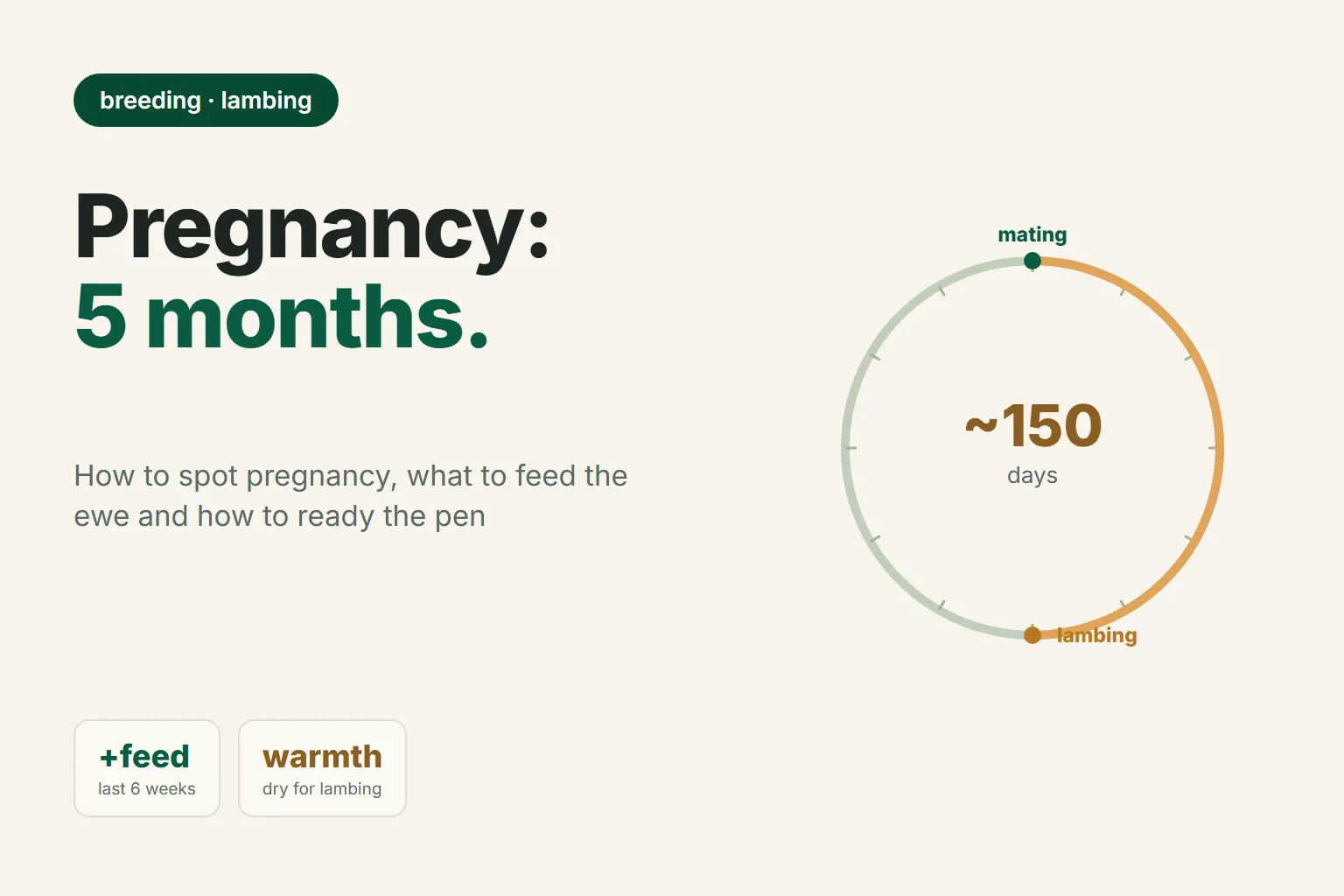
Pregnancy in a ewe (being in-lamb) lasts 145–155 days, that is about five months; use 150 days as your working average. The exact length depends on breed, the ewe's age and the number of foetuses: early-maturing and prolific breeds often lamb a few days sooner, while a ewe carrying one large lamb may go slightly longer. In the local fat-tailed breeds (Hissar, Edilbay) pregnancy falls within the same ~150 days and the ewe usually gives a single lamb; the Romanov breed often carries twins and triplets.
Once you know the mating date, the due date is easy to work out: add 5 months minus 5 days. Record this date for every ewe — that way you prepare the barn in advance and never miss a lambing.
How to tell a ewe is pregnant
The most reliable approach is to combine several signs.
- No return to heat. A ewe's oestrous cycle is about 16–17 days. If she does not come back into heat three weeks after mating, that is the first and simplest sign of pregnancy.
- Ultrasound. The most accurate method. The best window for scanning is days 45–90 of pregnancy: by day 45–50 the foetuses are clearly visible and can be counted (single, twins), with accuracy close to 95–100 %. Knowing the number of lambs matters for feeding.
- Palpation. After the third month an experienced keeper can feel the foetus through the abdominal wall of a lying ewe — in the later stages the lambs kick noticeably. Do this gently and on an empty stomach.
- Behaviour and appearance. A pregnant ewe is calmer, eats well and gains weight; towards the end her belly (on the right) rounds out clearly and the udder fills.
Caring for the pregnant ewe by trimester
Pregnancy is loosely divided into three periods. In the first two, maintenance feeding is enough; the main jump in requirements comes in the last 6 weeks, when the foetus grows fastest.
| Period | What happens | Feeding and care |
|---|---|---|
| 1st period (months 1–2, ~days 1–60) | The fertilised egg implants and the foetal organs form; the foetus is still tiny. | Ordinary maintenance feeding (pasture/hay). Do not change the feed abruptly; avoid stress — early pregnancy is the most vulnerable to resorption and abortion. |
| 2nd period (~months 2–3.5, ~days 60–105) | The placenta forms; foetus and uterus grow moderately. | Good hay/lucerne, pasture; keep moderate condition. Best window for ultrasound (days 45–90) — count the foetuses. |
| 3rd period (last ~6 weeks, ~days 106–150) | 70 % of foetal growth; energy and protein needs rise sharply; risk of toxaemia. | Raise energy and protein by 30–50 % (twins up to 75 %): add concentrates and lucerne in small portions. Vaccinate per the vet's schedule; prepare the barn. |
General rules for the whole period: do not change the feed abruptly, provide constant access to clean water and a salt lick, and do not graze on frozen or mouldy grass. Keep pregnant ewes in a separate group and protect them from stress.
Feeding and preventing toxaemia
70 % of foetal growth happens in the last 6 weeks of pregnancy. In this period the ewe's energy requirement rises by 30–50 %, and with twins by up to 70–75 %. Hay alone usually cannot meet this, so the ration is topped up with concentrates (barley, maize, a grain mix) and good lucerne (alfalfa); cottonseed cake or meal supplies protein. Feed concentrates in several small portions.
Concentrates for the last six weeks are budgeted in advance along with the hay: in autumn buy cake and concentrates for ewes is cheaper than in February, when the requirement has already risen.
Keep the ewe in moderate body condition — both thin and over-fat ewes are equally at risk. When energy runs short in late pregnancy, especially in ewes carrying twins, in old ewes or in very fat ones, pregnancy toxaemia (ketosis, "twin-lamb disease") develops. Signs: the ewe is dull, lags behind the flock, grinds her teeth, is unsteady, walks in circles, presses against a wall and later cannot stand. This is a dangerous condition — call the vet at the first signs; treatment only works early. The best protection is correct feeding in the last 6–8 weeks.
Under winter housing watch vitamins A, D, E and minerals; in some regions of Uzbekistan the soil is low in selenium, which threatens lambs with white-muscle disease. Specific supplements and doses should follow your vet's advice.
How to spot pregnancy toxaemia day by day, what to drench with, and how much barley to feed single- and twin-bearing ewes week by week is worked out separately: pregnancy toxaemia in sheep — signs, treatment and feeding in the last 6 weeks before lambing.
Preventing abortion
Mass abortions are most often caused by infections: chlamydiosis (enzootic abortion), toxoplasmosis, brucellosis, campylobacteriosis, listeriosis. Many of these cause abortion in the last weeks of pregnancy and the birth of dead or weak lambs. Brucellosis is especially dangerous — it is contagious to humans and must be reported to the veterinary service. Isolate an aborting ewe and the foetus, do not handle them with bare hands, and call the vet to establish the cause.
Non-infectious measures also cut the risk: do not chase or frighten pregnant ewes, do not force them through a narrow gate in a crowd, avoid sudden droving and transport, and do not change the feed abruptly. Agree the vaccination schedule (including against clostridial diseases and enterotoxaemia) with your vet: shots are usually timed so the ewe has plenty of antibodies at lambing — some of which pass to the lamb in the colostrum. As a rule this is 2–4 weeks before lambing; first-time mothers need two doses.
To keep the timing from slipping, a pregnant-ewe vaccination schedule is easier to hold with a reminder than in your head — the 2–4 week window before lambing is narrow.
Getting the barn and kit ready for lambing
One to two weeks before the due date, prepare the place:
- A dry, clean barn — free of draughts but ventilated; clean and disinfect it.
- Fresh bedding — dry straw, topped up regularly.
- Lambing pens (jugs) for the ewe and newborns — about 1.2–1.5 m² per ewe, so she does not crush the lambs and bonds with them.
- Kit: clean cloths and towels, iodine for the navel, scissors, warm water, soap, a first-aid box; rubber gloves just in case. In cold weather, a heat lamp for the lambs.
- Spare colostrum or supplement in case the ewe rejects a lamb or is short of milk.
The birth itself and the care of newborn lambs are a topic for a separate article; here the key is to meet lambing fully prepared.
Separately, on the first three days after lambing — why lambs die of hypothermia and missed colostrum, and what to do hour by hour — see the breakdown why newborn lambs die.
Signs that lambing is near
A few days before lambing the ewe changes:
- the udder fills and colostrum appears;
- the vulva swells and reddens, with a mucous discharge;
- the ligaments at the base of the tail slacken, the belly drops and the flanks sink in;
- the ewe separates from the flock, is restless, paws the bedding, lies down and gets up often, and goes off her feed.
When these signs appear, move the ewe to a clean pen and keep her under watch. A calm, well-fed ewe that was prepared in time lambs more easily, and her lambs are born strong.
Manage your flock in QoyHunterCRM for sheep farmers: livestock, health, weighing, finance and analytics — in the app and a Telegram bot.All features →