Worms and Parasites in Sheep: Signs, Deworming, and a Treatment Schedule
How to spot an infected sheep, which parasites are the biggest threat in hot climates, and what deworming schedule to follow by season. Drug classes, rotation to fight resistance, and prevention — a practical guide for farmers.
Parasites rarely kill a sheep outright. What they do is worse — they quietly steal weight gain, milk, and fertility before you even notice. A lamb that should have grown into a sturdy ram by Qurbon Hayit is 3–5 kg behind; a ewe comes into heat sluggishly; deaths in the flock creep up "for no obvious reason." Most of the time there is a reason — it's sitting in the stomach, the gut, or the skin.
This article is a map, not a prescription. The exact drug, the weight-based dose, and the schedule should always be set by a vet. What we can do is help you understand who you're dealing with in time, so you don't waste money on a dewormer that's useless against this particular parasite.
Who's Stealing Your Weight Gain: The Region's Main Parasites
Haemonchosis — Summer's Number One Bloodsucker
Haemonchus contortus (the "barber's pole worm") lives in the abomasum and feeds on blood. Its key feature: it doesn't cause diarrhea — it causes anemia. The sheep loses weight, grows weak, and its mucous membranes — the inner eyelid, the gums — turn pale, almost white. In severe infections a soft swelling appears under the jaw — "bottle jaw." Haemonchus loves warmth and moisture: low-lying areas near water, irrigated plots, dew. In Uzbekistan's hot summers, this is the parasite that kills the most young stock.
Tapeworms (Moniezia) — A Curse for Lambs on Their First Grazing
Moniezia is a large tapeworm. Infection mostly happens to lambs the first time they go out to pasture: the intermediate host is soil (oribatid) mites, which the animal swallows along with the grass. Signs: stunted growth, a bloated belly, alternating diarrhea and constipation, a rough coat. Whitish segments show up in the droppings — like swollen "grains" or bits of broken noodle. Important: not every dewormer kills tapeworms (see the table below).
Liver Fluke (Fascioliasis) — Wherever It's Wet
The liver fluke develops through a freshwater snail and lives in the liver's bile ducts. It needs water: marshy patches, irrigation ditch banks, damp meadows, standing puddles. It causes wasting, the same "bottle jaw," and death; the livers of infected animals are condemned at slaughter. Fighting liver fluke requires a separate drug class — ordinary roundworm dewormers don't touch it.
Which drug kills liver flukes of which age, and when to treat a flock that grazed by irrigation ditches, is covered separately: fasciolosis in sheep — signs and treatment schedule.
Coccidiosis — Not a Worm, a Protozoan
Coccidia (Eimeria) aren't worms at all — they're single-celled parasites. They hit lambs aged 1–6 months hardest, especially in crowded, damp, dirty conditions (a cramped pen, filthy bedding). The sign is watery or bloody diarrhea, and the lamb "withers." Crucially: dewormers do NOT kill coccidia — you need dedicated coccidiostat drugs.
Mange and Skin Parasites
Mange mites (psoroptic and sarcoptic mange), lice, and biting lice cause intense itching, scratching, wool loss, scabs, and thickened skin. Sheep rub against walls and feeders, damage their fleece, and lose weight. The exact mite species is identified from a skin scraping under a microscope — treatment depends on it.
How to Tell a Sheep Is Infected
Walking through the flock, watch for these "red flags":
- weight loss and lambs falling behind despite normal feed;
- pale mucous membranes — pull down the lower eyelid: in a healthy sheep it's bright pink, in an anemic one it's pale pink or white (the FAMACHA reference card is used to score this);
- "bottle jaw" — a soft swelling under the lower jaw;
- diarrhea, a dirty, matted rear end;
- a dull, shedding coat, itching and scratching;
- whitish segments or "grains" in the droppings.
An exact diagnosis comes from a fecal exam (fecal egg count) at the vet's — it will show exactly who is infecting the flock and how heavily. That's cheaper than dosing the whole flock with an expensive drug on a guess.
Deworming: What Treats What (By Drug Class)
There's no such thing as "one pill for all worms." Drugs fall into classes by active ingredient, and each class covers its own set of parasites:
| Class (active ingredient) | Effective against | NOT effective against |
|---|---|---|
| Benzimidazoles (albendazole, fenbendazole) | roundworms, lungworms, tapeworms; albendazole at a higher dose also covers adult liver fluke | immature liver fluke, coccidia |
| Macrocyclic lactones (ivermectin, moxidectin, doramectin) | roundworms + external parasites (mange, lice) | tapeworms, liver fluke, coccidia |
| Levamisole | roundworms | tapeworms, liver fluke, external parasites |
| Praziquantel | tapeworms | roundworms, liver fluke, external parasites |
| Triclabendazole | liver fluke (immature and adult) | roundworms, tapeworms |
| Coccidiostats (toltrazuril, diclazuril, amprolium, sulfonamides) | coccidia | all worms |
The dose is always calculated from actual body weight, per the product label, and on the vet's instructions. Never underdose — that's the single biggest driver of resistance. And remember two key pairs: ivermectin does NOT cover tapeworms or liver fluke; nothing labeled as a dewormer treats coccidia.
Seasonal Treatment Schedule
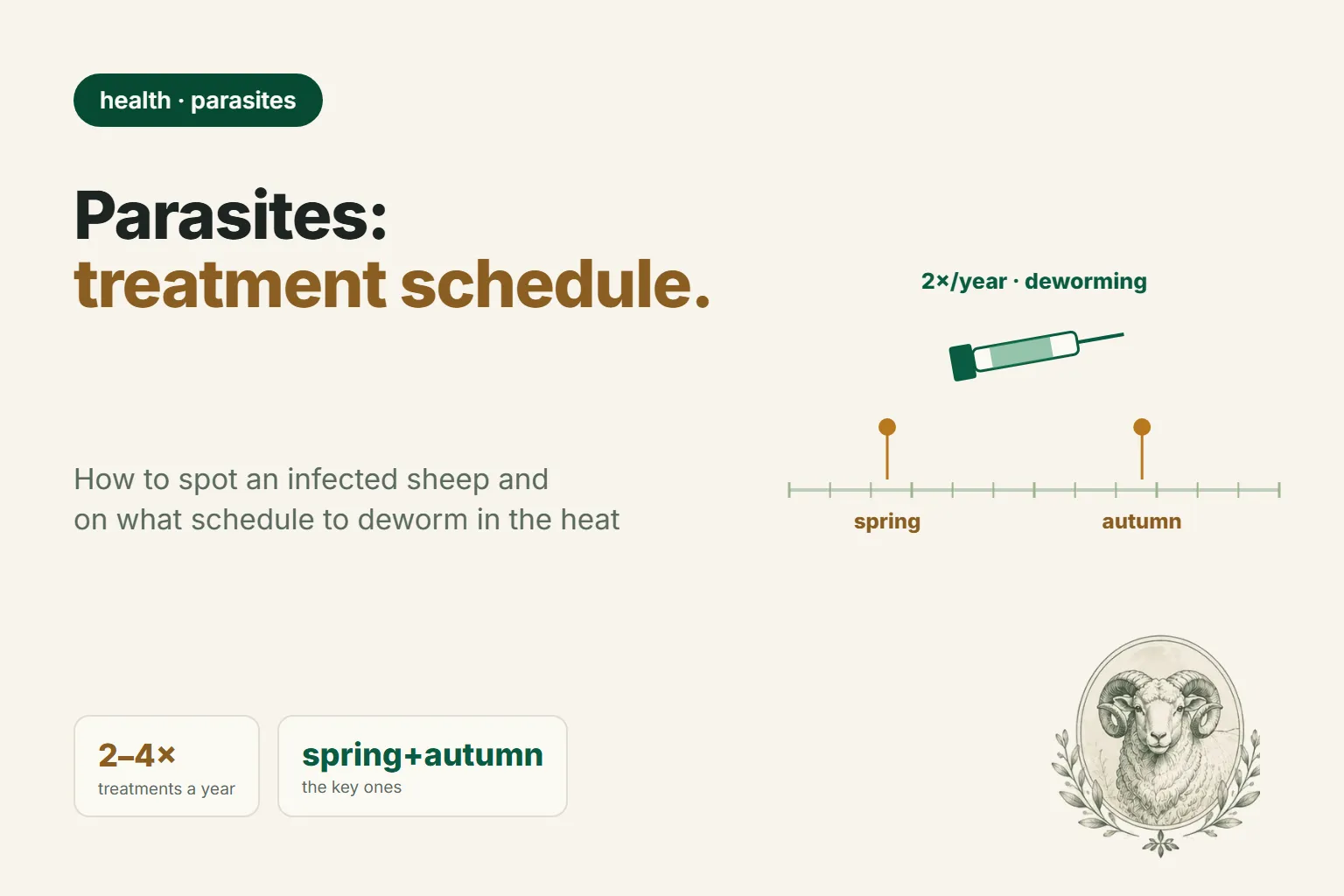
The schedule below is a reference point for Uzbek conditions (hot summers, transhumance/distant pastures). Fine-tune the exact timing and drugs to your local area and lambing calendar together with your vet.
| Season | Primary target | Drug class |
|---|---|---|
| Early spring (before turnout, before lambing) | roundworms (Haemonchus and others) | benzimidazole or macrocyclic lactone |
| Late spring–early summer | tapeworms in lambs on first grazing | praziquantel or albendazole |
| Summer (hot season) | Haemonchus in damp low ground; coccidiosis in lambs | as indicated: roundworms — targeted treatment; coccidiostat |
| Autumn (return from distant pastures, entering winter housing) | roundworms + liver fluke (in wet areas) | macrocyclic lactone/benzimidazole + flukicide |
| Winter (in the barn) | mange and external parasites at housing | macrocyclic lactone (injectable) |
New animals are treated separately — see quarantine below.
Resistance: Why "the Same Old Thing" Stops Working
Keep pouring on the same drug year after year and parasites adapt to it, and treatment stops working — this is already a worldwide problem. How to slow it down:
- rotate drug CLASSES, not brands: change the drug class roughly once a season or year, not with every single treatment;
- don't underdose — calculate based on the heaviest animal in the group, strictly per the label;
- don't treat the whole flock when you don't need to — treat the infected animals first (based on FAMACHA and fecal testing), and leave some healthy animals untreated: this preserves "non-resistant" parasites in refugia and slows resistance;
- check whether it worked: a fecal exam before treatment and again about 2 weeks after will show whether the drug did its job.
For class rotation to work, you have to be able to see it: a treatment log with active ingredient covering two or three years shows at once what you dosed with last time and when.
Prevention: Half the Battle Without Any Drugs
- Quarantine new arrivals: keep any purchased animal separate for 3–4 weeks, treat it "at entry," and run a fecal exam before letting it into the flock.
- Water and drainage: don't let sheep drink from puddles or standing ditches; drain or fence off marshy spots where you can — this cuts off liver fluke.
- Don't graze on dew: early morning and evening, roundworm larvae climb up wet grass. Turn animals out after the dew has burned off, and don't graze grass down "to the root" — the bottom few centimeters carry the heaviest infection.
- Rotate pastures: don't keep the flock on one plot the whole season; rotating plots and alternating grazing with cattle reduces the parasite load.
- Keep the pen clean: dry bedding, don't crowd lambs together — this is a direct way to prevent coccidiosis.
- Feed to requirement: a well-fed sheep in good body condition handles parasites far better than a thin one.
It is the follow-up test two weeks later that usually gets lost — it is worth setting repeat treatment reminders for it, otherwise the efficacy check never happens.
In Short
Parasites cause weight loss and deaths that are almost invisible until it's too late. Know your enemy by sight (Haemonchus in summer, tapeworms in lambs, liver fluke where it's wet, coccidia in crowded conditions, mange on the skin), catch the early signs — a pale eyelid, "bottle jaw," diarrhea, itching — and work off a seasonal schedule while rotating drug classes. But the dose, the exact timing, and the choice of drug are always up to the vet. This article helps you spot the problem in time — it doesn't replace the vet.
To keep treatments from slipping through the cracks, it helps to keep a log: tracking flock vaccinations and treatments.
The treatment calendar clears out the flock's own parasites, but not the ones dogs bring in: gid and echinococcosis reach the pasture through dog feces, and deworming the sheep doesn't break that chain. We cover the full cycle in gid in sheep and treating farm dogs. For the medications and supplies themselves, see where farmers actually get them: vet medications and flock supplies.
The skin mite deserves its own breakdown: psoroptic mange runs on its own timeline, a two-treatment schedule 7–10 days apart, and its own price for getting it wrong — infected young stock come out of winter 5–8 kg lighter. Details: sheep scab — signs and the treatment schedule.
Manage your flock in QoyHunterCRM for sheep farmers: livestock, health, weighing, finance and analytics — in the app and a Telegram bot.All features →