When to Shear Sheep in Spring and Autumn: Timing, Flock Prep, and Tracking Shearing Costs
In Uzbekistan, coarse-wool sheep are sheared twice a year — in May–early June and in September. Timing by breed, prep, dipping after shearing, whether the fleece pays for the shearer, and what to record for each shearing.
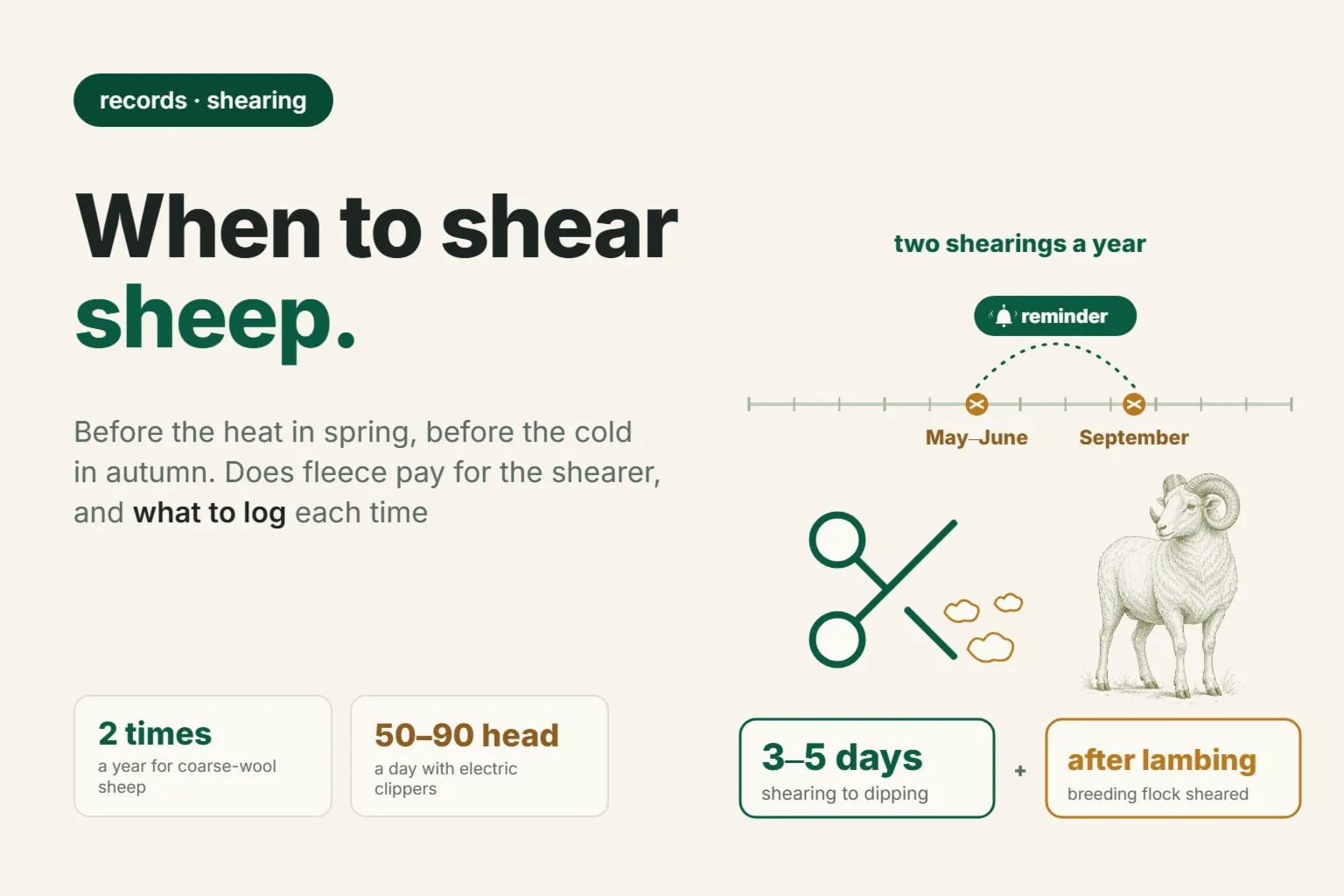
In Uzbekistan, coarse-wool sheep breeds — Hissar, Edilbay, Jaydara and Karakul — are sheared twice a year: in spring, in May and early June, before the worst heat sets in, and in autumn, in September, so the fleece has time to grow back before the cold. Pregnant ewes aren't sheared: the breeding flock is sheared after lambing. Three to five days after shearing, once the nicks have healed, the flock is dipped against mites.
For coarse-wool breeds, shearing is a cost, not income: one sheep's coarse fleece is worth less than a kilogram of its live weight. So what matters isn't wool revenue, but timing and expenses. A missed spring shearing leads to overheating and slower weight gain; a late autumn one leaves sheep facing the cold without fleece.
How many times a year are sheep sheared?
Coarse-wool and fat-tailed sheep are sheared twice a year; fine-wool breeds only once, in spring. All of Uzbekistan's main breeds are coarse-wool, so the twice-a-year rule applies to them.
| Breed | Shearings per year | Annual yield, ram | Annual yield, ewe |
|---|---|---|---|
| Hissar | 2 | 1.3–1.6 kg | 1.0–1.4 kg |
| Edilbay | 2 | 3–3.5 kg | 2.3–2.6 kg |
| Jaydara | 2 | 2.8–3.5 kg | 2–2.5 kg |
| Karakul | 2 | 3.5–3.8 kg | 2–2.2 kg |
These yield figures come from breed reference guides; different sources give slightly different ranges for the Hissar and Karakul breeds, but the order of magnitude is the same: one to four kilograms of coarse wool per head a year.
When to shear sheep in spring and autumn?
Spring shearing takes place in May and early June. The rule of thumb is simple — a sheep should enter the heat already shorn. Shearing too early, while cold nights are still possible, isn't worth it: a shorn sheep has nothing left to keep it warm.
Autumn shearing happens in September. The rule from industry guides: shear so the fleece has time to grow back before the cold sets in. The closer shearing is to the first frosts, the worse: a sheep shorn in cold weather spends its feed on staying warm instead of gaining weight.
The breeding flock is sheared after lambing. Sheep-farming guides advise against shearing pregnant ewes: turning and restraining them during shearing is stress that can end in a miscarriage. If mating on your farm falls in autumn, schedule the ewes' autumn shearing before it.
What does a farm lose if it delays shearing?
- Late in spring — you lose weight gain. In summer, steppe heat tops +40°C, and an unshorn sheep overheats, eats less and grows more slowly. A kilogram of live weight in September 2026 costs 55,000–65,000 UZS (≈ $4.7–5.5), and one kilogram of missed gain costs more than a whole year's fleece from any sheep in the table above.
- Late in spring — you lose the best mite treatment of the year. Dipping in the first days after shearing is the most effective flock treatment all year: the fleece is short, so the solution reaches the skin. Delay shearing and you delay dipping too, giving mites time to go into a hidden, dormant form. For timing and products, see mange in sheep: signs and how to treat it.
- Late in autumn — the sheep meets the cold without fleece and spends its feed on staying warm.
- Shear a pregnant ewe and you risk the lamb. A lost lamb costs more than the fleece of dozens of ewes from a single shearing.
How to prepare the flock for shearing, and what to do afterward?
Before shearing:
- Book a shearer ahead of time. During the season, shearers get booked up in advance, so call at least two weeks before the date.
- Shear only dry sheep. Wet fleece self-heats in the sack, turns yellow and loses strength. After rain, wait until the fleece dries.
- Stop feeding the evening before. Industry guides recommend shearing on an empty stomach: 10–12 hours without feed, with water withheld 4–6 hours before starting.
- Ask for the clippers to be disinfected. Shearers travel between farms with their own tools, and that's exactly how mange mites move from flock to flock.
After shearing:
- For the first 10–14 days, keep shorn sheep in the barn during bad weather and at night.
- 3–5 days later, once the nicks from the clippers have healed, dip the whole flock in an acaricide solution. Don't dip straight after shearing: the solution gets into fresh nicks.
- Weigh the yield and keep the wool dry. Buyers and workshops talk business once you can state the batch weight, breed and shearing dates — see where to sell sheep's wool for the options.
How long it takes: according to industry data, a shearer with electric clippers shears 50–90 head in a working day, and several times fewer with hand shears. A crew with clippers gets through a 100-head flock in a day or two; a lone shearer with hand shears takes several days.
Does the wool pay for the shearer's work?
For coarse-wool breeds — almost never. To check on your own flock, work out the fleece per head for a single shearing: divide the annual yield by two shearings.
| Animal | Fleece per shearing | At 2,500 UZS/kg (≈ $0.2) | At 5,000 UZS/kg (≈ $0.4) | At 10,000 UZS/kg (≈ $0.85) |
|---|---|---|---|---|
| Hissar ewe | ≈ 0.6 kg | 1,500 UZS | 3,000 UZS | 6,000 UZS |
| Jaydara ewe | ≈ 1.1 kg | 2,750 UZS | 5,500 UZS | 11,000 UZS |
| Edilbay ram | ≈ 1.6 kg | 4,000 UZS | 8,000 UZS | 16,000 UZS |
As of September 2026, open sources don't publish purchase prices for raw coarse wool or shearers' rates in Uzbekistan: both are negotiable and vary by district. So the table above is a grid for plugging in your own numbers. Ask a buyer for the price per kilogram, ask a shearer for the price per head, and compare it with your row. If a shearer charges more per head than that head's fleece is worth, shearing is a pure cost for the farm.
For scale: even an Edilbay ram, at 10,000 UZS per kilogram of wool, yields 16,000 UZS (≈ $1.4) from a single shearing — less than a third of a kilogram of live weight. Wool isn't the reason to shear; flock health and weight gain are. Which means shearing belongs right alongside feed and vet care — in the farm's annual expenses.
What should you record for each shearing?
Five fields are enough:
- Date. The next shearing and dipping deadline are counted from it.
- Scope and headcount. The whole flock or specific sheep by tag. When a shearer is paid per head, this is what you check their bill against.
- Cost of the work. Without it, you can't see at year's end what one head actually cost the farm.
- Who did the shearing. If the flock starts itching after shearing, the date and shearer show where the problem came from.
- Yield in kilograms. A year later, this is a ready-made batch description for a buyer.
A notebook handles this fine for a 20–30-head farm: two lines a year. It has three problems. A notebook won't remind you of the date or to call a shearer two weeks ahead. The shearing expense stays on its page and never makes it into the farm's overall cost tally. And a couple of years on, you can no longer find when the last autumn shearing was or who did it.
A spreadsheet adds up the totals, but it doesn't remind you either. You have to remember to open it, and manually carry the shearing cost into your overall expense tally, or it falls out of your cost accounting.
How to manage shearing in QoyHunter?
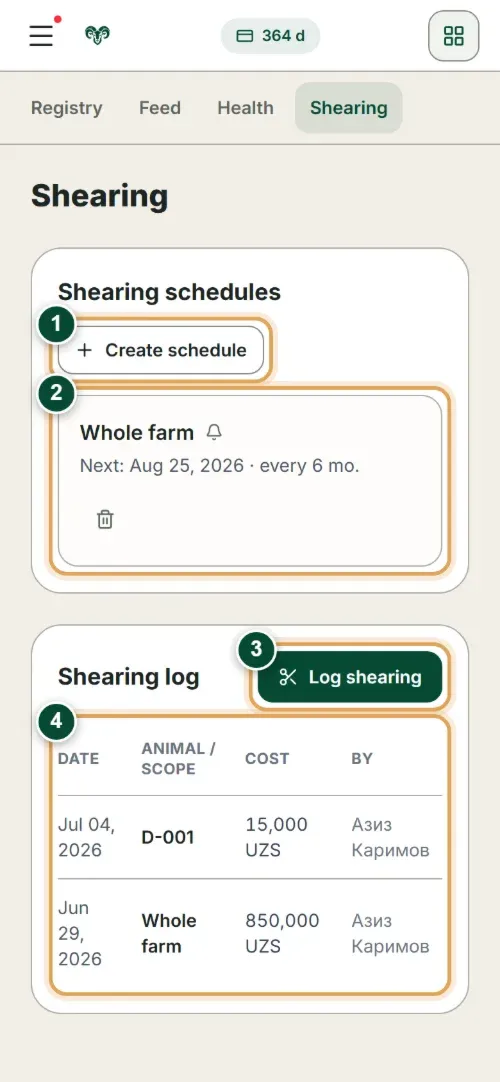
QoyHunter — a CRM for sheep record-keeping and the bazar.qoyhunter.com marketplace. Its Shearing section is made up of two blocks: a shearing schedule and a shearing log.
Schedule. The "Create schedule" button: set the interval in months, and the system works out the next date and sends a Telegram reminder. The schedule card shows the next shearing date and the interval; the bell on it means the reminder is on.
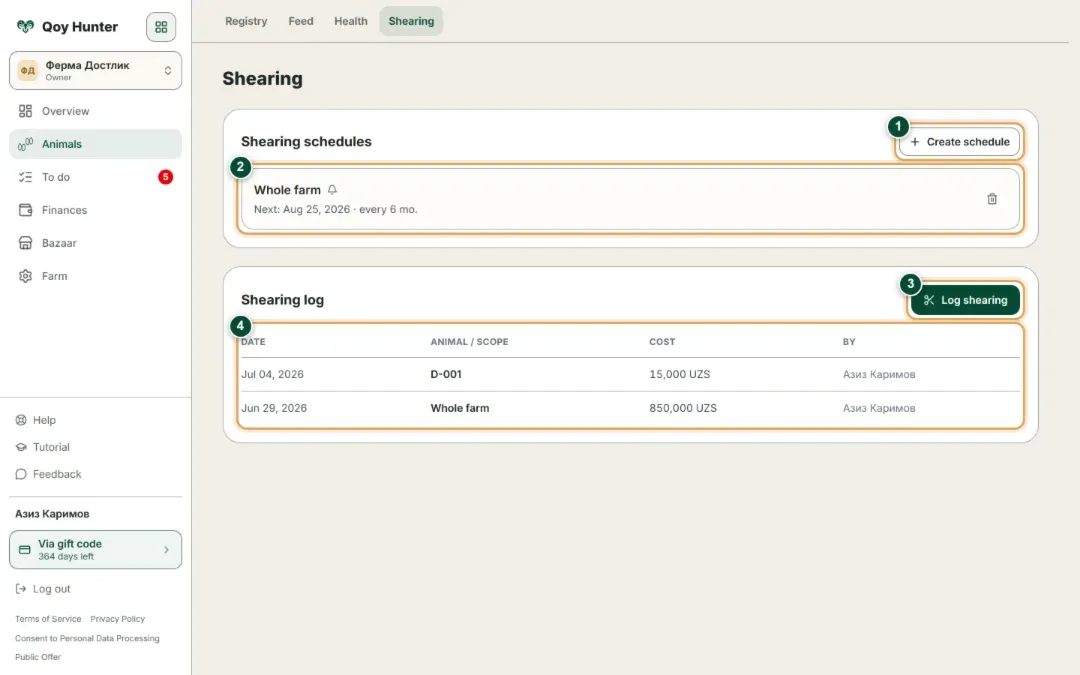
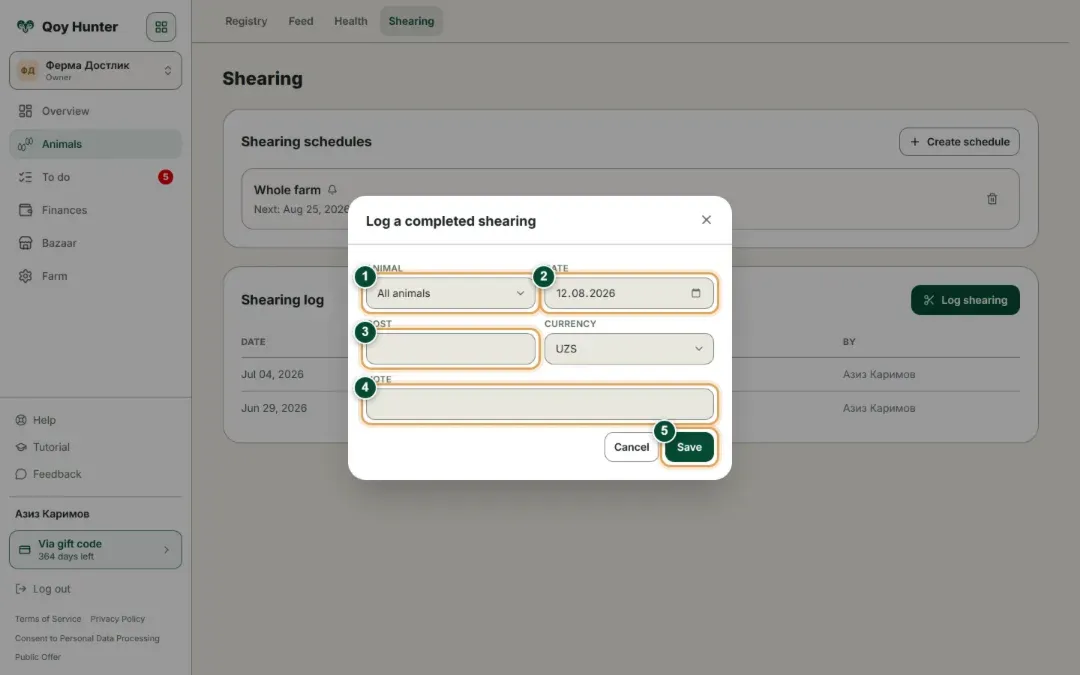
Shearing record. After the job, tap "Log shearing" and fill in the form:
- scope — a specific animal by tag, or "All animals" if you sheared the whole flock;
- date — the history builds on it, and the next scheduled shearing is counted from it;
- cost — the amount is automatically added to farm expenses;
- note — who did the shearing, how much wool was taken, and other details.
After tapping "Save," the shearing appears in the log and the expense in the farm's finances.
The log keeps the shearing history for the whole flock: date, scope, cost, and who did it. The scope on a record is either one animal or the whole farm at once, so if you only sheared part of the flock, it's easiest to put the headcount in the note. Step by step, this is shown on the sheep shearing log with reminders page.
Since the shearing cost lands straight in your expenses, it shows up next to feed and vet care, not in a separate notebook. How such records add up to the annual cost per head is covered on the farm income and expense tracking page.
FAQ
When should sheep be sheared in spring in Uzbekistan?
Coarse-wool sheep — Hissar, Edilbay, Jaydara and Karakul — are sheared in spring in May and early June, so they enter the summer heat already shorn. The second shearing happens in September, so the fleece grows back before the cold. The breeding flock is sheared after lambing.
Can a pregnant ewe be sheared?
Shearing pregnant ewes is not recommended: turning and restraining them during shearing is stress that can end in a miscarriage. The breeding flock is sheared after lambing, and if mating falls in autumn, the ewes' autumn shearing is done before it.
How many days after shearing should sheep be dipped?
3–5 days later, once the nicks from the clippers have healed. Don't dip right after shearing — the solution gets into fresh nicks. Dipping in the first days after shearing is the most effective all year: the fleece is short, so the acaricide solution reaches the skin.
Does wool pay for shearing sheep?
For coarse-wool breeds, usually not. One head's fleece from a single shearing weighs 0.6–1.6 kg, and even at 10,000 UZS per kilogram that's 6,000–16,000 UZS (≈ $0.5–1.4). Shearing is done for flock health and weight gain, and its cost is booked as a farm expense.
How many sheep can one shearer shear in a day?
According to industry data, a shearer with electric clippers shears 50–90 head in a working day, and several times fewer with hand shears. A crew with clippers gets through a 100-head flock in a day or two.
Manage your flock in QoyHunterCRM for sheep farmers: livestock, health, weighing, finance and analytics — in the app and a Telegram bot.All features →