How to Sell a Ram Online Straight from Your Records: Listings from the Animal Card, Buyer Inquiries, and Marking the Sale
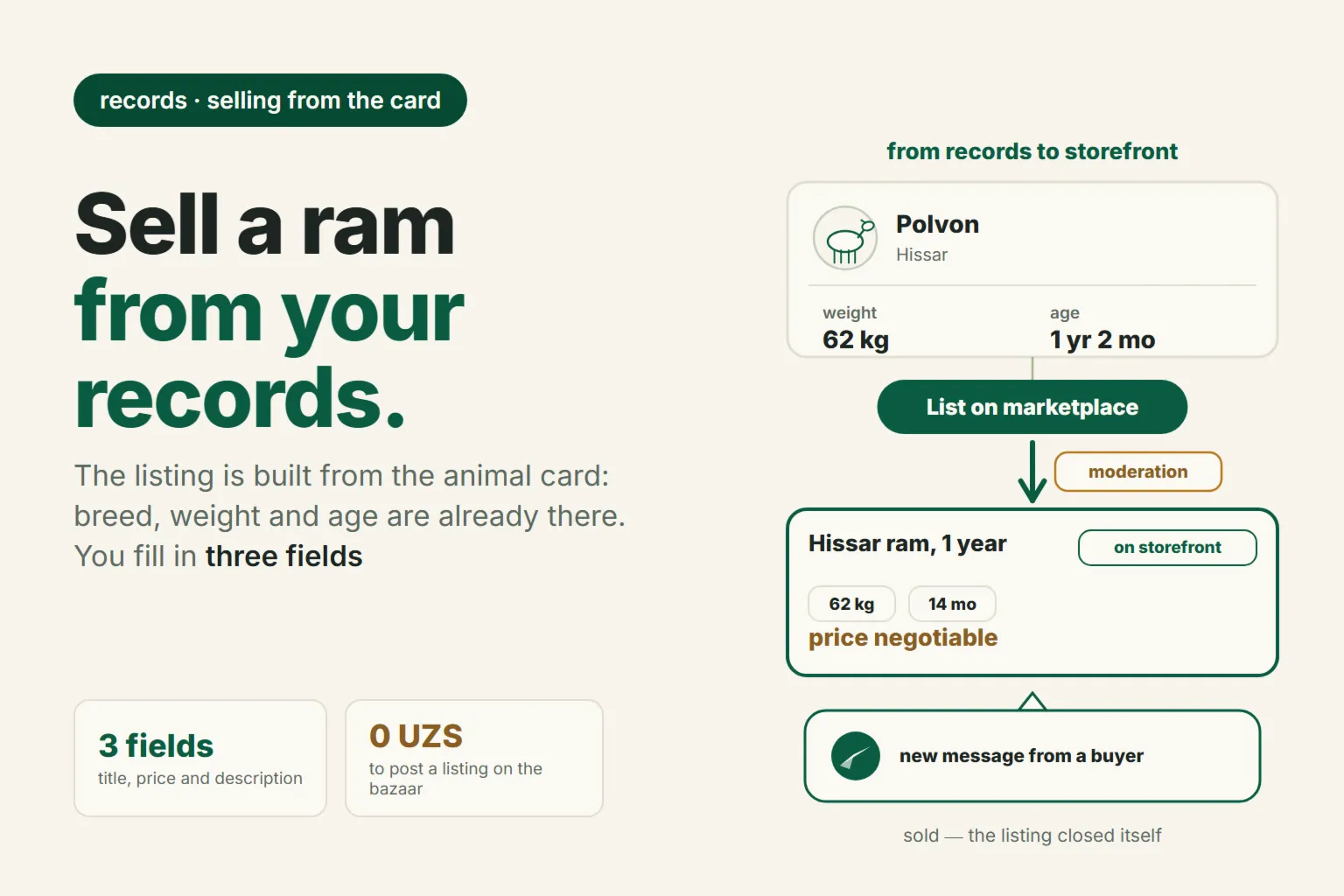
A ram's sale listing is put together from what's already logged in your records: breed, live weight, age, vaccinations. Where money leaks when you sell "from the notebook," why the listing's weight has to be today's, and how not to forget to close the listing after the sale.
Selling a ram online straight from your records means posting a listing with the data already saved in the animal's card: breed, sex, live weight, age, vaccinations. There's no need to write it all out again, and once the ram is sold, the listing closes together with the sale record instead of sitting there for another week. A farm that sells three to five head a year to neighbors doesn't need this. For anyone who sells regularly and to strangers, it saves time and closes two costly mistakes: an outdated weight in the listing, and a sale that never made it into the records.
A listing from your records is a sale listing filled in from the animal's card in your flock record-keeping program, instead of being written from scratch.
Below: the steps a ram sale is made of, where money leaks at each step when you track it in a notebook or Excel, and how it works in QoyHunter. Prices are as of September 2026; the Central Bank of Uzbekistan's exchange rate on September 18, 2026 was 11,833 UZS per dollar.
What steps does selling a ram consist of?
Selling one ram is five steps: choosing which animal to sell, gathering the data, posting the listing, answering buyers, and after the deal, recording that the animal is gone. With manual record-keeping, these steps live in different places: weight in a notebook, photos on a phone, the listing in a Telegram group, messages in private chats, and the sale mark — in the owner's memory.
| Sale step | How it's done without shared records | What gets lost |
|---|---|---|
| Choose which animal to sell | By eye, by how it looks in the pen | A still-growing ram gets sold, while one whose gain has stalled keeps eating |
| Gather data for the listing | Flip through the notebook, guess the weight and age | Weight from spring, age "about a year" — the listing undersells the ram |
| Post the listing | Write the text into two or three groups | The listing sinks in a few hours and gets reposted |
| Answer buyers | Calls and messages across different chats | Questions get lost; who was promised what stays in someone's head |
| Close the deal | Money's in hand, recording it is left for "later" | In the records the ram stays in the flock, the listing stays up, and people call about an animal that's already sold |
The first two steps decide how much you get for the ram. The last two decide how much effort the sale takes, and whether your records stay accurate afterward.
Which animal in the flock should you sell first?
The first to sell is the ram that has reached market weight and stopped paying for its feed, not the one that simply looks biggest. The economics of fattening: as long as a kilogram of gain costs less than a kilogram of live weight, feeding it pays off; once it costs more, it's time to sell.
The yardstick here is average daily weight gain. In Uzbekistan's fat-tailed breeds (Hissar, Edilbay, Jaydara), it drops as the animal grows during stall fattening: at 30–45 kg live weight, 200–250 grams a day is considered normal, at 45–60 kg it's 170–200, and toward the finish, at 60–75 kg, 120–160 grams. A heavy ram's ration isn't any cheaper, and its gain is smaller, so every kilogram it adds costs more.
Caveat: if a young ram still far from market weight sees its gain drop, it's too early to sell it. First look for the cause — water, ration, parasites.
Without records for each animal, none of this is visible: in the pen, two rams look equally well-fed, and the difference between 170 and 200 grams a day only shows up on a scale. For how to calculate gain and which norms apply at which weight, see a ram's average daily weight gain.
Why should a ram's sale listing show today's weight?
Because in Uzbekistan a ram's price is calculated from live weight per kilogram, and in September 2026 that's roughly 55,000–65,000 UZS per kilogram (≈ $4.6–5.5). Every kilogram that doesn't make it into the listing is 55,000 UZS handed to the buyer for free.
Example. A Hissar lamb was weighed in June at 40 kg, and that number just stayed in the notebook. Since then it spent 90 days on feed, gaining an average of 170 grams a day — about 15 kg. Today it weighs 55 kg.
| Weight in the listing | Live weight | Price at 55,000 UZS/kg |
|---|---|---|
| From the notebook, June measurement | 40 kg | 2,200,000 UZS (≈ $186) |
| After a fresh measurement, September | 55 kg | 3,025,000 UZS (≈ $256) |
| Difference | 15 kg | 825,000 UZS (≈ $70) |
A buyer who sees "40 kg" will offer a price for 40 kg. And on the livestock storefront, they might not find the listing at all: buyers search there with a weight filter, and the lamb ends up in the wrong results. The opposite mistake — an eyeballed weight padded with a margin — hurts trust: the buyer shows up with a scale, sees 50 kg instead of the stated 55, and starts haggling from the other end.
The rule is simple: before listing a ram for sale, weigh it and log the measurement with a date. A chest-girth tape is off by ±5–10 %, and on fat-tailed rams the tail can push the error higher. That is tolerable for tracking growth, not for setting a sale price.
What gets lost when sale listings live in Telegram groups?
Telegram groups are a free, fast channel, and they work fine for a one-off sale. The trouble starts when you have several rams to sell and you're selling every month.
- The listing sinks. In an active group it drops out of sight within a few hours. Bump it once a day, and a two-week sale means 14 posts in every single group.
- Data drifts apart. Weight and price get fixed in one group and forgotten in another — a week later, three different rams with the same photo are hanging in three places.
- Messages scatter. Questions arrive as private messages, as comments, and as phone calls. Who asked first and who was promised what has to stay in someone's head.
- The listing outlives the sale. Deleting it from every group gets forgotten, and people keep calling about an already-sold ram for another week.
For a 20–30-head farm that sells a few rams a year to neighbors and acquaintances, none of this is a problem. A notebook and a phone are plenty there, and a sales program, honestly, isn't needed. It's worth counting on one once sales come in batches or every month.
What happens if a ram is sold but never marked in your records?
This is the most expensive of the quiet mistakes: it doesn't hit one sale, it hits the whole flock's records. A ram that leaves without being logged stays in the flock "on paper."
- The headcount doesn't add up. When you recount by tags, the formula "had + born + bought − sold − slaughtered − died" comes out one head higher than what's standing in the pen, and the search for the missing animal begins.
- Feed gets calculated for extra heads. Winter hay stock is planned by headcount. Young stock held over from October to May eats about 315 kg of hay per head, so three rams that are sold but not written off means almost a ton of hay in the purchase plan.
- Income never becomes profit. Selling livestock is a sheep farm's main source of income. An unrecorded sale makes the month look like a loss on paper, and profit per head comes out wrong.
- Reminders keep coming for a sold animal. Vaccinations and treatments stay scheduled for a ram that's no longer on the farm.
The takeaway is simple: log the sale the same day you get paid, in the same action that closes the listing. If it's two separate actions in two separate places, sooner or later one of them gets skipped.
Notebook, spreadsheet, or record-keeping software: what should you use to sell livestock?
| What we're comparing | Notebook and Telegram | Spreadsheet and Telegram | Listing from record-keeping software |
|---|---|---|---|
| Where the listing data comes from | Copied out of the notebook by hand | Copied from the spreadsheet | Filled in from the animal's card |
| How fresh the weight is | Whatever was logged, if it was logged | Whatever was entered | From the card — needs a fresh measurement before the sale |
| Where you answer buyers | Private messages, comments, phone calls | The same | In storefront chat, with a Telegram notification |
| What happens to the listing after the sale | Deleted by hand in every group | Deleted by hand | Closes on its own once the sale is marked in your records |
| What it costs | Free | Free | Posting a listing is free; the software itself runs on a plan |
| Who it suits | Up to 20–30 head, a few sales a year to people you know | A farm that keeps a careful spreadsheet | Anyone who sells regularly to buyers they don't know |
How to sell a ram from your records in QoyHunter?
QoyHunter is a CRM for sheep records and the bazar.qoyhunter.com marketplace. In the records, every animal has its own card, and the sale starts right there.
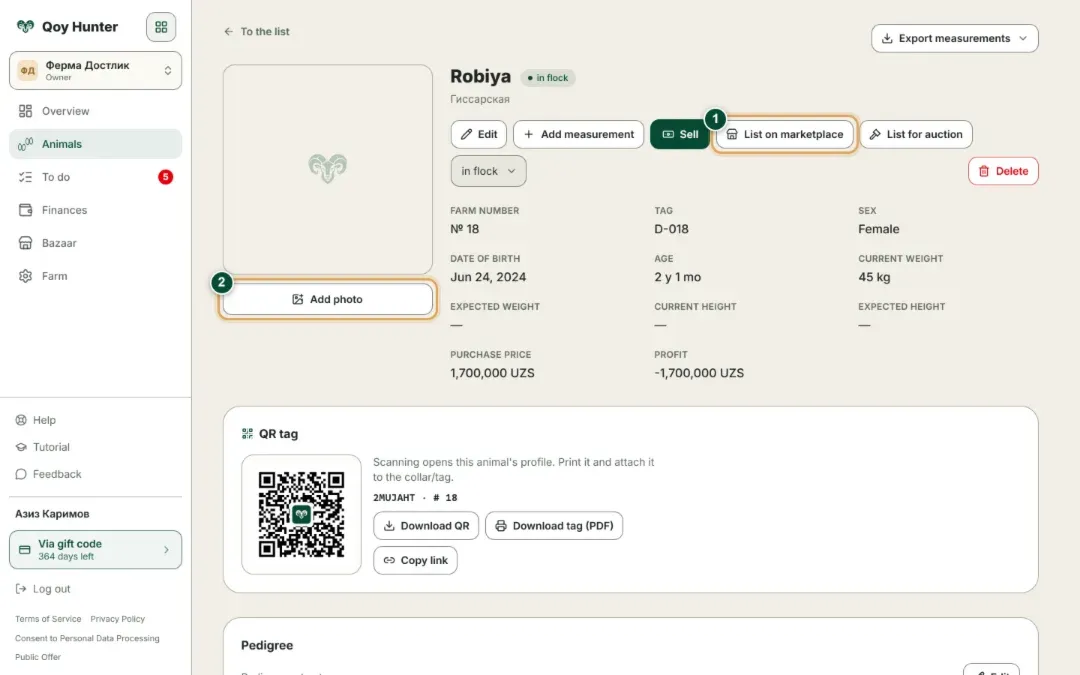
Step 1. The button on the animal's card. In the card's header there's a "List on marketplace" button. Right next to it is "Sell" — the two are easy to mix up: "Sell" logs the sale in your records, while "List on marketplace" is what publishes the listing. The same row has "Add measurement" and "Add photo": get a fresh weight and photo first, then post the listing. Buyers open listings with photos noticeably more often.
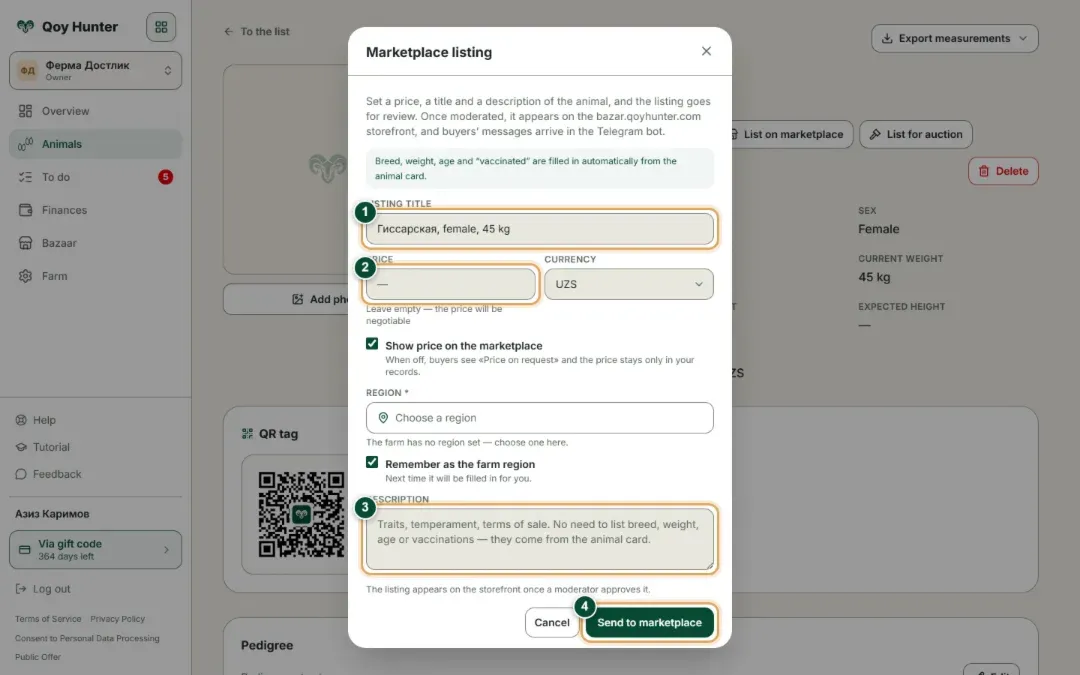
Step 2. The listing form. Breed, weight, age and the "vaccinated" mark are filled in automatically from the animal's card. Three fields are left to fill in:
- title — the breed is already filled in; add the sex and age;
- price — optional: an empty field means the price is negotiable. You can also set a price and uncheck "Show price on the marketplace": buyers will see "Price negotiable," and the amount stays only in your records;
- description — temperament, reason for selling, terms. No need to write breed, weight, age or vaccinations.
You'll need to pick the farm's region once, and after that it's filled in automatically. After the "Send to marketplace" button, the listing goes for moderator review, and once approved it appears on the bazar.qoyhunter.com storefront. The buyer sees the photo, breed, weight and age.
What to write in the title and description so the buyer messages first, and why a negotiable price performs worse in storefront filters — in a separate article on how to sell a ram through a listing.
Step 3. The seller cabinet. Every listed animal is gathered in the Bazar section. At the top you see how many listings are on the storefront and how many are waiting for moderation; below that, each listing shows its own status — on the storefront, in moderation, or closed. You can change the title, price and description anytime with the "Edit" button — the live listing updates instantly, with no need to recreate it. An unwanted listing comes down with the "Remove from storefront" button.
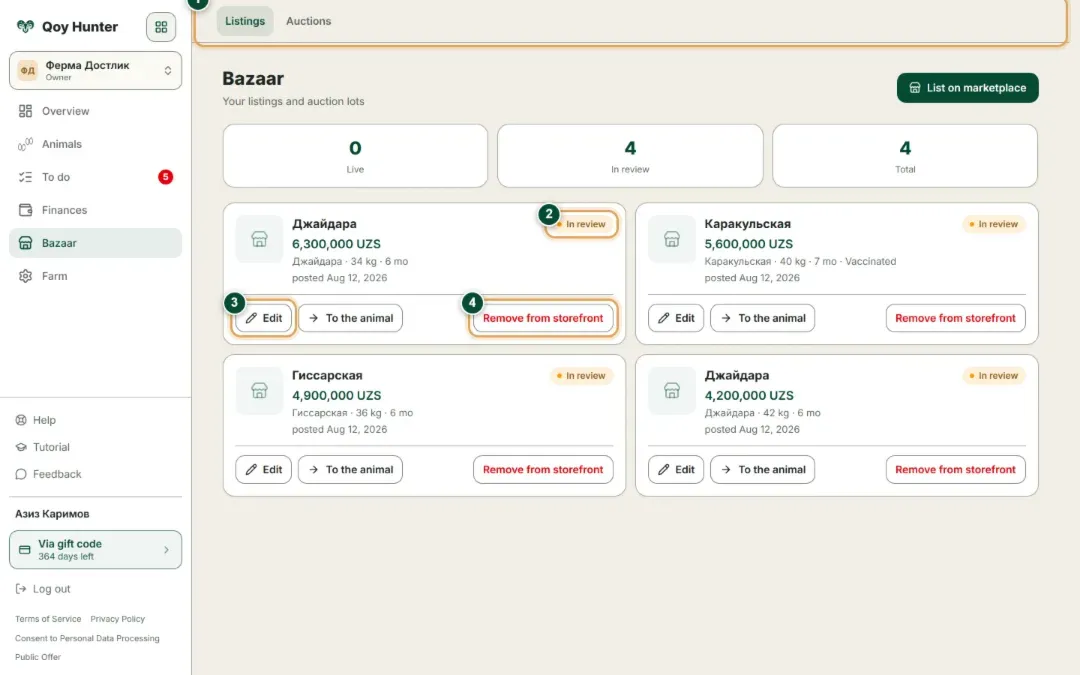
Step 4. Buyer messages. Buyers write directly in chat on the storefront, and a notification about a new message arrives in the Telegram bot. All the messages about a ram stay in one place, not scattered across three chats.
Step 5. The sale. Once the ram is sold, you mark the sale in your records — and the listing closes on its own. The same happens if the animal leaves the farm for another reason. This is exactly what closes the main hole in the manual approach: a sale can no longer stay stuck in a listing while slipping past the records.
Posting a listing is free. Step by step, with screenshots for both computer and phone, how to list a ram for sale from your farm records is shown on the feature page.
On the size of the marketplace — plainly, as it is. As of September 18, 2026, the sheep and rams section of the storefront has 8 listings, 3 of them Hissar. The marketplace is young, and it doesn't yet have the buyer traffic of a weekend livestock market. You can see what rams for sale in Uzbekistan look like — with weight, age and breed — in the catalog; Hissar has its own page — Hissar sheep for sale.
FAQ
How much does it cost to list a ram for sale from your record-keeping software?
Posting a listing on the bazar.qoyhunter.com marketplace is free. The owner sets the ram's price and can choose not to show it: buyers then see "Price negotiable," and the amount stays only in the records. The QoyHunter record-keeping software itself runs on the plans published on qoyhunter.com.
How is the "Sell" button different from "List on marketplace"?
"List on marketplace" creates a sale listing for the animal on the storefront. "Sell" records the sale itself in the farm's records. Once the deal is done, you mark the sale in your records, and that animal's listing closes on its own — there's no need to remove it separately.
Do you need to write the ram's weight and age into the listing again?
No. Breed, weight, age and the vaccination mark are filled in automatically from the animal's card, leaving only the title, price and description to fill in. The weight comes from the card, so it's worth weighing the ram and adding a fresh measurement before the sale: at 55,000 UZS per kilogram of live weight, every kilogram missing from the listing is 55,000 UZS (≈ $4.6) in the buyer's favor.
Where do messages from ram buyers arrive?
Buyers write in chat on the bazar.qoyhunter.com storefront, and a notification about a new message arrives in the QoyHunter Telegram bot. All the questions about one listing gather in one conversation instead of scattering across private messages and groups.
When is a notebook enough for selling rams?
If a farm keeps 20–30 head and sells a few rams a year to neighbors and acquaintances, a notebook and a phone are enough: the buyer already knows the animal, and a listing isn't needed. Record-keeping software for sales pays off once you're selling a ram every month, in batches, or to buyers you don't know — that's when a fresh weight in the listing and marking the sale the same day start to matter.
Manage your flock in QoyHunterCRM for sheep farmers: livestock, health, weighing, finance and analytics — in the app and a Telegram bot.All features →