How Many Head Are Really in the Flock: a Tag Register and Headcount Reconciliation
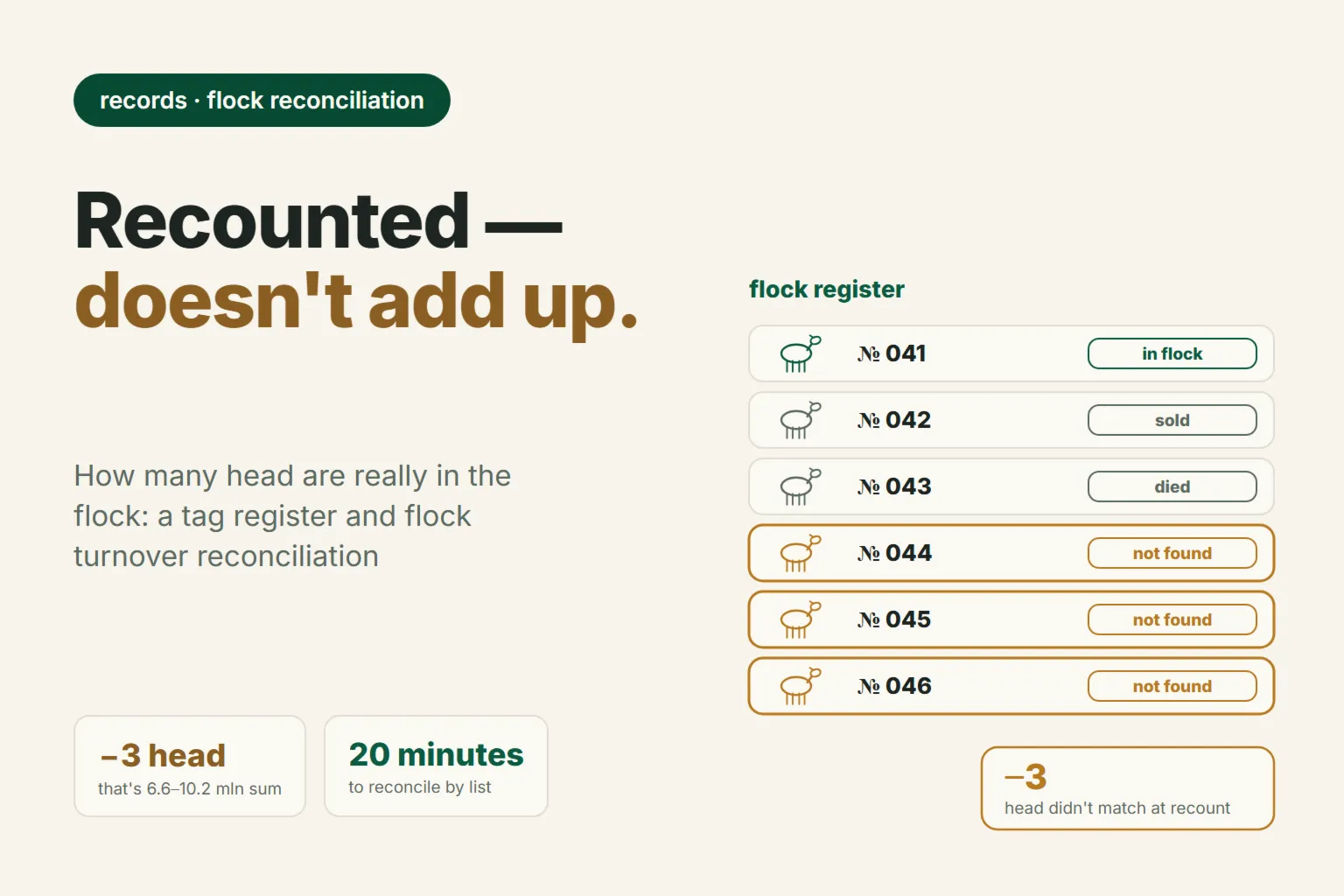
We recounted the flock — three head didn't match the records, that's 6.6–10.2 mln sum (≈ $550–855). The flock turnover formula, a 20-minute reconciliation routine, and the minimum fields a register needs so the number ever adds up.
For a flock recount to add up, you need one tag list where every animal has a status: in flock, sold, slaughtered, died, transferred. Then the number can be checked against the flock turnover formula: on hand at the start + lambs born + bought − sold − slaughtered − died = should be on hand now. If what you count in the pen doesn't match the calculation, the mistake is almost never in the counting — an event just never got recorded.
It's worth recounting at least four times a year: after lambing, before turnout to pasture, before putting the flock up for winter, and after Eid al-Adha, once some animals have gone to sale and to slaughter. Plus always whenever a shepherd changes.
Why the Headcount Doesn't Match at Recount
Where records are kept from memory, a flock recount almost always comes out a few head short of what's expected. The reasons repeat from farm to farm.
Lambs never made it into the list. Lambs arrive in batches over the two-to-three-week lambing period, and there's no time to record them all. A lamb lives with its mother and doesn't exist in the register until it's grown — and if it dies in the first week, it never shows up anywhere at all.
A sale or a gift slipped past the records. A ram sold to a neighbor, one given away at a wedding, one slaughtered for a holiday. Each event on its own is easy to remember; all of them together over a season — not so much.
Deaths marked "I'll log it later." The most common hole of all. The animal gets taken out of the pen, the notebook never gets touched, and a month later the missing head gets blamed on a counting error.
Animals are physically somewhere else. Part of the flock is out on distant pasture, two ewes with lambs are staying with relatives, a ram has been loaned out for mating. They're not in the pen, but they haven't left the farm either.
One animal counted twice. A tag gets lost, the animal gets retagged — and in the records it now shows up twice under two different numbers. Here, unlike the other cases, the recount actually comes out lower than the calculation. How to avoid that is covered in our guide to marking sheep and choosing tag numbers.
What a Three-Head Discrepancy Costs
Take a farm that started the year with 120 head: 80 ewes, the rest young stock and breeding rams.
| Flock turnover | Head |
|---|---|
| On hand Jan 1 | 120 |
| Lambs born (84 lambs from 80 ewes) | +84 |
| Bought | 0 |
| Sold during the season | −40 |
| Slaughtered for holidays and home use | −3 |
| Died | −6 |
| Should be | 155 |
| Recounted in the pen | 152 |
| Discrepancy | −3 |
Getting 84 lambs from 80 ewes is 105% — below the breed fertility of fat-tailed sheep (livestock reference tables put it at 110–120 lambs per 100 ewes): some ewes stay barren, and some lambs die in the first few days.
Three head of young stock, per our roundup of ram prices in Uzbekistan, comes to 6.6–10.2 mln soum (≈ $550–855). An adult ram costs 4.5–9.5 mln soum (≈ $375–795), a ewe around 2.8 mln (≈ $235). It's simpler to estimate by live weight: in summer 2026 a kilogram of live weight in listings runs 55,000–65,000 soum, so every head that's disappeared somewhere at 40 kg is 2.2–2.6 mln soum (≈ $185–220). All dollar equivalents here are converted at the Central Bank of Uzbekistan's rate for August 2026 — about 11,900 soum to the dollar.
It is easy to recalculate your own loss at today’s market: check what rams are currently asking in listings and multiply by the number of missing head.
But the direct cost of the missing animals is only half the loss. The other half is quieter:
- Feed gets calculated off the wrong headcount. The winter hay stock gets sized to the head count someone's keeping in their head, not to the records. A 3–5 head error on a flock of 150 means a ton of hay too many — or worse, a ton too few.
- The cause of the losses never gets found. Three missing head might be three lambs from the same poor-mothering ewe, or deaths clustered in the same corner of the shed. As long as the events aren't in the records, the pattern stays invisible — and repeats next season.
- The farm doesn't know its own structure. How many ewes there are now, how many young stock are on feed, how many head are ready for sale — without these numbers you can't plan mating or negotiate with a buyer.
How to Reconcile the Flock in 20 Minutes
The routine is simple, and it works whether you keep a notebook or use an app.
- Write down the calculated balance using the flock turnover formula for the period — from the last reconciliation to today.
- Recount the animals in the pen by tag, not "by eye." Counting by tag takes longer, but it's the only way to see exactly who's missing.
- Compare the two lists. Not number against number, but tag against tag: you need the specific tags that aren't in the pen.
- Find the event behind every missing tag. Sold, died, staying with relatives, retagged. Set the status and the date.
- Close out whatever's left unexplained as a loss — dated to the reconciliation. That's more honest than carrying it in the records for another year.
The key here is step 3. As long as the records hold only a count and not a list of numbers, reconciliation isn't possible in principle: you know three are missing, but not which three.
What a Record Needs to Make Reconciliation Possible at All
At minimum, for every animal:
| Field | Why it matters for reconciliation |
|---|---|
| Tag | The key. Without a unique number, animals can't be told apart |
| Sex | To count the breeding ewes separately |
| Breed | Flock structure and mating planning |
| Date of birth or arrival | Separates lambs born on the farm from purchases |
| Status (in flock / sold / slaughtered / died) | This is what actually makes it possible to reconcile intake and outflow |
| Weight | To value the flock and know when to sell |
Everything else — name, photo, pedigree, treatment history — is useful, but it doesn't hold up reconciliation. Start with the tag and the status.
A register answers the question of how many head you have; one animal history answers the question of who is actually making you money. That is a separate article: the animal card and the nine fields it needs.
The Notebook: Where It Works and Where It Doesn't
A notebook honestly covers the first step: logging an event the moment it happens, right there in the pen, with no phone and no internet. For a farm of 20–30 head, where the owner sees every animal every day, that's genuinely enough — and there's no point telling a farmer like that to "adopt a system."
Where a notebook breaks down is on status. To find out who's currently in the flock, you have to reread a whole year of entries and mentally subtract the sold and the dead. Nobody does that — so a notebook usually has history but no current flock makeup. Search is a separate headache too: pulling up one sheep's history means flipping through pages.
Excel: It Calculates, but It Doesn't Live Where the Flock Does
A spreadsheet removes the notebook's main pain point: a "status" column appears, along with filtering and totals. Filter for "in flock" and you get the calculated balance in a second.
Its own problems start after that. The file sits on a computer, but events happen in the pen: by the time you get to the laptop, half of it is forgotten. Status gets edited by hand, and one forgotten row breaks the whole reconciliation — silently, with no error on screen. Working together with a shepherd and a vet turns into passing file versions back and forth. And the more head you run, the more often a wrong filter hands you a wrong number that gets believed anyway.
Excel is a working option for someone who keeps records at a desk and is comfortable with formulas. It's not built for working from a phone out in the field.
How the Register Works in QoyHunter
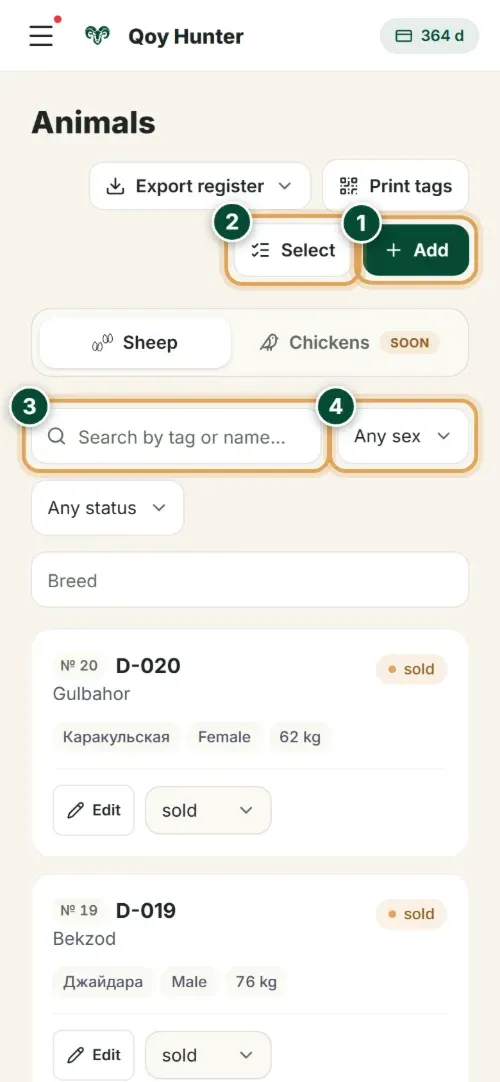
Livestock records in QoyHunter is one table for the whole flock, where every animal shows its tag, breed, sex, weight and status.
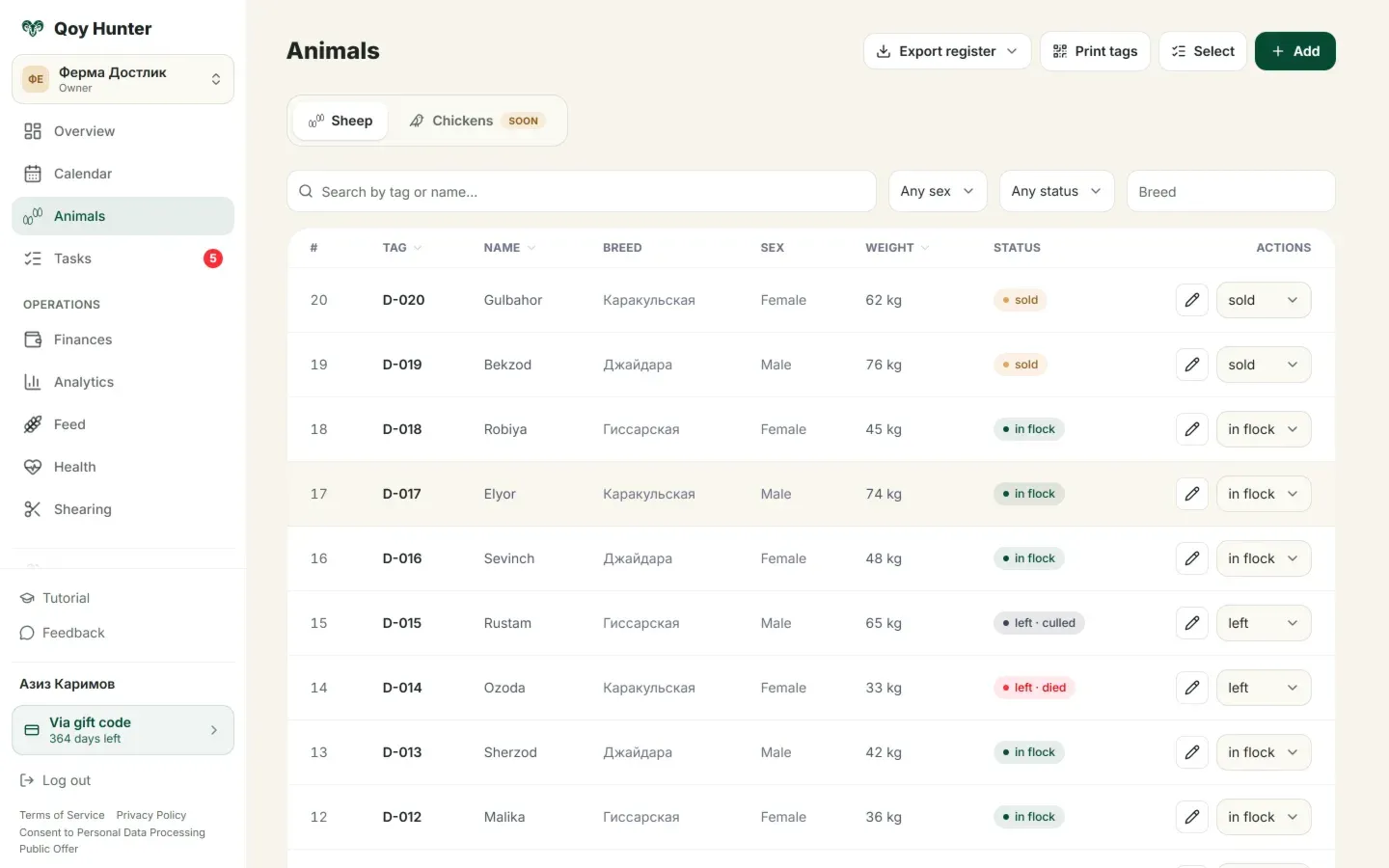
This screen covers exactly the reconciliation steps that take a notebook a whole evening:
- Filter by sex, status and breed — the calculated balance and the flock's structure come out in one click: females only, in-flock animals only, one breed only.
- Search by tag number or name — find a specific animal and see what's going on with it, instead of flipping through pages.
- "Select" — tick several animals at once and assign them feed, medicine or a vet event in one action. On a large flock, this is the biggest time saver.
- See who's in flock, who's sold, and who's gone — the up-to-date status a notebook can't give you.
A new animal is added as a card, and it has exactly one required field — the tag.
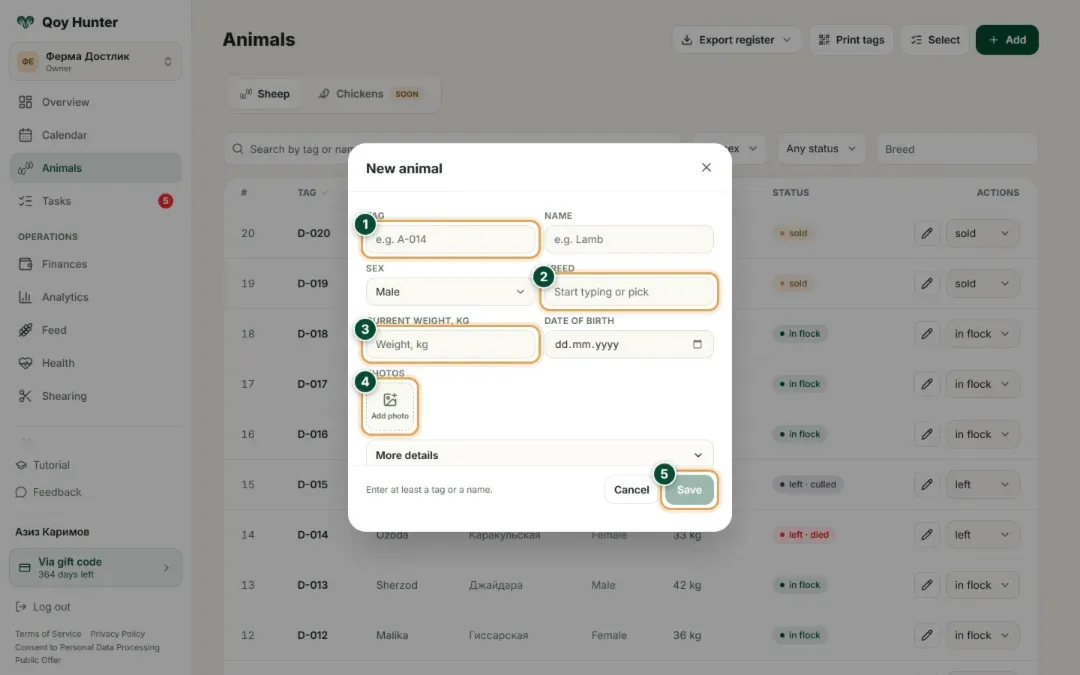
Pick the breed from the list or type your own, the current weight becomes the first point in the weighing history, and a photo helps you recognize the animal in the list. Tap "Save" and the animal is in the flock right away. That matters for lambing: you can add a lamb the same day with just a tag, and fill in weight, breed and pedigree later.
The second thing that decides whether reconciliation succeeds is where you enter the data. The list opens on your phone, so the record gets made right where the event happens — in the pen, not from memory that evening.
Being upfront about where the product stands: sheep ear-tag record software is getting ready to launch, and the waitlist is open now. The pricing on the site is marked as preliminary — final plans will be announced at launch; a free plan at 0 sum is planned for farms with up to 30 animals.
FAQ
How often should you recount the flock by tag?
At least four times a year: after lambing, before turnout to pasture, before winter housing, and after Eid al-Adha. Always do it when a shepherd changes, too — reconciling the flock at handover cuts out half the future arguments about where an animal went.
What if the farm has no tags at all?
You'll still have to start there: without a unique number, reconciliation isn't possible — animals can't be told apart. The simple way: tag the whole flock in one pass, and the same day write the numbers down as a list, marking the ewes separately. After that, every new animal gets a tag the day it appears — a lamb at birth, a bought ram on delivery day.
How many head before a notebook stops being enough?
The rule of thumb is 20–30 head, provided you see the flock every day. It's not about the number of lines but the number of events: once a season racks up dozens of lambings, sales, treatments and transfers, memory can't hold them all, and a notebook won't show the flock's current makeup without a full re-read.
If you're short on time, what should you record first?
The tag and the status — that is, the fact that an animal appeared or left, plus the date. Those two fields are enough for the reconciliation to add up. Weight, breed, photo and pedigree can be filled in later; they don't hold up reconciliation, but you need them to know what the flock is worth.
The old records don't match reality — how do you start over?
Don't try to reconstruct past years. Do a full recount by tag, record the resulting number as the balance on the reconciliation date, and log every event as it happens from then on. After one season you'll have an accurate history — digging through the old notebooks would cost you nothing but time.
Manage your flock in QoyHunterCRM for sheep farmers: livestock, health, weighing, finance and analytics — in the app and a Telegram bot.All features →