
Sheep manure: how much a flock produces in winter and what it sells for in 2026
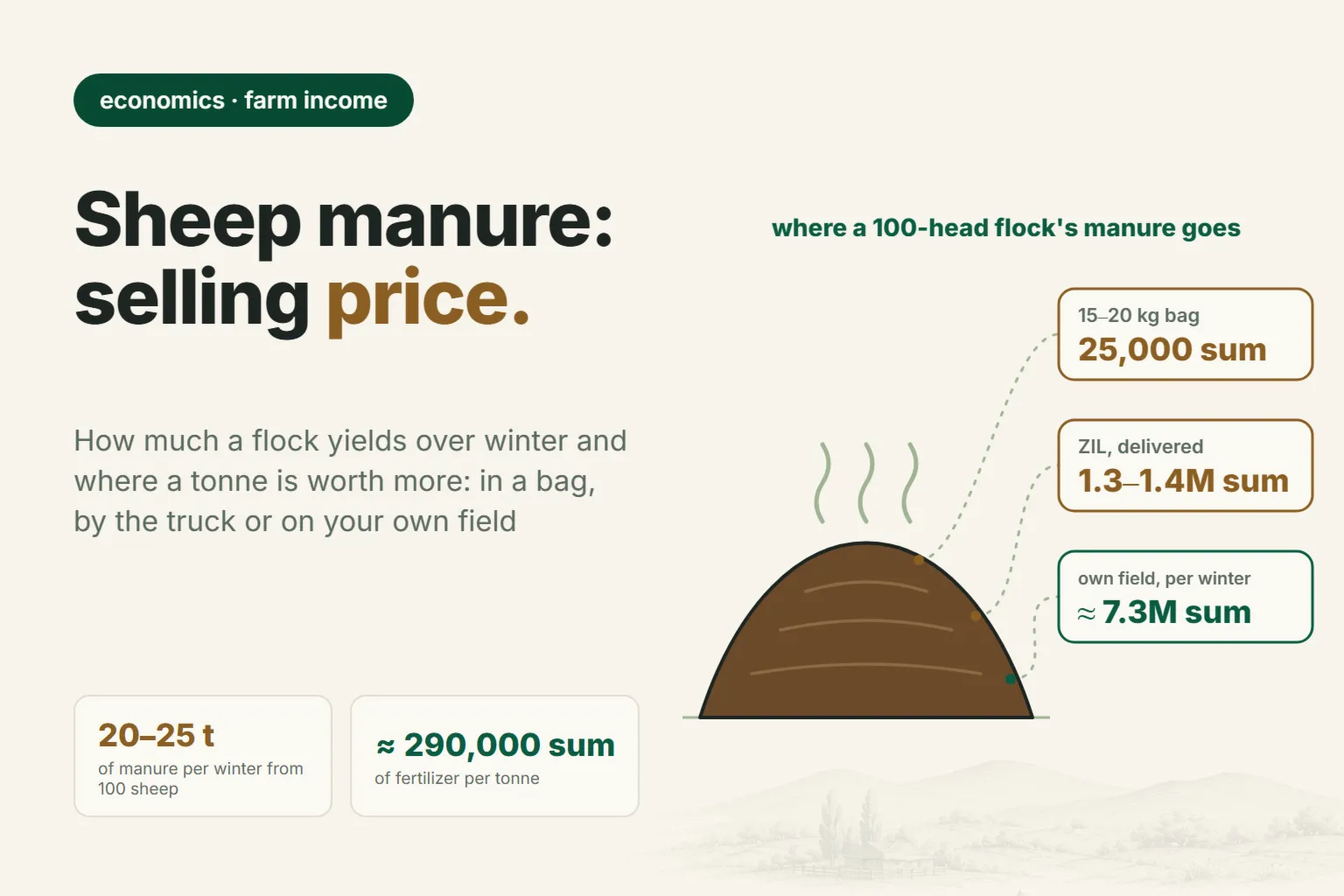
Sheep manure prices in Uzbekistan in autumn 2026: a ZIL truckload delivered in Tashkent — 1.3–1.4 million sum, collected at the farm — about 400,000 sum, a 15–20 kg bag — 25,000 sum. How much manure a sheep produces, what its nitrogen, phosphorus and potassium are worth, and whether it pays more to sell it or spread it on your own field.
Sheep manure in Uzbekistan sells for anything from nothing to 25,000 sum a bag: in 2026 a ZIL truckload of well-rotted manure delivered in Tashkent costs 1.3–1.4 million sum, about 400,000 sum if the buyer collects it from the farm, and sieved manure in 15–20 kg bags goes to vegetable growers for 25,000 sum. A flock of 100 head produces roughly 50 tonnes of fresh manure with bedding over the winter housing period, which is 20–25 tonnes of rotted manure. Sell it by the truckload for collection and the farmer takes in 2–2.4 million sum; spread it on your own field and you save about 7 million sum (≈ $610) on mineral fertilizer.
Below: how much manure a sheep produces, what it is worth in nitrogen, phosphorus and potassium, a comparison of sales channels by price per tonne, and how to prepare manure so it sells for more. Prices come from OLX.uz listings for July–October 2026; the Central Bank of Uzbekistan rate on 9 October 2026 is 11,847 sum per dollar.
How much manure does one sheep produce in winter?
An adult sheep in the housing period produces about 3.5–4 kg of manure a day, counting urine absorbed by the bedding and the bedding itself (0.3–0.5 kg of straw per head). Over a 120–135-day housing period that comes to about 0.5 tonnes of fresh manure per head.
| Flock size | Fresh manure over 135 days | Rotted manure (≈ half the mass) |
|---|---|---|
| 1 sheep | ≈ 0.5 t | ≈ 0.25 t |
| 50 sheep | ≈ 25 t | 10–12.5 t |
| 100 sheep | ≈ 50 t | 20–25 t |
| 300 sheep | ≈ 150 t | 60–75 t |
Rotted manure is manure that has sat in a heap (a windrow) for 6–8 months: crumbly, dark and almost odorless. In rotting, manure loses about half its mass as water and part of the organic matter escape. In summer, when the flock is on pasture, most of the manure stays on the pasture, so only the housing period and nights in the pen are counted.
How much straw goes into bedding and how to set up deep bedding in the pen is covered in the article on what a sheep shed should be like.
Why is sheep manure better than cow manure?
Sheep manure is one of the most concentrated among farm animals: it has less water, almost twice the nitrogen and about a third more potassium than cow manure.
| Manure (fresh) | Water, % | Nitrogen (N), % | Phosphorus (P₂O₅), % | Potassium (K₂O), % |
|---|---|---|---|---|
| Sheep | 65 | 0.83 | 0.23 | 0.67 |
| Horse | 71 | 0.58 | 0.28 | 0.63 |
| Cow | 77 | 0.45 | 0.23 | 0.50 |
The figures are the average chemical composition of fresh bedded manure from the textbook “Agrochemistry” (ed. V. G. Mineev). Actual composition depends on the ration and bedding: a flock fed alfalfa and meal produces more nitrogen than one fed straw.
Sheep manure is “hot”: it heats up fast in a heap. It is not applied fresh under plants, because the excess ammonia burns roots. That is why both vegetable growers and farmers take the rotted kind.
What is sheep manure worth as fertilizer?
A tonne of fresh sheep manure contains about 8.3 kg of nitrogen, 2.3 kg of phosphorus (P₂O₅) and 6.7 kg of potassium (K₂O). Buying the same nutrients as mineral fertilizer at autumn 2026 prices works out like this:
| Nutrient in 1 t of fresh manure | Replaced by | Fertilizer needed | Fertilizer price | Cost |
|---|---|---|---|---|
| Nitrogen 8.3 kg | urea (46 % N) | 18 kg | 5,600 sum/kg | 101,000 sum |
| Phosphorus 2.3 kg | ammophos (52 % P₂O₅) | 4.4 kg | 8,000 sum/kg | 35,400 sum |
| Potassium 6.7 kg | potassium chloride (60 % K₂O) | 11.2 kg | 3,200 sum/kg | 35,700 sum |
| Total | ≈ 172,000 sum (≈ $14.5) |
Fertilizer prices come from OLX.uz listings in 2026: urea in 50 kg bags — 270,000–325,000 sum, ammophos — 360,000–430,000 sum a bag, potassium chloride — about 160,000 sum a bag.
In rotting, manure loses half its mass, but nearly all the phosphorus and potassium stay in it, while 10–30 % of the nitrogen escapes. So a tonne of rotted manure is worth about 290,000 sum (≈ $25) in fertilizer content. Twenty-five tonnes of rotted manure from a flock of 100 head equals roughly 7.3 million sum (≈ $610) of mineral fertilizer.
Two corrections so you do not overrate manure:
- Nitrogen from manure is released slowly: in the first year plants take only 20–30 % of it, and the rest goes to the second and third years.
- Alfalfa hardly needs nitrogen: legumes pull it from the air themselves. For alfalfa the value of manure is phosphorus, potassium and organic matter, about 140,000 sum per tonne of rotted manure, not 290,000.
Where to sell sheep manure and what a tonne brings
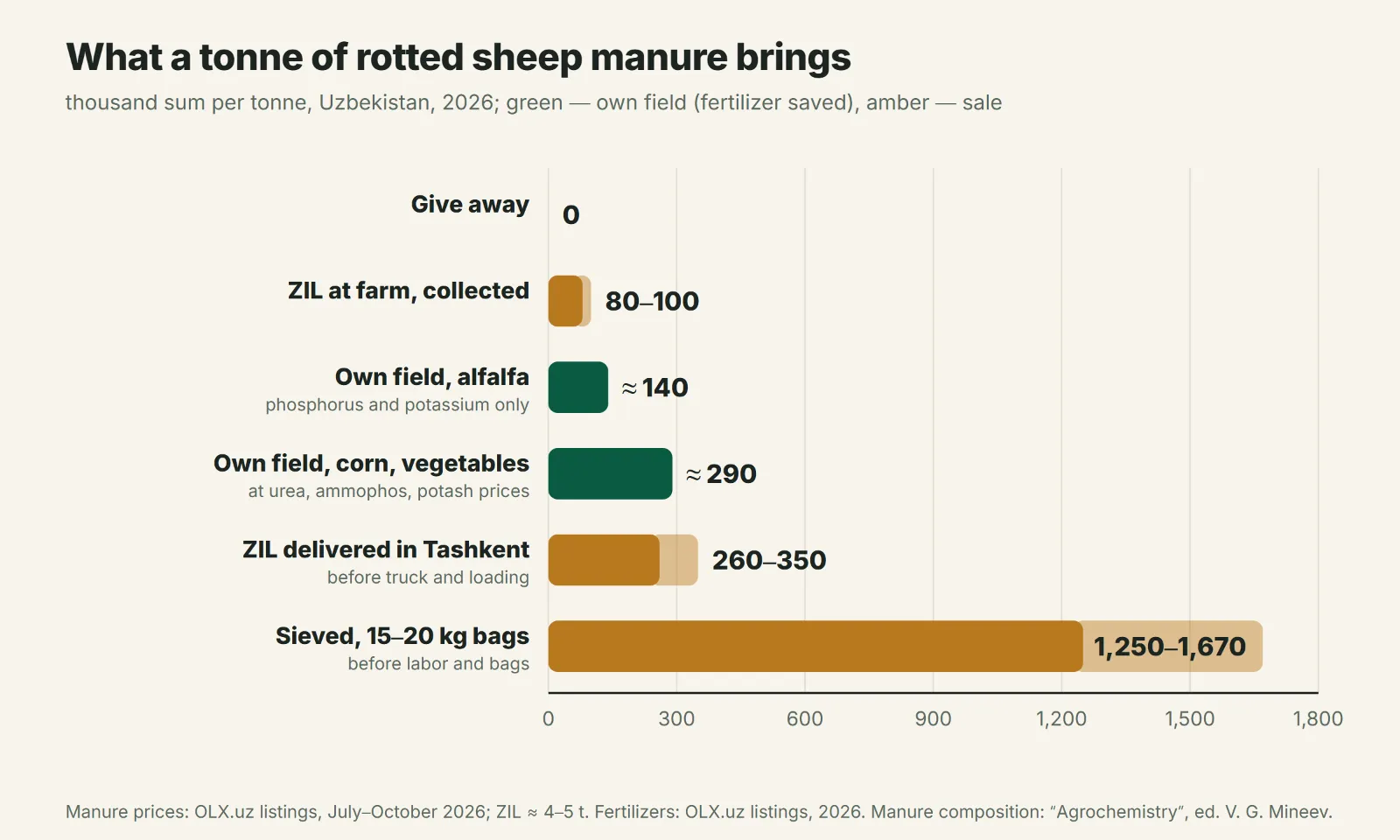
OLX.uz listings in 2026 show five ways to dispose of manure. Prices depend heavily on how much work the farmer takes on. A heaped ZIL dump-truck bed holds roughly 4–5 tonnes of rotted manure, depending on moisture.
| Option | Listing price, 2026 | Per tonne of rotted manure | ≈ $ per tonne | What is left to the farmer |
|---|---|---|---|---|
| Give away, buyer collects | 0 | 0 | 0 | nothing: the buyer loads and hauls it |
| Sell by the truckload at the farm, buyer collects | 400,000 sum per ZIL (Samarkand region, July) | 80,000–100,000 sum | 7–8 | showing the heap, agreeing terms |
| Sell by the truckload delivered in Tashkent | 1.3–1.4 million sum per ZIL (July–October) | 260,000–350,000 sum | 22–30 | hiring a truck, loading, finding a buyer |
| Sell sieved, in bags | 25,000 sum per 15–20 kg bag (Yangiyul, August) | 1.25–1.67 million sum | 105–140 | sieving, bags, selling a few bags at a time |
| Spread on your own field | — | ≈ 290,000 sum saved on fertilizer | ≈ 25 | hauling and spreading |
What this means for a flock of 100 head with its 20–25 tonnes of rotted manure over the winter:
- Give it away: 0 sum, but the pen gets cleaned at no cost to you. In 2026 many farms in the Samarkand region and in the Parkent and Zangiata districts do this.
- Sell by the truckload for collection: 5–6 trucks at 400,000 sum, which is 2–2.4 million sum (≈ $170–200).
- Sell delivered in Tashkent: 6.5–8.4 million sum (≈ $550–710) before the cost of the truck and loading. This pays if you have your own truck or a friend who drives cheaply.
- Sell in bags: the highest price per tonne, but the buyer is a city vegetable grower who needs 5–10 bags. Even 200 bags over the spring is 5 million sum (≈ $420), and that is only 3–4 tonnes out of 25.
- Spread on your own field: about 7.3 million sum (≈ $610) saved on fertilizer if the field is under corn, vegetables or an orchard, and noticeably less if it is under alfalfa.
The most common winning choice for a farm with land is to keep the manure and sell the surplus by the truckload. A farm without land does better selling delivered or in bags, if there is someone to handle it.
How much manure per hectare?
Rotted manure under corn, vegetables and orchards is usually applied at 20–30 tonnes per hectare every 2–3 years; for sowing alfalfa, the same amount before ploughing. So a flock of 100 head fertilizes about 1 hectare in one winter.
If you are deciding whether to grow your own alfalfa or buy hay, manure is an argument for growing it: on a farm with a flock, fertilizer for the sowing is nearly free. Yield and payback of the crop are covered in the article “Own alfalfa or bought hay”.
How to prepare manure to sell it for more
Buyers in the listings write the same things: “rotted”, “no debris”, “no smell”, “sieved”. That is what they pay for.
- Pile the manure into a windrow. A windrow is a heap 1.5–2 metres high on level ground, away from a well and an irrigation ditch. First lay the manure loosely and give it 4–6 days to heat to 50–60 °C, then pack it down and cover it with a layer of straw or soil. This disinfects the manure and it loses less nitrogen.
- Let the manure rot for 6–8 months. Manure cleared from the pen in March is already sellable as rotted by autumn. Vegetable growers do not take fresh manure.
- Do not mix in debris. Scraps of twine, bags, stones and construction rubble are the main reason a truckload goes for half price.
- For bags, sieve it. Sieved manure in a bag sells for 1,250–1,670 sum per kilogram, which is 4–6 times more than by the truckload with delivery.
- Sell in season. Demand from vegetable growers and gardeners comes in spring before planting and in autumn for digging over.
Is sheep manure dangerous for the flock and for people?
Fresh manure carries worm eggs and disease agents. So:
- Do not spread fresh manure on a pasture where the flock grazes: the sheep get reinfected with worms. For more on how worms spread through pasture, see the article on deworming sheep.
- Rotting in a windrow disinfects manure only if it has heated up: in a loosely piled heap the temperature rises to 50–60 °C, which kills most worm eggs and weed seeds. Manure that is packed down at once does not heat like this, and the outer layer of a windrow never heats up, so it is turned into the middle or left longer.
- Under quarantine, manure is not hauled out or sold. If the farm has foot-and-mouth disease, brucellosis or another contagious disease, manure and bedding are removed and disinfected only on the instruction of the veterinary service.
How to track income from manure
Manure income seems a trifle until you add it up for the year: 2–8 million sum from a hundred sheep is half a tonne to two tonnes of barley at 3,800 sum a kilogram. It is convenient to put manure money straight into feed: you can buy barley and compound feed for sheep from farmers' and suppliers' listings.
To see what the flock really earns, record this income too. In a notebook it is one line; in QoyHunter, a CRM for sheep records and the bazar.qoyhunter.com marketplace, it is an entry in the income and expense journal: a manure sale lands in the month's income next to ram sales and feed costs. How it works is shown on the page about farm income and expense tracking.
FAQ
How much does a truckload of sheep manure cost in Tashkent?
In 2026 a ZIL truckload of rotted manure delivered in Tashkent costs 1.3–1.4 million sum (≈ $110–120), according to OLX.uz listings for July–October. At the farm, with the buyer collecting, a truckload sells for less, about 400,000 sum (≈ $34), and some farms give manure away just to have it hauled off.
How much manure does one sheep produce?
An adult sheep in the housing period produces about 3.5–4 kg of manure a day including bedding, which is roughly 0.5 tonnes of fresh manure over a winter of 120–135 days. After rotting in a windrow about half remains, that is 0.25 tonnes. A flock of 100 head produces 20–25 tonnes of rotted manure over the winter.
Is it better to sell manure or spread it on your own field?
A tonne of rotted sheep manure holds nitrogen, phosphorus and potassium worth about 290,000 sum (≈ $25) at autumn 2026 mineral fertilizer prices, while at the farm for collection it sells for 80,000–100,000 sum. If you have a field under corn, vegetables or an orchard, it pays more to spread the manure yourself. Under alfalfa the gain is smaller: it hardly needs nitrogen.
Can I fertilize a vegetable garden with fresh sheep manure right away?
No. Fresh sheep manure is “hot”: the excess ammonia burns roots, and it also holds live worm eggs and weed seeds. Manure is kept in a windrow for 6–8 months to rot, and only then is it applied at 20–30 tonnes per hectare.
Why is sheep manure valued higher than cow manure?
Fresh sheep manure has 0.83 % nitrogen and 0.67 % potassium, against 0.45 % and 0.50 % in cow manure. Water is 65 % in sheep manure versus 77 % in cow manure. So a tonne of sheep manure gives plants almost twice the nitrogen of a tonne of cow manure.
Manage your flock in QoyHunterCRM for sheep farmers: livestock, health, weighing, finance and analytics — in the app and a Telegram bot.All features →