The Largest Sheep Breed: Gissar, Edilbay, Dorper — Which One to Choose
We compare the Gissar, Edilbay, Jaidara and Dorper breeds by live weight, dressing percentage, fat tail and hardiness — and look at which breed suits meat, fat tail, or pasture-based farming in Uzbekistan.
"I want the biggest rams" is how the conversation starts in almost every farm. But behind the word "biggest" lies not one breed but several, each with its own character, its own pasture requirements, and its own buyer. Let's look at four breeds you'll actually find in Uzbekistan: Gissar, Edilbay, Jaidara and Dorper. We'll compare them by live weight, dressing percentage, fat tail, early maturity and hardiness — and work out which one suits whom.
What Hides Behind the Words "the Largest"
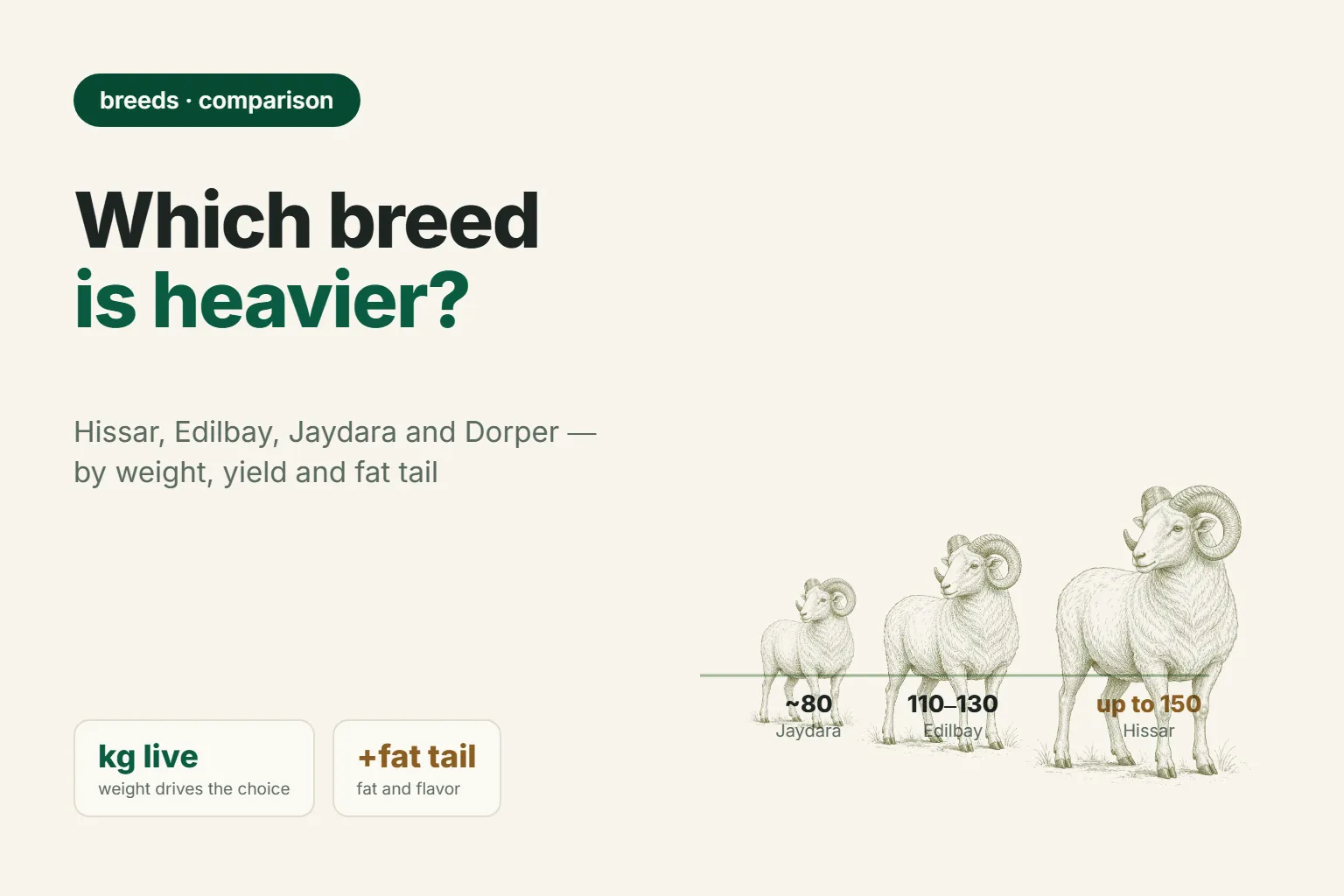
When people say "the largest sheep breed in the world," they almost always mean the Gissar. That's true: in mass and size, Gissars have no equal among cultivated breeds. But two things are important to understand.
First, record figures are individual champion animals, not the flock average. A 190 kg ram does exist, but it's a show specimen raised on excellent feed — not what you'll get from every lamb.
Second, "large" doesn't mean "profitable for you specifically." A giant eats more, needs good pastures, and costs more. Sometimes a hardy, medium-sized breed brings in more money than a record-holder that loses weight on poor feed.
Gissar: Champion in Weight and Fat Tail
The Gissar is a meat-and-fat, fat-tailed breed originating from the Gissar Valley (Tajikistan, Uzbekistan). Its calling card is a powerful frame, a broad body and a massive fat tail.
- Live weight. Rams typically 120–140 kg, outstanding individuals up to 190 kg. Ewes 80–90 kg, the best up to 150 kg.
- Fat tail. Up to 20 kg of pure fat — the largest among these breeds.
- Dressing percentage. 58–60 %, higher in well-fattened animals.
- Early maturity. Lambs gain up to 500 g per day, reaching up to 60 kg by six months of age.
- Wool. Coarse, with a lot of dead hair — practically no commercial value.
Its weak point is low fertility (usually a single lamb) and the need for spacious mountain and foothill pastures. For a detailed look at Gissars, see our separate article on the Gissar sheep breed.
It helps to look at live offers before you choose: Hissar young stock for sale shows what is being asked per head right now and what weights are actually on offer.
Edilbay: The Steppe's Hardy All-Rounder
Edilbay is a Kazakh fat-tailed breed developed under the harsh conditions of the steppe and semi-desert. It's valued for combining decent weight with phenomenal hardiness.
- Live weight. Rams 110–120 kg (best up to 150–160 kg), ewes 65–70 kg (up to 90–100 kg).
- Fat tail. 12–14 kg in adult animals.
- Dressing percentage. About 50–55 %.
- Strengths. Withstands winter feed shortages and summer heat, travels well on transhumance to distant pastures, and yields some milk and coarse wool.
Edilbay is a sensible compromise: nearly on par with the Gissar for meat, but noticeably less demanding when it comes to feed.
Jaidara: The Local Uzbek Fat-Tailed Breed
Jaidara is a coarse-wool, fat-tailed breed and the historical foundation of sheep farming in Uzbekistan. It was bred from local fat-tailed sheep and is ideally suited to the region's desert, semi-desert and mountain pastures.
- Live weight. Rams 100–110 kg, ewes 60–65 kg.
- Fat tail. 10–12 kg, up to 18–20 kg in the best animals.
- Young stock. Lambs reach 40–42 kg by 4 months of age.
- Main advantage. Maximum adaptation to the local climate and feed: grazing on natural forage year-round — in the desert in winter, in the mountains in summer.
Jaidara falls behind the Gissar and Edilbay in weight, but wins on the cost of keeping — it needs almost no purchased feed.
Dorper: A Fat-Free Meat Alternative
The Dorper is a short-wool meat breed from the arid regions of South Africa. It represents a different approach: not fat in a tail, but maximum quality meat on the carcass.
- Live weight. Rams 90–140 kg, ewes 60–70 kg.
- Dressing percentage. High — up to ~59 %.
- Early maturity. Gains up to 700 g per day; by 9 months, young stock reach up to 70 kg — growing noticeably faster than fat-tailed breeds.
- Characteristics. Has no large fat tail; wool is short and sheds on its own — no shearing needed. Tolerates heat and drought well; the meat is prized for its mild taste without a strong odor.
The downsides for Uzbekistan: breeding stock is expensive and scarce, and the Dorper only reaches its full weight-gain potential with good feeding. And the buyer at Eid al-Adha (Qurban) still expects a fat tail, which the Dorper simply doesn't have.
What a Dorper ram costs in listings today, and how much extra gain per lamb it needs to pay for itself, is worked out separately: the Dorper breed in Uzbekistan — ram prices and payback.
Table: Breed Comparison
| Indicator | Gissar | Edilbay | Jaidara | Dorper |
|---|---|---|---|---|
| Ram, live weight | 120–140 kg (up to 190) | 110–120 kg (up to 160) | 100–110 kg | 90–140 kg |
| Ewe, live weight | 80–90 kg (up to 150) | 65–70 kg (up to 100) | 60–65 kg | 60–70 kg |
| Dressing percentage | 58–60 % | ~50–55 % | ~50–55 % | up to ~59 % |
| Fat tail | up to 20 kg | 12–14 kg | 10–12 (up to 20) | none |
| Early maturity | high | high | average | very high |
| Hardiness | average | high | maximum | average |
| Type | meat-and-fat | meat-and-fat | meat-and-fat | meat |
Which Breed Suits Whom
- Betting on the fat tail and an impressive carcass for Eid al-Adha (Qurban) — the Gissar. Maximum weight and fat, a premium buyer. But it needs good pastures and feed, otherwise the records stay on paper.
- Pasture-based and transhumance farming with minimal costs — Jaidara or Edilbay. Jaidara if your operation relies on local desert-mountain pastures; Edilbay if you need somewhat more weight plus a reserve of hardiness for a harsh winter.
- Maximum commercial meat under intensive fattening — the Dorper. If you have feed and are targeting the meat market rather than the fat tail, the Dorper delivers fast weight gain and a clean carcass. It's less suited to the classic "for Qurban" sale.
Once you have settled on a type, the next question is availability: in Uzbekistan, to buy meat-breed rams usually means fat-tailed breeds, while a Dorper has to be sought out deliberately.
A good practical approach is not to chase one "largest" breed, but to pick the one that matches your pastures, feed base and buyer. Crossbreeding is often more profitable: for example, covering local Jaidara ewes with a Gissar or Edilbay ram to raise the offspring's weight while keeping their hardiness.
Bottom Line
"The largest" is the Gissar, and it's hard to argue with that on weight alone. But choosing a breed isn't decided by a record on the scale — it's decided by your conditions: pasture, feed, and what your customer is willing to buy. The Gissar wins on fat tail and weight, Edilbay and Jaidara on hardiness and cheap upkeep, the Dorper on growth speed and commercial meat. Count not the champion's kilograms, but the profit per head in your specific operation.
If your choice comes down to the local Jaydara, there is a separate breakdown of it based on FAO data: what a ram and a ewe weigh, how many lambs and how much milk the breed gives, and on which pasture it beats a Hissar — in the article "Jaydara sheep of Uzbekistan: weight, fertility and what a flock earns in 2026".
Manage your flock in QoyHunterCRM for sheep farmers: livestock, health, weighing, finance and analytics — in the app and a Telegram bot.All features →