Jaydara sheep of Uzbekistan: weight, fertility and what a flock earns in 2026
Jaydara is the native fat-tailed sheep breed of Uzbekistan: ram 95–110 kg, ewe 60–84 kg, lamb at weaning 40–44 kg, wool clip 2–3.5 kg a year. A comparison with the Hissar and Edilbay breeds based on FAO data, and the arithmetic of getting into a flock of 100 ewes at August 2026 prices.
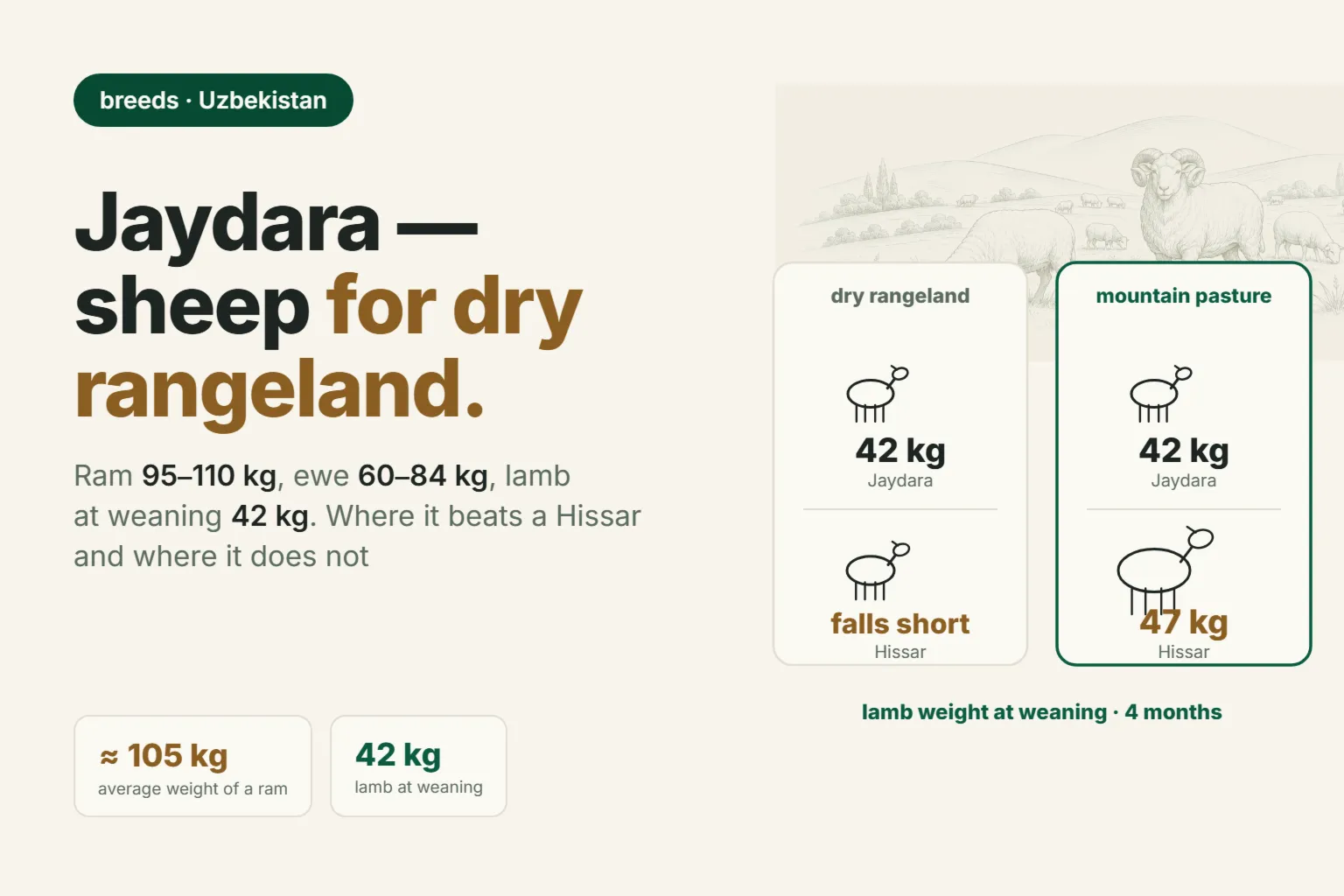
Jaydara (also spelled Jaidara or Jaydari) is a native fat-tailed sheep breed of Uzbekistan, bred for meat and tail fat. A grown Jaydara ram weighs 95–110 kg, around 105 on average, a ewe 60–84 kg, around 74 on average; a lamb comes to weaning at 4 months at 40–44 kg, and the coarse wool clip is 2–3.5 kg over two shearings a year. The main difference between Jaydara and the Hissar breed is not weight but the pasture each was selected for: Jaydara took shape on dry foothills and in semi-desert, Hissar on mountain summer pastures.
Below are the production figures, a comparison with the Edilbay and Hissar breeds, and the arithmetic for a flock of 100 ewes. The main source on the breed is the FAO handbook "Animal Genetic Resources of the USSR", with data from the Uzbek Research Institute of Animal Husbandry. Prices are as of August 2026, converted at 11,818 soum to the dollar (Central Bank of Uzbekistan rate for 25 August 2026).
What Jaydara is and where it came from
Jaydara, also called jaydari, is a local fat-tailed sheep breed shaped by folk selection in the foothills and valleys of central Uzbekistan. This is not imported genetics: for centuries the breed was selected under dry hot summers, thin grass and long moves between seasonal pastures.
Jaydara is kept almost everywhere in the country except two zones: the western deserts and semi-deserts, where the Karakul sheep holds the ground, and the mountain districts of the south, where they keep Hissar. The best flocks historically stood in the Jizzakh region (Gallaaral and Zomin districts), in Samarkand and in Syrdarya.
The colour of a Jaydara is most often black — about two thirds of the stock, roughly a quarter red, the rest grey and brown in various shades. The fat tail is medium-sized and tight, noticeably bigger on rams than on ewes.
By production type Jaydara is a meat-and-fat breed: selection went for meat and tail fat. Farms do take milk, but it is a by-product, not the reason the breed was built.
How much a Jaydara ram weighs and how fast a lamb grows
Live weight of a grown Jaydara ram is 95–110 kg, and the best breeding sires reach 125–128 kg. A ewe weighs 60–84 kg, around 74 on average. That spread is not an accident but a property of a native breed: one flock holds ewes of 60 kg and ewes of 84 side by side.
A Jaydara lamb is born at 5–5.5 kg (the extremes run from 3.5 to 7–9 kg). Growth from there depends on the ewe's milk and on the grass:
| Lamb age | Live weight (normal pasture) |
|---|---|
| at birth | 5–5.5 kg |
| 4 months, weaning — ram lambs | 40–44 kg |
| 4 months, weaning — ewe lambs | 38–41 kg |
| 6–7 months, autumn sale | 45–52 kg |
Daily gain while the lamb is still on the ewe is 280–320 g for Jaydara: from 5.4 kg at birth to about 43 kg in four months. That is the pace the breed delivers out on pasture, with no daily concentrates.
After weaning the gain drops sharply — nothing replaces milk. On autumn pasture with no supplementary feed a lamb adds 50–100 g a day, and in a dry year it can stand still altogether. On a feeding ration with barley and cottonseed meal a ram lamb comes out at 180–220 g a day — less than under the ewe, but predictable; we went through gain targets and how to work them out in a separate piece — how much a kilo of gain costs.
Dressing-out yield for Jaydara is 52–56%, about 55 on average. So a 100 kg live ram gives roughly 55 kg of carcass, tail fat included. A lamb at weaning yields less, 50–53%: it has not laid down much fat yet.
How many lambs a Jaydara gives, and how much milk
Sources disagree on the lambing rate of Jaydara, and it is fairer to say so straight out. Breed handbooks give 130–150 lambs per 100 ewes; the practice of range-based farms is closer to 110–120. Plan on the lower figure: counting on 115 and getting 135 is nicer than the other way round. Twins do happen in Jaydara, but most ewes bring one big lamb — and that is no loss: a single lamb comes to weaning heavier than either half of a pair of twins, and the ewe carries it on pasture without extra feed.
The breed handbooks carry no separate milk measurements for Jaydara. Fat-tailed sheep in general give up to 120 kg of milk over a lactation, and with Jaydara farms usually count on the same order. While the lamb is under the ewe, the milk goes to the lamb; what becomes saleable is what you milk after weaning — usually 35–55 kg per ewe. On a flock of 100 ewes that is 3.5–5.5 tonnes of milk a season, which goes into kurt, suzma and cheese.
Whether to milk or not is a question of arithmetic, not tradition. Milking after weaning no longer affects the lamb's gain, but it takes condition off the ewe before mating, and a thin ewe brings fewer lambs. If your ewes look lean by September, stop milking a month before the ram goes out with the flock.
Jaydara wool is coarse carpet wool, sheared twice a year — in spring and in autumn. The yearly clip is 2–2.5 kg from a ewe and 2.8–3.5 kg from a ram. It brings no real money: coarse fleece is bought for felt and koshma mats at a price where shearing at best covers the shearer's wage.
Jaydara, Edilbay or Hissar — which one to pick?
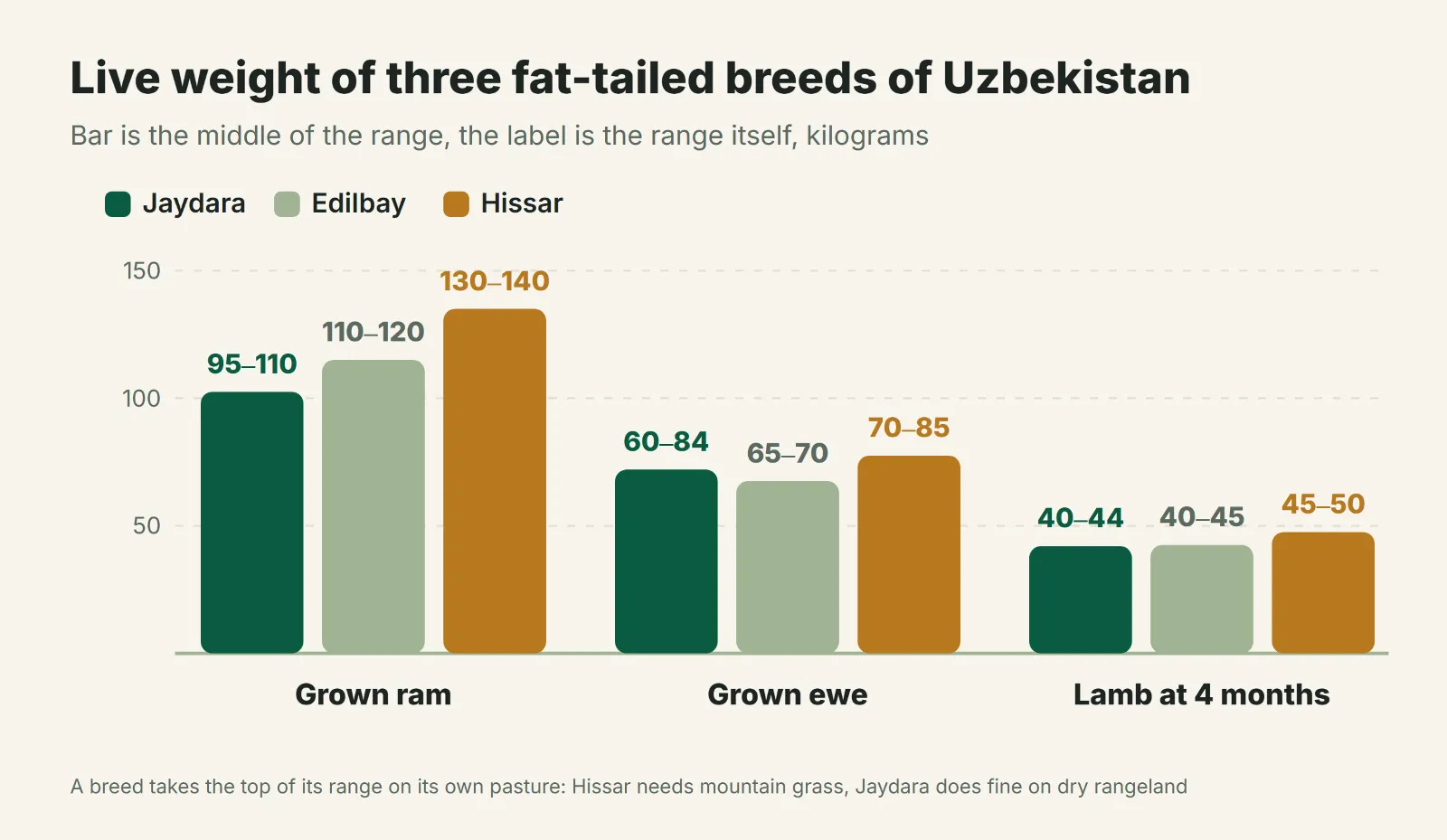
A head-to-head look at the three fat-tailed breeds a farmer in Uzbekistan can actually get hold of:
| Metric | Jaydara | Edilbay | Hissar |
|---|---|---|---|
| Ram, live weight | 95–110 kg | 110–120 kg (up to 150–160) | 130–140 kg (up to 190) |
| Ewe, live weight | 60–84 kg | 65–70 kg (up to 90–100) | 70–85 kg (up to 100–120) |
| Lamb at 4 months | 40–44 kg | 40–45 kg | 45–50 kg |
| Lambs per 100 ewes | 110–150 | 110–120 | 105–115 |
| Wool clip per year | 2–3.5 kg | 2.3–3.5 kg | 1.0–1.6 kg |
| Milk per lactation | up to 120 kg | 150–155 kg | 100–120 kg |
| Dressing-out yield | 52–56% | 50–55% | 55–60% |
| Pasture it was bred for | dry foothills, semi-desert | dry steppe, long drives | mountain range, alpine meadows |
Read this table from the bottom up, starting with the last line. A ram's weight is not what you will get; it is what the breed gives on its own pasture. A 140 kg Hissar grows up where the summer grass is mountain herbage: the breed was developed under year-round pasture keeping and walks drives of 400–500 km without trouble. But on dry rangeland and in semi-desert a Hissar lamb will not reach its breed weight — not because it needs alfalfa and compound feed, but because the breed took shape on a different kind of grazing. A Jaydara on that same pasture still comes to weaning at its own 42 kg. A full breakdown of the big fat-tailed breeds with prices is in the article which sheep breed is heavier.
Edilbay sits between the two: it is bigger than Jaydara on the rams, gives more wool and noticeably more milk — 150–155 kg per lactation — and is just as undemanding about pasture. It has one weak spot: wet and boggy ground.
There is a third path — not choosing between the breeds but combining them: Jaydara ewes are bred to a Hissar ram, and the whole crossbred lamb crop is sold for meat. Such a crossbred ram lamb is 5 kg heavier than a purebred one by seven months — the math for a hundred ewes is in the piece on crossbreeding sheep breeds.
What it costs to get into a flock and what it returns in a year
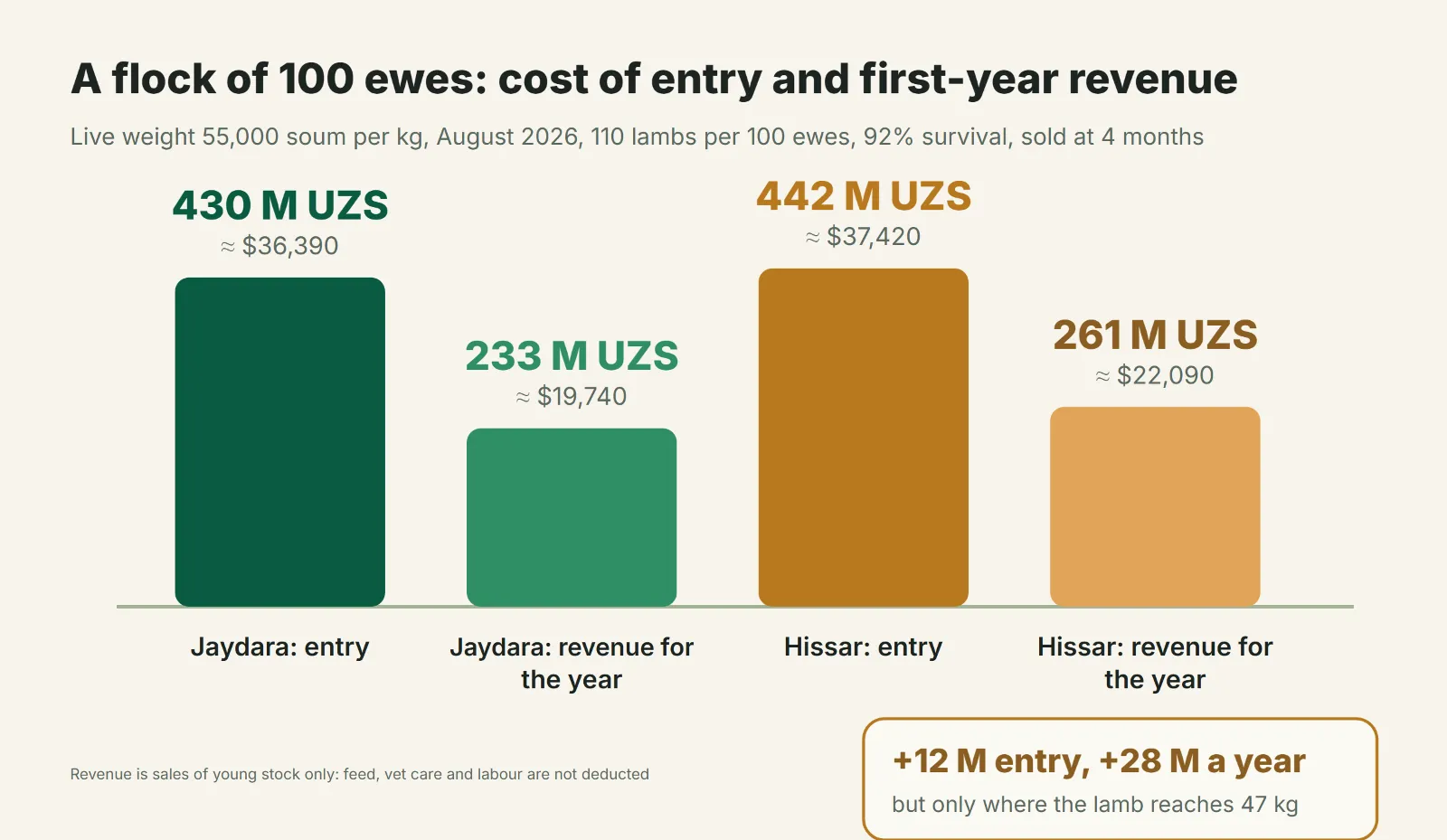
We count by live weight: 55,000 soum per kilo (≈ $4.65) in meat condition, August 2026 prices. The flock is 100 ewes plus 4 breeding rams, lambing rate 110 lambs per 100 ewes, survival to weaning 92%, young stock sold at 4 months.
| Item | Jaydara | Hissar |
|---|---|---|
| Ewe, average weight | 74 kg | 75 kg |
| Price of one ewe | 4.07 million soum (≈ $344) | 4.13 million soum (≈ $349) |
| 100 ewes | 407 million soum (≈ $34,440) | 412.5 million soum (≈ $34,900) |
| 4 breeding rams | 23.1 million soum (≈ $1,955) | 29.7 million soum (≈ $2,513) |
| Total entry | 430 million soum (≈ $36,390) | 442 million soum (≈ $37,420) |
| Lambs to weaning | 101 head | 101 head |
| Lamb weight at sale | 42 kg | 47 kg |
| Revenue per head | 2.31 million soum (≈ $195) | 2.59 million soum (≈ $219) |
| First-year revenue | 233 million soum (≈ $19,740) | 261 million soum (≈ $22,090) |
The first thing the numbers show: by live weight the cost of entry is almost the same — a gap of 12 million soum (≈ $1,020) across the whole flock, under 3%. Ewes of these two breeds weigh about the same, and the familiar "Jaydara is cheaper" is not about weight at all but about the breed premium asked for a Hissar on top of live weight. The size of that premium depends on the seller alone — it is the one place in the deal worth haggling over, and what you should demand in return is papers and pedigree, not words.
Second: on paper the Hissar earns more — plus 28 million soum (≈ $2,350) in the very first year, and the extra paid at entry comes back in a single season. But that line holds exactly where the lamb really does reach 47 kg, that is, on mountain or good steppe pasture.
Hence the practical conclusion. If you have mountain or rich steppe summer pastures, take a Hissar — it will pay back the entry in one season. Dry rangeland, semi-desert, long drives over thin grass — Jaydara: on that feed it delivers its kilos, while a Hissar stays an expensive flock with ordinary gain. To see what fat-tailed stock is on offer right now and at what price, take a look at the sheep and rams for sale in Uzbekistan.
Where Jaydara loses
An honest list of the downsides no seller at the bazaar will mention:
- Smaller at slaughter. Buyers for Qurban Hayit and wholesalers want a big carcass, and they pay a premium for it. Jaydara rarely earns that premium.
- Uneven stock. The breed is native and pedigree work was not done everywhere: one flock holds ewes of 60 kg and ewes of 84 kg. Buying a batch of "Jaydara", you are buying spread, not a standard.
- Wool worth almost nothing. Coarse fleece sells badly, and you still have to shear — that is a cost, not an income.
- Patchy paperwork. Pedigree documents are issued far less readily for a native breed than for imported genetics. And bear this in mind: targeted sheep subsidies in Uzbekistan are currently tied to the import of breeding stock (the measure has been extended to the end of 2030) and to a VAT exemption on such imports until 2029. There is no per-head payment for a domestic breeding ram, the way there is for a pedigree calf.
There is one more point that matters more than the choice of breed. The spread between the best and the worst ewe inside a single Jaydara flock — from 60 to 84 kg — is wider than the difference between breeds in the table above. Until you know which ewe brings a 44 kg lamb and which brings a 30 kg one, you feed both the same and pay for it out of your own pocket. We at QoyHunter — a CRM for sheep record-keeping and the bazar.qoyhunter.com marketplace — see exactly this most often: a farm switches breed when the problem was two dozen ewes that should have been culled long ago. Working it out is easy — it takes weight and daily gain tracking, in a notebook or in an app.
FAQ
How much does a Jaydara ram weigh?
A grown Jaydara ram weighs 95–110 kg, around 105 on average; the best breeding sires reach 125–128 kg. A Jaydara ewe weighs 60–84 kg, around 74 on average. The spread inside a flock is wide — that is normal for a native breed, so it is better to weigh your animals than to judge them by eye.
How is Jaydara different from the Hissar breed?
Jaydara is smaller: a ram of 95–110 kg against 130–140 kg for a Hissar, a lamb at 4 months of 40–44 kg against 45–50 kg. But the main difference is not weight, it is the pasture each breed was bred for. Hissar was developed on mountain range and reaches its 140 kg on alpine summer meadows. Jaydara was selected on dry foothills and in semi-desert, so on thin grass it gives its breed weight and a Hissar does not. On ewe weight the two breeds are nearly equal, and the cost of entry by live weight differs by less than 3%.
How many lambs does a Jaydara bring?
Breed handbooks give 130–150 lambs per 100 ewes; range-based farms in practice get 110–120. Plan on the lower figure. Twins do happen in Jaydara, but most ewes bring one big lamb. If your flock comes in below 100 lambs per 100 ewes, the breed is not the reason — the condition of the ewes before mating and barrenness are.
Are Jaydara sheep milked?
Yes, but milk is a by-product for Jaydara: selection went for meat and tail fat, and the handbooks carry no separate milk measurements for the breed. Fat-tailed sheep give up to 120 kg of milk over a lactation, and what becomes saleable is the yield after the lamb is weaned — usually 35–55 kg per ewe. It goes into kurt, suzma and cheese. Milking after weaning no longer affects the lamb's gain, but it runs the ewe down before mating, so milking is wound up a month before the ram goes out.
Which is better to keep in Uzbekistan in 2026 — Jaydara or Edilbay?
Edilbay is bigger on the rams (110–120 kg against 105) and gives noticeably more milk — 150–155 kg per lactation against 120 for fat-tailed sheep in general — while on ewe weight the breeds are comparable and both are equally undemanding about pasture. The gap in the cost of entry for 100 ewes comes to 30–55 million soum (≈ $2,500–4,650), and it depends far more on who you buy from than on the breed. Edilbay does not like wet or boggy ground — if that is your pasture, take Jaydara.
Manage your flock in QoyHunterCRM for sheep farmers: livestock, health, weighing, finance and analytics — in the app and a Telegram bot.All features →