Hissar Sheep: Weight, Price, and How It Compares to Jaydara and Edilbay
How much a Hissar ram really weighs, what it costs in Uzbekistan in 2026, and when Jaydara or Edilbay is the better choice — verified numbers and a comparison table.
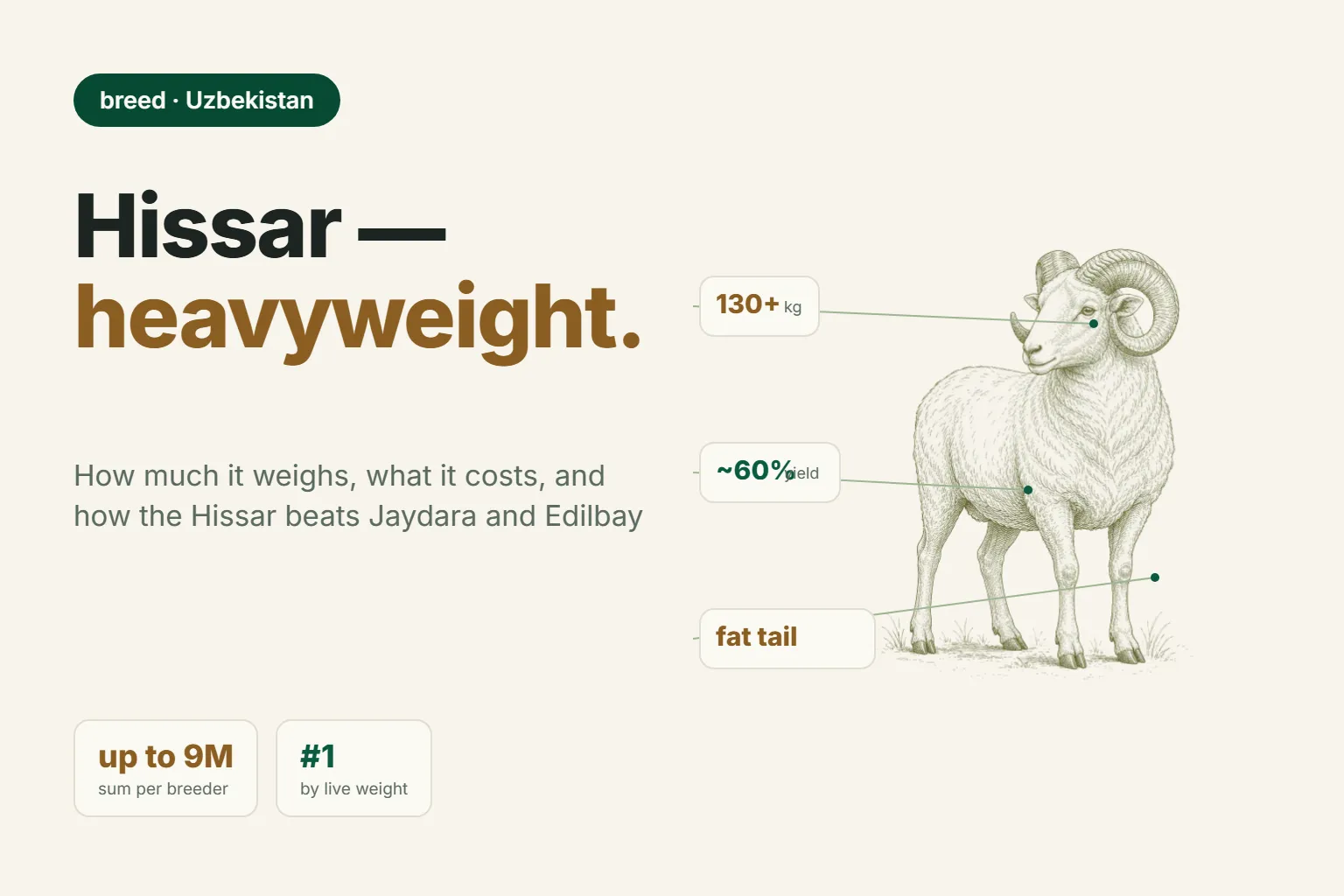
The Hissar is Central Asia's legendary breed and the largest fat-tailed sheep in the world. It is the breed buyers ask for most at Uzbek livestock markets — and the one surrounded by the most myths: "200-kilogram rams," "a fat tail weighing half a centner." Let's sort out what is actually true, how much a Hissar sheep really weighs, what it costs in 2026, and when it beats the more common Jaydara or Edilbay.
How to Recognize a Hissar
You cannot mistake this breed for any other:
- Height. Rams stand 80–90 cm at the withers, ewes 75–80 cm — tall, long-legged animals built for long treks.
- Fat tail (kurdyuk). A large, high-set fat deposit at the base of the tail: 18–20 kg of fat in well-conditioned adults, 30 kg and more in fattened wethers.
- Head. Massive, with a distinctive roman nose and long drooping ears. Both rams and ewes are usually polled (hornless).
- Color. Dark brown, reddish, or black; the wool is coarse and short.
The breed took shape through folk selection in the Hissar Valley (in present-day Tajikistan) and was bred for centuries for transhumant mountain herding: highland pastures in summer, plains in winter. Hence its core qualities — endurance, the ability to cover hundreds of kilometers on grazing alone, and tolerance of both heat and cold. Today the Hissar is raised in Tajikistan, Uzbekistan, Kazakhstan, and Kyrgyzstan; several newer local types in Uzbekistan were developed from it.
How Much Does a Hissar Ram Weigh?
The most asked question — and the main source of myths. The verified numbers:
| Metric | Typical | Best animals |
|---|---|---|
| Ram live weight | 130–140 kg | 180–190 kg |
| Ewe live weight | 80–100 kg | up to 120–135 kg |
| Fat-tail weight | 18–20 kg | 30 kg and more |
| Height at withers (rams) | 80–90 cm | — |
| Wool clip | 1.2–2 kg | — |
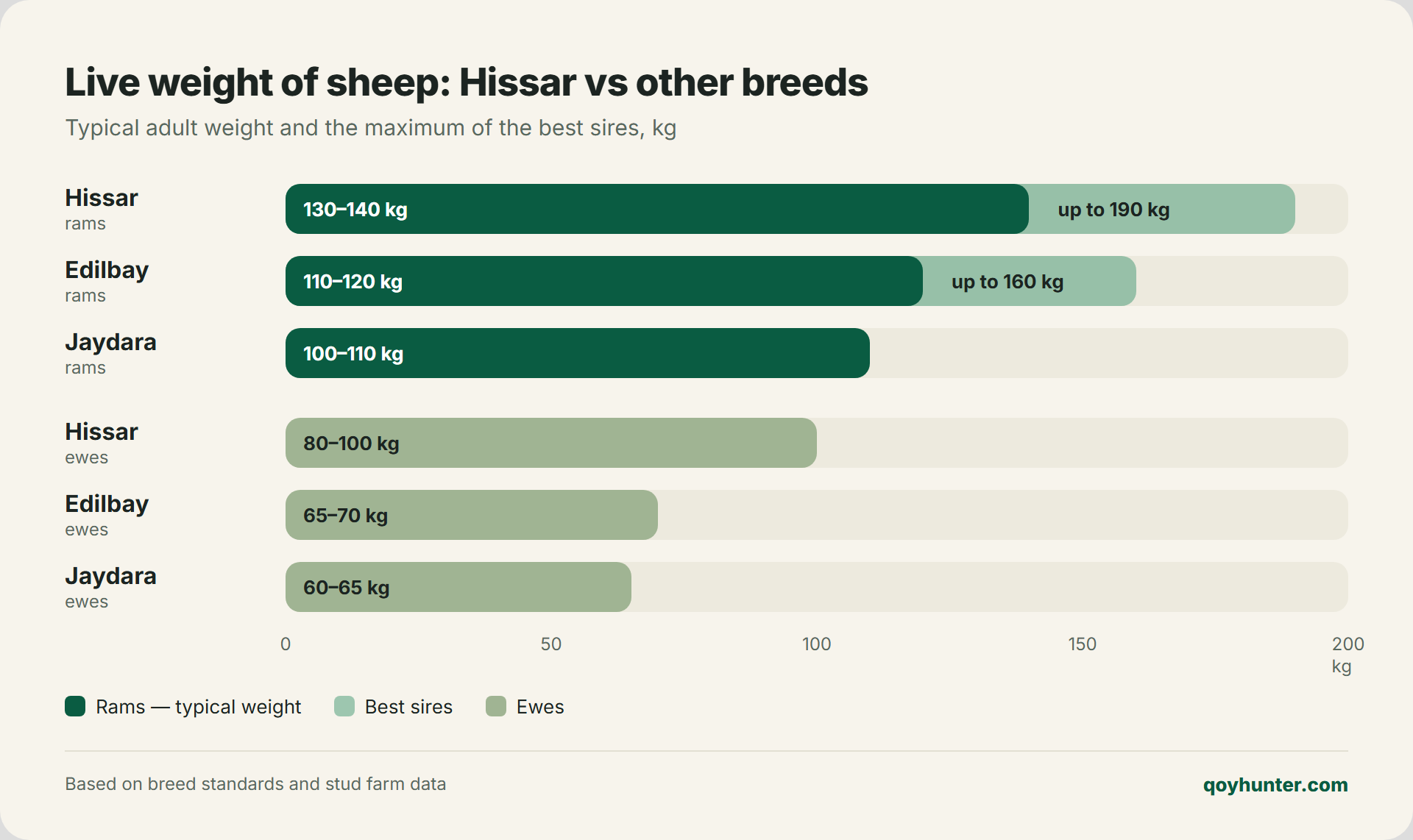
What about the famous "212 kilograms"? That figure keeps wandering from article to article, but it traces back to unverified reports from expeditions of the 1920s and has never been officially confirmed. The honest way to put it: a typical adult ram weighs 130–140 kg, and outstanding sires reach 180–190 kg. That is still enough to remain the largest sheep breed in the world.
Growth Rate: How Fast Do Lambs Gain?
Hissar lambs are born large and grow very fast on their mothers' rich milk: by weaning at 4–5 months, ram lambs weigh 40–50 kg and ewe lambs 35–45 kg. Dressing percentage in young stock is around 50–53%.
Be careful with daily-gain claims: promotional texts love "500–600 grams per day," but such rates occur only during the suckling period under excellent conditions. Actual measured post-weaning feedlot gains are more modest — roughly 130–230 g per day depending on the ration and conditions. When planning a fattening cycle, budget on the lower end — then the economics won't betray you.
The Breed's Weak Points
An honest portrait has to include them:
- Low prolificacy. 105–115 lambs per 100 ewes — almost always singles. Jaydara, by comparison, lambs far better.
- Nearly worthless wool. A clip of just 1.2–2 kg of coarse wool with dead fiber — good only for felt.
- Dislikes damp. The breed was made for dry pastures; wet lowlands and damp sheds are not for it.
Hissar vs. Edilbay vs. Jaydara
| Breed | Rams | Ewes | Prolificacy | Fat tail | Key point |
|---|---|---|---|---|---|
| Hissar | 130–140 kg (up to 190) | 80–100 kg | 105–115% | 18–30 kg | Maximum meat and fat per head; best for transhumant grazing |
| Edilbay | 110–120 kg (up to 160) | 65–70 kg | 110–120% | 12–14 kg | Slightly smaller, but more and better wool (3–3.5 kg) |
| Jaydara | 100–110 kg | 60–65 kg | 130–150% | 10–12 kg | The workhorse breed of lowland Uzbekistan: undemanding and the most prolific of the three |
A simple rule of thumb:
- need maximum carcass weight and fat tail — Hissar;
- need to grow the flock faster — Jaydara: a hundred ewes will give you 25–40 more lambs;
- need a balance of meat and wool — Edilbay.
What a Hissar Ram Costs in Uzbekistan
Based on marketplace listings across Uzbekistan in 2025–2026:
| Animal | Price range |
|---|---|
| Lamb / young ram (8–9 months) | 2.2–3.4 mln UZS |
| Adult ram | 4.5–7.5 mln UZS |
| Large sire of Hissar bloodlines | 9 mln UZS and up |
Prices vary a lot by region, condition, and season: the market peaks before Qurban Hayit and cools off by autumn. Pedigreed sires with documents and outstanding weight sell at negotiated prices that can be several times higher. See our full market breakdown for 2026.
It is convenient to check this breakdown against a live catalogue: Hissar ram sale listings show the current weight, age and asking price for each animal.
When buying a "Hissar," trust the breed markers, not the seller's words: height, roman nose, drooping ears, high-set fat tail — and always weigh the animal. A Jaydara cross costs less and weighs less, yet is often sold at purebred prices.
Bottom Line: Who Should Choose the Hissar
The Hissar is the breed for farmers focused on meat and fat who can give the flock room: pastures, seasonal moves, a dry climate. It forgives sparse feed and heat but does not forgive crowding and damp. If your goal is a fast-growing flock, look at the Jaydara; if it is maximum weight per head — take the Hissar.
You can compare a Hissar with the local Jaydara — on weight, fertility, dressing-out yield and the cost of getting into a flock of 100 ewes — in the article "Jaydara sheep of Uzbekistan: weight, fertility and what a flock earns in 2026".
Manage your flock in QoyHunterCRM for sheep farmers: livestock, health, weighing, finance and analytics — in the app and a Telegram bot.All features →Keeping a flock? Mobile flock weighing records let you track your animals from your phone — weighings, weight gains, treatments — for free. And you can buy or sell rams on the sheep and ram listings catalogue.