
Pumpkin, fodder beet and carrots for sheep: how much to feed a day and at what price they beat hay
Pumpkin, fodder beet and carrot norms for sheep by group (1–2 kg a day for an adult ewe, 2–3 kg for a nursing ewe) and a feed-unit price calculation for autumn 2026: bought pumpkin at 1,200 soum/kg costs 4 times more than alfalfa hay. When root crops pay off and how to feed them without choke and acidosis.
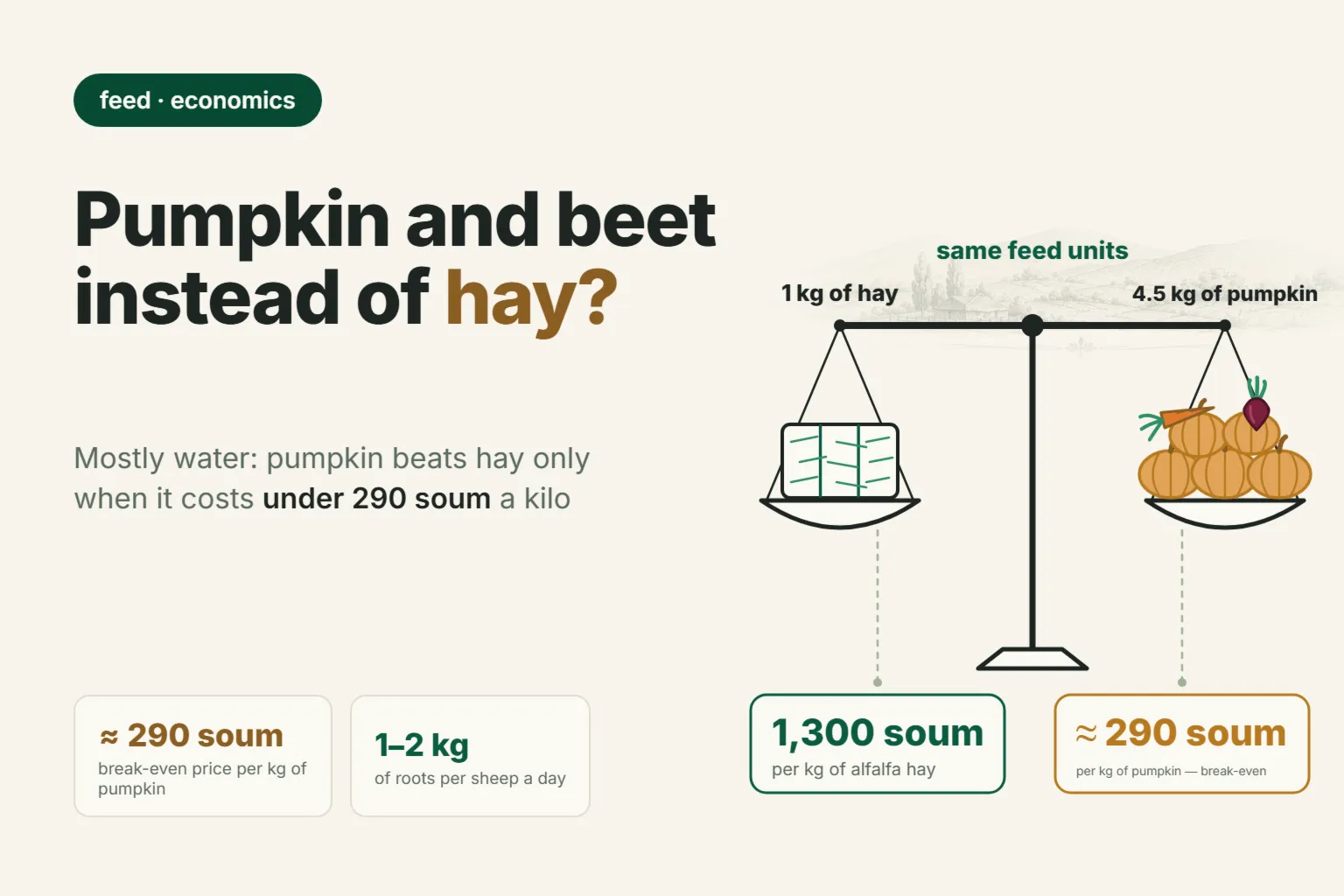
You can feed sheep pumpkin, fodder beet and carrots: an adult ewe in the winter housing period gets 1–2 kg of root crops a day, a nursing ewe 2–3 kg, a pregnant ewe in the second half of pregnancy 1–1.5 kg, and young stock of 6–9 months up to 1 kg. But nearly all their mass is water, and per feed unit, pumpkin and beet bought at the market for 1,000–1,200 soum a kilogram cost the sheep farmer 3–4 times more than alfalfa hay. They pay off in two cases: when you get them almost for free (your own culls, waste, pumpkin cheaper than 290 soum/kg), or when you need them not as calories but as succulent feed for nursing ewes and as carotene for rams before breeding.
Below: the nutrition of each root crop, a feed-unit price calculation at autumn 2026 prices, rations by sheep group, and the mistakes that make root crops kill sheep. The Central Bank of Uzbekistan rate on 3 October 2026 is 11,773 soum per dollar.
How much nutrition is there in pumpkin, beet and carrots?
Root crops and gourds are succulent feeds: they are 76–91% water. That is why a kilogram of pumpkin gives a sheep four and a half times less energy than a kilogram of alfalfa hay.
| Feed | Dry matter, % | Feed units per 1 kg | Digestible protein, g/kg |
|---|---|---|---|
| Fodder pumpkin | 10 | 0.10 | 7 |
| Fodder beet | 12 | 0.12 | 9 |
| Red carrot | 12 | 0.14 | 8 |
| Sugar beet | 23 | 0.24 | 7 |
| Alfalfa hay | 83 | 0.45 | 105 |
| Barley | 85 | 1.15 | 85 |
The data come from reference tables of average feed nutrition in oat feed units; dry matter and protein were cross-checked against the reference book "Norms and Rations for Feeding Farm Animals" (edited by A. P. Kalashnikov, 2003). Actual nutritional value depends on variety and storage. A feed unit is the nutritional value of 1 kg of oats, the general measure of feed energy in animal science across CIS countries.
The table shows the main thing: root crops have almost no protein. A kilogram of fodder beet has almost 12 times less than a kilogram of alfalfa hay. You cannot replace alfalfa or meal with root crops, only part of the energy and the "succulence" of the ration.
At what price are pumpkin and beet cheaper than hay?
Comparing feeds by the price of a kilogram makes no sense. They are compared by the price of a feed unit: the price per kg divided by the number of feed units in a kg. The root crop prices come from OLX.uz listings for September to early October 2026: fodder and sugar beet sold as livestock feed at 1,000 soum/kg (Samarkand, Bukhara, Jizzakh), table pumpkin wholesale at 1,200 soum/kg (Jizzakh region), carrots at 2,500 soum/kg (Karshi). Hay and barley are September 2026 prices from our calculation of the yearly cost of keeping a sheep.
| Feed | Price per 1 kg, soum | Price per feed unit, soum | Same in $ |
|---|---|---|---|
| Alfalfa hay | 1,300 | 2,890 | 0.25 |
| Barley | 3,800 | 3,300 | 0.28 |
| Sugar beet | 1,000 | 4,170 | 0.35 |
| Fodder beet | 1,000 | 8,330 | 0.71 |
| Pumpkin (wholesale) | 1,200 | 12,000 | 1.02 |
| Carrots | 2,500 | 17,860 | 1.52 |
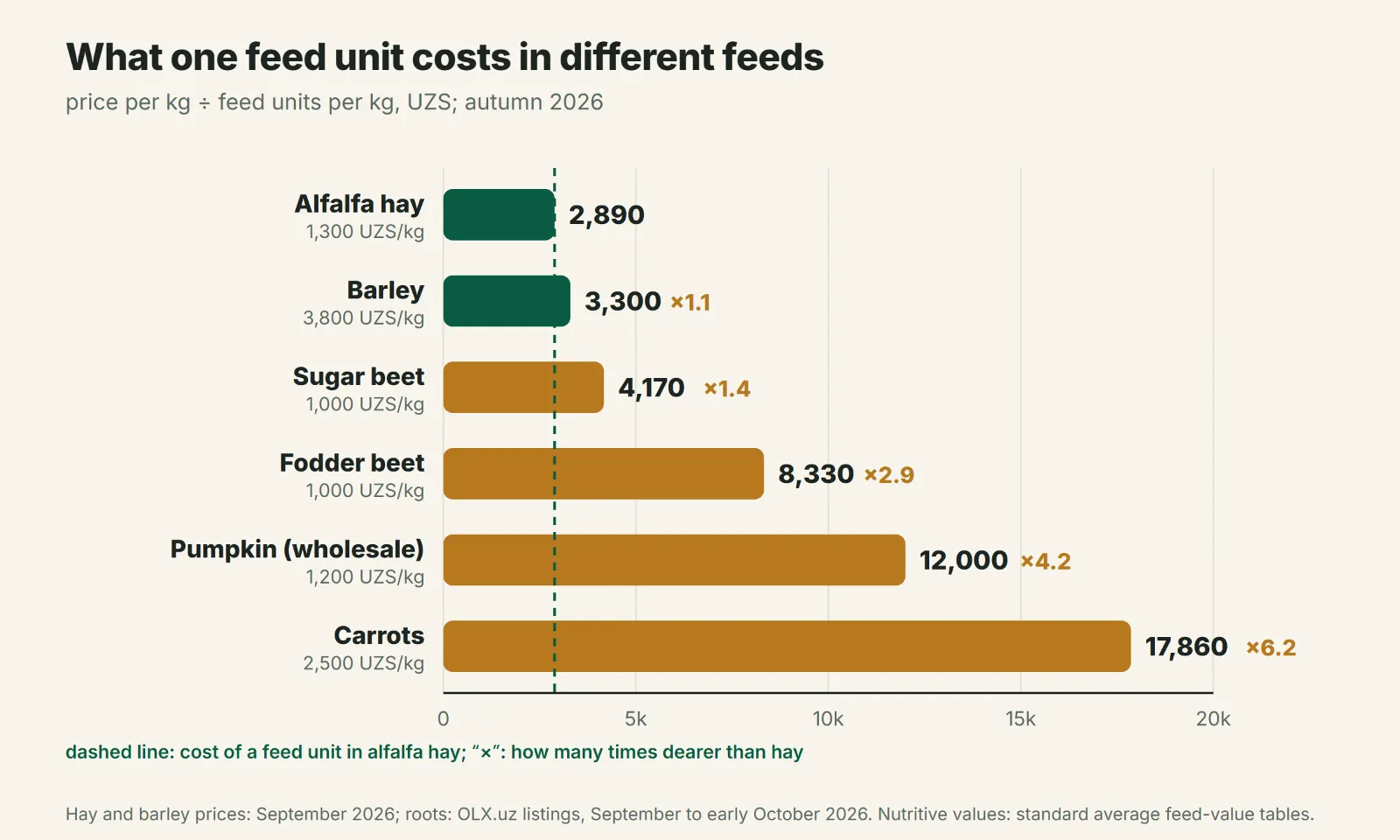 From this comes the price above which a root crop loses to alfalfa hay at 1,300 soum/kg:
- pumpkin: about 290 soum/kg (≈ $0.025);
- fodder beet: about 350 soum/kg (≈ $0.03);
- carrots: about 400 soum/kg (≈ $0.034);
- sugar beet: about 690 soum/kg (≈ $0.06).
In the OLX.uz listings we looked at in September to early October 2026, bought root crops did not fall to these prices. Only things that cost almost nothing sit below the threshold: your own pumpkin from the garden, small and cracked culls after sorting, vegetable warehouse waste. For example, in September 2026 one listing in Tashkent offered fodder pumpkin at 150 soum/kg, which puts the feed unit at 1,500 soum, almost twice cheaper than hay.
How much does a flock overpay when fed bought beet?
Take a flock of 100 ewes and a housing period of 135 days. Each ewe gets 2 kg of fodder beet a day at 1,000 soum/kg.
| Item | Beet | Hay with the same energy |
|---|---|---|
| Per head per day | 2 kg = 2,000 soum | 0.53 kg = 690 soum |
| For 135 days, 100 ewes | 27.0 million soum (≈ $2,290) | 9.4 million soum (≈ $795) |
The overpayment is about 17.6 million soum (≈ $1,500) over the winter for the same energy in the ration. That is roughly the revenue from five rams sold for meat at 60 kg live weight (at 55,000 soum/kg). So bought beet is given as a supplement in small portions to the groups that really need succulent feed, not as a replacement for hay across the whole flock.
So winter money goes first to hay and grain, and root crops get what is left. You can buy hay and compound feed in Tashkent through farmers' listings. Choose hay by bale weight and feed-unit price, which our article on buying hay for sheep covers in detail.
Which sheep need root crops even when they cost more than hay?
Root crops are valuable not for calories but for what winter hay lacks: water in an accessible form, sugar for the rumen microflora and (in carrots and orange pumpkin) carotene, from which a sheep's body makes vitamin A. Hay that has lain all winter keeps little carotene, especially if it is overdried and sun-bleached.
- Nursing ewes. Succulent feed supports milk yield, and the lamb's weight gain in the first month depends on the ewe's milk. Here 2–3 kg of root crops a day support milk yield.
- Pregnant ewes in the second half of pregnancy, 1–1.5 kg: it improves intake of roughage.
- Breeding rams 1–1.5 months before breeding and during it, 0.5–1 kg of carrots: carotene is needed for semen quality.
- Lambs after weaning, up to 1 kg of finely chopped root crops: it gets them used to the housing ration.
Wethers and fattening lambs hardly need root crops: gain comes from energy and protein, and those are cheaper to get from barley and alfalfa.
Root crop norms for sheep by group
| Sheep group | Root crops and pumpkin, kg a day | Best to give |
|---|---|---|
| Dry ewes and ewes in the first half of pregnancy | 1–2 | fodder beet, pumpkin |
| Ewes in the second half of pregnancy | 1–1.5 | fodder beet, carrots |
| Nursing ewes | 2–3 | fodder beet, pumpkin |
| Breeding rams in the breeding period | 1–1.5 | carrots (0.5–1 kg) |
| Young stock 6–9 months | up to 1 | carrots, beet |
| Sugar beet, any group | no more than 1–1.5 | only together with hay |
The norms follow domestic sheep feeding guides and were set on the cautious side. The upper limit for an adult sheep is about 3–4 kg of succulent feed a day, silage included: beyond that the sheep eats less hay.
How to feed pumpkin and beet without harming the sheep
- Cut it up. A hard piece of root lodges in the esophagus. That is choke, after which the rumen quickly bloats with gas. The most dangerous pieces are walnut-sized ones, which sheep swallow without chewing. Cut into thin slices or shreds, carrots lengthwise. What to do about bloat is covered in the article on bloat in sheep.
- Introduce gradually. Start at 0.3–0.5 kg per head and reach the norm over 7–10 days.
- Limit sugar beet. Its sugar ferments fast in the rumen: a sudden switch to 2–3 kg of sugar beet without adaptation can cause acidosis, just like overfeeding barley.
- Do not feed frozen, rotten or sprouted roots. Beet and pumpkin that froze and then thawed can cause diarrhea and, in pregnant ewes, abortions. Cut off moldy sides, throw rotten pumpkin away whole.
- Wash or shake off the soil. Soil on root crops fills the rumen with sand, especially with beet from heavy soils.
- Store them so they do not freeze. Pumpkin keeps 2–4 months in a dry, cool place; fodder beet keeps until spring in a clamp under straw and earth.
Pumpkin seeds are sometimes recommended "against worms". They cannot replace deworming: treatment is done with medicines on a schedule, as in our vaccination and treatment calendar.
How to count what succulent feed costs over the winter
It is easy to underestimate root crop use: 2 kg a day looks like a trifle, but over 135 days for a hundred ewes it is 27 tonnes. Write down how much feed you bought, at what price, and how much goes out daily for each group. Then you can see where the overpayment is and how many days of stock are left. You can do it in a notebook, and in QoyHunter, a CRM for sheep record-keeping and the bazar.qoyhunter.com marketplace, the feed and warehouse stock tracking section keeps a feed directory with stock levels: a purchase goes straight into farm expenses, feeding writes off the stock, and a reminder arrives when stock hits the threshold.
FAQ
Can sheep eat pumpkin?
Yes. An adult sheep gets 1–2 kg of pumpkin a day (a nursing ewe up to 3 kg), cut into thin slices and introduced gradually over 7–10 days. Pumpkin is a succulent feed: it is about 90% water and has 0.10 feed units per kilogram, so it supplements hay but does not replace it. Do not feed rotten or frozen pumpkin.
How much beet can a sheep get per day?
Fodder beet: 1–2 kg for a dry ewe, 1–1.5 kg for a pregnant one and 2–3 kg for a nursing one. Sugar beet: no more than 1–1.5 kg a day and only together with hay, because its sugar ferments fast in the rumen and a sharp overfeed can cause acidosis.
What is more profitable for sheep in winter, beet or hay?
Hay, if the beet is bought. At autumn 2026 prices from listings, a feed unit in alfalfa hay costs about 2,890 soum and in fodder beet at 1,000 soum/kg about 8,330 soum. Beet beats hay only if it costs less than 350 soum/kg, meaning it is your own or culls for almost nothing.
Why give carrots to rams before breeding?
Carrots are a source of carotene, from which the body makes vitamin A, and stale winter hay has little of it. A breeding ram gets 0.5–1 kg of carrots a day from 1–1.5 months before breeding and through it, which supports semen quality.
Why did the sheep choke on beet and what should I do?
A hard piece of root lodges in the esophagus and the rumen starts to bloat with gas. Cut root crops into thin slices or shreds. If a sheep has choked, with drooling, a stretched-out neck and bloating on the left side, call a vet urgently: the vet removes the piece with a tube or by flushing. Do not push it down yourself with a hose or a stick, as you can tear the esophagus.
Manage your flock in QoyHunterCRM for sheep farmers: livestock, health, weighing, finance and analytics — in the app and a Telegram bot.All features →