How to Track Farm Income and Expenses: Categories, a Ledger, and the Real Cost of One Ram
A farm income and expense ledger: which categories to use, what to log for every operation, and why a notebook's profit figure comes out five times too high. A calculation for one feeder ram at August 2026 prices.
Tracking farm income and expenses means keeping an operations ledger: every expense and every payment gets logged on the day it happens, with a date, a category, and an amount. Five categories are enough for a sheep farm: feed, vet care and medicines, buying animals, labor and services, sales. At the end of the month the categories add up, and instead of just "how much cash is in my pocket," you see what the flock actually cost you and what it actually earned.
Below: which fields belong in every record, which categories to set up on a sheep farm, and a calculation at August 2026 prices — what one feeder ram actually cost, and why a notebook came up with a profit five times higher than the real number. Exchange rate used throughout: 11,795 sum per dollar (the Central Bank of Uzbekistan's rate on August 20, 2026 was 11,794.88).
What to Record for Each Operation
A record without these fields is useless: three months from now, a line that just says "feed — 400,000" won't tell you what it was, how much, or from whom.
| Field | What goes in it | Why it matters |
|---|---|---|
| Date | the day the money came in or went out | otherwise the month won't add up |
| Type | income or expense | determines the sign of the amount |
| Category | feed, vet care, buying animals, labor, sale | categories build your expense breakdown |
| Amount and currency | sum or dollars, whichever the deal was actually in | livestock in Uzbekistan is often traded in dollars |
| Linked to | an animal, a group, or a batch of feed | without this you can't work out the cost per head |
| Note | "cottonseed cake, 3 bags, from the neighbor" | you'll be glad it's there six months from now |
There's one rule: log the operation on the day it happens. A ledger filled in once a month from memory loses the small cash expenses — and those are exactly what piles up into "miscellaneous."
Which Categories to Set Up on a Sheep Farm
Five expense categories are enough for any farm in Uzbekistan — from twenty head to a thousand. The shares in the table below come from a 100-head flock calculation we walked through in our article on how to calculate profit per head.
| Expense category | What falls under it | Share of annual expense |
|---|---|---|
| Feed | hay, alfalfa, barley, cottonseed cake, bran, mineral supplements | 55–60% |
| Labor and services | shepherd's pay, shearing, slaughter, vet call-outs | 25–30% |
| Buying animals | feeder lambs, a breeding ram | 5–15% |
| Vet care and medicines | vaccines, dewormers, treatment | about 5% |
| Transport and other | hauling, water, ear tags, sheepfold repairs | about 5% |
There are usually four income categories: selling animals for meat, selling breeding stock, raw materials (wool, hides, milk), and government subsidies. Keep them separate: selling for meat and selling breeding stock are different money and different work, and lumped together they look the same.
If "miscellaneous" adds up to more than a tenth of your expenses, that means everything's getting dumped into it. Break it out by category — you can't see where the slack is in one big pile.
What One Ram Actually Cost: A Calculation for August 2026
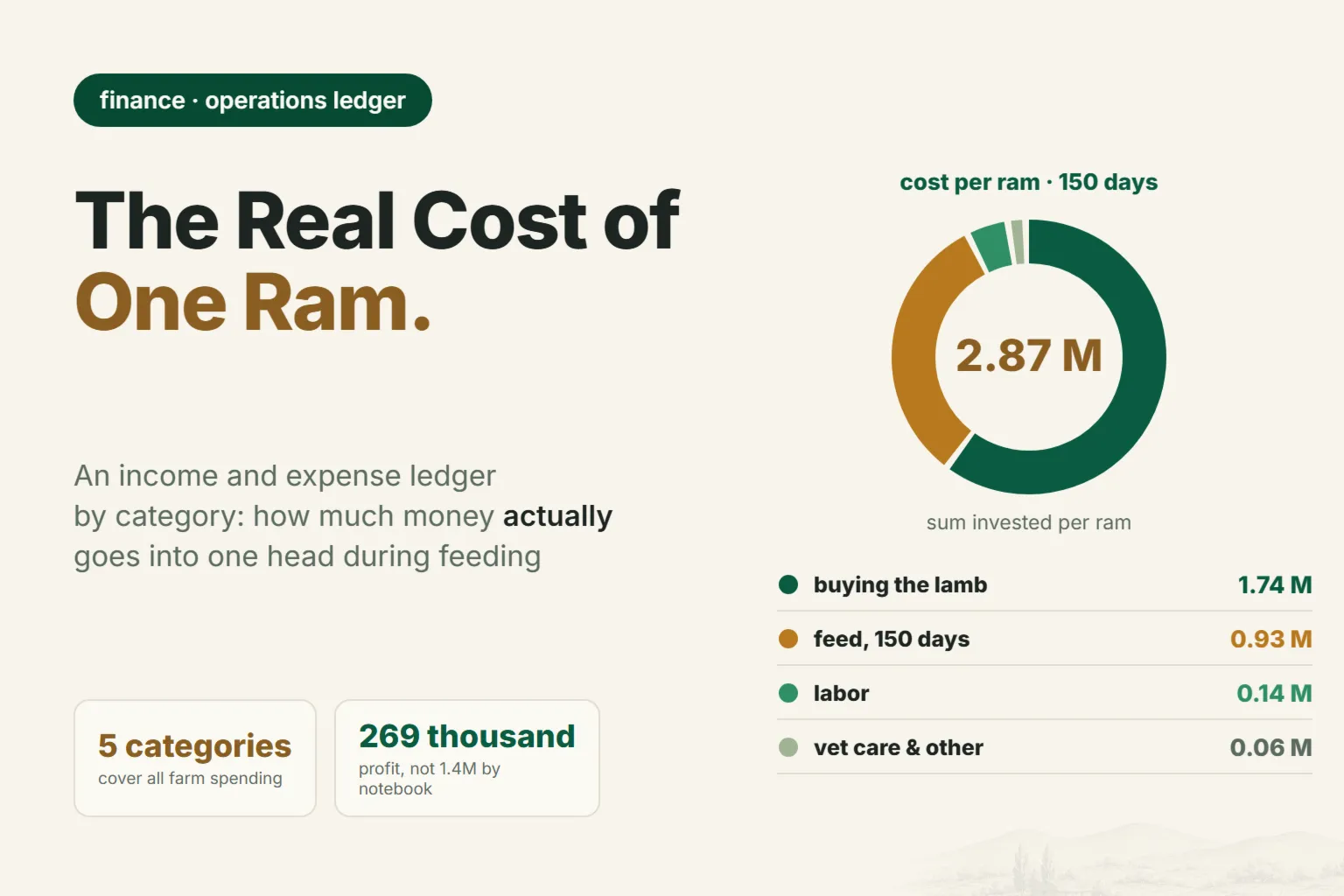
A farm bought a lamb weighing 28 kg live weight in March and sold it in August at 55 kg — a gain of 180 g a day over 150 days on feed.
| Expense item | Calculation | Amount |
|---|---|---|
| Buying the lamb | 28 kg × 62,000 sum/kg | 1,736,000 sum |
| Feed for 150 days | 6,200 sum a day per head | 930,000 sum |
| Labor (shepherd's share) | 28,000 sum a month × 5 months | 140,000 sum |
| Vet care and medicines | treatments and vaccines for the period | 30,000 sum |
| Transport and other | water, ear tags, hauling | 30,000 sum |
| Total invested | 2,866,000 sum (≈ $243) |
Sold for 3,135,000 sum (55 kg × 57,000 sum/kg, ≈ $266). The real profit on this ram is 269,000 sum — about $23 for five months of work.
Now here's the same ram by the notebook's math: "bought for 1.74 million, sold for 3.14 million — made 1.4 million sum." That's five times the real number, and the whole gap sits in the lines that never made it into the notebook: feed, labor, vet care, transport.
Notice the entry price: feeder lambs run about 62,000 sum a kilo, while a finished ram sells for 57,000. The kilo you buy costs more than the kilo you sell, and that's normal — feeding makes money on the weight gain, not on the price per kilo. Which gives you a working rule: as long as a kilo of gain costs less than a kilo of live weight, feeding pays off. We cover how to work out that number in our article on the cost of a kilogram of live weight gain.
Why the Notebook's Profit Is Always Higher Than the Real One
A sale is remembered whole; expenses are remembered in pieces. Three million sum for a ram sticks in your memory. Six thousand sum a day on feed doesn't — even though over five months that's nearly a million.
Cash out of your pocket doesn't get logged. You pay for a bag of bran at the bazaar, hand cash to your helper, fill up on gas — the money's gone, but no record shows up anywhere.
Nothing is linked to the animal. You have a total for feed, but not what any one ram actually cost. Which means you can't compare two feeding groups against each other or tell which batch of lambs actually paid off.
Your own labor and your own hay get treated as free. In that case the farm only "feeds you" to the exact extent that you're not paying yourself a wage.
There's only one notebook, and it goes missing. It gets rained on, left in the truck, carried off by the shepherd — and a year's worth of records disappears with it.
Let's be honest: for ten to twenty head and two sales a year, a notebook is enough. Keep it careful and that's all you need. A spreadsheet beats a notebook because it adds things up for you, but it has two problems of its own: the file sits on a computer while you're out in the field, and it usually gets filled in after the fact, from memory. The gap starts to matter once you're past fifty head, feeding runs in groups, and sales aren't one-off events.
What Tracking by Category Gets You
You see where the money actually goes, not where you assume it goes. Feed eats up more than half of expenses for everyone — that's normal for sheep farming. But if your share runs noticeably higher, the problem usually isn't the price per bag, it's animals that have stopped gaining and are still eating. Before you cut the ration, check your bag price against current barley and cottonseed cake listings — half of "expensive feed" often just turns out to be buying at the wrong time of year.
You see whether a feeding group is paying off. A group's total expense divided by its weight gain is exactly the cost per kilogram. You can't work that out without linking operations to animals.
You have something to show the bank. Subsidized livestock loans and subsidies are granted against documents, not against your word — you need an export of operations for the period, with dates and amounts.
How This Works in QoyHunter
QoyHunter is a CRM for tracking sheep, paired with the bazar.qoyhunter.com marketplace. The Finances screen shows your farm's income, expenses, and profit for a selected month or period, broken down by category.
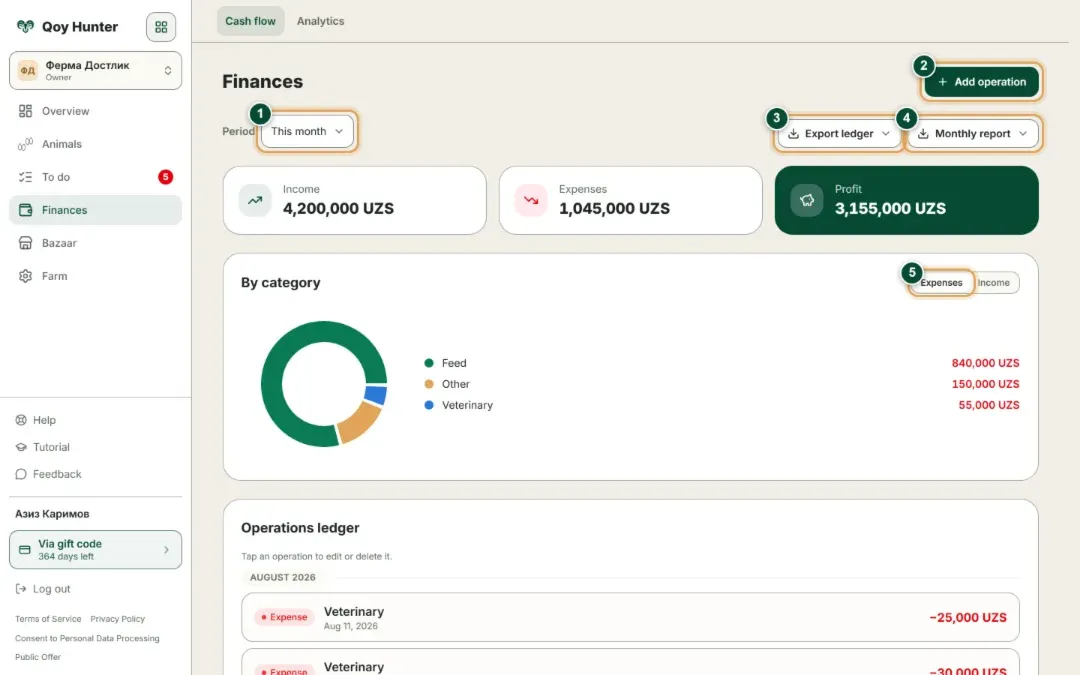
At the top you pick a period, and three numbers show up right away: income, expenses, profit. Below that is a ring chart of the breakdown by category, which toggles between expenses and income — feed, medicines, sales. Underneath sits the operations log, every entry by date. The "Export ledger" button downloads the operations into a file for bookkeeping and farm records, and "Monthly report" puts together a ready summary of income, expenses, and profit for the period.
A new operation is a single form: operation type (expense or income), category — feed, medicines, vet care, buying animals, shearing, or a sale — amount and currency.
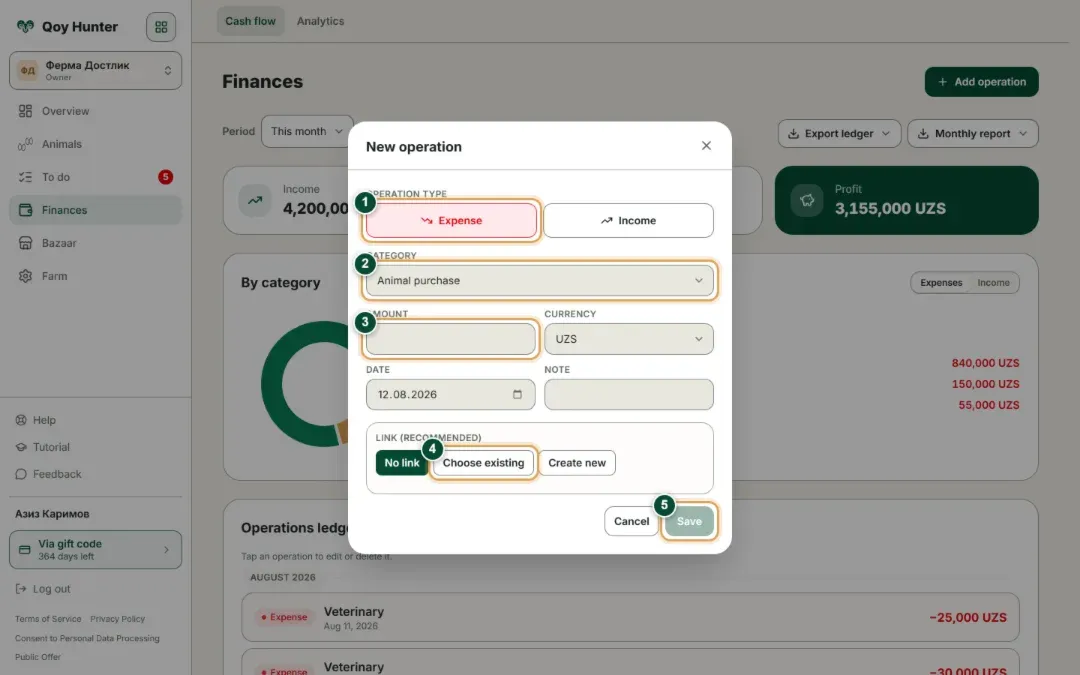
The most important field here is the last one: you link the operation to an animal or to feed. That link is exactly where the cost and profit for each ram comes from — the number a notebook can never show you. Some operations create themselves: buy an animal, sell one, draw feed or medicine, and the entry lands in the ledger without any manual typing.
The screens and the full workflow are covered in detail on our page about farm income and expense tracking software.
Where to Start If You've Never Tracked This Before
- Set up five expense categories and four income categories — you don't need more than that.
- Write down your cash balance today and your headcount today. That's your starting point — don't try to reconstruct the past.
- For one month, log everything on the day you spend it, including small cash purchases.
- At the end of the month, look at the share each category takes. Even the first month will show you where the money's going.
- From the second month on, link operations to animals and groups — that's when the cost per head shows up.
Three months in, you'll have something most of your neighbors don't: a real figure for what it costs to keep one head, and a clear picture of which feeding group makes money and which one just eats through feed.
FAQ
What expense categories do you need on a sheep farm?
Five are enough: feed, labor and services, buying animals, vet care and medicines, transport and other. By our calculation for a 100-head farm in Uzbekistan, feed takes 55–60% of annual expenses, labor 25–30%, and the rest splits between buying animals, vet care, and everything else. If "other" climbs past a tenth of your expenses, that means everything's getting dumped into it — break it out by category.
How do you calculate the cost of one ram?
Add up everything invested in it over the period: the purchase price (or a share of the ewe's upkeep, if it's home-bred), feed for the days on feed, a share of labor costs, vet care, and transport. At August 2026 prices, a feeder ram bought as a 28 kg lamb and sold at 55 kg costs the farm about 2.87 million sum (≈ $243) and sells for 3.14 million sum (≈ $266) — a profit of around 269 thousand sum per head.
Is a notebook enough for tracking farm finances?
For ten to twenty head and two or three sales a year, yes — as long as you log on the day you spend and don't skip cash purchases. A notebook stops working once feeding runs in groups and you need to compare batches against each other: it has a total for feed, but nothing to work out the cost for one specific animal.
Why link an operation to an animal?
So you know what that specific head actually cost. Without the link, all you see is the total spend on the flock, and a successful feeding group looks identical to a losing one. With the link, you can immediately see which batch of lambs paid for itself in weight gain and which one ate through more feed than the gain was worth.
Do you need income and expense records for a subsidy or a loan?
Yes. Subsidized loans and livestock subsidies in Uzbekistan are issued against documents: you need an export of operations for the period, with dates and amounts. A ledger that exports to a file settles this in a minute; a notebook has to be copied out by hand.
Manage your flock in QoyHunterCRM for sheep farmers: livestock, health, weighing, finance and analytics — in the app and a Telegram bot.All features →