Average Daily Gain in Sheep: How to Calculate It, What's Normal, and Why You Can't See It by Eye
Average daily gain is the difference between two weighings divided by the days between them. Here's the normal range for fat-tailed breeds on feed, how often to weigh the flock, and what a 30-gram-a-day difference actually costs you.
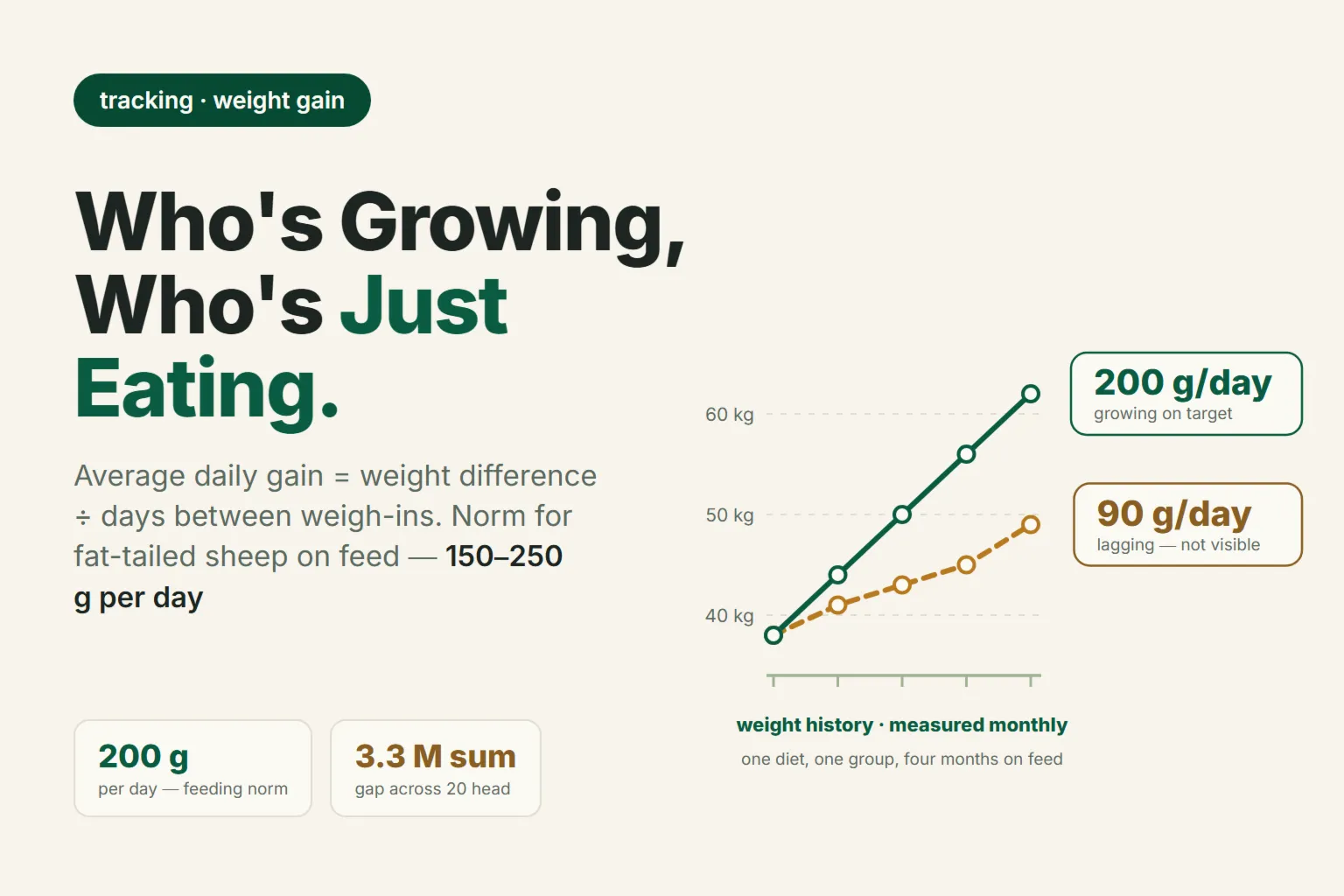
A sheep's average daily gain is the difference between two weighings, divided by the number of days between them. Weigh on June 1 at 42 kg, weigh again on July 1 at 48 kg: (48 − 42) ÷ 30 = 0.2 kg, or 200 grams a day. For Uzbekistan's fat-tailed breeds — Hissar, Edilbay, Jaidara — the norm during the main feedlot phase is 150–250 grams a day, while lambs still on the ewe, before weaning, put on 250–350.
This number isn't for paperwork. Average daily gain shows two things nothing else can: whether the feed you bought is paying for itself, and whether an animal in the flock has gotten sick before it's visible to the eye. All figures below use August 2026 prices; the Central Bank of Uzbekistan rate on August 21, 2026 was 11,847 sum per dollar.
What Is Average Daily Gain and How Do You Calculate It?
Average daily gain is how many grams of live weight an animal puts on per day between two weighings. Here's the formula:
(Today's weight − weight at the last weighing) ÷ number of days between measurements = average daily gain.
Example. An Edilbay ram weighed 38 kg on April 12, 2026, and 47 kg on May 26. That's 44 days between the two weighings. (47 − 38) ÷ 44 = 0.205 kg, or 205 grams a day.
Two mistakes that wreck the whole calculation:
- Rounding the interval to "about a month." Between April 12 and May 26 there are neither 30 nor 45 days — there are 44. Calculate it as "a month" and you get 300 grams instead of 205, an overstatement of almost 1.5x. Even a one-week error on a month-long interval throws the gain off by about 20%.
- Weighing one animal and applying the result to the whole flock. The spread inside a single group is huge: at an average gain of 200 grams, some rams will give 280, and others just 90.
What Counts as a Normal Gain for Sheep in Uzbekistan?
Gain drops as the animal gets heavier: a bigger ram eats more but puts on less. Here are the benchmarks for fat-tailed breeds on feeds available in Uzbekistan (alfalfa hay, barley, corn, wheat bran, cottonseed cake):
| Animal group | Housing conditions | Gain, g/day |
|---|---|---|
| Lambs before weaning | on the ewe, with concentrate supplementation | 250–350 |
| Young stock, starting feedlot weight 30–45 kg | hay + concentrates, barn-fed | 200–250 |
| Feedlot, 45–60 kg | hay + concentrates, barn-fed | 170–200 |
| Finishing, 60–75 kg | intensive barn feeding | 120–160 |
| Young stock on pasture | grass + 0.5 kg barley supplement | 150–180 |
| Adult ewe, not lactating | maintenance ration | 0–50 |
The practical takeaway from the table: 200 grams a day is normal for a 40 kg ram, and an excellent result for a 70 kg one. You can't judge the same number without knowing the animal's current weight.
Hissar lambs before weaning can gain up to 400 grams a day — it's the fastest-maturing of the fat-tailed breeds.
If your numbers fall below the lower bound for the animal's current weight for more than two weighings in a row, it's not the breed. Look for the cause in water, diet, or parasites.
Why Can't You Judge Gain by Eye?
An experienced sheep farmer really can tell whether an animal is putting on weight or standing still. But he can't see the difference between 170 and 200 grams a day — and that's exactly the gap where the money is.
Let's do the math. A difference of thirty grams a day adds up to 3 kg per head over a 100-day feeding cycle. Live weight for a meat ram in August 2026 goes for 55,000–65,000 sum per kilogram; taking the conservative low end — 55,000 sum/kg (≈ $4.6) — three kilograms works out to 165,000 sum per head (≈ $14), and for a group of 20 head, 3.3 million sum (≈ $279) per feeding cycle. That's the price of a gap you can't see with your eyes but can see on a scale.
The second loss is quieter and hurts more. The group's average gain can look normal while five animals inside it have been gaining half as much as the rest for months — worms, bad teeth, or they can't reach the feeder because of crowding. You're feeding them a full ration and getting half the gain back. Without individual weighings, animals like these only surface at sale time — when the buyer picks the best ones and these five stay with you.
How Often Should You Weigh, and How Do You Measure Correctly?
During feeding — every 21–30 days. More often than that doesn't help: day-to-day live weight swings from rumen fill and watering reach 2–3 kg, and over a short interval that noise drowns out the real gain. Weigh lambs at birth and at weaning, and ewes before breeding and before lambing, to assess body condition.
Rules for the weighing itself:
- In the morning, before feeding and watering. Otherwise you're measuring rumen contents, not meat.
- The same scale and the same time of day, every time. Consistency matters more than accuracy: a scale that's off by a steady 1 kg is still fine for calculating gain, but switching scales from month to month isn't.
- Record the exact date of the weighing, not just the month. Gain is calculated in days, and "sometime in June" turns the calculation into a guess.
If you can't run the whole flock across a scale, set up a control group: 10–15% of the flock, but at least 20 head, typical in age and weight. Their gain becomes the batch's gain. You can also estimate weight without a scale using a tape measure — chest girth and body length — a method and table we covered in How to estimate a sheep's weight without scales. The tape's margin of error is ±5–10%, which is fine for tracking trends but not for settling up with a buyer.
What Should You Do If Gain Drops?
Gain drops before an animal starts looking sick. It's the cheapest problem sensor on the farm, and you already have it.
What to check if gain drops while the ration stays the same:
| What happened | How it looks in the numbers | Where to look |
|---|---|---|
| Not enough water | gain drops for the whole group at once, in summer | waterers, volume, water temperature |
| Parasites | gain sags in 3–5 animals from the group, the rest are normal | timing of the last deworming |
| Poor-quality hay from a new cutting | drop right after switching feed batches | quality and protein content of the batch |
| Crowding at the feeder | the smallest animals in the group fall behind | feeding-space per head |
| Heat above +38 °C | drop across the board, recovers by autumn | shade, feeding time |
This number does a second job too — economics. As long as a kilogram of gain costs less than a kilogram of live weight sells for, feeding pays off; the moment it costs more, you're feeding the ram out of your own pocket. How to calculate the cost per kilogram of gain by feeding phase, and where the breakeven point is, is covered in detail in How much does a kilogram of gain cost. If the drop comes from feed, you can compare prices and find a replacement in the same place — where to buy hay, barley and cottonseed cake — as of August 24, 2026, the feed and supplies section had 48 listings.
Where Should You Keep Records: Notebook, Excel, or an App?
The right record-keeping method depends on the size of your operation, and a notebook is a perfectly normal choice for a small one.
| Method | Works for | Where it breaks down |
|---|---|---|
| Notebook | up to 10–15 head | you have to calculate gain in your head for every date; you can't compare animals against each other; the notebook gets lost along with the entire history |
| Excel on a computer | 20–100 head, if you're used to spreadsheets | gets filled in from memory in the evening, not in the pen; the spreadsheet is unreadable on a phone; one typo in a formula breaks the calculation for the whole flock |
| Phone app | any flock size | you need to set up the flock once and get in the habit of recording on the spot |
The difference isn't in the recording itself — it's that a notebook and Excel store weight, while decisions are made based on gain, a number you still have to calculate from the dates for every animal. With ten head, you can do that math in your head over an evening. With fifty, nobody does, and the records turn into an archive nobody opens.
How to Track Weighing in QoyHunter
QoyHunter is a CRM for sheep record-keeping plus the bazar.qoyhunter.com marketplace. The weighing section covers exactly the part of the job where a notebook and Excel break down: it calculates gain for you.
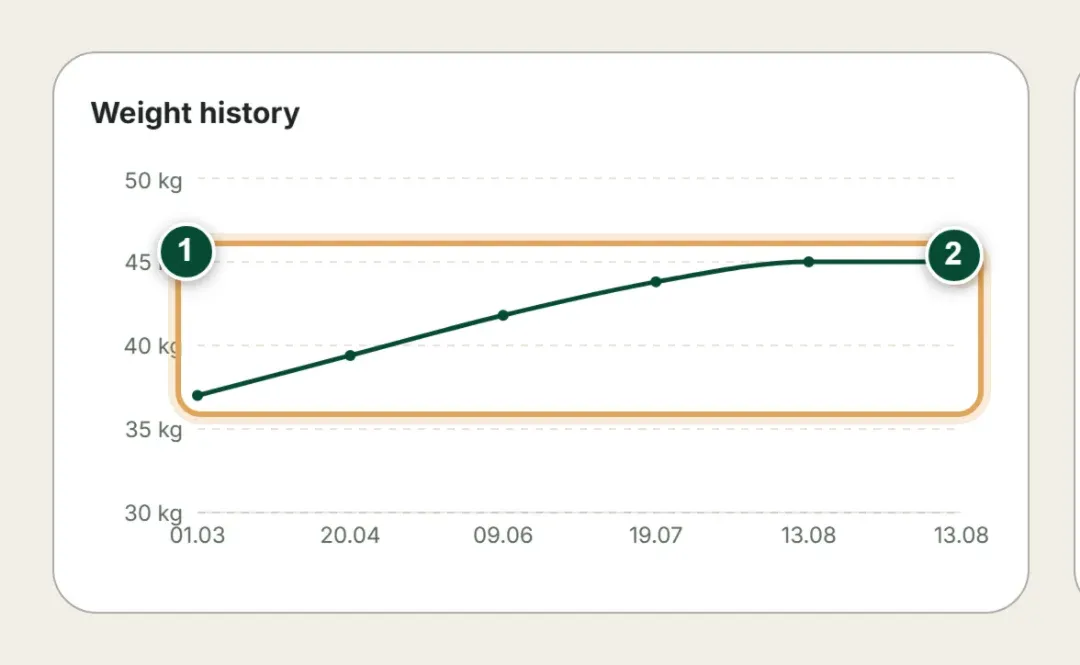
Every weighing lands on the animal's weight history chart — you can see at a glance whether a ram is climbing or has stalled. The system calculates the average daily gain itself: it takes the first and last measurement, divides the difference by the number of days between them, and shows a ready number for every animal — no manual date math required. The most recently entered weighing becomes the animal's current weight, and every point on the line stays a separate measurement with its own date.
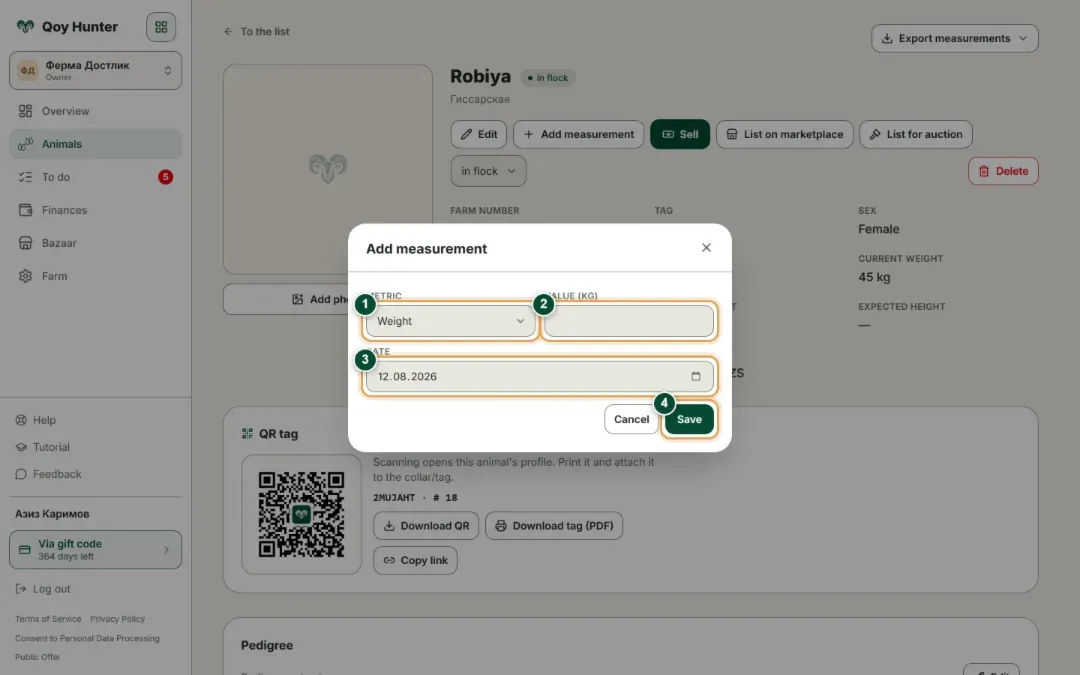
A new measurement is added with the Add measurement button on the animal's card. In the window, you pick the metric — weight or height at the withers — enter the value in kilograms and the date of the measurement; only the value and the date are required. Once saved, the measurement goes into the history, and the weight chart updates right away.
Reminders keep you from missing the next weighing — on a month-long interval that's the main risk, because a missed measurement doubles the next interval and blurs the picture. For everything else the section does, and what it looks like on a phone, see the weighing and daily gain records for sheep feature page.
In Short
- Average daily gain = (today's weight − previous weight) ÷ number of days between measurements.
- The norm for fat-tailed breeds during the main feeding phase is 150–250 g a day; at finishing weight, 60–75 kg, gain naturally drops to 120–160.
- Weigh during feeding every 21–30 days, in the morning before feeding, on the same scale, recording the exact date.
- No scale for everyone — use a control group of 10–15% of the flock, at least 20 head.
- A difference of 30 g a day comes to 165,000 sum per head over 100 days of feeding (≈ $14) and 3.3 million sum for 20 head (≈ $279).
- A drop in gain on the same ration is a signal: water, parasites, a feed batch, crowding, heat.
FAQ
How do you calculate a sheep's average daily gain?
Subtract the weight at the last weighing from today's weight and divide by the number of days between the two dates. For example, a ram weighed 38 kg on April 12, 2026, and 47 kg on May 26: (47 − 38) ÷ 44 days = 0.205 kg, or 205 grams a day.
Count the days exactly from the calendar, not "about a month": a one-week error on a month-long interval throws gain off by about 20%, and a two-week error by nearly 50%.
What's a normal gain for a Hissar ram on feed?
For Uzbekistan's fat-tailed breeds — Hissar, Edilbay, Jaidara — the norm during the main barn-feeding phase is 150–250 grams a day. Young stock at 30–45 kg on a good ration gain 200–250 grams; at finishing weight of 60–75 kg, gain naturally drops to 120–160 grams.
You can't judge the number without accounting for current weight: 200 grams is normal for a 40 kg ram and an excellent result for a 70 kg one.
How often should you weigh sheep on feed?
Every 21–30 days. More often than that doesn't help: the live weight of the same ram swings by 2–3 kg over the course of a day from rumen fill and watering, and over a short interval those swings will drown out the real gain.
Weigh in the morning before feeding and watering, on the same scale every time, and record the exact date of the measurement.
Can you estimate gain without a scale?
Yes, using a tape measure for chest girth and body length — the margin of error for this method is ±5–10%. That's fine for tracking the trend in gain, because the error is roughly the same on both measurements and partly cancels out when you subtract.
The tape isn't good enough for settling up with a buyer at sale: 10% of a 60 kg ram is 6 kg, which comes to 330,000 sum (≈ $28) at the conservative August 2026 price.
Why did gain drop even though the feed stayed the same?
In summer, the first thing to check is water: in ordinary weather, an adult ram needs 6 liters a day, but at heat above +38 °C it drinks 10–12 liters or more, and an empty waterer stops gain within a day. Next most common are parasites (only 3–5 animals from the group fall behind, not the whole group), a new hay batch with a different protein content, and crowding at the feeder, where smaller animals simply can't get enough space.
If gain drops for the whole group at once, look for the cause in water, heat, or the feed batch. If individual animals sag while the group average stays normal, it's about the health of specific animals — and without individual weighings you won't find them.
Manage your flock in QoyHunterCRM for sheep farmers: livestock, health, weighing, finance and analytics — in the app and a Telegram bot.All features →