Why Meat Is Getting More Expensive in Uzbekistan in 2026 — and What It Means for Farmers
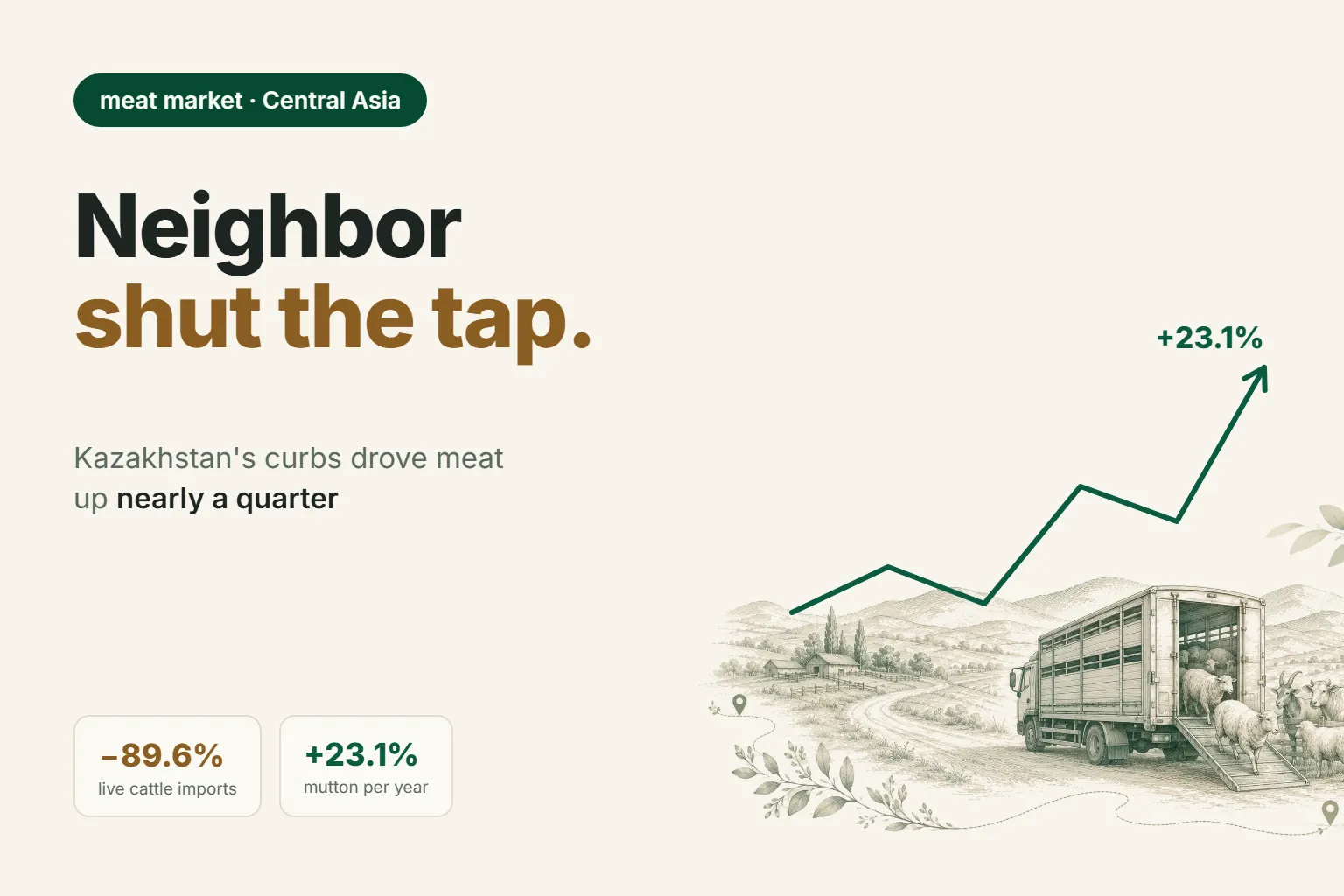
In Uzbekistan, mutton prices rose 23.1% year-on-year by June 2026, while cattle imports from Kazakhstan collapsed by almost 90%. We break down what's behind the rise in meat prices and why, for a farmer, it's both a risk and a window for expanding the herd.
If you sold sheep at the bazaar this year, you've seen it yourself: meat is getting more expensive faster than almost anything else. And behind the price rise isn't one shop or middleman, but an entire chain of events that started back in autumn 2025, next door in Kazakhstan.
Ahead: exactly how much prices have risen, why that happened, what the government is doing, and what all of this means for your farm.
How Much More Expensive Has Meat Gotten
Let's start with the numbers.
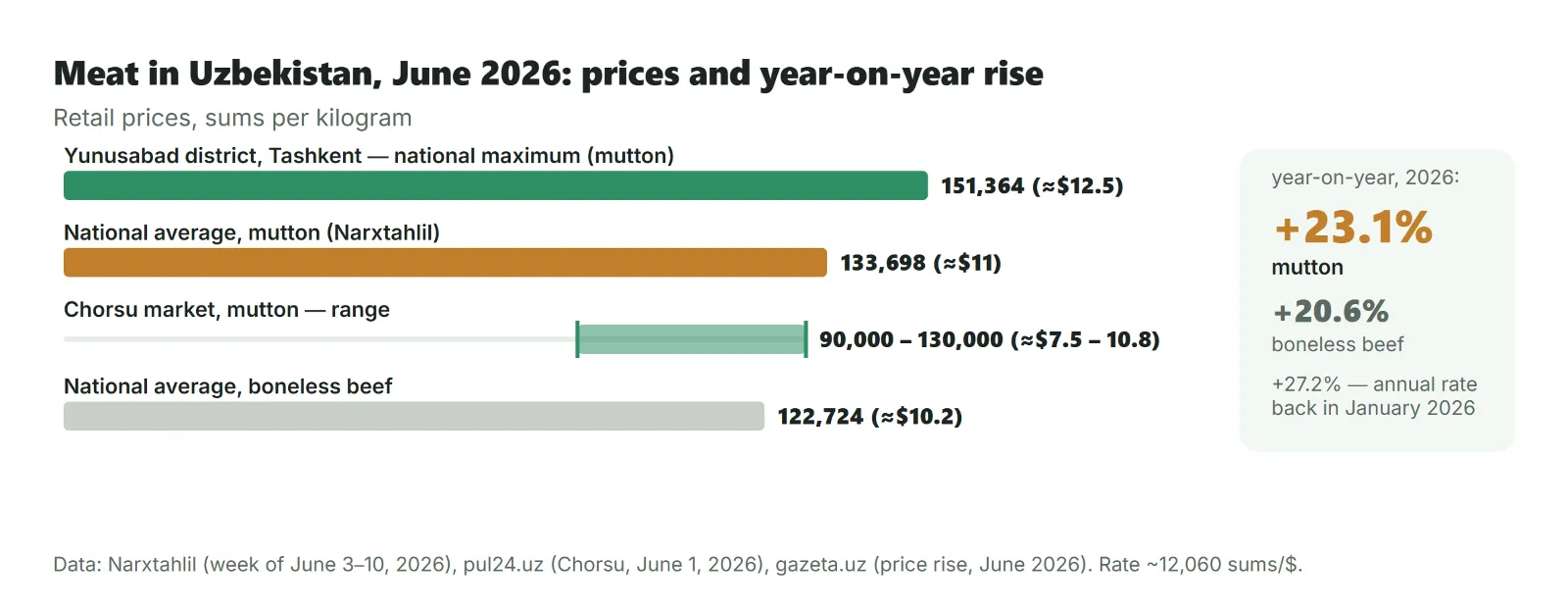
According to official statistics for June 2026 (published by gazeta.uz on July 6, 2026), mutton prices rose 23.1% year-on-year, and boneless beef rose 20.6%. For comparison, overall inflation in the country over the same period was 6.4% year-on-year. In other words, meat prices are rising three to four times faster than the economy's "average price tag."
Here's what that looks like at the counter:
| Where / what | Price, June 2026 | In dollars |
|---|---|---|
| National average, mutton (Narxtahlil monitoring, June 3–10) | 133,698 sums/kg | ≈ $11 |
| Maximum, Yunusabad market (Tashkent) | 151,364 sums/kg | ≈ $12.5 |
| National average, boneless beef | 122,724 sums/kg | ≈ $10.2 |
| Chorsu market, mutton (pul24.uz, June 1, 2026) | 90,000 – 130,000 sums/kg | ≈ $7.5 – 10.8 |
This isn't a one-off spike. In January 2026 alone, mutton rose about 17% in a single month, and year-on-year through January it was up 27.2%. It's no surprise that in a Central Bank survey (nuz.uz, June 23, 2026), 54% of people named meat and dairy as the main driver of the inflation they feel.
What's Happening with Imports
For years, Uzbekistan covered part of its demand for meat with livestock and beef from Kazakhstan. That's exactly where the knot has tied itself.
Starting in autumn 2025, Kazakhstan began restricting livestock exports through a series of orders — first with cyclical, six-month measures, then tightening them further in spring 2026:
- Starting April 12, 2026, a ban took effect on exporting breeding females (mother stock) — that is, reproductive females — of cattle and small ruminants (sheep and goats). The ban runs for 6 months. The logic is simple: the neighbors are keeping the animals their own herds' future depends on.
- A quota on lambs older than 4 months — 120,000 head per half-year (order dated June 1, 2026). This is a recurring, half-yearly measure: the exact same quota had already been in effect since November 2025.
- The ban on exporting bull calves has been extended through November 1, 2026.
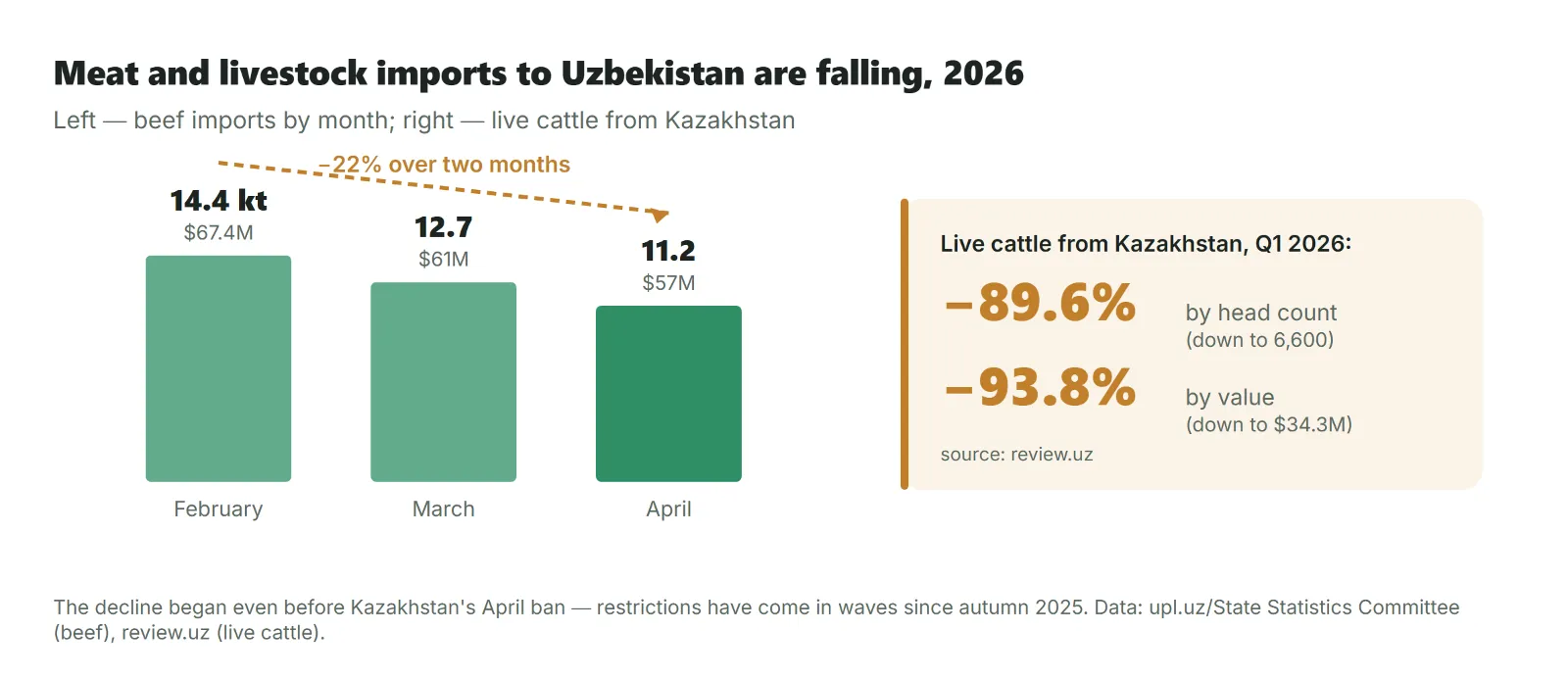
The result for Uzbekistan shows up in the foreign trade figures. In Q1 2026, imports of cattle from Kazakhstan collapsed 89.6% by head count (down to 6,600 head) and 93.8% by value (down to $34.3 million), according to review.uz. Live livestock has almost stopped coming into the country.
Imports of ready beef are falling too: February — 14,400 tons ($67.4 million), March — 12,700 tons ($61 million), April — 11,200 tons ($57 million). The trend started even before the April ban — precisely because restrictions next door have been coming in waves since autumn 2025.
An honest caveat is in order here. No one has officially stated that prices in Uzbekistan rose specifically because of Kazakhstan's restrictions — there's no direct link drawn in 2026 documents. But the coincidence in timing is hard to miss: the channel of cheap imports narrowed, and against that backdrop domestic prices climbed. This is an analytical conclusion, not an official position — but for planning your farm, it matters more than any official statement.
What the Government Is Doing
The authorities are responding systemically, with an outlook spanning several years.
The key document is Resolution PP-179 dated May 12, 2026, a livestock development program for 2026–2028. Its goals by the end of 2028: bring the cattle population up to 16.5 million, sheep and goats up to 30 million, poultry up to 141 million head, and meat processing up to 50%. The same decree also created a separate Agency for Livestock and Pasture Development.
For farmers, the program contains three things that genuinely change the math:
- Cheap loans. Starting July 1, 2026 — loans for terms of up to 10 years, with a 4-year grace period, at 10% annual interest. The limit for purchasing breeding cattle, sheep, and goats is up to 5 billion sums (≈ $415,000) per farm.
- Cheap funding for banks. Uzbekistan's Agricultural Support Fund allocates up to 1 trillion sums a year (≈ $83 million) at 6%, plus a separate $50 million line from FRRUz at 6% over 10 years, channeled through Xalq Bank and Mikrokreditbank.
- VAT exemption on imports of breeding cattle, sheep, and goats — from June 1, 2026 through January 1, 2029. If you're importing pedigreed livestock, you won't be charged tax on that import.
In parallel, the government is tackling the meat shortage "here and now." Since April 2026, a temporary subsidy has covered air freight for imported meat, and the authorities have opened a new procurement channel — sheep from Mongolia, flown in literally by plane. We cover that story in detail in the article "Why Uzbekistan Is Flying In 200,000 Sheep From Mongolia".
What This Means for Your Farm
Let's put it all together and see what follows for a specific farm.
A rare combination is forming: high meat prices (meaning high revenue per head — we covered what a live ram costs today in the article "How Much Does a Ram Cost in Uzbekistan in 2026") plus cheap credit at 10% plus zero VAT on breeding-stock imports. In effect, the government is right now pushing farms to grow their herds and is willing to help cover the cost of entry. For anyone who's long been thinking about expanding, this is exactly the kind of window that doesn't open often.
You can check in a minute whether that price has reached your district: sell rams at the current price shows up in fresh listings with weights, not in average reports.
But a window isn't a guarantee. Before taking out a loan and buying more breeding females, honestly weigh the risks:
- Feed gets more expensive in winter. High meat prices won't help if you have nothing to feed the flock. Calculate wintering costs in advance — they can eat up the entire gain from expensive meat.
- Losses eat into your margin. The bigger the herd, the more expensive every lost animal becomes. Expanding without veterinary control and record-keeping just dissipates money instead of growing it.
- 10% annual interest is still debt. The rate is preferential, but you'll still have to pay interest. A loan only makes sense against a clear-eyed calculation, not just "because they're offering it."
- The feeding cycle runs about 6 months. A ram you put on feed today, you'll sell in six months. And by then prices may have changed: the neighbors' bans are set for 6 months, and the program is boosting supply — so today's record price isn't carved in stone.
Bottom Line
The rise in meat prices in 2026 isn't a fluke or sellers' greed — it's the consequence of a major shift: the usual import channel has narrowed, and domestic production is now valued like never before. The government is responding with money — cheap loans and tax breaks stretching several years ahead.
For farmers, this is both a risk and an opportunity. The opportunity: expand on favorable terms while prices are high and money is cheap. The risk: take on debt against a price tag that could sag in six months. The difference between these two outcomes comes down to whether you work out your farm's economics in advance. If you're thinking about expanding from scratch, start with our piece "Sheep Farming: A Business From Scratch" — and plan by the numbers, not by market mood.
Better to work this out before the loan than after: profit-per-head analytics for last year shows whether the farm can carry the payment if meat prices fall back to 2024 levels.
Manage your flock in QoyHunterCRM for sheep farmers: livestock, health, weighing, finance and analytics — in the app and a Telegram bot.All features →