Why Uzbekistan Is Flying In 200,000 Sheep From Mongolia
Uzbekistan is flying sheep in from Mongolia on cargo planes through Navoi airport — roughly 100,000 head in 2025, with the program's target already raised to 200,000. We explain what the Bayad breed is, why it's flown in by air, what state support comes with it, and what this "air bridge" means for your farm.
A cargo plane touches down at Navoi airport. Its hold carries no equipment or mail — just live sheep: around 1,000 head per flight, roughly 37 tons. On August 16, 2025, one such plane completed the first flight of the state program to bring livestock in from Mongolia. Flights have been running by the dozen ever since.
A country with millions of sheep of its own is flying more in from thousands of kilometers away. The reason is simple: meat prices are rising, neighboring Kazakhstan has restricted livestock exports, and the government is betting on rapid imports to grow the national flock. Here's what's being imported, why by air, and what it means for the Uzbek farmer.
What the government has planned: from 100,000 to 200,000 head
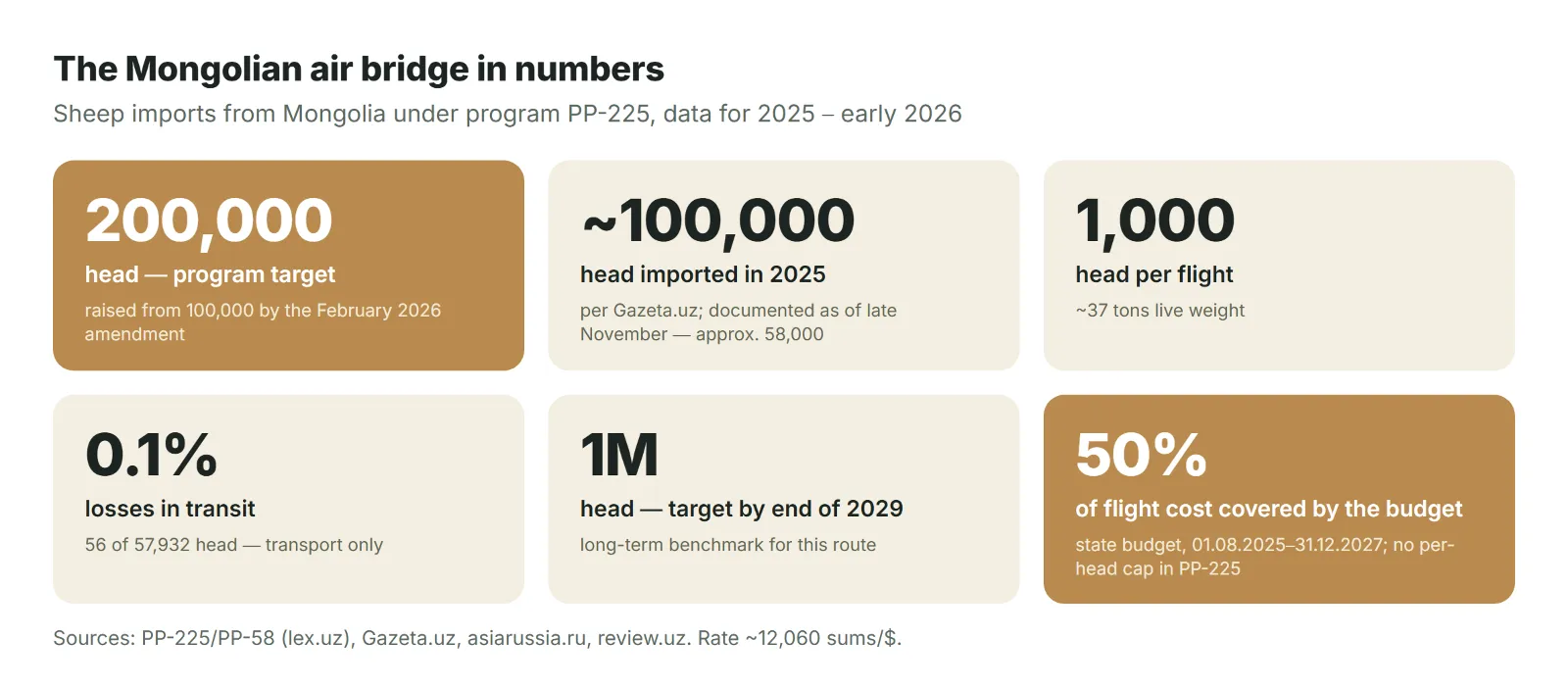
The legal basis is Resolution PP-225, dated July 17, 2025. It originally called for bringing in 100,000 head of small ruminants from Mongolia. The bar was raised in 2026: an amendment, Resolution PP-58 of February 11, 2026, raised the target to 200,000 head, with an additional 70,000 to go to the Navoi region in 2026–2027.
Here's how execution is going:
- By the end of 2025 — roughly 100,000 head (a retrospective estimate, per Gazeta.uz, February 2026). The documented figure as of late November 2025 is more modest — about 58,000 head.
- The state program's first flight — August 16, 2025: one plane brought in 1,000 sheep (37 tons).
- By the end of October 2025, the plan called for 60 flights and 50,000 head — and, as of late October, it had been met.
- Losses in transit are minimal: 56 deaths out of 57,932 head, about 0.1% (deaths during transport, not disease).
- The long-term target is 1 million head on this route by the end of 2029.
The Bayad breed
The breed being brought in is the Mongolian coarse-wool Bayad. It's a steppe fat-tailed sheep, and its traits are known primarily from the FAO reference guide:
- rams weigh around 72 kg, ewes around 56 kg;
- fat tail — 2–4 kg;
- dressing percentage — 45.4%;
- wool clip — 2.0 kg per ram and 1.6 kg per ewe;
- fertility is low, twins are rare.
Against local breeds, the Bayad is small. The Hissar sheep is larger, with a much heavier fat tail: a standard adult Hissar weighs up to 191 kg, meaning a Bayad ram's weight is only a bit more than a third of a top Hissar's. The Bayad also lags behind the Hissar in dressing percentage, and especially in fat-tail size. For more on the breed most valuable to the region, see our article "The Hissar Sheep Breed".
Bayads are smaller than Hissars, but the program is betting on three of their qualities:
- scale — they can be sourced hundreds of thousands of head at a time;
- hardiness — the breed is adapted to heat, cold, and sparse pastures (gov.uz cited exactly this as the reason for the choice);
- price — the Mongolian steppe sheep is noticeably cheaper than elite breeding stock.
The goal is to grow the country's overall livestock numbers quickly and cheaply; improving the genetics of any single flock isn't the point.
Why by air, not overland
Officials have not given an official explanation for why air transport was chosen specifically. But the context suggests the logic. Uzbekistan shares no border with Mongolia — any overland route transits two or more countries. A pilot truck shipment on a similar route (Uzbekistan–Kyrgyzstan–China–Mongolia, 4,500 km, organized by the Ministry of Transport and the Chamber of Commerce and Industry) gives a sense of the timeline: it took 8 days (per Daryo, June 2025) — and that was ordinary cargo, not live animals. But even that is an optimistic benchmark: for sheep, the same days on the road mean far more stress, weight loss, and risk of death.
Inside the country the same arithmetic works in your favour: live livestock delivery across Uzbekistan takes hours rather than days, and weight loss is measured in percent rather than tens of percent.
Against that backdrop, a plane that delivers a thousand head in a few hours with about 0.1% mortality looks expensive but predictable. An important caveat: the actual per-head air freight rate has not been publicly disclosed — it's only known that the state covers part of it (more on that below).
What the state offers program participants
The program targets importers and farms, not one-off buyers. Key support measures under PP-225:
- 50% compensation for air freight costs from the state budget — between August 1, 2025, and December 31, 2027. The resolution's text sets no upper limit on the payout per head. (Not to be confused with a similarly worded limit — up to 4 million sums per head — introduced in 2026 for a separate measure covering imports of pedigree cattle, not small livestock from Mongolia.)
- VAT payment deferral — with no collateral and no interest. Note: this is a deferral, not an exemption from the tax.
- Preferential loans for importers — for 5 years (2 of them preferential) at 10% annual interest.
- Pastures in seven regions, for those who import 1,000 head or more.
In other words, the state is deliberately lowering the entry threshold for those willing to import livestock in large batches.
What this means for your farm
Even if you have no plans to import anything from Mongolia, the program affects you — here's how.
- Future pressure on young-stock prices. Hundreds of thousands of extra head mean, down the line, more young-stock supply on the domestic market. For a buyer of young stock, that's more likely a plus; for a seller, it's a reason to watch prices.
- A chance to take part. Compensation for half the freight cost, a VAT deferral, preferential loans, and pasture access for imports of 1,000+ head are real tools for anyone with the scale and appetite to get into importing.
- Competition for pastures. Land for imported livestock is allocated in seven regions. Where pasture is already tight, there will be more claimants for grazing land.
- Part of a bigger government bet. The Mongolian import is just one piece of Resolution PP-179 (May 2026), which targets 30 million sheep and goats by the end of 2028. The backdrop: rising meat prices (mutton, per Gazeta.uz, rose 27.2% year-over-year by February 2026) and Kazakhstan's fall restrictions on livestock exports.
Until supply grows, the seller sets the price: buy young sheep now through current listings is the simplest way to see where the market stands before the imports arrive.
And — to be honest about what we still don't know. How Bayads will adapt to Uzbekistan's climate, what kind of lambing rate they'll produce on local pastures, whether the import will pay off — there's no public data on this yet. The breed's fertility, per the FAO reference guide, is low, and as of this article's publication there had been no news about the imported flocks' acclimatization or first lambing. So for now this is a large-scale, expensive, and largely untested experiment — one worth watching, with conclusions to be drawn from the facts as they emerge.
Manage your flock in QoyHunterCRM for sheep farmers: livestock, health, weighing, finance and analytics — in the app and a Telegram bot.All features →