
Sheep Farming as a Business: How Much to Invest and When It Pays Off
How much to invest in a flock, how the increase is calculated, and when sheep pay off in Uzbekistan. Startup costs, income models, state support, and beginners' mistakes.
Sheep farming is one of the most straightforward ways to enter agriculture in Uzbekistan: demand for mutton keeps growing steadily, and the flock reproduces itself. But "buy some sheep and get rich" doesn't work: without proper calculations, a feed base, and veterinary care, a newcomer loses money in the very first winter. Let's be honest about it: where to start, what it costs, and what you can realistically expect.
Where to Start: Flock and Breed
A minimum working flock to start with is 20–50 ewes and one or two breeding rams. Under free (pasture) mating, the ratio is roughly one ram per 25–50 ewes. Keeping fewer than a dozen ewes barely makes sense as a business: the income won't cover the labor and feed.
Breed choice depends on your goal:
- Meat and fat (the main route for beginners) — Hissar or Jaidara. Hissar sheep are larger; Jaidara are more prolific and hardier on flat terrain.
- Karakul (lambskin pelts) — the Karakul breed. This is a separate business with its own technology and export market, harder to start with.
- Wool and milk — not relevant for local meat-and-fat breeds: the wool is coarse and cheap, and there's practically no commercial sheep-milk market in Uzbekistan.
Bottom line: for a beginner, two income models are realistic — fattening young stock for meat and selling young stock for breeding. Build your calculations around these.
How Much You Need to Invest
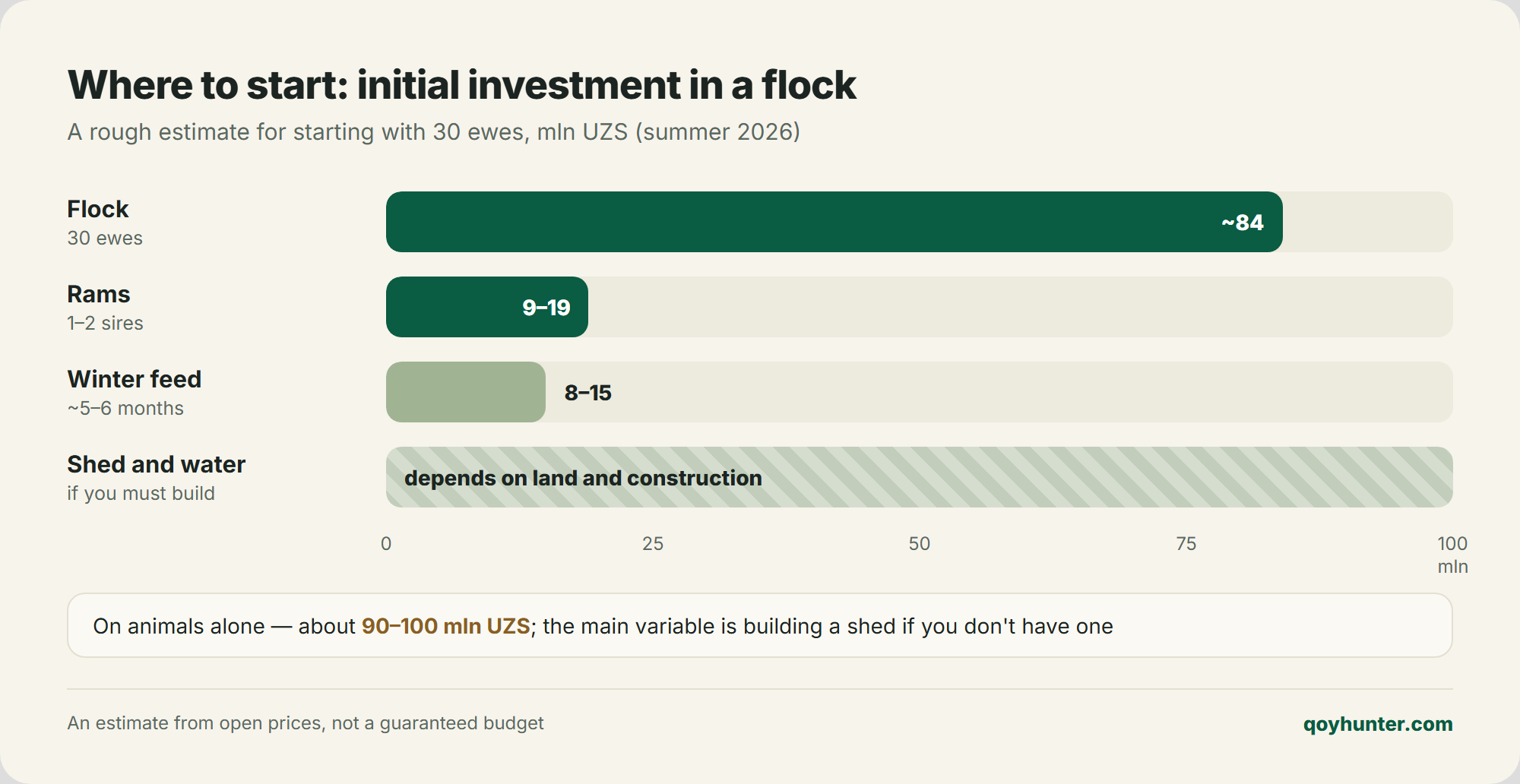
Below is a rough estimate for starting with 30 ewes (prices are based on listings and market data for summer 2026; this is an estimate, not a fixed price list). Exact amounts depend on the region, and on whether you already have land and buildings.
| Item | Estimate, mln UZS |
|---|---|
| 30 ewes (~2.8 mln each) | ~84 |
| 1–2 breeding rams | ~9–19 |
| Sheepfold / pen and water | depends on whether you already have land and buildings |
| Feed for the first winter (~5–6 months) | ~8–15 |
The flock itself is the main and almost unavoidable expense: roughly 90–100 mln UZS just for the animals. The biggest variable is the sheepfold: if you already have a building and land, starting up is many times cheaper; if you need to build one, this can become the largest expense item, and only a local builder can give you an exact estimate. At the start you usually buy two rams — as a backup and for future replacement, so both are included in the estimate (a single ram starts at 4.5 mln).
How the Growth Is Calculated
It's reproduction that makes sheep farming a business. Let's estimate with 30 ewes:
- fertility of local breeds is roughly 105–115 lambs per 100 ewes (higher for Jaidara);
- lamb survival to weaning is around 90%.
That gives: 30 ewes × 1.1 × 0.9 ≈ 30 lambs a year. In other words, the flock's head count nearly doubles in a season. You sell or fatten part of the young stock for meat that same year, and over time you cull some ewes and replace them with the best young ewes. The gap between the price of a lamb (2–3 mln UZS) and a fattened ram (from 4.5 mln) is your main margin.
That margin rests on the price of feed: to buy feed for the first year in advance and in one lot is the simplest way not to lose it in your very first winter.
When It Pays Off — Being Honest About Profitability
There are no exact profitability figures for sheep farming specifically in Uzbekistan in open sources, so be wary of promises of "300% profit." Here's what's reliably known:
- Overall profitability of Uzbek farming enterprises is 5–7%; after VAT on agricultural products is zeroed out starting in 2026, the Ministry of Agriculture expects it to grow to roughly 15%. That's for agriculture as a whole, not sheep farming specifically.
- Foreign estimates for meat sheep farming cite profitability of 15–30% and a payback period of 2–5 years — but these are different markets, and can't be directly applied to Uzbekistan.
A realistic benchmark for a beginner: payback in several years, not in one season. The flock doesn't turn a profit right away — only once it reaches a stable reproduction cycle and you've dialed in feeding and sales.
Government Support and Paperwork
The state actively supports livestock farming — it's worth taking advantage of:
- Concessional loans. Credit lines for agricultural projects (including livestock) are available at subsidized rates; loans for farmers and household-plot owners are arranged online through the oilakredit.uz platform. There are also grant programs that partially reimburse the loan amount (with a higher share for women and young people).
- Business structure. For a small herd, a personal household plot or dehkan (farming) enterprise is usually enough; for industrial scale, you register a farming enterprise with leased land. Check the exact procedure with your local authorities.
- Mandatory animal identification. Starting August 7, 2026, Uzbekistan's law on animal identification and record-keeping takes effect: sheep will need to be ear-tagged (12-digit number) and registered within set deadlines after birth. Plan for this in advance — record-keeping for every single animal is becoming a legal requirement, not just a good idea.
- Veterinary certification is required to legally sell meat.
Common Beginner Mistakes
- Overfeeding concentrates. Grain without roughage disrupts digestion. The base of the winter ration should be hay (60–70%), with concentrates as a supplement.
- A damp, poorly ventilated sheepfold is a direct path to pneumonia and losses.
- Buying animals without veterinary paperwork is the main channel for disease introduction. Get healthy animals with a veterinary certificate, ideally straight from a farm rather than an unregulated market.
- Underestimating winter. Stock up on feed in summer with a margin — in winter it's more expensive and may run short.
- Skimping on veterinary prevention. In 2026, due to the threat of a new foot-and-mouth disease strain, the country declared a month-long veterinary sanitation campaign with mandatory biosecurity measures — a reminder that prevention is cheaper than an outbreak.
- Hiring labour "by eye". A flat wage with no link to results costs more than it looks: a lamb that never made it to weaning is nobody's personal loss. How much to pay a shepherd and how to calculate a lamb-survival bonus — worked through on a flock of 300 ewes.
Why You Need Record-Keeping
Sheep farming is profitable where everything is tracked. Without records, you can't tell which ewe is producing lambs and which one is just eating feed; whether the weight gain justifies the grain spent; or when it's most profitable to sell. And starting in 2026, individual record-keeping for each animal is also becoming a legal requirement. Tracking 50 head in a notebook is hard — the numbers get lost.
With per-animal cost and income tracking you can manage your whole flock from your phone for free: head count, weight gain, lambings, expenses and income for every animal — instantly showing what's profitable and what isn't. To buy a starter flock or sell young stock, visit the starter flock for sale listings.
The amounts in this article are rough estimates based on publicly available summer 2026 prices, not guaranteed figures; before starting out, put together a budget for your own region and conditions.
Manage your flock in QoyHunterCRM for sheep farmers: livestock, health, weighing, finance and analytics — in the app and a Telegram bot.All features →