Sheep Shed Design: Space per Head, Ventilation and Bedding
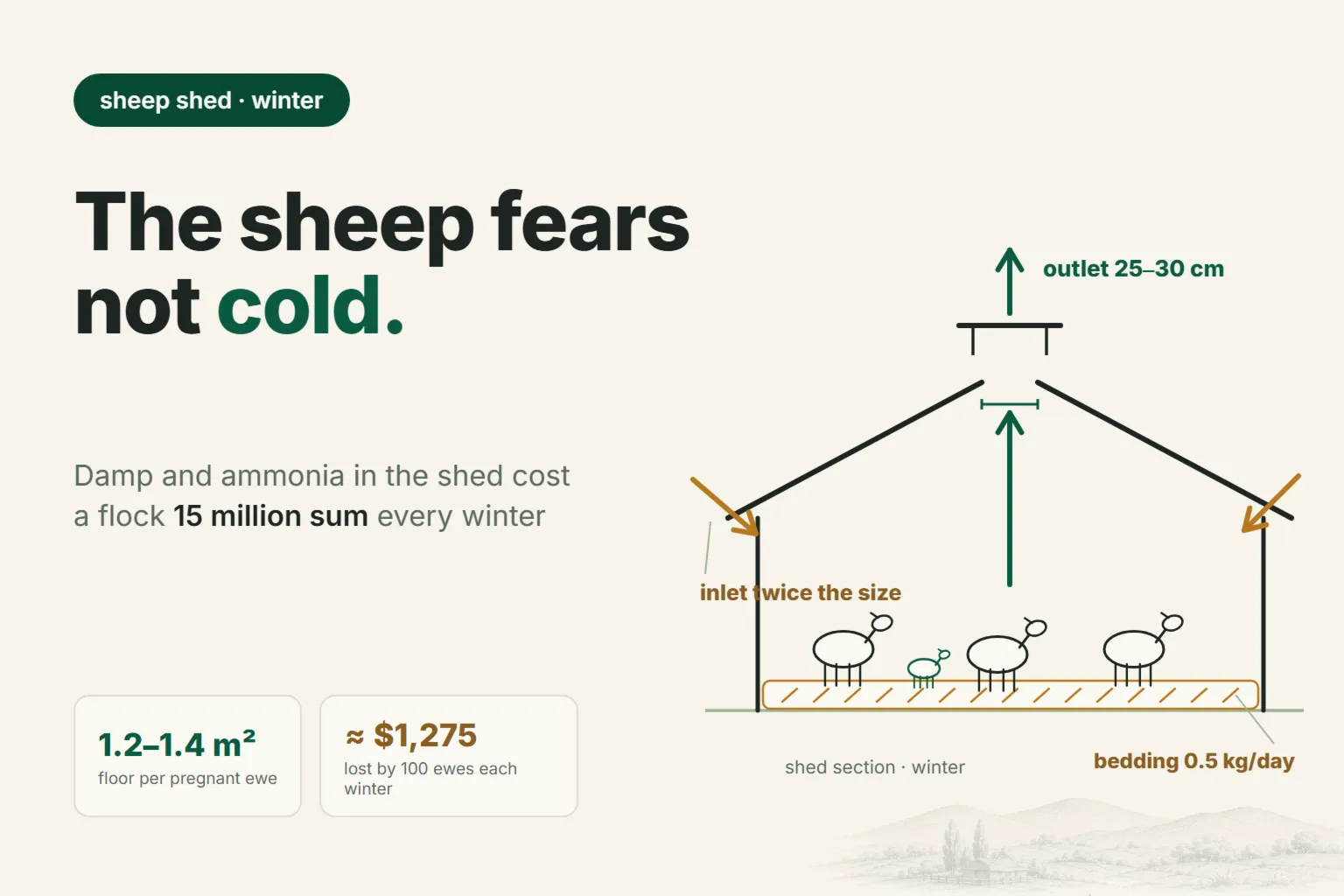
A sheep can handle hard frost — damp is what kills it: a hundred head give off about 200 liters of water a day. Space standards (1.2–1.4 m² per pregnant ewe), a draft-free ventilation layout, how much straw the bedding needs, and the math showing one winter in a damp shed costs a flock about 15 million sum.
A sheep shed usually gets built once, from memory: walls thicker, roof lower, the door on the leeward side — for extra warmth. Then every winter the farm is puzzled all over again: why the lambs are coughing, why the ewes are losing weight on the same hay, why hooves are rotting on half the flock.
The reason is almost always the same. In a dry building a sheep handles hard frost calmly, but damp, stuffy air kills it. One adult sheep gives off about two liters of water a day: almost a liter through breathing, the rest in urine. A hundred head means roughly two hundred liters settling overnight onto the walls, into the fleece and into the bedding. If that water has nowhere to go, you haven't built a sheep shed — you've built a damp box.
Let's go through the numbers: how much space you need per head, how to add ventilation to an old building in a single day, how much straw the bedding takes, and what a winter in a cramped, damp shed actually costs. Prices are from August 2026, exchange rate used for conversion — ≈ 11,930 sum to the dollar.
How Much Space Each Animal Needs
The first mistake isn't cold, it's overcrowding. In a packed shed humidity climbs, air stops circulating, infection spreads through the whole flock within a week, pregnant ewes get injured jostling at the trough, and weaker animals simply don't get enough to eat.
| Group | Floor area, m²/head | Trough front, cm |
|---|---|---|
| Pregnant ewe | 1.2–1.4 | 40–50 |
| Ewe with lamb (maternity pen) | 1.8–2.5 | 40–50 |
| Weaned lambs | 0.7–0.9 | 25–35 |
| Breeding ram (grouped) | 1.7–2.0 | 50 |
| Fattening stock | 0.8–1.0 | 30–40 |
Large fat-tailed breeds — Hissar, Edilbay — need the upper end of the range: a ewe weighing over 80 kg physically takes up more room than a Karakul ewe.
Let's work it out for a flock of 100 ewes: winter needs roughly 130 m² of main shed floor, plus 40 m² for a maternity pen (usually only about a fifth of the flock is lambing at any one time, not the whole flock at once). On top of that, an outdoor exercise yard — 2–4 m² per head: a sheep needs to get outside on any dry day, not stand in the shed for four months straight.
 )
)
Trough front is the second number people skip. It's sized for rationed feeding, when feed is given twice a day: every animal needs to reach the manger at the same time. If hay sits in the manger around the clock and is always available, half that front length is enough — animals take turns. When the front is too short, dominant ewes eat more than their share while timid ones arrive at an empty manger — by spring the condition gap within one group becomes visible to the eye. We worked out how a bad feeder widens that gap in "A Third of Your Hay Lost Underfoot".
Ventilation Without a Draft
A sheep carries its own several-centimeter-thick coat — the fleece. As long as it's dry, the animal handles −15…−20 °C without any loss. Let the fleece get wet, and insulation drops several times over — the same night suddenly turns dangerous. So a sheep shed doesn't need heating, it needs an exhaust.
The working rule for natural ventilation is simple: warm, moist air rises out through the ridge, fresh air comes in along the sides, and the inlet area needs to be twice the outlet area. For a 20-meter shed built for a hundred ewes, that works out to:
- outlet (exhaust) — 5–6 m²: an open gap 25–30 cm wide running the full length of the roof ridge;
- inlet — 10–12 m²: gaps of the same width under the roof overhang on both long walls, screened with bird netting.
A word on the cap over the ridge. It's there to keep out rain and snow — but seal the gap shut, or fold the edges inward, and the exhaust loses up to 80% of its area and stops working. The cap needs to sit on posts, with a gap above the slot, not rest directly on it.
The key condition is that the inlet sits above the animals' backs, at least 1.5 m off the floor. That way cold air has time to mix with the warm air under the roof before it sinks, without a sharp draft. A hole in the wall at sheep height isn't ventilation, it's a draft: air speed at animal level in winter shouldn't exceed 0.3 m/s (a match flame bends but doesn't go out).
To check whether the draw is working: light a smoke bomb or a bundle of damp straw in the middle of the shed. The smoke should clear out through the ridge in 1–2 minutes. If it spreads along the floor and hangs there in a layer, there's no exhaust, and all the moisture is staying inside.
The second test is for ammonia, and it's even simpler. Crouch down to lamb head height and take a few breaths. A sharp smell that stings your eyes means the concentration is already over the limit (20 mg/m³ for a sheep shed). Ammonia burns the mucous membrane of the airways, and after that any respiratory infection walks straight into the lungs unopposed. That's exactly how "mystery" pneumonia in lambs shows up every February.
Here's what a healthy shed microclimate looks like:
| Indicator | Standard | Risk if violated |
|---|---|---|
| Temperature (adults) | +3…+6 °C | lower — feed overspend, higher — stuffiness |
| Temperature (maternity pen) | +12…+16 °C | newborns get chilled |
| Humidity | not above 75–80% | wet fleece, pneumonia, foot rot |
| Ammonia | up to 20 mg/m³ | burnt mucous membranes, respiratory disease |
| Carbon dioxide | up to 0.25% | lethargy, lambs falling behind in growth |
| Winter air speed | up to 0.3 m/s | drafts, lambs catching cold |
Floor and Bedding: Where the Damp Lives
A concrete floor without bedding is the most expensive way to save money in a sheep shed: it pulls heat out of a lying animal around the clock. The working solution for our conditions is a rammed-clay or earthen floor with a 2–3% slope, raised 20–30 cm above ground level, with a drainage ditch outside so meltwater doesn't run in.
On top of that goes deep litter bedding that isn't replaced. The logic is simple: lay down a 15–20 cm layer of straw and add fresh straw on top of it every day, without removing the old layer. The lower layers decompose and generate their own heat, while the top layer stays dry. You clean it all out just once, in spring, after the flock goes out to pasture.
Straw use runs 0.3–0.5 kg per head a day under normal conditions, and up to 0.8–1 kg on deep litter in a wet winter; over a whole winter that adds up to 50–120 kg per sheep. Let's take the middle figure — 120 days at 0.5 kg for a hundred ewes:
It is cheaper to take deep-litter straw in one go after harvest: in autumn, buy bedding straw costs noticeably less than hauling bales all winter.
| Item | Calculation | Amount |
|---|---|---|
| Straw for bedding | 6 t × 400 sum/kg | 2.4 million sum (≈ $201) |
| Per head for the winter | 60 kg | 24,000 sum (≈ $2) |
Two dollars per sheep for the whole winter — against a dead lamb worth a hundred and fifty. And that's not all: over one winter, a hundred head produce 20–25 tons of well-rotted manure — ready-made organic fertilizer for alfalfa or corn.
What shouldn't be in the bedding: rotten, moldy straw (mold spores are a direct route to pneumonia and abortion in ewes) and a wet layer that's stopped getting topped up. Damp bedding pulls heat out of a lamb faster than any frost and keeps hooves in constant moisture — and that's already foot rot, with all the weight-gain losses that come with it.
What those 20–25 tons are worth sold by the truckload, in bags, or spread on your own field is worked out separately: sheep manure — how much a flock produces and what it sells for.
The Maternity Pen: Jugs That Pay for Themselves in One Night
The most valuable spot in the shed is the corner where ewes lamb. It's kept separate from the main pen: warmer, drier, and no crowding.
Inside go individual lambing jugs, 1.2 × 1.2 m (1.5 × 1.5 m for large fat-tailed ewes). The ewe stays in the jug with her newborn for 24–48 hours: in that time she bonds with the lamb, the lamb learns to find the udder confidently and gets its colostrum, and you get to see whether it's actually nursing.
How many jugs do you need: one per 8–10 ewes if lambing is tightly bunched, one per 12–15 if it's spread out. For a hundred ewes, that's ten jugs. You can knock them together from panels, pallets and old boards over a weekend.
What this corner actually buys you: a lamb the ewe loses in the general flock during its first hours almost always ends up either dead or hand-reared — and that costs you time, milk, and still leaves the lamb behind on growth.
What to Build and What Not To
Don't build a sealed, warm barn. A building with no exhaust, put up "so it doesn't get drafty," turns into a steam room by winter: humidity near 90%, condensation dripping off the ceiling onto the animals' backs, ammonia sitting at lamb height. An open, three-walled shelter always beats an airtight barn — and costs several times less.
What actually matters in the build:
- a solid wall to the north, with the open or closable side facing south: shelter from cold wind in winter, shade in summer;
- height to the underside of the structure of at least 2.4–3 m: the more air volume under the roof, the better the draw, and the slower moisture builds up;
- 50–70 cm roof overhang, so rain doesn't wash into the inlet gaps and walls;
- gates at least 2.5 m wide: the flock needs to flow out, not squeeze through — a narrow opening crushes lambs and causes abortions in pregnant ewes;
- separate sections: pregnant ewes, nursing ewes with lambs, young stock and rams winter apart, otherwise feeding rates stop working.
What It Costs: One Winter in a Damp Shed
Now, the whole point of all this counting. Let's take a flock of 100 ewes and compare two winters — one in a cramped, damp shed, one in a dry, well-ventilated one.
The difference in lamb losses between a dry and a damp shed usually runs 5–8 percentage points — for a hundred ewes that's about six lambs, each of which would be worth roughly 1.8 million sum by weaning (28 kg live weight at the entry price for fattening).
| Loss item | Damp, cramped shed | Dry, ventilated shed |
|---|---|---|
| Excess lamb deaths (6 head × 1.8 million sum) | 10.8 million sum ($905) | 0 |
| Extra hay for thermoregulation (+10%) | 3.7 million sum ($310) | 0 |
| Treating respiratory disease in lambs | 0.75 million sum ($63) | 0 |
| Total for one winter | ≈ 15.2 million sum ($1,275) | — |
Against that — the cost of fixing up the shed:
| What to do | Amount |
|---|---|
| Straw for deep litter (6 t) | 2.4 million sum ($201) |
| Cut a ridge exhaust and inlet gaps | ≈ 1.5 million sum ($126) |
| Ten lambing jugs built from panels | ≈ 1.2 million sum ($101) |
| Total | ≈ 5.1 million sum ($428) |
 )
)
Five million against fifteen. And the exhaust and the jugs are a one-time investment that lasts for years, not an annual expense — only the straw repeats.
The record-keeping side deserves its own word. As long as losses are tracked "by eye," the difference between a damp and a dry shed stays invisible: lambs die one at a time, and every case gets its own explanation — weak, got crushed, cold night. It only becomes obvious once a number adds up over a whole winter. Track lambs and losses by group in flock headcount software, or at least in a notebook — and after one winter you'll know for certain whether that ridge gap is worth it.
In Short
- A sheep isn't afraid of cold, it's afraid of damp and stuffiness: a hundred head give off about 200 liters of water a day, and that water needs somewhere to go.
- Space standard: 1.2–1.4 m² per pregnant ewe, 1.8–2.5 for a ewe with a lamb, 0.7–0.9 for young stock. Trough front for rationed feeding — 40–50 cm per adult head.
- Ventilation: an open gap 25–30 cm wide along the ridge, with inlet area twice the outlet and set above the animals' backs. Smoke from a bundle of straw should clear through the ridge in 1–2 minutes.
- Crouch down to lamb height: a sharp ammonia smell already means you're over the 20 mg/m³ limit, and pneumonia is coming.
- Deep, unreplaced litter: 0.3–0.5 kg of straw per head a day, 24,000 sum per sheep for the winter, and 20–25 tons of manure from a hundred head come spring.
- Maternity pen: 1.2 × 1.2 m jugs, one per 8–10 ewes, ewe and lamb stay in it 24–48 hours.
- A sealed, warm barn is worse than an open, three-walled shelter: without an exhaust it just stockpiles moisture and ammonia.
- One winter in a damp shed for a hundred ewes costs around 15 million sum; fixing up the shed costs about 5.1 million, and most of that money is spent only once.
If the young stock in your shed is already coughing, has a runny nose, or is falling behind on growth, ventilation is only half the fix: show the animals to a vet — the treatment plan is theirs to set.
Manage your flock in QoyHunterCRM for sheep farmers: livestock, health, weighing, finance and analytics — in the app and a Telegram bot.All features →