Fattening a ram for Eid al-Adha 2027: when to start, what to feed and what is left per head
When to start fattening a ram for Eid al-Adha 2027: six start dates calculated at autumn 2026 prices, a back-counted calendar with vaccinations and grain, the price of being late, and a check of the ram's age.
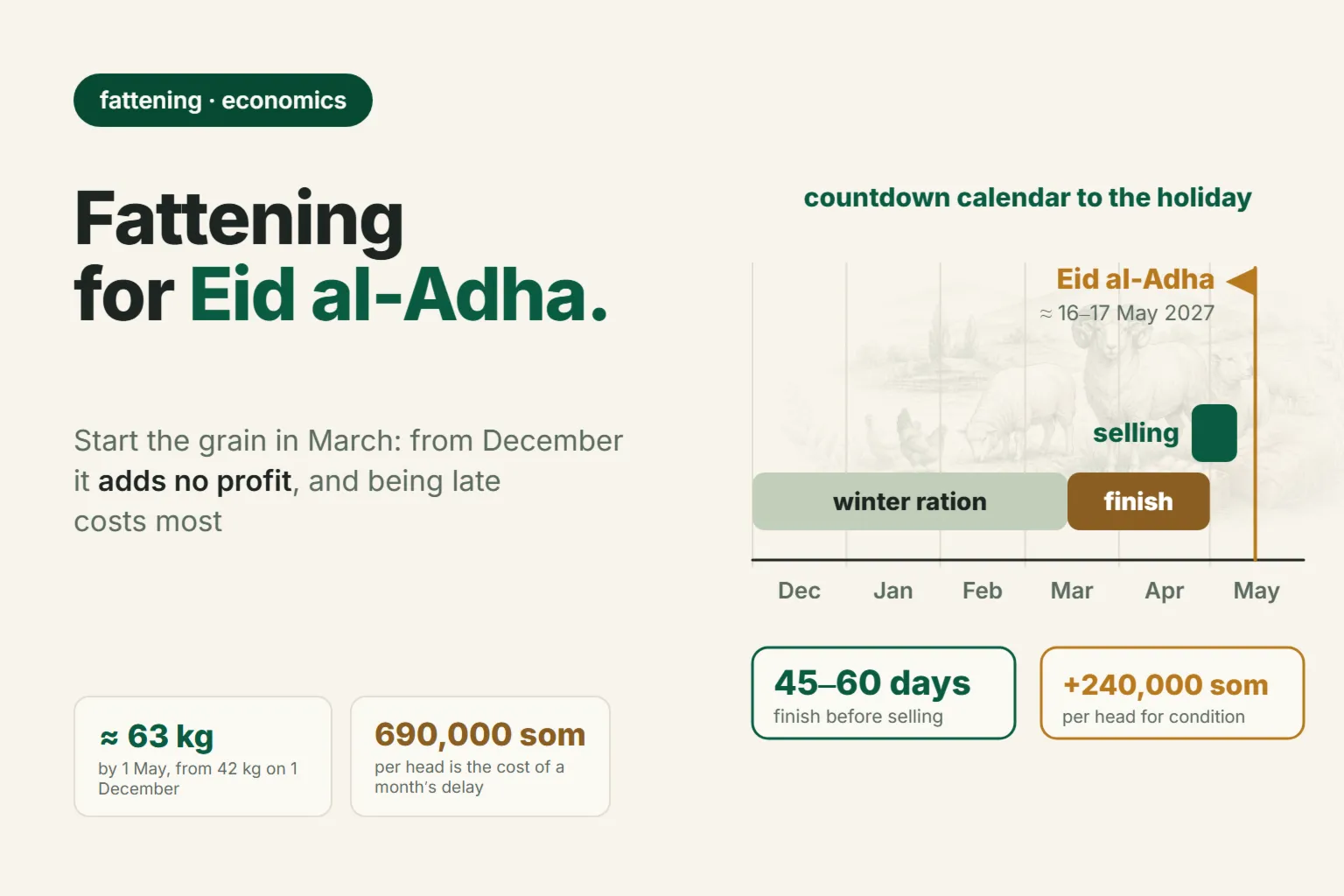
The best time to start fattening a ram for Eid al-Adha 2027 is 45–60 days before the sale, which means the first half of March 2027. Until then, keep young stock on a plain winter ration. A 42 kg ram lamb put on this schedule on 1 December 2026 weighs about 63 kg by 1 May and leaves 3.15 million som (≈ $261) after feed and treatment costs, if the buyer pays 65,000 som per kilogram of live weight for good condition; the price of the lamb itself is not included. Feeding grain from December on does not improve that result: the gain is bigger, but the feed eats the whole benefit.
Below you will find a calendar counted back from the holiday, a calculation of six start dates for fattening, the price of being late, and a check of the ram's age. Feed prices are autumn 2026; the exchange rate is 12,055.90 som per dollar (Central Bank of Uzbekistan, 17 October 2026).
When is Eid al-Adha in 2027, and when should you sell the ram?
Eid al-Adha in 2027 is expected around 16–17 May. The date follows the lunar calendar and is announced officially only shortly before the holiday: in 2026 the decree of the President of Uzbekistan came out on 20 May, a week before the holiday on 27 May.
So the fattening plan is built from the sales window: 25 April to 10 May 2027. In these two weeks buyers are already looking for a ram, and the animal still has time to reach its new owners. For the calculations below we take 1 May 2027 as the sale date.
The mol bozor, the livestock market that runs on the district's market day, is overloaded in the last days before the holiday: there are many buyers, but there are many sellers too, and it is hard to bargain when the animal has to be taken back home.
What age should a ram be for Eid al-Adha 2027?
A qurbonlik is the sacrificial animal. According to the recommendations of the Muslim Board of Uzbekistan, relayed by Zamin.uz in May 2026, a sheep for qurbonlik must be at least six months old. Hanafi explanations allow a six-month-old ram if it is large and looks no different from a yearling. Other local sources name one year, so it is worth asking the imam about a disputed case in advance.
There is a trap here for the seller. A buyer who wants a ram older than a year may look at the teeth, but the first pair of permanent incisors comes in only at 12–18 months. A ram lambed in spring can be over a year old and still have milk teeth.
| Month of lambing | Age on 16 May 2027 | Teeth and age |
|---|---|---|
| January 2026 | 16 months | most often the first pair of permanent incisors |
| March 2026 | 14 months | teeth may still be milk teeth |
| May 2026 | 12 months | most likely milk teeth |
| October 2026 | 7 months | milk teeth; needs to be a large ram that looks like a yearling |
What to do about it: write down the birth date and tag number of every ram you are preparing for the holiday right now. A lambing record does not replace the imam's word, but it ends the argument about age: you show a date instead of promising it verbally.
How much does it cost to feed a ram in winter and at finishing?
Finishing is the last weeks of fattening, when the ration is raised for condition and a full fat tail. We calculate the ration at autumn 2026 prices: alfalfa hay 1,800 som/kg (winter price), barley 3,500, corn 3,600, bran 3,000 som/kg, salt and mineral supplement 100 som per head per day.
| Period | Hay / barley / corn / bran, kg per day | Cost per day | Gain, g/day | Cost of 1 kg of gain |
|---|---|---|---|---|
| Winter holding | 1.5 / 0.4 / 0 / 0.2 | 4,800 som ($0.40) | 130 | ≈ 36,900 som ($3.1) |
| Fattening, 30–45 kg | 1.2 / 0.5 / 0.3 / 0.3 | 5,990 som ($0.50) | 230 | ≈ 26,000 som ($2.2) |
| Finishing, 45–60 kg | 1.5 / 0.7 / 0.4 / 0.4 | 7,890 som ($0.65) | 190 | ≈ 41,500 som ($3.4) |
| Finishing, 60–75 kg | 1.6 / 0.9 / 0.5 / 0.5 | 9,430 som ($0.78) | 140 | ≈ 67,400 som ($5.6) |
The rations and gains are the same as in our earlier calculations of wintering and the cost of fattening, recalculated at autumn 2026 prices. The last column explains almost everything: past 60 kg, a kilogram of gain costs more than you can sell it for, even right before the holiday.
When to start fattening for Eid al-Adha: which is more profitable?
Let us compare six options on one fat-tailed or crossbred ram lamb: 42 kg on 1 December 2026, sold on 1 May 2027, 151 days in all. Treatments and vaccinations are 60,000 som per head in every option. In the table, "Left over" is revenue minus feed and treatments; the price of the lamb itself is not deducted. To keep it simple, we assume the full ration runs from the first day of finishing; in practice grain is introduced gradually, and actual feed use will be a little lower.
| Finishing before the sale | Weight on 1 May | Feed for 151 days | Left over at 60,000 som/kg | Left over at 65,000 som/kg |
|---|---|---|---|---|
| No finishing | 61.6 kg | 725 thousand som | 2.91 million som ($242) | 3.22 million som |
| 30 days | 62.5 kg | 845 thousand som | 2.85 million som | 3.16 million som |
| 45 days (from 17 March) | 63.2 kg | 898 thousand som | 2.84 million som | 3.15 million som ($261) |
| 60 days (from 2 March) | 63.9 kg | 952 thousand som | 2.82 million som | 3.14 million som |
| 90 days (from 31 January) | 65.2 kg | 1.06 million som | 2.79 million som | 3.12 million som |
| 151 days (from 1 December) | 68.3 kg | 1.26 million som | 2.78 million som | 3.12 million som |
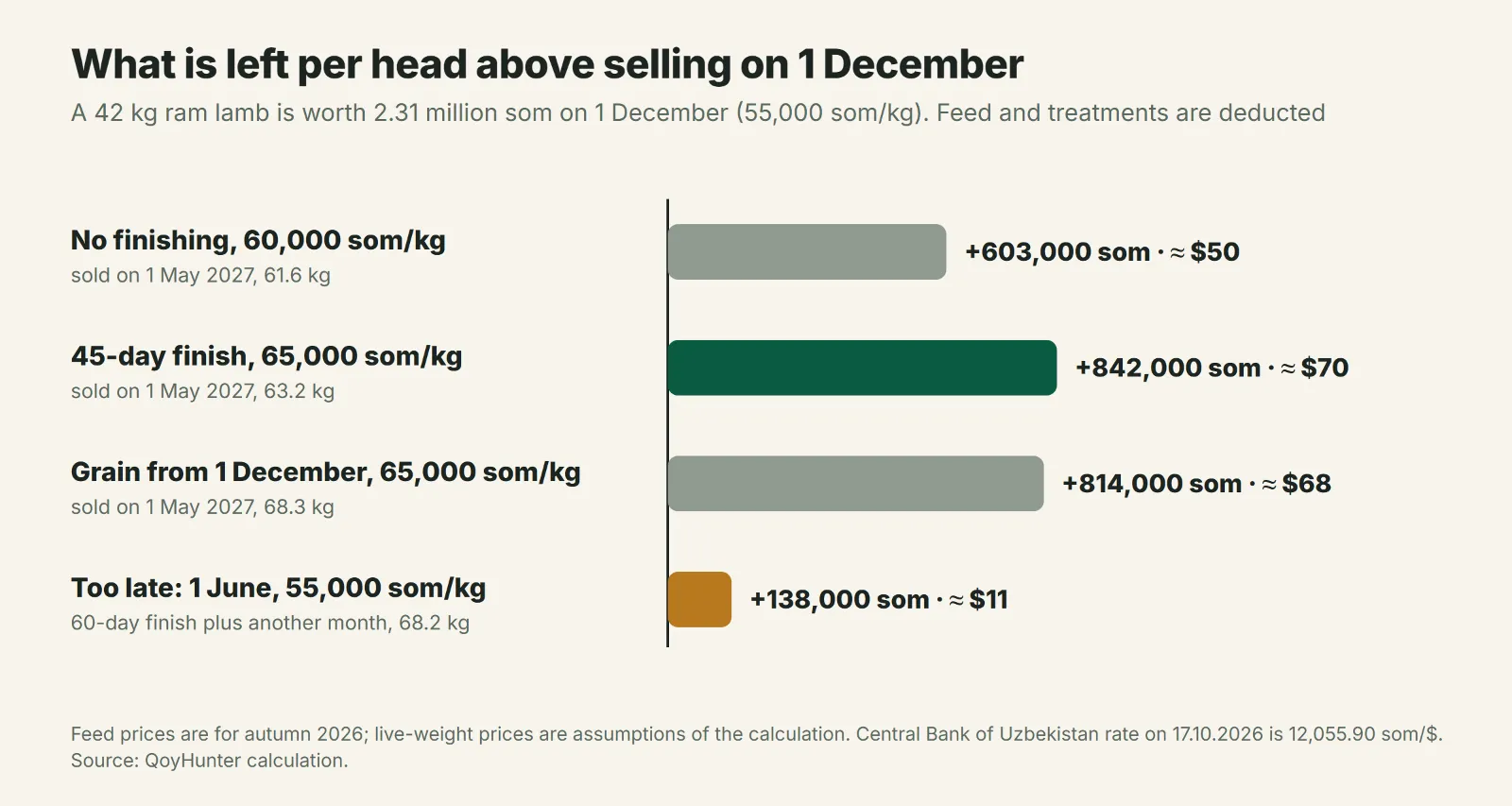
If the price per kilogram is the same, finishing brings no money: the extra weight costs almost as much as it sells for. Finishing pays off in a different way. A ram in good condition earns more for every kilogram, and a lean one will not get that price however much it weighs.
Let us count it directly. A ram with no finishing, sold at 60,000 som/kg, leaves 2.91 million som. A ram with a 45-day finish, sold at 65,000 som/kg, leaves 3.15 million som. The difference is +240 thousand som per head (≈ $20), and on twenty head it is 4.8 million som (≈ $398). The break-even bar is low: a 45-day finish pays for itself at a premium of only about 1,200 som per kilogram.
30 days looks slightly better on paper, but grain is introduced over 2–3 weeks, which leaves only 1–2 weeks on the full ration. In that time condition hardly changes. So the working period is 45–60 days.
The prices of 60,000 and 65,000 som per kilogram of live weight are our cautious assumptions, not a market promise. In May 2026, Kursiv Uzbekistan, citing sellers' offers, wrote that mutton costs about 145 thousand som per kilogram on average and a 30 kg ram about 4.3 million som; the publication did not say whether that is live weight or carcass. Building such asking prices into a plan is risky.
You can compare your price with real offers in advance: listings of rams for sale before the holiday show both weight and price.
What does it cost to miss Eid al-Adha?
Being late costs more than any mistake in the ration. Take a ram with a 60-day finish that did not sell before the holiday. The owner feeds it for another month and sells it on 1 June, when demand has fallen, at 55,000 som/kg.
| What we count | Sold 1 May | Sold 1 June |
|---|---|---|
| Weight | 63.9 kg | 68.2 kg |
| Price per kg | 65,000 som | 55,000 som |
| Feed and treatments | 1.01 million som | 1.30 million som |
| Left over | 3.14 million som ($260) | 2.45 million som ($203) |
A month's delay costs 690 thousand som per head (≈ $57). That is why it is better to sell a batch in parts starting at the end of April, rather than wait for the last day.
What is the calendar for preparing a ram for Eid al-Adha 2027?
The dates below are counted back from the sale on 1 May and the holiday on 16–17 May 2027. Your veterinarian confirms the vaccine, the drug and the dose: the table shows the order of actions and does not replace a prescription.
| When | What to do | Why |
|---|---|---|
| November 2026 | weigh, record tag and birth date, buy hay | hay is cheaper in autumn than in winter |
| December – February | winter ration, weigh once a month | keep gain at about 130 g a day |
| By 8 January | deworming with closantel, if that is your choice | the withdrawal period can be up to 107 days |
| By 15 January | deworming with another drug, if that is your choice | vaccinate no sooner than 14 days after treatment |
| 1 February | first dose of clostridial vaccine | protection before grain |
| 22–25 February | second dose of vaccine | immunity by the time grain starts |
| From 4 March | another treatment if needed, only with a drug with a short withdrawal period | do not vaccinate within 7 days before treatment |
| 15–17 March | start raising the grain | introduction takes 2–3 weeks |
| 1 April | post the listing with weight and photo | buyers search ahead of time |
| 10–15 April | trim the hooves | lameness lowers the price and gets in the way of selling for qurbonlik |
| 25 April – 10 May | sale | demand window |
Count the withdrawal period up to the first possible sale. A buyer may slaughter the ram right after the deal, and the meat goes on the table, so in our schedule the count runs from 25 April. The period depends on the drug: for ivermectin from a few days to 2 months, for closantel, according to the European Medicines Agency (EMA), 28–107 days. The exact period is in the package insert.
Keep vaccination and treatments apart. The instructions for the Klostarm-9 vaccine forbid vaccinating within 7 days before and 14 days after deworming, within 2 weeks before and after shearing, and sick or emaciated animals. Check the interval between doses and the duration of immunity in the instructions of your own vaccine: for a polyvalent vaccine common in CIS countries, we gave a guide of 20–25 days between doses and immunity 10–12 days after the second.
Introduce grain slowly. The rumen takes 2–3 weeks to get used to grain; the step is about 5–10% of the ration every 3–5 days. On grain, rams also get urinary stones: the ration needs a calcium-to-phosphorus ratio of at least 2:1, a salt lick available at all times, and clean water. The introduction scheme is covered in the article why rams die on grain fattening.
Which rams to fatten for the holiday, and which to sell earlier?
Growing young stock is what suits fattening for May. A ram that already weighs 65–70 kg does not pay for the winter: this is visible in our analysis of selling a ram in autumn or holding it until spring. It is better to sell such a ram now, or to put it on finishing only to order for a buyer who has agreed on the price in advance.
Keep for the holiday:
- young stock weighing 35–45 kg in November–December that gains 120 g or more a day;
- animals without lameness, disease or emaciation, with whole ears, tail and eyes: according to the recommendations of the Muslim Board of Uzbekistan, an animal with such defects is not fit for qurbonlik;
- rams with a known birth date.
Sell earlier those that have been sick, are falling behind in weight or are lame. In winter they eat like healthy ones, and selling them as qurbonlik for the holiday will be hard anyway.
If you are buying young stock now, work out the limit. On our calculation with a 45-day finish it is 67,500 som per kilogram if you sell at 60,000 and 75,000 som per kilogram if you sell at 65,000: at that price you break even. You should buy noticeably cheaper. New animals are kept apart from your own flock for 30 days. For a large qurbonlik the breed matters too; buying Hissar rams for fattening makes sense only if the purchase price fits within this limit.
How much feed to stock per ram until May?
One ram with a 45-day finish uses about 230 kg of hay (roughly 12 bales of 20 kg) and about 140 kg of concentrates up to 1 May. For 20 head that is 4.6 tonnes of hay and 2.8 tonnes of grain with bran.
It pays to buy hay now. In September 2026 a bale cost 24–28 thousand som, and in winter it usually goes for 30–45 thousand. Buying in autumn saves about 90–135 thousand som per head (≈ $8–11) compared with the calculated price of 1,800 som/kg. For grain, get a batch by February so you do not have to hunt for it in March: buy barley and bran for fattening.
The only way to tell whether a ram is on schedule is the scale: the difference between 90 and 130 grams a day is not visible by eye. QoyHunter, a CRM for sheep record-keeping and the bazar.qoyhunter.com marketplace, lets you keep the weigh-ins and gain of every ram from your phone. For a dozen head a notebook is enough, as long as you write down the tag, the date and the weight.
FAQ
When should you start fattening a ram for Eid al-Adha 2027?
Intensive fattening of a ram starts 45–60 days before the sale, which means the first half of March 2027 if you sell around 1 May. Before that, young stock is kept on a winter ration at about 4,800 som a day. Eid al-Adha in 2027 is expected around 16–17 May; the exact date will be announced shortly before the holiday.
Is it profitable to feed a ram grain all winter before Eid al-Adha?
Not by the autumn 2026 calculation. A 42 kg ram lamb kept on the finishing ration for all 151 days from 1 December weighs about 68 kg by 1 May, but feed costs 1.26 million som instead of 898 thousand with a 45-day finish. At a sale price of 65,000 som/kg, what is left is 3.12 million som against 3.15 million som, and the acidosis risk lasts the whole period.
How old should a ram be for Eid al-Adha?
According to the recommendations of the Muslim Board of Uzbekistan, a sheep for qurbonlik must be at least six months old; Hanafi explanations allow a six-month-old ram if it is large and looks like a yearling. It is better to check a disputed case with the imam. The first pair of permanent incisors appears at 12–18 months, so a ram lambed in spring 2026 may be over a year old in May 2027 and still have milk teeth. The seller should keep a record of the birth date and tag number.
When is it most profitable to sell a ram before Eid al-Adha?
Most profitable is one to three weeks before the holiday: in 2027 that is roughly 25 April to 10 May. If the ram is not sold and is fed for another month and then sold at 55,000 som/kg, 690 thousand som (≈ $57) less per head is left than from selling on 1 May at 65,000 som/kg.
What price can you pay for a lamb if you fatten it for Eid al-Adha?
On the calculation for a 42 kg ram lamb with a 45-day finish, the break-even point is about 67,500 som per kilogram when selling at 60,000 som/kg and about 75,000 som per kilogram when selling at 65,000 som/kg. These figures include feed and treatments, but not your labour or losses, so you should buy the lamb noticeably cheaper than the limit.
Manage your flock in QoyHunterCRM for sheep farmers: livestock, health, weighing, finance and analytics — in the app and a Telegram bot.All features →