Feeding sheep in winter: alfalfa, hay, cottonseed cake — norms and ration
What to feed sheep in winter in Uzbekistan: alfalfa (lucerne) hay, straw, barley, cottonseed cake and bran. Daily norms for pregnant ewes, rams and young stock, a “hay — concentrate — water” table, salt, vitamins and the main mistakes.
In summer the pasture feeds the flock — in winter everything falls on the feeder and on the owner. In the steppe districts of Uzbekistan winter is cold, there is no greenery for four to five months, and the winter ration determines the ewes' condition, the health of the future lambs and the weight at which young stock reaches spring. Let's break it down simply: what to feed the flock in winter, how much to give each group, and where people go wrong most often.
One note up front: this is about keeping the whole flock through winter, not about intensive fattening of rams for sale — for fattening we have a separate piece, “Fattening rams: the ration”. The norms below are guidelines. Large Hissar and Edilbaev sheep need the top of the range, smaller ones the bottom.
The winter feed base in Uzbekistan
The winter ration is assembled from what the farm has on hand:
- Alfalfa (lucerne) hay — the foundation. A legume, rich in protein and carotene; when well dried it is the best roughage, especially for pregnant ewes.
- Straw (wheat, barley) — a cheap filler. Almost no protein, so it replaces only part of the hay, not all of it, to keep the rumen working.
- Barley and corn — grain energy. Barley is universal; corn is more calorie-dense and easier to overfeed.
- Cottonseed cake and meal — the cheapest local protein. But it contains gossypol, more on that below.
- Bran — a soft concentrate that mixes in well.
A working winter combination: alfalfa hay plus a little straw as the roughage part, and concentrates as a mix of barley, corn and bran with a small share of cottonseed cake.
It is cheaper to cover the whole combination in a single purchase at the end of summer: before the cold, to buy alfalfa hay and cottonseed cake costs about one and a half times less than the January price.
Daily norms by group
Norms depend on the animal's weight and physiological state. Below are practical ranges for the winter stall period.
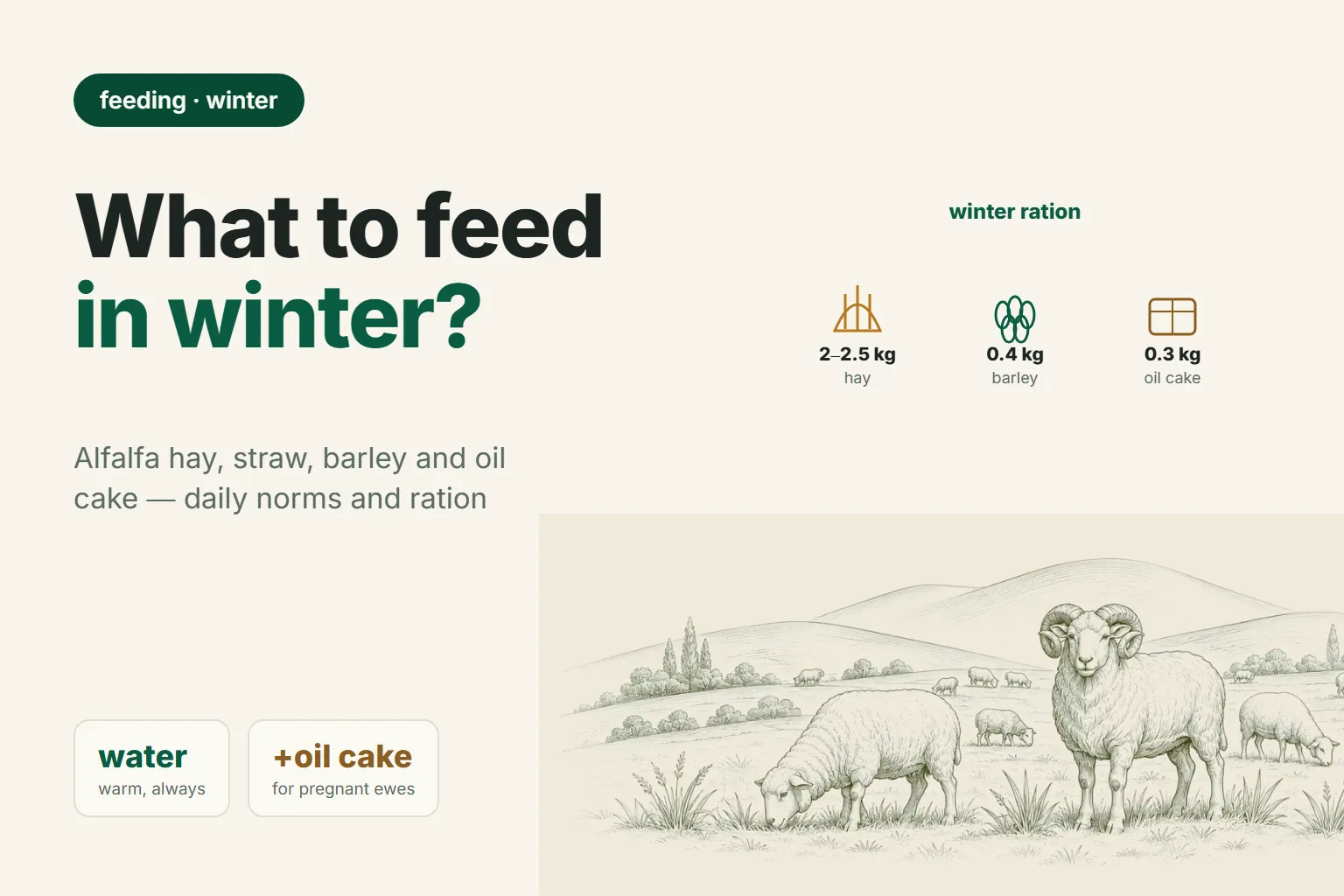
| Group | Hay, kg/day | Concentrate, kg/day | Water, L/day |
|---|---|---|---|
| Dry (open) ewe (maintenance) | 1.5–2.0 | 0.2–0.3 | 3–4 |
| Pregnant ewe (2nd half of gestation) | 1.5–2.0 (part as straw) | 0.3–0.5 | 4–5 |
| Breeding ram | 2.0–2.5 (up to 1 kg as straw) | 0.4–0.6 (oats up to 1 in mating season) | 4–6 |
| Young stock 6–12 months | 1.0–1.5 | 0.2–0.4 | 2–3 |
How to read this. A dry, open ewe needs only hay and a minimum of grain — overfeeding here only harms. The concentrate share is raised in the second half of gestation (the fetus grows fast) and kept high for rams. Young stock needs protein and concentrate for growth, but in smaller amounts. Feed is given in 2–3 servings: in the morning part of the roughage and succulent feed, midday after watering the concentrates, in the evening the rest of the hay.
Go by more than weight — check body condition too. Feel along the back and ribs with your hand: if the spine and ribs stand out sharply, the animal is underfed — add concentrate or succulent feed. If the back is buried in fat, cut the grain instead. Check the flock this way at least every 2–3 weeks, and pregnant ewes more often: their condition going into lambing matters most of all.
How much hay can be replaced with straw, and at what price it actually pays, we worked out separately: straw for sheep — rates, feed unit cost and urea treatment.
Water and salt — forgotten in winter
In winter sheep drink less and owners relax. That is a mistake. An adult sheep needs 3–4 litres of water a day (more when lactating or in heat) — roughly 2–3 litres per kilogram of dry feed. In winter the water in the trough freezes: give it warm, or at least unfrozen, twice a day. A sheep that does not drink eats less hay and loses weight. Norms by animal group, water salinity thresholds and winter watering rules are covered separately in "How much water a sheep needs per day".
Salt is a must: 8–10 g of loose salt per head per day (closer to 15 g for pregnant ewes and rams, 5–8 g for lambs), plus a salt lick always in the feeder. On dry winter feed the need for salt and minerals is only higher.
Vitamins in winter: where the carotene goes
In summer the flock gets vitamin A from greenery. In winter there is no greenery, and carotene (provitamin A) breaks down quickly as hay dries — the longer and worse the hay dried, the less of it there is. Hence the winter troubles: weakness, poor appetite, hard lambing, weak lambs.
What helps: good, timely-harvested alfalfa hay (it has the most carotene), carrots and pumpkin, quality silage. Vitamin D falls short in winter because of the short sun — grazing on fine days helps. With clear signs of deficiency, vitamin products (A, D, E; vitamin E often together with selenium) are used only as prescribed by a vet, not by guesswork.
How much carrot, pumpkin and fodder beet each group should get, and why bought-in roots cost 3–4 times more than hay per feed unit, is worked out separately: pumpkin, beet and carrots for sheep — rates and cost.
Cottonseed cake: cheap, but handle with care
Cottonseed cake is the cheapest protein in Uzbekistan, but it contains gossypol, a toxic substance with a cumulative effect. Sheep are less sensitive to it than pigs or horses, but safety is not unlimited.
The rules are simple:
- For an adult sheep — no more than ~200 g of cake per day, roughly up to 10–15 % of the ration (up to 20 % is allowed for fattening stock).
- Gossypol accumulates: signs of poisoning appear not right away, sometimes after several days and even after the feed is stopped.
- Introduce it gradually, give it cautiously to pregnant ewes and young stock, and it is better not to give cake at all to lambs under 4 months.
- If lethargy, refusal to eat or shortness of breath appear — remove the cake and call a vet.
The main winter feeding mistakes
- Overfeeding concentrates. It seems the flock will gain faster and cheaper on grain. In reality a sudden excess of grain drops the rumen pH — rumen acidosis sets in: refusal to eat, lethargy, diarrhoea. Roughage must remain the base, grain an addition.
- Abrupt switch to grain. The rumen microflora needs 2–4 weeks to adjust. Introduce new feed and raise the concentrate share gradually, over 2–3 weeks.
- Straw alone. On straw a sheep fills its belly but starves for protein and energy — the ewe loses condition before lambing. Straw is only part of the roughage.
- Forgotten water and salt. It quietly steals gains and health (see above).
- “Whatever hay is around.” Musty, dusty, mouldy hay is more dangerous than it looks: minimum vitamins, risk of digestive problems and abortions in ewes.
In short
Three things carry the flock through winter: enough good roughage (alfalfa hay plus a little straw), a moderate — not excessive — share of concentrates, and, always, clean unfrozen water with salt. Keep norms by group: the top of the protein range for pregnant ewes and rams, the minimum for open ewes, growth level for young stock. Stock up on feed in advance and watch body condition: if you see the ewes losing weight, add concentrate before it is too late, ahead of lambing.
It pays to plan the stock-up not only by volume but by price: where to buy feed cheaper — the bazaar, the plant, the mill or online listings.
It is easier to keep these norms in an app: feeding norms by group recalculate against your actual headcount, so in winter you are not splitting hay by eye.
Manage your flock in QoyHunterCRM for sheep farmers: livestock, health, weighing, finance and analytics — in the app and a Telegram bot.All features →