Buying Compound Feed for Sheep in Tashkent: August 2026 Prices and Where Feed Is Cheaper
In August 2026 compound feed for sheep in Tashkent costs 3 800 to 4 600 UZS per kilogram. We go through five buying channels — the dehqon bazaar, the compound feed plant, the oil mill, the farmer in the field and online listings — count what each one really costs in money and time, and show the calculation that cuts a month's concentrate bill for 50 head by a million UZS.
In Tashkent, compound feed for rams in August 2026 costs 3,750 to 4,600 UZS per kilogram ($0.32–0.39), depending on whether you buy a ready-made mix or put it together yourself from grain and meal. The gap between ready-made compound feed and an equally nutritious grain-and-meal mix is about 20% — and on a flock of 50 head that turns into a million UZS a month.
Below are five real channels Uzbekistan farmers use to buy feed, an honest look at how much time and money each one eats up, a price table for August 2026, and a calculation that brings the monthly concentrate purchase for 50 rams down from 5.52 to 4.49 million UZS.
How much compound feed for rams costs in Tashkent in August 2026
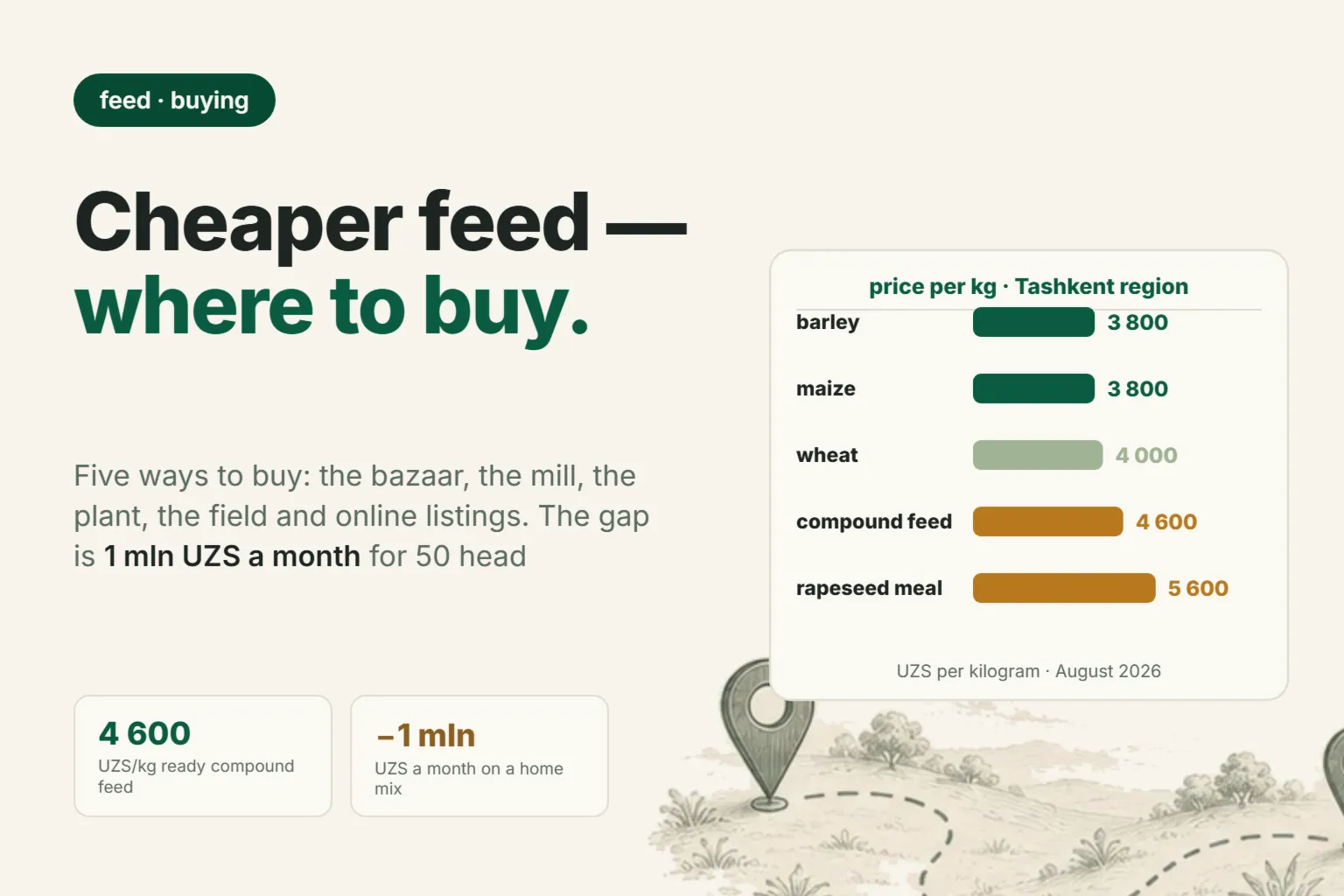
Here are live prices from the Tashkent region. The left column is what's openly listed in ads on the bazar.qoyhunter.com marketplace as of 25 August 2026; the right one is market benchmarks from early August 2026 from our breakdown of protein cost in feed. The Central Bank of Uzbekistan's rate on 25 August was 11,818 UZS per dollar.
| Feed | Price in listings, UZS/kg | Market benchmark, UZS/kg |
|---|---|---|
| Compound feed for rams | 4,600 ($0.39) | — |
| Barley | 3,800 ($0.32) | 3,800 |
| Corn (grain) | 3,800 ($0.32) | 4,500 |
| Wheat | 4,000 ($0.34) | — |
| Rapeseed meal | 5,600 ($0.47) | — |
| Cottonseed meal | out of stock | 3,500 |
| Wheat bran | out of stock | 2,800 |
| Alfalfa hay (summer) | out of stock | 1,100 |
| Wheat straw | out of stock | 400 |
Take a look at corn: 3,800 against 4,500 — it's roughly 16% cheaper than the market benchmark. That gap isn't from haggling for a discount; it just comes from using a different buying channel.
Compound feed is a ready-made mix of grain, meal, bran and mineral additives, balanced for the animal's species and age. You're paying not just for the raw ingredients but for milling, mixing, pelleting, bagging and delivery. That's where the markup over plain grain comes from.
Where sheep farmers in Uzbekistan buy feed: five channels
The feed rows at the dehqon bazaar
How it works: you show up, look the goods over, haggle, buy by the sack and pay cash. The price is negotiable, and you judge quality by eye and by smell.
What eats into the savings: the drive and half a day of your time; a small batch always costs more per kilogram; you don't measure the grain's moisture, so you end up paying for water as if it were feed. There are usually no papers for the batch — if the grain turns out musty later, there's no one to hold accountable.
Who it suits: a farm with 10–30 head that needs a sack now, not a tonne for the season ahead. For that volume, driving to a feed plant makes no sense, and the bazaar genuinely wins out.
Buying direct from a feed plant or grain elevator
How it works: a contract, cashless payment, shipments by the tonne. The price per kilogram is lower than at the bazaar, and the composition is known and consistent from batch to batch.
What eats into the savings: the minimum order size. For a flock of 30 head on fattening, a tonne of compound feed is roughly a month and a half's supply, and it all has to sit somewhere the whole time without getting damp or attracting rodents. Plus you need your own vehicle or hired transport.
Who it suits: a farm with 100+ head that has dry storage and steady, ongoing consumption.
The mill and the oil plant: bran, meal and kunjara
Kunjara is cottonseed cake — what's left of cotton seeds after the oil has been pressed out. Cottonseed meal is the same raw material after the oil has been extracted with solvent: it has less fat and more protein per kilogram. Both are by-products of oil production, and straight from the plant they cost less than the same sacks would through a middleman at the bazaar.
What eats into the savings: availability. Cottonseed meal is seasonal — it appears after the cotton harvest is processed, and large farms snap it up during the peak of the season. By spring, only leftovers remain on the market, at a very different price.
Who it suits: anyone running a fattening operation — by price per kilogram of protein, cottonseed meal is one of the best-value feeds available here. One caveat: cottonseed meal contains gossypol, so it's fed in limited amounts — up to 250–300 g a day for an adult sheep, half that for young stock over four months old, and none at all for lambs under four months.
Buying straight from a dehqon's field: alfalfa, straw, corn
How it works: you deal directly with whoever grew it, and pick it up from the field or the threshing floor.
What eats into the savings: loading, transport and the season. But the price here is the lowest of all the channels, and you see the quality with your own eyes — which matters most for hay, where the difference between a first cutting and one caught by rain runs to 10–20% in protein.
Who it suits: anyone with transport. Hay and straw are cheapest right after cutting, in summer; we covered how much hay to stock for winter separately.
Online listings and Telegram groups
How it works: you see the price and the region upfront, so there's no need to call or drive out on a guess. From there it's a normal conversation with the seller.
What eats into the savings: you still have to check quality on the spot, and the selection is noticeably narrower than at the bazaar for now. An honest number: as of 25 August 2026, the "Feed and supplies" section on bazar.qoyhunter.com has 49 listings, nine of them feed: three kinds of compound feed (for rams, for cows and for bulls), barley, corn, wheat, rapeseed meal, and two grain mixes for poultry. All from the Tashkent region.
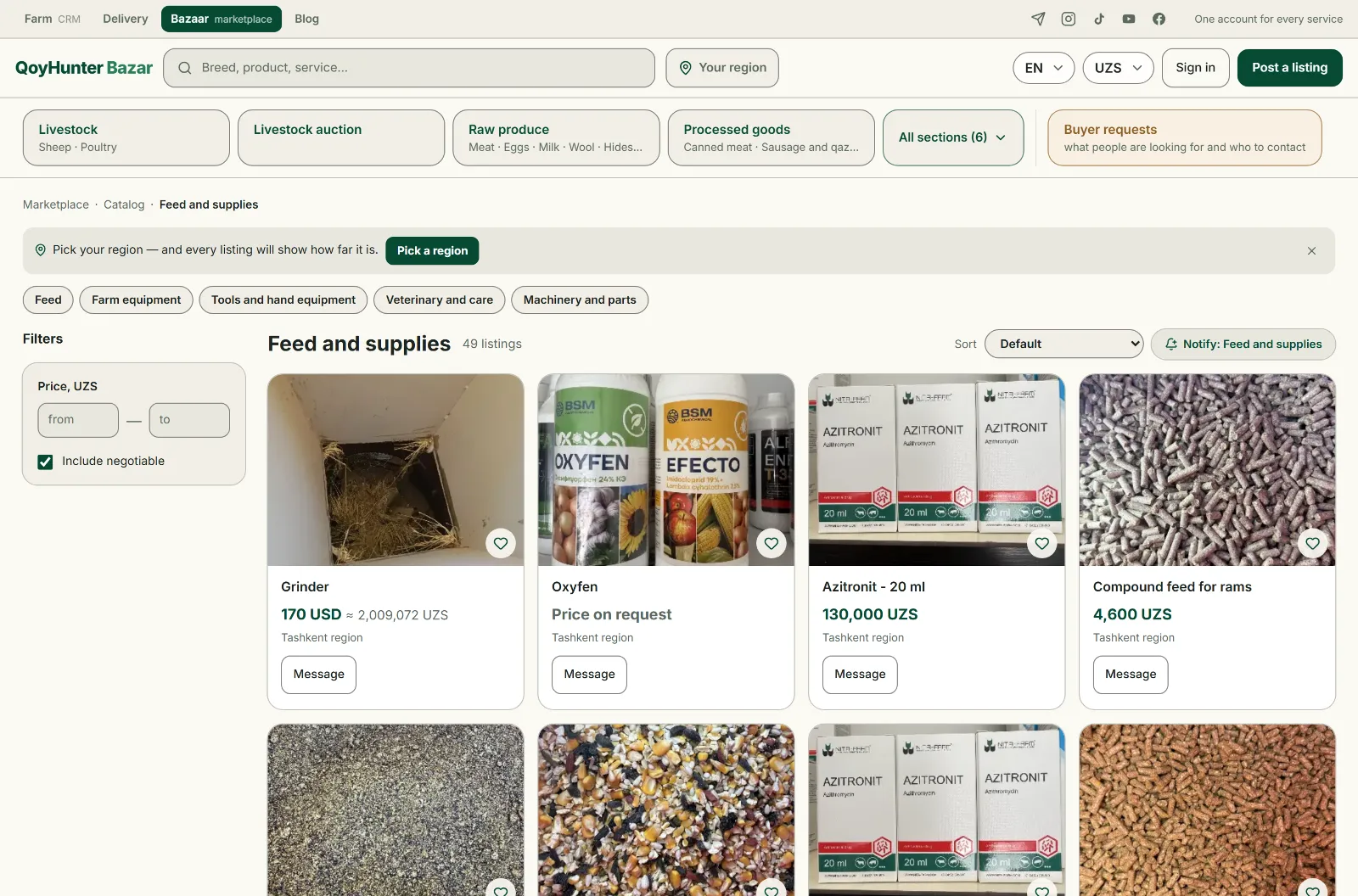
The strength of this channel isn't its size but the fact that the price is right there in the listing, before any haggling — so you can compare it with bazaar prices without leaving home. Posting is free, and the request goes straight to the owner, with no middleman. You can browse compound feed and grain listings in Tashkent without registering.
What each channel costs: summary table
| Channel | Minimum order | Price per kg | What eats into the savings | Who it suits |
|---|---|---|---|---|
| Dehqon bazaar | one sack | above average | travel, moisture, no paperwork | 10–30 head |
| Feed plant, elevator | large batch | below average | storage, transport, prepayment | 100+ head |
| Mill, oil plant | a few sacks and up | low | seasonality, availability | fattening of any size |
| Dehqon's field | by agreement | lowest | loading, transport, season | if you have your own vehicle |
| Online listings | by agreement | average, but visible before haggling | selection still narrow | comparing prices before a trip |
Why a cheap sack doesn't mean cheap feed
A ram doesn't eat sacks — it eats protein and energy. As long as you're comparing the price tag, you're comparing the wrong thing.
By standard livestock feeding norms, a ram on fattening needs about 1.4–1.7 feed units a day and 100–110 g of digestible protein per feed unit. That gives you a buying rule: divide the price per kilogram of feed by its protein content, and you get the price per kilogram of protein. That's the number to compare across channels.
There's a telling example right in the table above. Rapeseed meal is listed at 5,600 UZS/kg — roughly 60% more than cottonseed meal. The two meals are comparable in protein content, so a kilogram of protein works out roughly that same 60% more expensive too. At the same time, ordinary rapeseed meal has to be fed to sheep in limited amounts because of glucosinolates, and the inclusion rate is best agreed with a livestock specialist (low-glucosinolate canola meal is a different matter — but that's something to ask the seller about). So the more expensive feed here is also less versatile — and that doesn't show up on the price tag.
Ready-made compound feed or your own mix: the numbers for 50 head
Take a flock of 50 rams on fattening, at 0.8 kg of concentrates per head per day. That's 40 kg a day, or 1.2 tonnes a month.
Option A — ready-made compound feed. 1,200 kg × 4,600 UZS = 5.52 million UZS a month (≈ $467).
Option B — your own mix. Per head per day: barley 0.5 kg (1,900 UZS), corn 0.15 kg (570 UZS), cottonseed meal 0.15 kg (525 UZS). That's 2,995 UZS per head, or 3,744 UZS per kilogram of the mix. Per month: 4.49 million UZS (≈ $380).
The difference is 1.03 million UZS a month, about $87. Over a four-month winter that's 4.1 million UZS (≈ $348).
Let's check the mix for nutritional value, or the savings turn out to be fake. In 0.8 kg of this mix there's roughly 98 g of digestible protein and 0.93 feed units — around 106 g of protein per feed unit. That's within the norm for protein. And this is only about the concentrate part of the ration: 0.93 feed units cover a little over half of the daily requirement, with hay and straw providing the rest — and those are counted separately. The mix works not because it's cheaper, but because at that price it's no worse on protein.
Three caveats, without which this calculation is just a promise:
- You don't know the exact composition of a ready-made compound feed. If it contains a mineral premix and vitamins, part of the price gap is those, not markup. Ask about the composition, not just the price.
- You don't need a grain crusher for this saving. A sheep chews its feed thoroughly and grinds it again while ruminating, so it digests whole grain almost as well as crushed grain. A mill is useful for old animals with worn teeth and in lamb rations, where the grind should be coarse, not flour-fine. A universal grain crusher listed on our marketplace costs $170 (about 2.01 million UZS) — roughly two months' worth of the saving from switching to your own mix. But that saving comes not from the crusher, but from dropping ready-made compound feed itself: adult sheep are fed whole grain.
- A new feed is introduced gradually, over 10–14 days — and over two to three weeks if you're significantly increasing the share of concentrates. Switching abruptly to concentrates is a direct path to rumen acidosis, and a dead ram costs more than any savings on a sack.
What eats into the savings after you've already bought the feed
Money isn't lost only in choosing a channel.
Moisture. By general storage rules, grain stores safely at up to 14% moisture. Wet grain is heavier — you're paying for water as if it were feed — and in storage it heats up, cakes together and goes moldy. A simple on-the-spot check: a handful of grain should crumble and pour with a light, dry sound, not stick together in a clump.
Storage. Sacks left on the ground pull up damp from below; rodents can eat their way through a noticeable share of your stock over the winter. A pallet, a dry, ventilated room, and a first-in-first-out system all cost less than a lost tonne.
Tracking stock. The quietest leak of all: a farm buys feed "when it runs out" instead of on a plan, and ends up paying for an expensive small batch every time. When you can see exactly how much feed is left and how many days it will last, purchases get planned around the season. That's what feed and stock records for a farm are for: consumption is calculated automatically from the feeding schedule, not from memory.
Which channel to choose, and when
- Need a sack today, and your flock is under 30 head — the dehqon bazaar. The per-kilogram markup is smaller than the cost of a trip for a tonne.
- Steady, ongoing fattening and you have dry storage — a feed plant or elevator, on contract, buying ahead of season.
- Need cheap protein — the oil plant and the mill, and buy during the cotton-processing season, not in spring.
- Hay and straw — straight from a dehqon, in summer, right after cutting.
- Whatever you choose, before you set out — check prices in listings: it takes five minutes, and haggling is always easier with a number in hand than without one.
QoyHunter is a CRM for tracking sheep and the bazar.qoyhunter.com marketplace, where farmers in Uzbekistan post listings for free and get requests directly.
FAQ
How much does compound feed for rams cost in Tashkent in 2026?
As of 25 August 2026, ready-made compound feed for rams in listings from the Tashkent region costs 4,600 UZS per kilogram (about $0.39). Grain is cheaper: barley and corn are 3,800 UZS/kg, wheat is 4,000 UZS/kg. A sack's price at the dehqon bazaar is usually higher than buying a tonne-sized batch direct from a feed plant.
Is it cheaper to buy ready-made compound feed or mix your own?
A homemade mix of barley, corn and cottonseed meal runs about 3,750 UZS per kilogram, against 4,600 UZS for ready-made compound feed. For 50 rams eating 1.2 tonnes of concentrates a month, that's around 1 million UZS in savings a month (≈ $87). But mixing your own requires understanding the norms: the mix has to deliver the same 100–110 g of digestible protein per feed unit, or the savings turn into lost weight gain.
Do sheep need their grain crushed?
Not adult sheep. A sheep chews its feed thoroughly and grinds it again while ruminating, so it absorbs whole barley, corn and wheat almost as well as crushed grain. Grinding is worthwhile for old animals with worn teeth and in lamb rations, and it should be coarse: a fine fraction ferments faster in the rumen and raises the risk of acidosis.
How do you check grain when buying it, so you don't end up with wet grain?
Take a handful: dry grain crumbles and pours with a light, dry sound; wet grain sticks together in a clump and smells musty. By general storage rules, safe grain moisture is up to 14%. A wet batch is doubly dangerous: you're paying for water as if it were feed, and in storage that grain heats up and goes moldy.
How much feed should you buy per head per month?
On fattening, a ram gets about 0.8 kg of concentrates a day — that's roughly 24 kg a month per head, or 1.2 tonnes for a flock of 50. Add roughage on top: hay and straw are counted separately, and they make up the bulk of your winter reserves.
Manage your flock in QoyHunterCRM for sheep farmers: livestock, health, weighing, finance and analytics — in the app and a Telegram bot.All features →