Brucellosis in Sheep: Signs, Blood Testing, and the Rev-1 Vaccine Before Mating
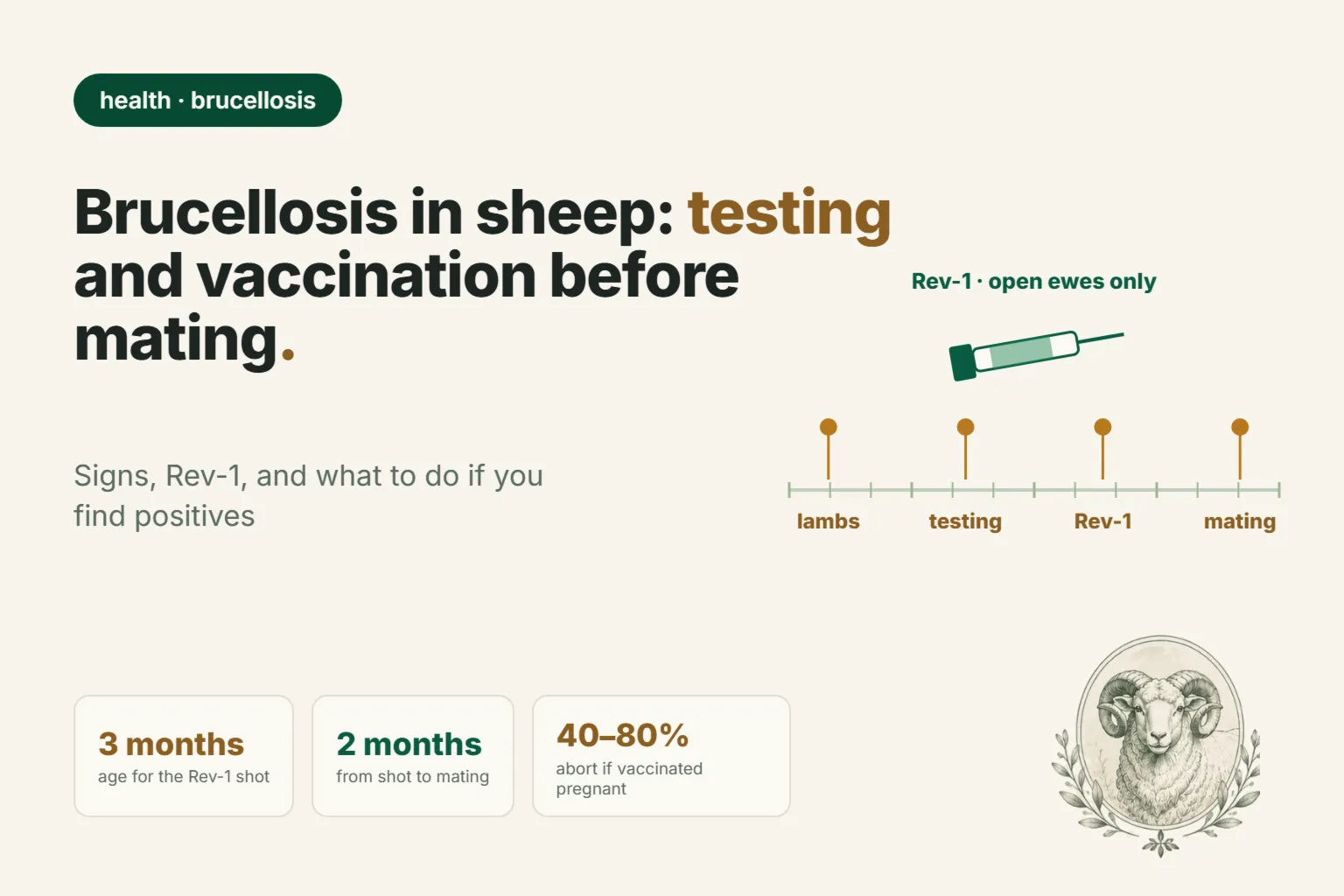
Brucellosis in sheep isn't treated: infected animals are identified by a blood test and sent to slaughter, while healthy ones are vaccinated with Rev-1 — only when open, and no later than 2 months before mating. Signs, a loss estimate for a flock of 100 ewes (up to 59 million UZS), and how to avoid catching it yourself.
Brucellosis in sheep is a contagious disease that causes abortions in ewes in the second half of pregnancy and infertility in rams, and it passes to humans through raw milk, afterbirth, and carcass butchering. Brucellosis in sheep isn't treated: infected animals are identified by a blood test and sent to slaughter, while healthy ones are protected with the Rev-1 vaccine. The vaccine is given only to open ewes, no later than two months before mating, so in Uzbekistan the smart time to deal with brucellosis is before the mating season starts.
What Is Brucellosis in Sheep, and Why Is It Dangerous for a Farm?
Brucellosis is a chronic bacterial infection. In sheep and goats it's caused mainly by Brucella melitensis — the species most dangerous to humans. Rams separately can carry Brucella ovis — infectious epididymitis, an inflammation of the epididymis, that drops a ram's fertility all the way down to infertility.
For Uzbekistan, this isn't rare. According to data from Uzbekistan's veterinary service presented at a CAREC program meeting, in the contagious-disease statistics for 2015–2017, small-ruminant brucellosis was registered nationwide 400 to 681 times a year, even though only about 10% of sheep and goats are tested for brucellosis annually. In those same years, 376 to 471 people fell ill each year, with acute brucellosis registered most often in the Bukhara, Kashkadarya, Jizzakh, and Navoi regions. The risk group includes shepherds, livestock owners, butchers, and veterinarians.
Brucellosis costs a farm in three ways:
- Abortions and dead lambs. A lost lambing means a whole year of keeping a ewe wasted.
- Culling. Ewes and rams that test positive for brucellosis aren't treated — they're sent to slaughter, and the flock has to be restocked.
- Restrictions. If brucellosis is confirmed, the khokimiyat (district administration), acting on a report from the state veterinary inspector, declares the farm infected and imposes restrictions. Until the restrictions are lifted, livestock can only be sold or moved the way the veterinary service allows.
What Are the Signs of Brucellosis in Sheep?
The main sign of brucellosis in sheep is abortion in ewes in the last months of pregnancy. Often it's not just one ewe but several in a short span of time. Other signs:
- retained afterbirth after lambing or abortion;
- stillborn and weak lambs that die in the first days;
- in rams — an enlarged, firm, or asymmetric testicle, inflammation of the epididymis;
- ewes that stay barren after mating;
- in some sheep — swollen joints and lameness.
The danger is that most infected sheep look healthy. A ewe can go through the infection, then lamb normally afterward, all while shedding brucella in her milk and amniotic fluid. So brucellosis in a ewe can't be spotted by appearance — a blood test is needed. For more on what to do with a ewe that has aborted, see our article on why ewes abort and what to do in the first hours.
How Do Sheep Get Infected with Brucellosis?
Most brucella is released during abortion and lambing: in the fetus, the afterbirth, and the amniotic fluid. Sheep get infected by licking the discharge, or eating feed and drinking water contaminated by it, while lambs get infected through the milk of a sick ewe. In rams, Brucella ovis spreads mainly through mating and through keeping rams together.
Brucellosis most often enters a healthy flock with a purchased animal. That's why new ewes and rams are kept apart for at least 30 days, and blood is drawn for brucellosis testing during that time. We covered the quarantine procedure in our article on quarantining new sheep: the 30 days that save a flock.
How Much Does Brucellosis Cost a Flock of 100 Ewes?
Let's count only the direct loss — lambs lost. Based on our breakdown of the annual cost of keeping a ewe, one lamb at weaning brings a farm roughly 1.18 million UZS (≈$100) net, at autumn 2026 prices. That's exactly what's lost with every abortion. The share of abortions when brucellosis enters a flock varies a lot, so here are three scenarios.
| Share of ewes with abortion | Lambs lost (per 100 ewes) | Lost revenue, UZS | ≈ $ |
|---|---|---|---|
| 10% | 10 | 11.8 mln | $1,000 |
| 30% | 30 | 35.4 mln | $3,000 |
| 50% | 50 | 59.0 mln | $5,000 |
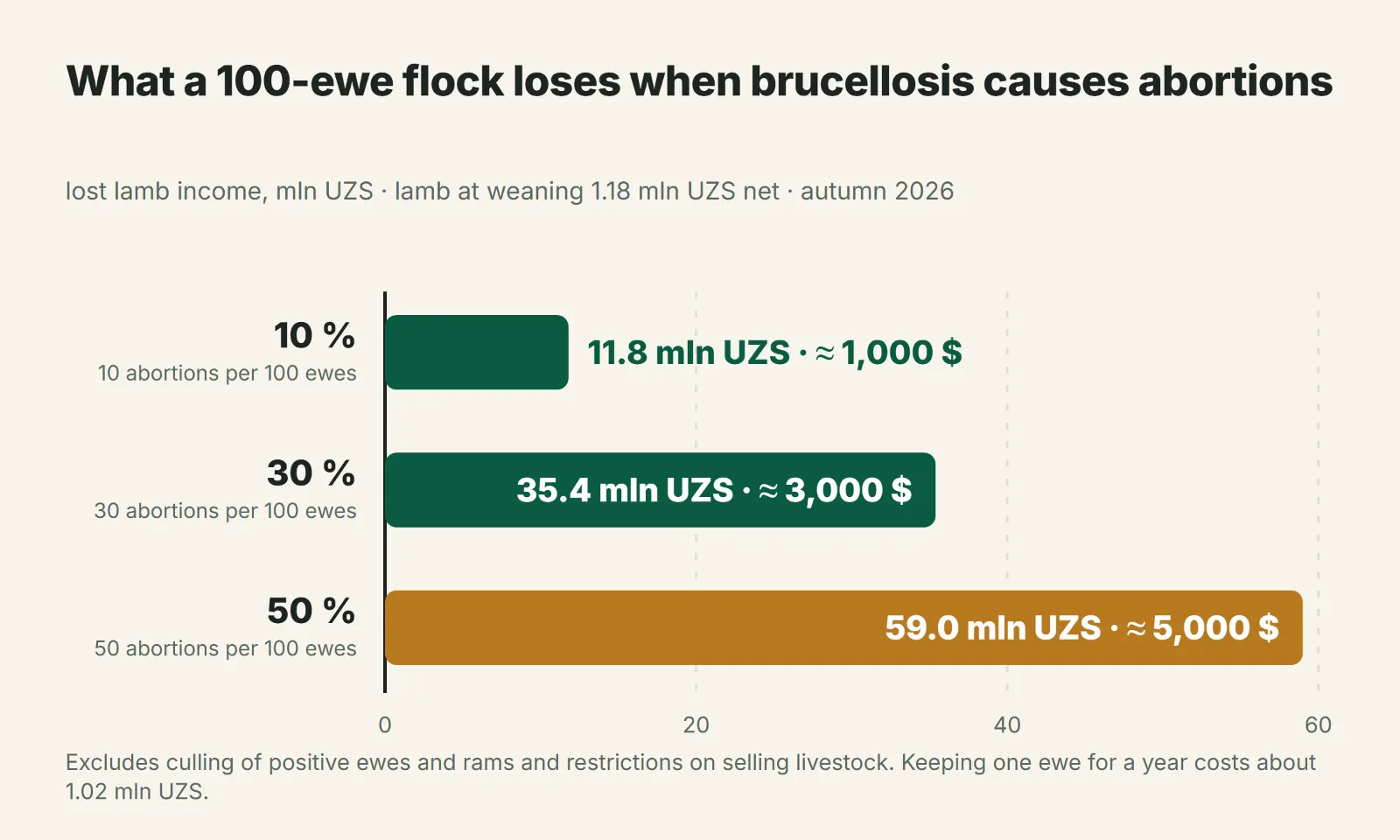
This doesn't include culling positive ewes and rams, buying replacements for them, or the fact that livestock can't be sold freely while restrictions are in place. For comparison: keeping one ewe for a year costs about 1.02 million UZS, so every abortion is a whole year of feed and labor that brought back nothing.
How Do You Test Sheep for Brucellosis?
Brucellosis in sheep is diagnosed by a blood test. A veterinarian draws the blood, and a state veterinary laboratory runs the test. According to Uzbekistan's veterinary service, the country has 14 provincial and 130 district veterinary laboratories. Serological tests are used: the Rose Bengal test as a quick screen, and the complement fixation test or ELISA for confirmation.
When to test the flock:
- before mating — all breeding rams, and ewes too if the farm has had abortions;
- every new animal — during quarantine, before it's let into the flock;
- after an abortion — the fetus and afterbirth go to the lab in a sealed bag, and the ewe is kept apart.
There's an important subtlety here. A ewe vaccinated with Rev-1 also tests positive for a while. Per the Rev-1 vaccine instructions, ewes vaccinated once are tested for brucellosis no sooner than 12 months after vaccination, and ewes vaccinated more than once — no sooner than 24 months. So when buying, ask the seller for the veterinary document: when and with what the ewe was vaccinated.
When and With What Should You Vaccinate Sheep Against Brucellosis?
In Uzbekistan, sheep and goats are vaccinated with a live vaccine made from the Brucella melitensis Rev-1 strain. According to the same veterinary service, this vaccine has been used on practically the entire sheep and goat population since 2015 — about 17 million head in 2018. The Rev-1 vaccine protects against both brucellosis in ewes and infectious epididymitis in rams.
Rules from the Rev-1 vaccine instructions:
| What | Rule |
|---|---|
| Who gets vaccinated | ewes, goats, and rams |
| Age | from 3 months |
| Pregnant ewes | vaccination is prohibited |
| Timing before mating | no later than 2 months before mating |
| Revaccination | once a year, at intervals of no less than 12 months |
| How it's given | subcutaneously behind the elbow joint, or into the conjunctival sac of the eye |
The ban on vaccinating pregnant ewes isn't a formality. According to scientific reviews, a full dose of Rev-1 causes abortion in 40–80% of vaccinated pregnant ewes. That's why the vaccine is given before mating, no later than 2 months out: if mating on a farm starts in September, vaccinate in July; if it starts in October, no later than early August. If mating has already started, pregnant ewes aren't vaccinated — this fall, what's left is testing the rams and the flock with a blood test, and vaccinating open ewes and yearling ewes ahead of time, 2 months before the next mating.
The Rev-1 vaccine is live and dangerous to humans: if it's injected into your hand or gets into your eye, see a doctor. The vaccine is given by a veterinarian, not by a shepherd. It's convenient to record the vaccination date for each sheep right away — for example, in the vaccination and treatment log in QoyHunter, a CRM for sheep record-keeping with the bazar.qoyhunter.com marketplace: there you set the planned date of the next treatment, and the app reminds you ahead of time. That's also the answer to a buyer's question, "when was she vaccinated."
What to Do If Brucellosis Is Found in Sheep?
Brucellosis in sheep isn't treated with antibiotics: treatment doesn't guarantee the ewe will stop shedding brucella, and the disease itself is on the list of contagious diseases a country is required to report to the World Organisation for Animal Health. So the procedure is as follows:
- Report it to the district veterinary service. Brucellosis measures are handled by the state veterinary service, not the farmer alone.
- Separate the positive animals from the flock and keep them out of mating.
- Don't sell or give away livestock to neighbors or resellers. That's exactly how brucellosis spreads across a district.
- Send the positive animals to slaughter in the order set by the veterinarian. Don't slaughter them yourself and hand out the meat to relatives: it's exactly the people butchering the carcass who get infected.
- Clean and disinfect the sheep shed, especially the lambing area; don't give the fetus and afterbirth to dogs.
- Repeat flock testing on the schedule set by the veterinary service, until the results come back negative.
How Do You Avoid Catching Brucellosis from Sheep?
People catch brucellosis from sheep through raw milk and dairy products made from it — kaymak, homemade cheese, and brynza made from unboiled milk — and also during lambing, abortion, and carcass butchering. Protection is simple and cheap:
- always boil milk from sheep and goats;
- wear gloves during lambing and when cleaning up an aborted fetus;
- wear gloves when butchering carcasses from an infected farm, and don't slaughter livestock at home without a veterinary check;
- if you have prolonged fever, sweating, and joint pain, tell your doctor you work with sheep.
How Do You Avoid Bringing Brucellosis into a Flock When Buying?
Brucellosis most often enters a flock with a purchased animal, so the most worthwhile move is not to bring the disease in at all. When buying ewes and rams through listings of sheep and rams for sale, ask the seller three things: whether the farm has had abortions in the past year, whether there's a recent negative brucellosis test, and when and with what the animals were vaccinated. Then: 30 days of quarantine and your own test before the new sheep joins the flock and goes into mating.
FAQ
Can a Sheep Be Cured of Brucellosis?
No. Brucellosis in sheep isn't treated: even after a course of antibiotics, a ewe can remain a carrier and infect the flock and people. Ewes and rams that test positive are separated from the flock and sent to slaughter in the order the state veterinary service sets.
Can You Vaccinate a Pregnant Ewe Against Brucellosis?
No. The Rev-1 vaccine instructions prohibit vaccinating pregnant ewes, and according to scientific reviews, a full dose of Rev-1 causes abortion in 40–80% of vaccinated pregnant ewes. Ewes are vaccinated while open, no later than 2 months before mating; yearling ewes from 3 months of age.
How Can You Tell a Ram Has Brucellosis?
Brucellosis in a ram (and infectious epididymitis from Brucella ovis) often shows up as an enlarged, firm, or asymmetric testicle, but many rams look healthy. Only a blood test gives a sure answer, which is why breeding rams are tested before every mating. The standard brucellosis test doesn't detect Brucella ovis — that needs a separate test, so tell your veterinarian the ram also needs to be checked for epididymitis.
Can You Drink Sheep's Milk If There Was Brucellosis in the Flock?
Raw milk — no. Brucellosis passes to humans through unboiled milk and the kaymak and homemade cheese made from it. Boiling kills brucella, which is why milk from sheep and goats should always be boiled, not just after an abortion in the flock.
Why Does a Vaccinated Ewe Test Positive for Brucellosis?
The Rev-1 vaccine is live, and it produces the same antibodies in the blood as the disease does. Per the Rev-1 instructions, ewes vaccinated once are tested no sooner than 12 months after vaccination, and ewes vaccinated more than once — no sooner than 24 months. When buying, ask for the vaccination document so you don't mistake a vaccinated ewe for a sick one.
Manage your flock in QoyHunterCRM for sheep farmers: livestock, health, weighing, finance and analytics — in the app and a Telegram bot.All features →