Foot-and-mouth disease in sheep: signs, vaccination, and why a few lame sheep can shut down sales of your whole flock
In sheep, FMD often runs hidden: lameness, fever, sores on the coronary band, and sudden death in nursing lambs. Signs, how it differs from foot rot, yearly vaccination, quarantine, and a loss calculation for a 100-ewe flock: about UZS 19.5 million (≈ $1,650).
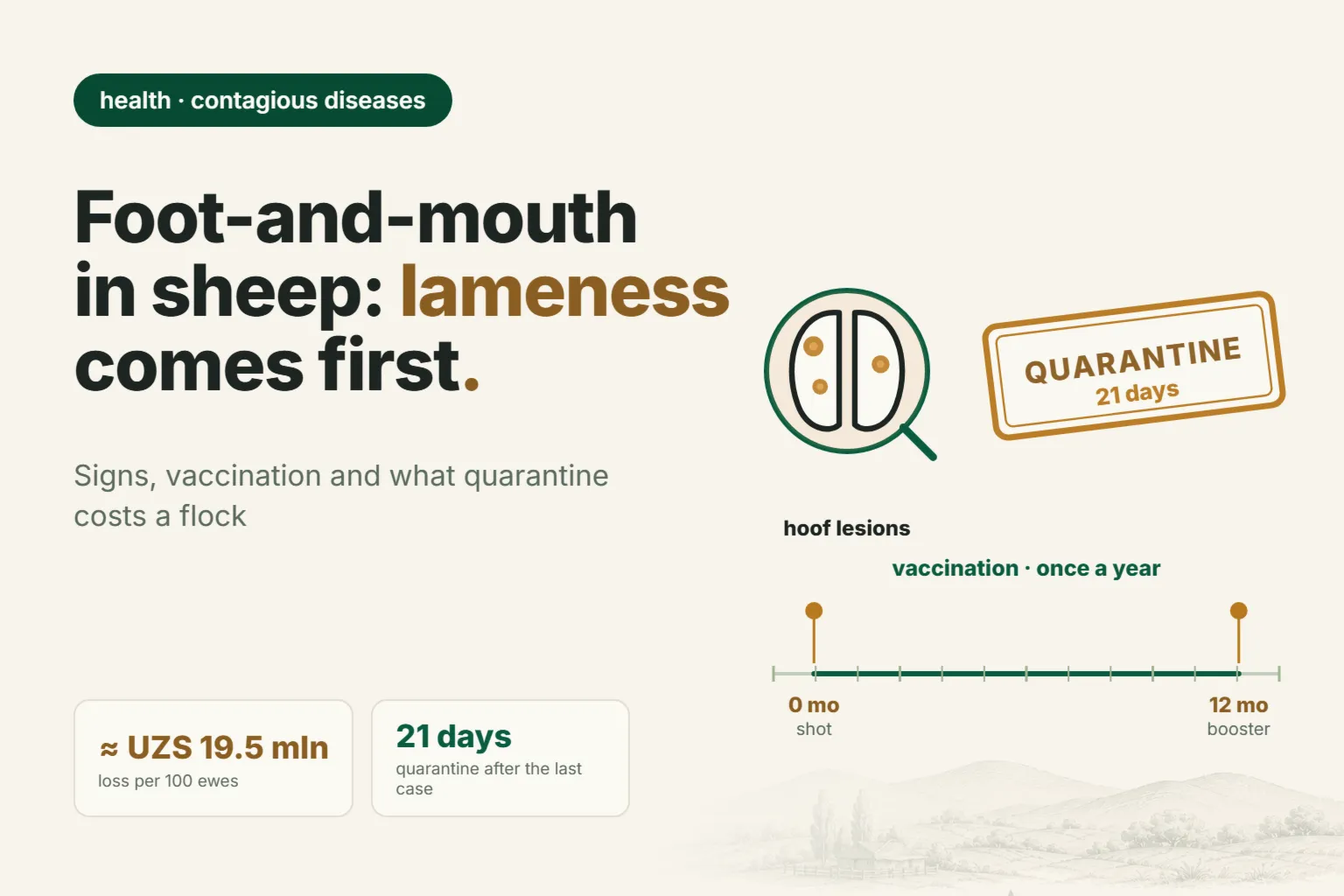
Foot-and-mouth disease (FMD) in sheep is a contagious viral illness with no cure. In sheep it often runs mild and almost unnoticed: the main sign is several sheep suddenly limping and lying down, and in nursing lambs, sudden death with no visible cause. Only vaccination protects the flock, and if FMD is confirmed, the farm is put under quarantine and no livestock can be sold. Below: the signs of FMD in sheep, how it differs from foot rot, when to vaccinate, and a loss calculation for a flock of 100 ewes.
The calculations use September 2026 prices, converted at 11,807 UZS per US dollar (the official Central Bank of Uzbekistan rate on September 29, 2026).
What is foot-and-mouth disease and how does it get into a flock?
Foot-and-mouth disease (FMD) is an acute viral disease of cloven-hoofed animals (cattle, sheep, goats, camels), in which blisters (vesicles) and then sores appear on the feet, in the mouth and on the udder. The World Organisation for Animal Health (WOAH) lists FMD among the diseases that countries are required to report, and keeps a separate register of countries officially free of FMD. Uzbekistan is not in that register: for Central Asia, FMD is a constant threat. According to the European Commission for the Control of Foot-and-Mouth Disease (EuFMD) under the FAO, serotypes O, A and Asia-1 circulate in the region.
The FMD virus is highly contagious. It is shed in fluid from vesicles, saliva, milk, dung and exhaled air, even before signs appear. It gets into a flock through:
- purchased sheep, rams and cattle;
- livestock that came back from the market or from a stopover next to other people's animals;
- people, vehicles, sacks and feed from affected farms;
- meat, milk and hides from sick animals.
What is special about sheep: they often get FMD mildly, and the owner does not notice the disease until the cattle in the same yard fall ill. According to the Center for Food Security and Public Health (CFSPH) at Iowa State University, some recovered sheep remain carriers of the virus: most often for 1-5 months, in rare cases up to a year. That is why a purchased sheep is kept apart from the flock and from cattle, even if it looks healthy.
What are the signs of FMD in sheep?
The incubation period of FMD in sheep, from infection to the first signs, is usually 2-8 days; for its trade rules WOAH takes it as 14 days. The signs in sheep are milder than in cattle, so look at the feet first.
| Where to look | What you see with FMD in a sheep |
|---|---|
| Behavior | Several sheep limp at the same time, lie down a lot, are reluctant to get up and follow the flock |
| Temperature | 40-41 °C in the first 1-2 days, then it drops |
| Hooves | Blisters and sores on the coronary band (where skin meets hoof) and in the cleft between the toes, the hoof is hot |
| Mouth | Small vesicles on the dental pad (the toothless upper gum), less often on the tongue; drooling is slight, the sheep eats worse |
| Udder | In nursing ewes, blisters on the teats, the ewe will not let the lamb suck |
| Nursing lambs | Sudden death with no diarrhea or other signs, because the virus attacks the heart muscle |
In a sheep the blisters burst quickly, within a day or two, leaving red erosions. So at an inspection you more often find not a blister but a sore on the coronary band.
The most vulnerable animals in the flock are lambs under 2-3 months. According to CFSPH, adult sheep rarely die of FMD (usually under 1%), while among young lambs mortality can be high because of damage to the heart. Pregnant ewes may abort with FMD.
How do you tell FMD from foot rot in sheep?
Lameness in sheep is most often not FMD but foot rot or inflammation between the toes. A mistake is costly both ways: a missed FMD case spreads across the district, and foot rot must not be confused with a quarantine disease.
| Sign | FMD | Foot rot |
|---|---|---|
| How fast | Many sheep go lame within 1-3 days | Lameness builds up over weeks, a few animals at a time |
| Temperature | 40-41 °C at the start of the disease | Usually normal |
| Smell | None | Sharp rotting smell from under the hoof horn |
| Where the damage is | Blisters and erosions on the coronary band and in the cleft, vesicles in the mouth | The horn separates from the soft tissue, the mouth is clean |
| Lambs | Sudden death of nursing lambs | They do not die from hoof problems |
| Cattle nearby | They fall ill too, with more obvious signs | They do not get it |
We covered how to treat foot rot separately: foot rot in sheep: causes, signs and treatment. If several sheep at once have lameness, fever and sores in the mouth, call a vet the same day and do not treat anything yourself.
How much does a flock lose in an FMD outbreak?
Let's count a flock of 100 ewes and 90 spring-born lambs that weigh about 30 kg by autumn. There was no vaccination, and FMD was brought in with purchased sheep. We take a cautious scenario for our example:
- 70% of the lambs fall ill, which is 63 head; over 2-3 weeks of illness each loses about 3 kg of live weight and missed weight gain; the price of lamb live weight is UZS 55,000 per kg, as in our calculation of the annual cost of keeping a sheep;
- 3 lambs die, at UZS 1.54 million each;
- 40 lambs that were meant to be sold in autumn stay on the farm for 45 days of illness and quarantine and eat feed worth about UZS 2,500 a day.
| Loss item | Calculation | Amount |
|---|---|---|
| Weight loss of sick lambs | 63 × 3 kg × UZS 55,000 | UZS 10.4 million (≈ $880) |
| Dead lambs | 3 × UZS 1.54 million | UZS 4.6 million (≈ $390) |
| Feed for 45 days of delayed sale | 40 × 45 × UZS 2,500 | UZS 4.5 million (≈ $380) |
| Total | UZS 19.5 million (≈ $1,650) |
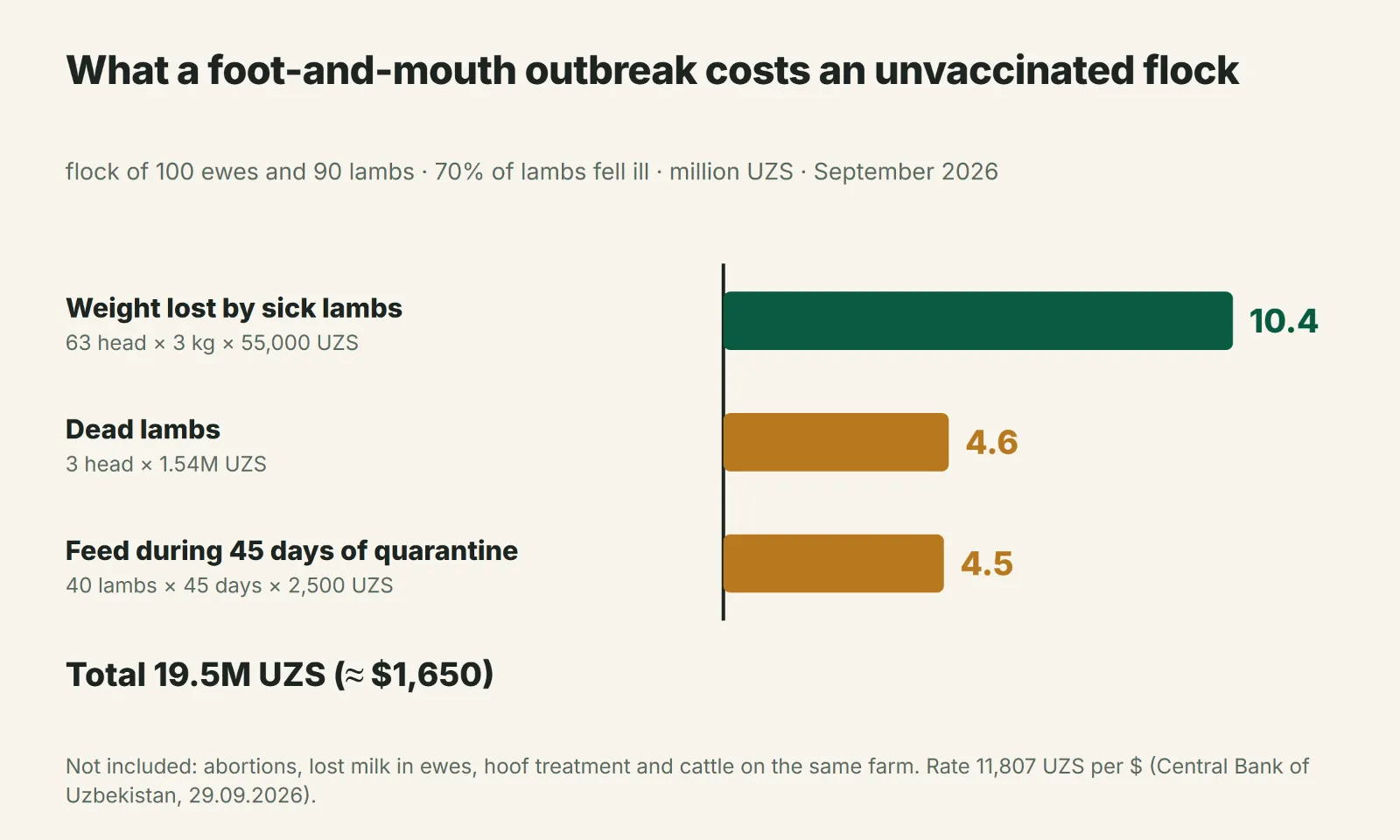
The calculation leaves out abortions in pregnant ewes, lost milk in nursing ewes, treatment of hoof complications, and the cattle in the same yard. In spring, when the flock has nursing lambs, deaths are higher and losses are bigger. Lamb mortality in FMD can be much higher still: according to CFSPH, from a few percent to most of the young stock. The main blow lands not on the health of the flock but on sales: while quarantine is in force, not a single ram can leave, and an outbreak in April-May wipes out the preparation for Eid al-Adha (Kurban Hayit).
Can FMD in sheep be cured?
No, there is no medicine for the FMD virus. A sheep gets through it on its own in 2-3 weeks if there are no complications. A vet may prescribe treatment of the sores and antibiotics: they do not act on the virus, but they protect the hooves and mouth from purulent inflammation.
What is done for sick sheep on a vet's instructions:
- keep them on dry, clean bedding, apart from healthy animals, with no driving around;
- give soft feed and plenty of clean water, since with sores in the mouth the sheep chews poorly;
- supplement-feed lambs whose mother will not let them near the udder;
- treat the sores on the hooves so that rot and flies do not settle in them.
You must not slaughter sick sheep for meat at home or sell the meat: the carcass, hide and milk from an affected flock spread the virus, and their fate is decided by the veterinary service.
When should you vaccinate sheep against FMD?
Vaccination against FMD uses an inactivated (killed) vaccine. An important detail: the vaccine protects only against the serotypes it contains, so for Central Asia you need a vaccine with serotypes O, A and Asia-1, and which exactly to use is decided by the state veterinary service. In April 2026 the Ministry of Agriculture of Uzbekistan, citing WOAH, warned about new types of the SAT serotype virus, against which the vaccines in use do not fully protect. So besides vaccination, a closed yard and disinfection at the entrance matter.
According to the recommendations of the Ministry of Agriculture of Uzbekistan (April 2026), the procedure is:
- Sheep, once a year: all clinically healthy animals older than 2.5-3 months; sick and emaciated animals are not vaccinated. If the district is at risk, the veterinary service may order revaccination more often.
- Lambs are vaccinated for the first time from 2.5-3 months (per the instructions of the specific vaccine), then on the veterinary service's schedule.
- Purchased sheep without a vaccination document stay in quarantine until they join the flock.
- Cattle in the same yard, twice a year, in spring and autumn, under the same Ministry of Agriculture recommendations. An unvaccinated cow next to a vaccinated flock is an open door for FMD.
Immunity builds up 15-21 days after vaccination, so vaccinate in advance, not when FMD is already in the next village. Vaccination is done by a veterinarian: in which districts, on what dates and at whose expense livestock is vaccinated against FMD is decided by the veterinary service, so start with your district veterinary station.
It is worth recording the vaccination date for each sheep, otherwise in a year nobody will remember who was vaccinated and when. QoyHunter, a CRM for sheep records and the marketplace bazar.qoyhunter.com, has vaccination and vet treatment records for your flock for this: you set the date of the next revaccination on the vet's schedule, and the app reminds you well ahead. A buyer who asks about FMD will see a record, not hear "I think they were vaccinated."
What should you do if FMD is in the flock?
FMD is a disease you report to the state veterinary service right away. The procedure in the first 24 hours:
- Call the district veterinarian the same day you see lameness with fever in several sheep, or sores in the mouth.
- Close the yard: sell no one, buy no one, do not let animals out to shared pasture and watering places, do not take livestock to the market.
- Separate the sick sheep from the healthy ones and from the cattle.
- Keep outsiders out: no buyers, no neighbors, no vehicles. The shepherd should change clothes and wash footwear on leaving the pen.
- Prepare disinfection: the FMD virus is sensitive to alkali and acid. According to WOAH recommendations, a 2% solution of sodium hydroxide (caustic soda) and a 4% solution of sodium carbonate (soda ash) are suitable for disinfection; work in gloves, because caustic soda burns skin.
Next the veterinary service takes samples and, if FMD is confirmed, declares quarantine on the farm and often on neighboring villages. Quarantine is lifted by decision of the veterinary service; under the veterinary rules of neighboring countries (for example, Russia), not earlier than 21 days after the last sick animal recovers or is slaughtered and final disinfection is done. During all that time, livestock are not sold or moved from the farm.
How do you avoid bringing FMD in when buying sheep?
The cheapest thing is not to bring FMD into your flock. When buying ewes and rams, for example through listings of rams and ewes for sale, ask the seller:
- when the flock was last vaccinated against FMD and whether there is a record or a vet's certificate;
- whether there was FMD on the farm or in the village in the past year, and whether there is a quarantine there;
- check the feet and mouth: no lameness, no sores on the coronary band and between the toes, no vesicles on the upper gum.
Then keep them in quarantine apart from the flock and the cattle for at least 21 days, and vaccinate if there is no document. How to set up quarantine on a farm is covered in the article quarantine for new sheep: 30 days that save the flock.
FAQ
Can a person catch FMD from sheep?
People catch FMD very rarely, mostly through raw milk from sick animals or while caring for them, and the disease in people is mild. The main danger of FMD is not to people but to livestock: a person carries the virus on clothes, shoes and hands from a sick flock to a healthy one. So milk from an affected farm is boiled, and you do not visit other people's animals after being with sick ones.
How many times a year should sheep be vaccinated against FMD?
Under the recommendations of the Ministry of Agriculture of Uzbekistan (April 2026), sheep are vaccinated against FMD once a year and cattle twice a year, in spring and autumn. Healthy animals older than 2.5-3 months are vaccinated, and immunity builds up in 15-21 days. If the district is at risk, the veterinary service may order revaccination more often, so confirm the schedule and vaccine at your district veterinary station.
Why does FMD in sheep go unnoticed?
In sheep, FMD often runs milder than in cattle: the blisters are small, burst within a day or two, and there is almost no drooling. The owner sees only a few sheep limping and puts it down to the hooves. Meanwhile the sheep shed the virus and infect cattle and neighbors' flocks, and in nursing lambs FMD causes sudden death from heart damage.
Can I sell sheep if a village is put under FMD quarantine?
No. While FMD quarantine is in force, it is forbidden to take livestock out of the farm and quarantine zone or sell it, and often meat, milk and hides too. Quarantine is lifted by the state veterinary service no earlier than 21 days after the last case and final disinfection. Selling a sheep on the quiet spreads FMD to other people's farms.
What should I use to treat the sheep shed after FMD?
The FMD virus dies in alkaline and acidic conditions. According to WOAH recommendations, after manure is cleared, the shed, feeders, drinkers and equipment are treated with a 2% solution of sodium hydroxide or a 4% solution of sodium carbonate. Manure and bedding are removed and decontaminated on the vet's instructions. Final disinfection before quarantine is lifted is carried out or accepted by the veterinary service.
Manage your flock in QoyHunterCRM for sheep farmers: livestock, health, weighing, finance and analytics — in the app and a Telegram bot.All features →