Buying Feeder Lambs: The Entry Price Ceiling That Decides Your Fattening Profit
Half your fattening profit is decided at the bazaar, in the hour you buy the lamb — not later at the feed trough. We work out the maximum entry price per kilogram, what age, weight and breed actually pay off, and why most deaths hit in the third week after purchase.
Fattening is treated like it's all about the feed trough: throw in more barley, make more money. In reality, half your profit gets decided in one hour at the bazaar, the moment you shake hands and pay for the lamb. Buy him too dear, and no amount of feeding afterward will win that difference back.
The reason is simple. A kilogram of live weight costs more in a lamb than in a fattened ram. Feeder lambs sell fast, and sellers know it. But you'll be selling a heavy animal, and the rate per kilogram is lower for that. So you buy an expensive kilogram and sell a cheap one — and your entire profit lives in the gap between those two numbers.
Let's go through it in order: what age and weight to buy, up to what price per kilogram bargaining still makes sense, what to check on the animal in five minutes, and why deaths usually happen not in your own flock but in the third week after purchase. Exchange rate used here — about 12,000 so'm to the dollar (the official rate on August 10, 2026 was 11,952 so'm).
The formula that sets your price
Before you bargain, you need one number — your maximum entry price: how much you can pay per kilogram of lamb and still break even. Anything below that number is profit. Anything above it is you working for free.
Maximum entry price per kg = (final weight × sale price per kg − total fattening costs) ÷ weight at purchase
Let's run a real example, using August 2026 prices.
| Item | Value |
|---|---|
| Lamb at purchase | 28 kg |
| Fattening period | 120 days |
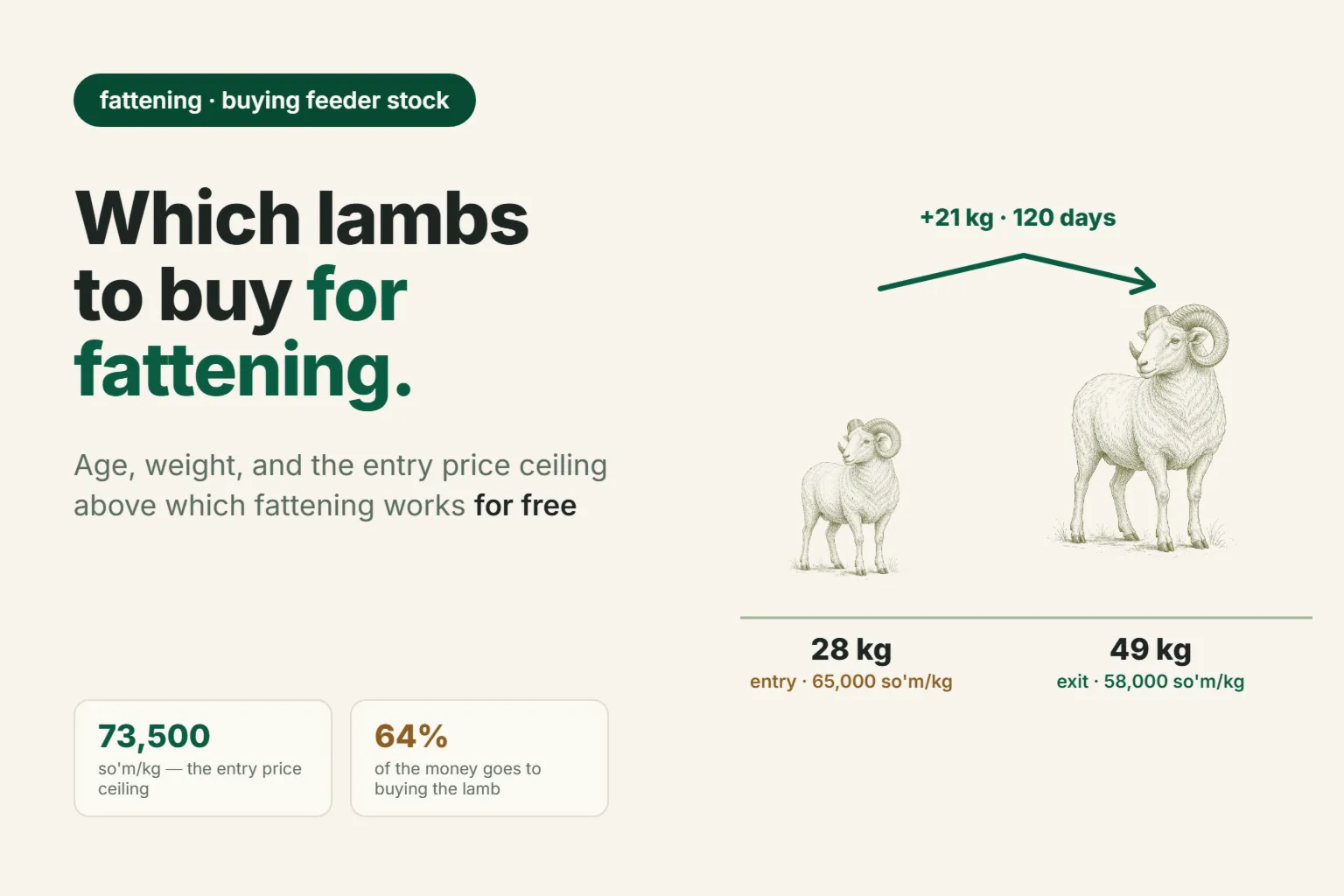
| Weight gain | 175 g/day → +21 kg |
| Weight at sale | 49 kg |
| Sale price (live weight) | 58,000 so'm/kg (≈ $4.8) — a cautious figure, selling to a middleman |
| Feed over 120 days | 744,000 so'm (≈ $62), averaging 6,200 so'm/day |
| Vet treatments, salt, odds and ends | 40,000 so'm (≈ $3.3) |
Revenue: 49 × 58,000 = 2,842,000 so'm (≈ $237). Costs excluding the purchase: 744,000 + 40,000 = 784,000 so'm (≈ $65). Left over for the purchase: 2,842,000 − 784,000 = 2,058,000 so'm.
You take that figure to the market: buy feeder lambs at 2 million soum a head or less is exactly the range that fits the calculation.
Divide by the lamb's weight: 2,058,000 ÷ 28 = 73,500 so'm per kilogram. That's your ceiling. Pay 73,500, and you spent four months feeding the ram as a gift to the seller.
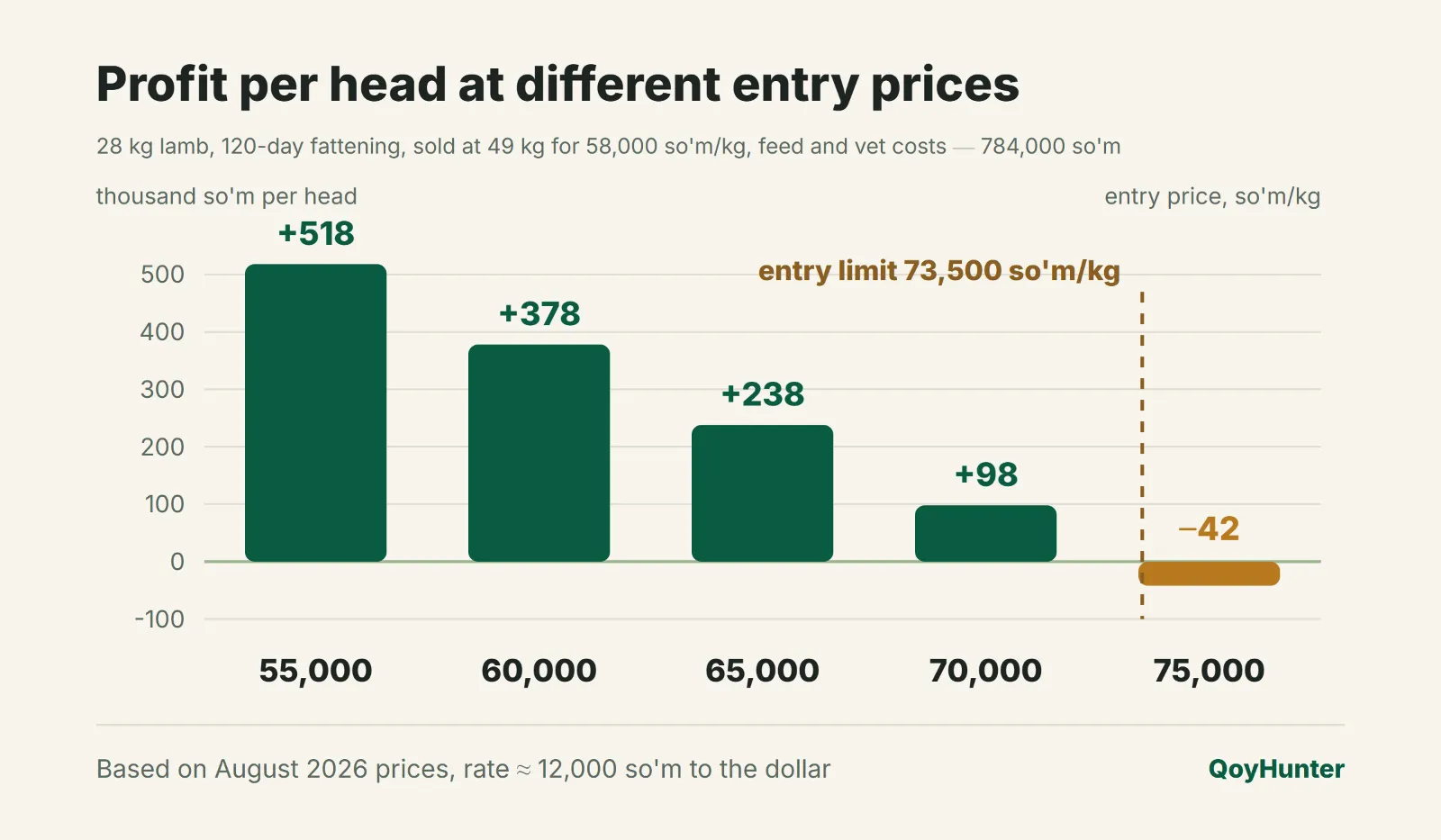
From here it's one line of arithmetic: every extra thousand so'm on the entry price per kilogram costs you 28,000 so'm per head, and on a batch of 20 head — 560,000 (≈ $47).
| Entry price, so'm/kg | Cost of a 28 kg lamb | Profit per head over 120 days |
|---|---|---|
| 55,000 | 1,540,000 so'm | +518,000 so'm (≈ $43) |
| 60,000 | 1,680,000 so'm | +378,000 so'm (≈ $32) |
| 65,000 | 1,820,000 so'm | +238,000 so'm (≈ $20) |
| 70,000 | 1,960,000 so'm | +98,000 so'm (≈ $8) |
| 75,000 | 2,100,000 so'm | −42,000 so'm (≈ −$3.5) |
This calculation doesn't include your own labor, water, electricity or upkeep of the pen. Count those too, and the ceiling drops another 5,000–8,000 so'm per kilogram. Be honest in your math — the only labor that's ever free is someone else's.
And one more thing, the most important one. Your entry ceiling doesn't depend on how well you bargain — it depends on the price you'll be selling at. Sell at 52,000 so'm/kg, and the entry limit drops to 63,000; sell at 65,000 (roughly the demand level right before Qurban Hayit), and it rises to 85,700. So decide when and to whom you're selling first, and only then go bargain for the lamb. We covered how ram prices form in "Sheep Prices in Uzbekistan".
Buying eats up two-thirds of your money
Break the revenue from one head down into pieces, and the picture is sobering: at an entry price of 65,000 so'm/kg, the lamb itself eats 64% of the total, feed takes 26%, and profit is eight cents on every so'm.
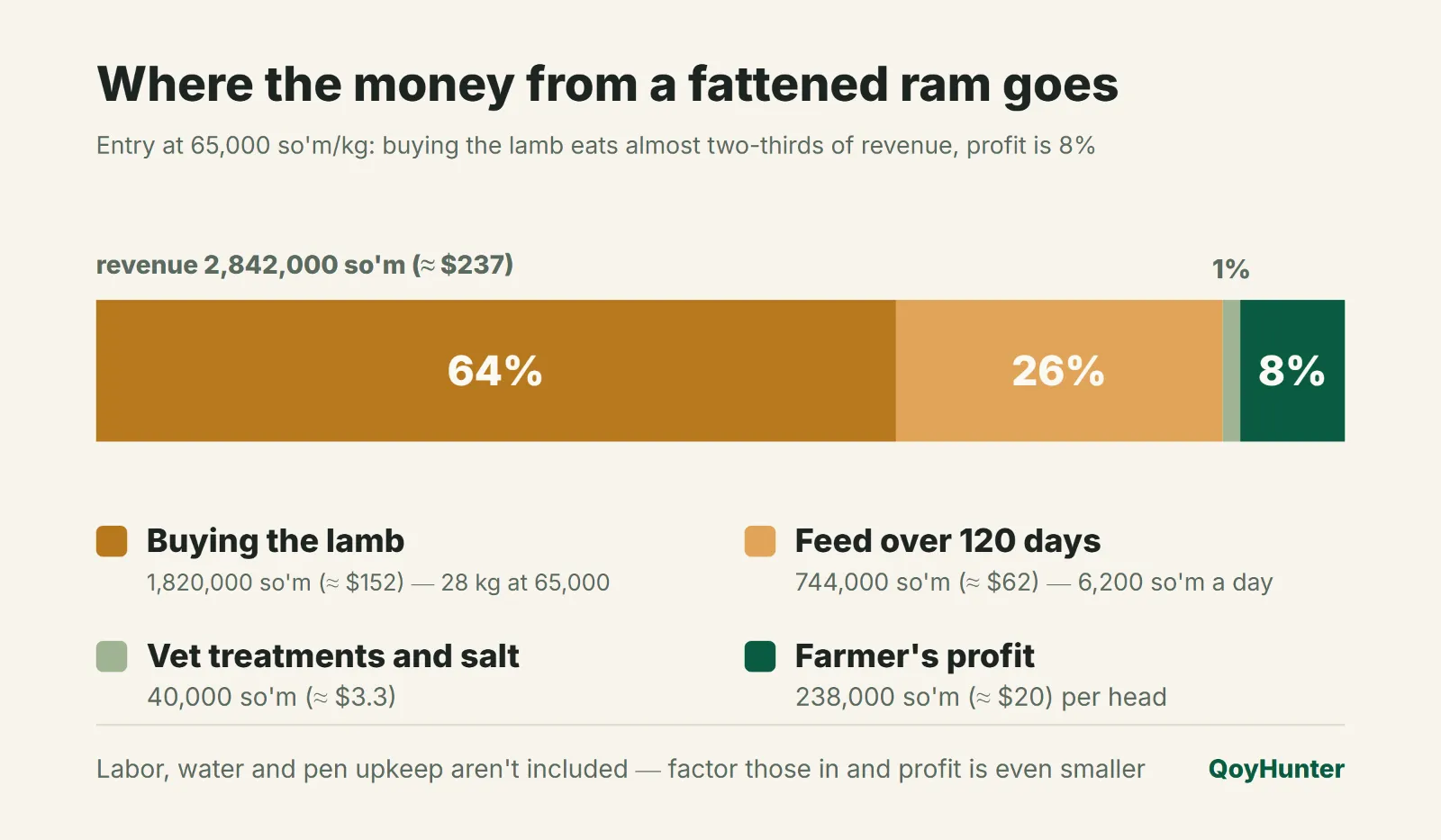
That points to a conclusion a lot of people don't like: skimping on feed barely moves the needle, but knock 5,000 so'm off the entry price per kilogram and that's +140,000 so'm in profit per head, right away. One good round of bargaining is worth a month of scrimping on barley.
But do not buy feed blind either: where to buy barley and bran cheaper is the other half of the same arithmetic, especially with a batch of more than ten head.
Which lamb pays off: age, weight, sex
Age 4–7 months, weight 25–35 kg — that's the working range for pen fattening. A young animal converts feed into meat more efficiently: a kilogram of weight gain costs two to three times less at the start than near the finish. We worked through this in detail in "How Much a Kilogram of Weight Gain Costs".
- Under 22–25 kg. A freshly weaned lamb hasn't built up strength yet, needs a pricier protein-heavy ration, and death losses in the first weeks run higher. You'll need to keep him longer, so your money sits tied up in the animal longer.
- Over 40 kg. Weight gain slows, the daily ration grows, and each kilogram of gain gets pricier. Buy an animal like this for a quick resale, not for fattening.
- Check age by the teeth, not by what the seller tells you. Small, even milk incisors mean the animal is under a year old — that's what you want. Two broad "spade" teeth in the middle are the first pair of permanent incisors — that animal is already 12–18 months old. How to read teeth year by year is covered in telling a sheep's age by its teeth.
- Sex. A ram lamb gains weight noticeably faster than a ewe lamb on the same feed, which is why fattening operations buy ram lambs. A ewe lamb is worth more left in the breeding flock than turned into meat.
- Breed. Hissar, Edilbay and their fat-tailed crosses grow faster than others — worth paying extra for. Karakul lambs are smaller-framed, so only buy them for fattening if the price per kilogram is noticeably lower.
And the most important thing before you bargain: know the actual weight. Not "by eye" — use a scale or a chest-girth tape. How to do that is covered in "How to Weigh a Ram Without a Scale". A 3 kg error from eyeballing it is 200,000 so'm thrown away.
Five minutes of checking that save the batch
Buy a sick animal, and you pay a healthy animal's price for it — then pay again to treat it, and treat the rest of your flock for what it gave them.
| What to check | Warning sign | What it means |
|---|---|---|
| Eyelids and gums | pale, almost white | anemia from worms — a lamb like this won't put on weight |
| Belly and body condition | pot belly with a thin, bony back | parasites, not "eating well" |
| Breathing | coughing when driven, nasal discharge | pneumonia — the animal will stall on the feedlot |
| Tail and rear end | dirty, signs of scours | diarrhea, coccidiosis |
| Hooves | limping, foul smell | foot rot — it will spread to your own flock |
| Skin and fleece | scratch marks, scabs, bald patches | mange — you'll have to treat the whole group |
| Jaw and bite | teeth don't meet properly | the animal eats poorly, no weight gain |
One more thing on its own: swelling under the jaw, a soft "pillow" — that's not breed type and it's not fat, it's bottle jaw, a sign of severe anemia. Don't buy that animal at any price.
Check lambs in the morning, before they've been worn down by the heat, and make sure to watch how the animal walks — limping and listlessness at the bazaar don't go away on their own. If you're unsure about an animal's condition, don't guess and don't treat blind: show it to a vet. That's cheaper than any mistake.
A full inspection checklist, from incisors to hooves, plus a breakdown of the buying channels, is set out separately: buying a ram in Tashkent with delivery.
The month that decides your profit
Deaths among newly bought stock almost never happen on day one. They hit in the second or third week, when three things line up at once: the stress of transport, an abrupt feed change, and pathogens the animal picked up at the bazaar.
What makes the difference:
- Quarantine for 30 days — keep new arrivals separate from your own flock, no shared pen, no shared trough. Vet services name a month as the minimum: many diseases show no signs at all in the first few days. It's inconvenient, but one disease brought onto the farm costs more than any extra shed.
- The first day — water and hay only. No grain straight off the road.
- Bring in concentrates gradually, adding a little more each day over several days. A sudden switch to grain causes rumen acidosis — the animal stops eating and you lose exactly what you paid for.
- Deworming and vaccination on schedule — see the treatment calendar. Treat on the second or third day, once the animal has recovered from the trip.
- Weigh every head at intake and write it down. Without a starting weight, you won't know four months later which animals in the batch dragged the group down and which ones paid off. Keeping these numbers is easier somewhere they won't get lost: in a weighing and weight-gain app, every animal gets a card with weighings and treatments, and weight gain is calculated automatically.
The stakes are easy to see in plain arithmetic: one dead animal out of twenty costs you 1.8–2 million so'm (≈ $150–170) — the profit from five to eight successfully fattened animals.
The riskiest days for a bought-in batch are days 14 to 30 after arrival: that is when coccidiosis flares up in lambs, often without obvious scours, just as lagging weight gain. How to spot it, when to give treatment and what it costs a feedlot is covered in our guide to coccidiosis in feedlot lambs.
When fattening isn't worth starting
- Entry price above 70,000 so'm/kg with an expected sale price of 58,000 — your margin is under 100,000 per head, and the first lamb that gets sick will eat it whole.
- Buying right before Qurban Hayit and selling right after it. You're entering at the price peak and exiting into the slump, once the bazaar empties out. The right way round is the opposite: buy in the calm season and time the fattening period so the animal reaches condition right at peak demand.
- No scale and no records. Without weights at intake and at sale, you're not calculating your profit, you're guessing it.
- Grain prices rise faster than meat prices. Recalculate your entry ceiling — when feed gets pricier, the ceiling drops.
In short
- Fattening profit gets locked in on the day you buy: a kilogram of lamb costs more than a kilogram of fattened ram.
- Work out your maximum entry price: (final weight × sale price − costs) ÷ weight at purchase. For the example above, that's 73,500 so'm/kg.
- Every extra thousand so'm on the entry price per kilogram costs you 28,000 per head, and 560,000 on a batch of 20 head.
- A solid candidate: a ram lamb, 4–7 months old, 25–35 kg, a fat-tailed breed or a cross of one.
- Five minutes of checking: eyelids, belly, breathing, tail, hooves, skin, bite.
- Quarantine for 30 days, introduce grain gradually, weigh and record every animal at intake.