Inbreeding in Sheep: Can a Ram Cover His Daughters?
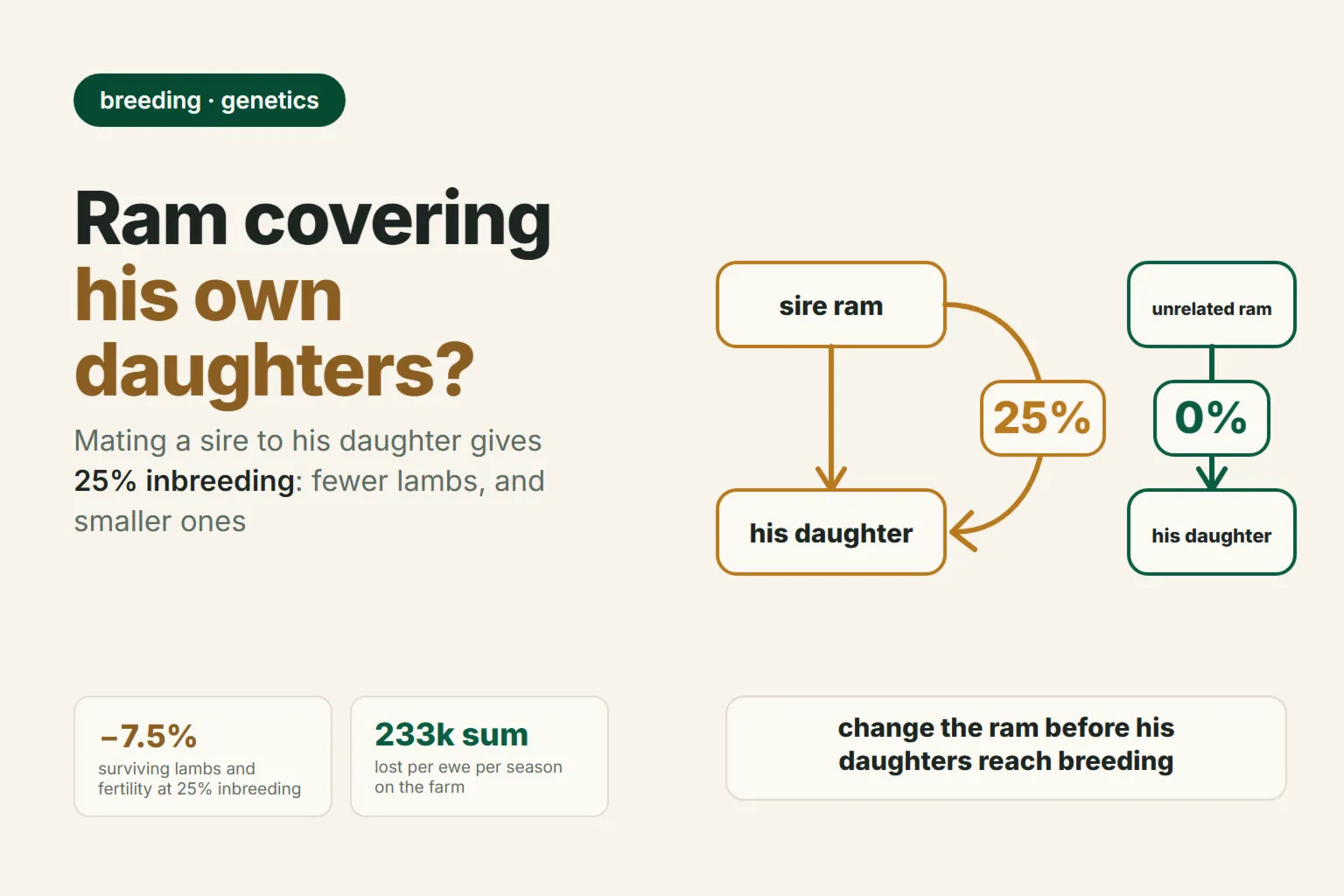
A ram mated to his daughter gives 25% inbreeding: fewer and smaller lambs, about 233,000 sum lost per ewe a season. When to change a ram, and how.
Inbreeding in sheep means mating related animals: a ram to his daughters, a brother to his sister, a son to his dam. A ram mated to his own daughter gives the lambs an inbreeding coefficient of 25%. A summary of studies on seven livestock species, sheep included, puts that at roughly 7.5% fewer surviving lambs and lower fertility, and 5–6% less live weight in the lamb crop. In a flock of 35 ewes that comes to about 233,000 sum (≈ $19) lost on each such ewe per season. To avoid it, change the ram or separate him from his daughters before they reach breeding age.
Below: how much inbreeding each kind of related mating produces, what it costs in sum, when exactly a ram starts covering his own daughters, and four ways to avoid it. Prices are for November 2026, at the Central Bank of Uzbekistan rate of November 17, 2026: 12,023.61 sum to the dollar.
What is inbreeding in sheep and why is it harmful?
Inbreeding (mating of relatives) is the mating of animals that share ancestors. The inbreeding coefficient shows what share of a lamb's genes it received as two identical copies from a common ancestor. The higher it is, the more often a lamb carries hidden harmful genes in a double dose: in unrelated parents they stay hidden, in related parents they show up.
Scientists call this inbreeding depression. As inbreeding rises, fertility, lamb survival, growth and birth weight all fall. It does not look like a disease. It looks like a flock that has "got smaller": the lambs are smaller, there are more weak and dead ones at lambing, and more barren ewes. The owner blames feed or weather, when the real cause is a single ram who stayed in the flock too long.
How much inbreeding does each kind of related mating give?
The coefficients are calculated with Wright's formula, the classic one in animal genetics, and they are the same for every breed: Hissar, Edilbay, Jaydara and any other. The figures hold if the parents have no other common ancestors; with repeated related mating, inbreeding is higher.
| Who is mated to whom | Inbreeding coefficient of the lambs |
|---|---|
| Ram to his own daughter | 25% |
| Son to his dam | 25% |
| Full brother to full sister | 25% |
| Half-brother to half-sister (same ram, different ewes) | 12.5% |
| Grandsire to granddaughter | 12.5% |
| First cousins | 6.25% |
| Unrelated animals | 0% |
The most common mistake on a small farm is the fourth row of this table, half-brother to half-sister. The old ram is sold, and his own son, raised in the flock, is kept in his place. The new ram covers ewe lambs sired by the old ram, which makes them his half-sisters. That is 12.5% inbreeding, even though the owner thinks the blood has been renewed.
How much does inbreeding cost a farm?
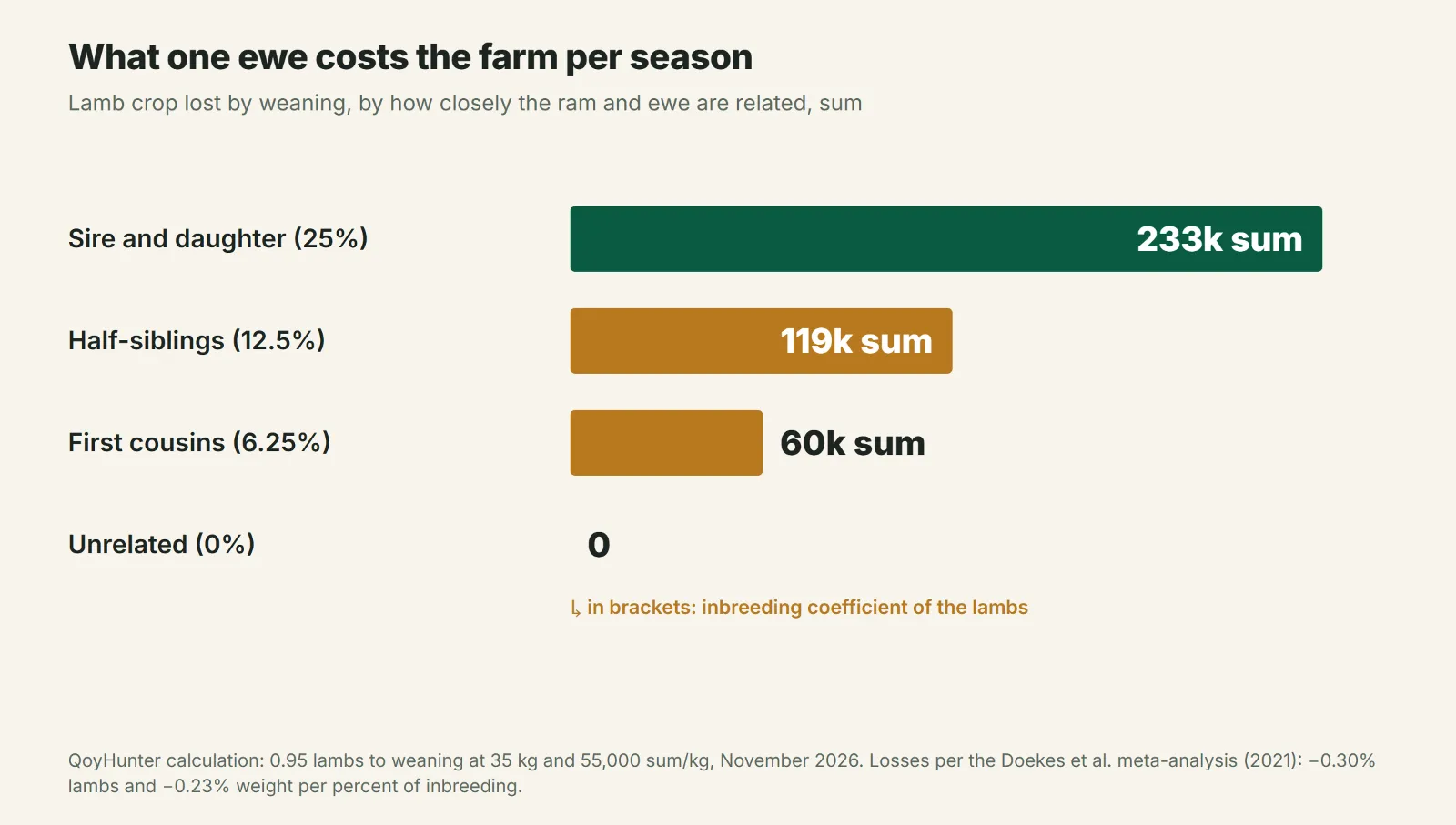
The fullest figures come from a meta-analysis of 154 studies on livestock of different species (Doekes, Bijma and Windig, Genes, 2021). It found that each percent of inbreeding lowers reproduction and survival traits by 0.30% on average, and weight and size traits by 0.23% of the herd mean. Sheep data are of the same order: in the Danish Texel, Shropshire and Oxford Down breeds, a rise in inbreeding of 10 percentage points cut birth weight, gain up to 2 months and litter size by 1.2–2.6% (Norberg and Sørensen, Journal of Animal Science, 2007).
Let us turn this into money. Take a ewe that rears 0.95 lambs to weaning at 35 kg each, and a price of 55,000 sum per kilogram of live weight, the same figures as in our calculation for replacement ewe lambs. Without inbreeding, such a ewe produces about 1.83 million sum worth of lambs per season.
| Relationship of ram and ewe | Inbreeding of the lambs | Fewer lambs at weaning | Lower lamb weight | Loss per ewe per season |
|---|---|---|---|---|
| Sire and daughter | 25% | −7.5% | −2.0 kg | ≈ 233,000 sum ($19) |
| Half-brother and half-sister (same sire) | 12.5% | −3.8% | −1.0 kg | ≈ 119,000 sum ($10) |
| First cousins | 6.25% | −1.9% | −0.5 kg | ≈ 60,000 sum ($5) |
| Unrelated | 0% | 0 | 0 | 0 |
This is an average estimate, not a ceiling. In a long experiment at the Roslin Institute in Scotland (Wiener, Lee and Woolliams, 1994), a ewe's gross lifetime income (from lambs, wool and culled ewes) fell almost in direct proportion to inbreeding, and for the most inbred ewes, with a coefficient of about 50%, it was only 35% of the income of non-inbred ones. This is what happens when related mating is repeated generation after generation: an inbred ewe lamb kept for breeding brings in less herself, and her lambs by a related ram lose even more.
When does a ram start covering his own daughters?
It depends on the age at which you breed your ewe lambs. Take a ram who joined the flock before the autumn breeding season.
- Ewe lambs are bred at 8–10 months. The daughters from the ram's first season are born in spring and are ready for breeding that same autumn, at 8–10 months. So in his second season the ram covers his own daughters.
- Ewe lambs are bred at a year and a half. The daughters reach breeding a year later, in the ram's third season.
A good breeding ram works about 4 seasons, and if nothing changes in that time, his daughters' share of the flock grows every year. Let us count for a flock of 35 ewes with one ram: each year about 8 ewe lambs are kept as replacements, that is, 20–25% of the ewes are replaced. The ewe lambs are bred at 8–10 months, and all the replacement ewe lambs are this ram's daughters.
| Ram's season | His daughters in the breeding group | Loss for the season |
|---|---|---|
| 1st | 0 | 0 |
| 2nd | 8 | ≈ 1.9 million sum ($155) |
| 3rd | 16 | ≈ 3.7 million sum ($310) |
| 4th | 24 | ≈ 5.6 million sum ($465) |
Over four seasons of one ram that is about 11.2 million sum (≈ $931), and this does not count the inbred ewe lambs from those lambings who go on to become replacements and drag the flock down further. The calculation is a simplified one: we did not subtract culling of young ewes and counted only the lamb crop at weaning.
How to avoid inbreeding in a flock
There are four ways. Choose by the size of your flock.
1. Change the ram before his daughters reach breeding age. If you breed ewe lambs at a year and a half, keep the ram two seasons. If you breed at 8–10 months, keep him one season or separate his daughters (see point 2). A change costs less than it seems. A good breeding ram starts at 6 million sum, and the old ram goes for meat: at 70 kg and 50,000 sum per kilogram that is 3.5 million sum. The difference is about 2.5 million sum (≈ $208), less than the loss from one third season in the table above. If you breed ewe lambs at 8–10 months, you would have to change the ram every year, and that costs more than the loss of the second season (1.9 million sum), so there it pays better to separate the daughters or swap rams with a neighbor. If you are choosing a new sire, take a look at Hissar rams for sale, and what to look for when choosing one is covered in our article on how to choose a breeding ram.
2. Keep two rams and run separate groups. This suits a flock of 60–70 ewes or more, where you need two rams anyway. Ewe lambs by ram A are bred to ram B and the other way round. To do this, mark the replacement ewe lambs by sire with a tag or paint right at birth, or by autumn nobody can tell whose daughter is whose.
3. Swap rams with a neighbor. The cheapest way for a small flock: after two seasons your ram goes to your neighbor's unrelated flock, and the neighbor's ram comes to you. It costs nothing, but the incoming ram is held in quarantine for 30 days, treated for scab on a vet's advice and blood-tested for brucellosis, like any bought-in sheep.
4. Do not keep your own ram's son as a breeding ram for the same flock. He is a half-brother to all the replacement ewe lambs sired by the old ram and a son of one of your ewes. It pays better to sell such a ram lamb as a breeding animal to another farm, or send him for meat.
How do you know who is related to whom without records?
If the flock has one ram, it is simple: all of this year's lambs are his. It gets harder when there are two or three rams running with the ewes together: nobody knows a lamb's sire, and any ewe lamb has to be counted as a possible daughter of each of them.
The minimum record that protects against inbreeding is this: every replacement ewe lamb has a tag, and her dam and sire are written down. For a flock of 30–50 head, a notebook with three columns is enough: tag, dam, sire. When there are more than a hundred ewes and several rams, it is easier to keep the pedigree of every sheep in its animal profile. This is a section of QoyHunter (a CRM for sheep records and the bazar.qoyhunter.com marketplace): the sire, the dam and the breed makeup are entered in the profile, and before breeding you can see whose daughter is standing in the group. How to select the replacement ewe lambs themselves is covered in our article on selecting replacement ewe lambs.
Can inbreeding ever be useful?
In stud farms, related mating is sometimes used on purpose, to fix the qualities of an outstanding ram. This works only with strict records and hard culling of weak lambs, and even there inbreeding is kept low, at the level of cousins, not sire and daughter. For a commercial farm that sells lambs for meat, inbreeding brings no benefit: it is paid for in lambs and weight.
FAQ
Can a ram cover his own daughters?
Not if lambs and weight matter to you. A ram mated to his daughter gives the lambs 25% inbreeding, and a summary of studies on different livestock species puts that at about 7.5% fewer surviving lambs and lower fertility, and 5–6% less weight. At November 2026 prices a farm loses about 233,000 sum (≈ $19) on each such ewe per season.
How often should you change the ram in a flock of sheep?
Change the ram before his daughters reach breeding age. If you breed ewe lambs at a year and a half, keep the ram two seasons. If you breed them at 8–10 months, the ram meets his daughters already in his second season. Then put the daughters to another ram or swap rams with a neighbor: buying a new ram every year usually costs more than the loss from one season.
Can I keep my ram's son as a breeding ram?
Not for your own flock. The old ram's son is a half-brother to all of that ram's replacement ewe lambs, so their lambs get 12.5% inbreeding, and with his own dam it is 25%. It is better to sell such a ram lamb to an unrelated farm or swap him for a neighbor's ram.
How can I tell if my flock already has inbreeding?
The signs are general: lambs are born smaller, there are more weak and dead ones at lambing, more barren ewes, and poorer gain on the same feed. If one ram has worked in the flock for three seasons or more and the replacement ewe lambs were kept from his own lamb crop, inbreeding is almost certainly there.
Manage your flock in QoyHunterCRM for sheep farmers: livestock, health, weighing, finance and analytics — in the app and a Telegram bot.All features →