Dewormer not working in sheep? Dose and egg count test
A dewormer fails in sheep from a dose set by eye, the wrong drug or resistant worms. How to dose by weight and check the drug with a fecal egg count test.
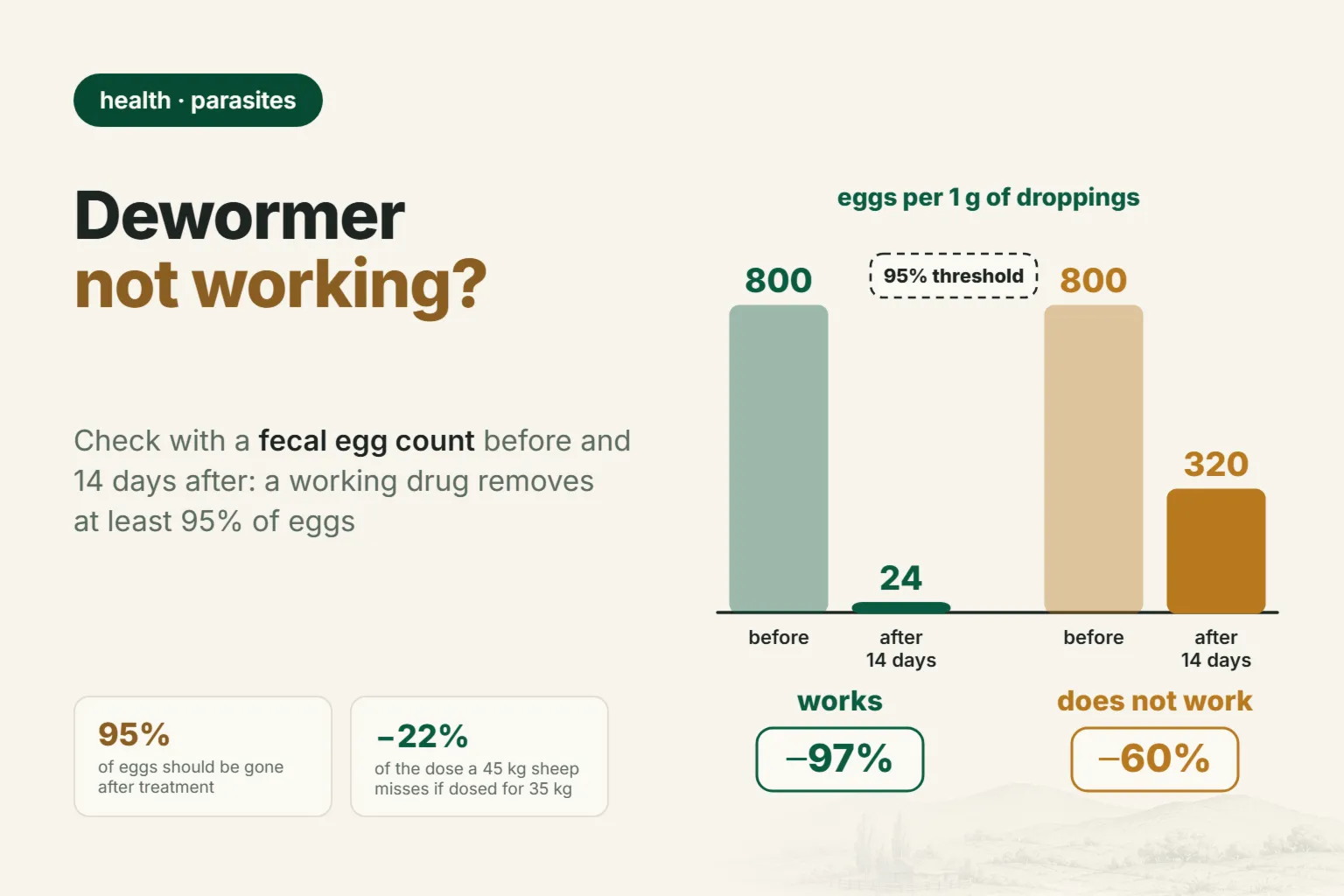
A dewormer usually fails in sheep for one of three reasons: the dose is too low because the weight was guessed by eye; the drug does not act on the parasite that is actually in the flock; or the worms on your farm have become resistant to that active ingredient. The only way to tell them apart is a test: a fecal egg count before treatment and again 10–14 days after it. A working drug cuts the number of eggs in the droppings almost completely: by at least 95–99% under the modern method.
Below we go through how to find the cause, how to run this test on your own flock, and what a dewormer that does nothing costs you.
Why a dewormer does not work in sheep: five common causes
Dewormer resistance is when the parasites in a flock survive treatment with the right dose, because worms that survived earlier treatments passed the trait on to their offspring. But before you blame resistance, rule out the simpler causes.
| Cause | What it looks like | What to do |
|---|---|---|
| Dose set by eye, lower than needed | Big ewes and rams keep losing weight after treatment, small ones gain | Calculate the dose for the heaviest animal in the group |
| The drug does not cover this parasite | Treated, but diarrhea, "bottle jaw" or tapeworm segments in the droppings remain | Run a fecal test first to see which parasites you actually have |
| Drenching mistake | Some of the dose dribbled out or was spat out | Place the nozzle at the corner of the mouth, over the base of the tongue, not deep; let the sheep go only after she swallows |
| Turned straight back onto contaminated pasture | Signs of worms again after 3–4 weeks | Avoid grazing on dewy grass or wet low ground; rotate paddocks |
| Resistant worms | Right dose, right class, yet almost as many eggs after treatment as before | Check with a fecal test, change the drug class |
The second cause is more common than it seems. Ivermectin does not kill tapeworms or liver fluke, albendazole at the usual dose does not kill immature fluke, and no dewormer works against coccidia. Our article on worms and parasites in sheep: signs and treatment schedule covers which class works against which parasite.
How much dose a sheep misses when you dose by eye
Dewormers are dosed per kilogram of live weight, and weight is most often estimated by eye. In a Norwegian study of 587 sheep farms (Acta Veterinaria Scandinavica, 2011), the dose was set this way on 78.6% of farms, and the authors estimated the risk of underdosing at more than 90% of sheep and goat flocks. If the dose is set for a 35 kg sheep and the group has ewes weighing 45–55 kg, the bigger animals get noticeably less than they need.
| Sheep live weight | Dose set for 35 kg | Share of the needed dose | Underdosed by |
|---|---|---|---|
| 35 kg | for 35 kg | 100% | 0% |
| 40 kg | for 35 kg | 88% | 12% |
| 45 kg | for 35 kg | 78% | 22% |
| 50 kg | for 35 kg | 70% | 30% |
| 55 kg | for 35 kg | 64% | 36% |
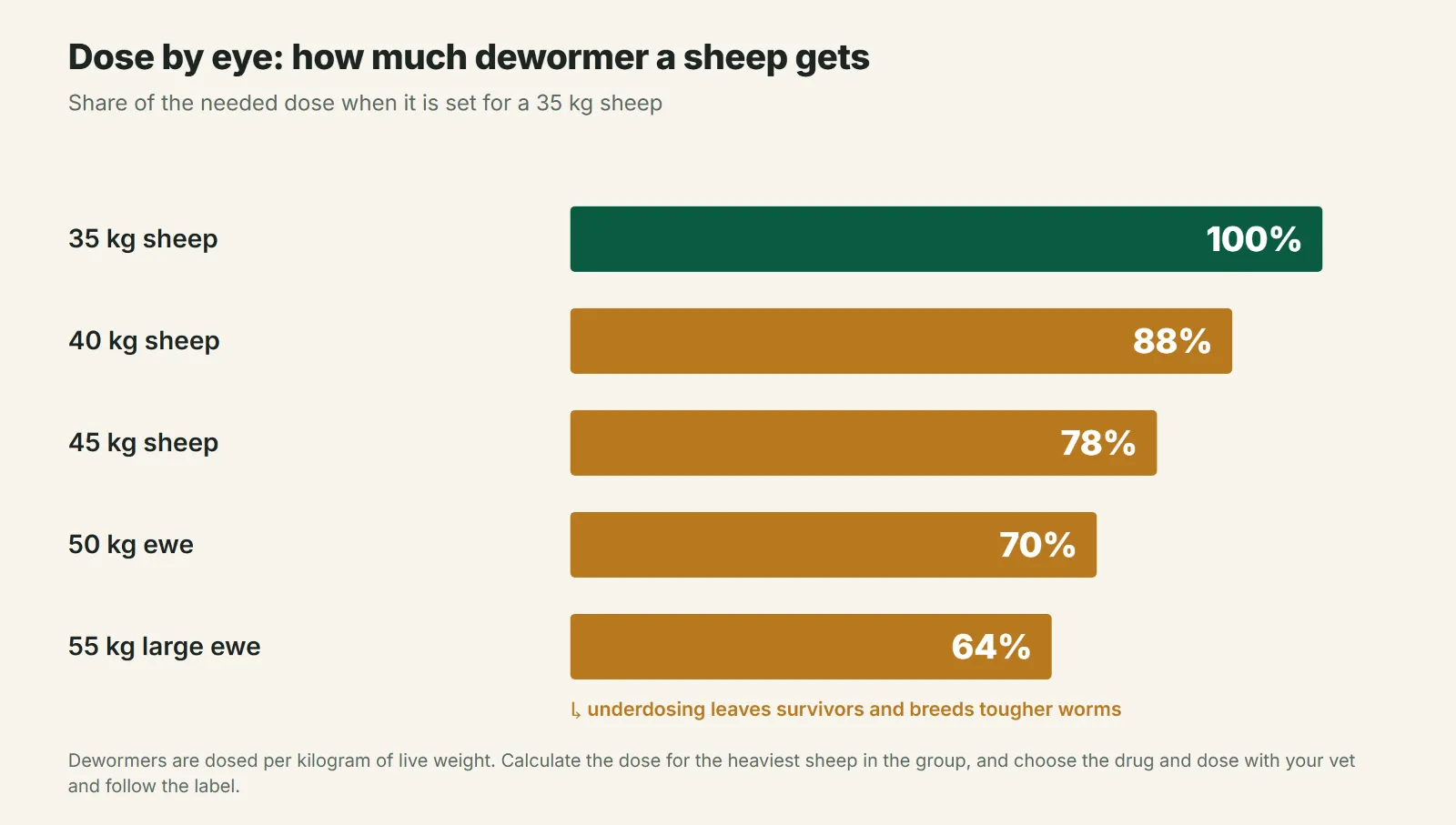
Underdosing does harm twice. First, part of the worms survive and the flock keeps losing weight. Later, the toughest worms are the ones left, and over time the drug may stop working even at the full dose.
How to dose correctly, per the recommendations of the British SCOPS program (Sustainable Control of Parasites in Sheep):
- weigh the 3–5 biggest sheep in the group and calculate the dose for the heaviest;
- if weights in the group vary a lot, split the flock into weight groups and dose each one separately;
- check the drench gun before treating: squirt several doses into a measuring cup or a syringe barrel and compare the volume with the one you set;
- give the drench at the corner of the mouth, keep the nozzle over the base of the tongue and do not push it deep into the throat; let the sheep go only after she has swallowed the whole dose.
Without scales, weight can be estimated with a measuring tape around the chest, but for the dose it is better to err on the high side than on the low one. If you weigh your flock regularly, sheep weight tracking and weigh-in records give you a current weight for each animal on treatment day, so you do not have to guess the dose.
Your vet should choose the drug and dose for your sheep: the dose depends on the active ingredient, age, weight and whether ewes are in lamb, and withdrawal periods before slaughter are on the label. This article does not replace a veterinarian's advice.
How to check whether a dewormer works: a fecal test before and after
The check is called a fecal egg count reduction test (FECRT). It follows the method of the World Association for the Advancement of Veterinary Parasitology (WAAVP), and a vet lab or your district veterinarian can run it on your flock.
- Pick 10–15 sheep of the same age, preferably young stock: they shed more eggs. Mark them with an ear tag or paint.
- On treatment day take a dropping sample from each one, straight from the rectum, into a separate numbered bag.
- Treat them with the right dose for the weight of the heaviest sheep and write down the drug, the active ingredient and the date.
- Sample the same sheep again after 10–14 days for benzimidazoles (albendazole, fenbendazole), after 7 days for levamisole and after 14–17 days for ivermectin.
- Calculate the reduction: (1 − eggs after / eggs before) × 100%.
| Egg count reduction | What it means |
|---|---|
| 99% or more | The drug works fully |
| 95–99% | Works, but it is a "gray zone": repeat the test in a year |
| Less than 95% | The worms in the flock are probably resistant to this active ingredient; with a small sample, repeat the test or talk to a vet |
The 95% threshold comes from the classic 1992 WAAVP method. In the updated 2023 method, a working drug is expected to reach 99% in sheep, and 95–99% is considered a gray zone.
Example: before treatment an average of 800 eggs per 1 g of droppings, 14 days after albendazole 320. The reduction is (1 − 320/800) × 100% = 60%. The drug killed less than two thirds of the worms, and there is no point in drenching with it any more.
Keep the before and after samples in a refrigerator without freezing them and take them to the lab within 1–2 days: eggs in warm droppings hatch into larvae within a few days, and the count is wrong.
What to do if the worms are resistant to the drug
Resistance is common. According to a summary of European studies since 2010 (Rose Vineer et al., Parasite, 2020), resistance to benzimidazoles was found on 86% of the tested sheep and goat farms, to ivermectin and related drugs on 52%, and to levamisole on 48%. The studies mostly covered farms where resistance was already suspected, so the figure overstates the picture for farms in general. There is no data for Uzbekistan in open sources, which is one more reason to test your own flock instead of hoping for average numbers.
Change the class, not the brand. Albendazole, fenbendazole and mebendazole are one class, benzimidazoles. If albendazole stopped working, fenbendazole will not help either. You need to switch to another class: levamisole or macrocyclic lactones (ivermectin, moxidectin), and check that one with a fecal test too.
| Class | Active ingredient | How to check after treatment |
|---|---|---|
| Benzimidazoles | albendazole, fenbendazole, mebendazole | sample after 10–14 days |
| Imidazothiazoles | levamisole | sample after 7 days |
| Macrocyclic lactones | ivermectin, doramectin, moxidectin | sample after 14–17 days |
Do not drench the whole flock unnecessarily. SCOPS advises leaving some adult sheep in good condition untreated. Worms in those sheep stay susceptible to the drug and dilute the resistant ones on the pasture (this is called refugia). The fecal test shows who needs treating and, where the flock carries a lot of Haemonchus (Barber's pole worm), so does the color of the lower eyelid lining: in a healthy sheep it is bright pink, in an anemic one pale or white. Pale membranes are not only from Haemonchus (liver fluke, for example, causes it too), so eyelid color alone is not enough to decide.
Do not buy in other farms' resistant worms. Bought-in sheep are treated in quarantine (your vet picks the drug and class), held 24–48 hours in a pen off pasture, and only then let onto a pasture where sheep have already grazed this year. Check the result with a fecal test 10–14 days after treatment. A day-by-day quarantine routine is in our article on new sheep quarantine. If you are buying sheep for your flock, ask the seller what the animals were treated with and when, and write it down.
Record every treatment. A year on, nobody remembers whether spring's treatment was albendazole or ivermectin, and without that, changing class turns into guessing. A paper log is enough if it has the date, active ingredient, dose and weight. QoyHunter is a sheep record-keeping CRM and marketplace (bazar.qoyhunter.com), and it keeps this in the sheep deworming and treatment log: the drug, dose and cost are recorded per animal or for the whole flock, and the date of the next treatment comes as a reminder.
What a dewormer that does not work costs: a calculation for 100 lambs
The drug itself is the cheapest part of this story. What costs money is weight gain that never happens. By our estimate in the parasites article, a wormy lamb is 3–5 kg short at sale. At 60,000 sum per kilogram of live weight (a conservative assumption for November 2026) that is 180,000–300,000 sum ($15–25) per head.
| Batch of 100 lambs on fattening | Weight shortfall | Lost revenue |
|---|---|---|
| Drug works, dose by weight | 0 kg | 0 sum |
| Drug does not work, shortfall 3 kg | 300 kg | 18 million sum (≈ $1,500) |
| Drug does not work, shortfall 5 kg | 500 kg | 30 million sum (≈ $2,500) |
Calculated at the Central Bank of Uzbekistan rate of 12,014 sum per dollar on November 14, 2026. A fecal test before and after treatment on 10–15 sheep costs far less than one such loss, and it answers the main question: whether you are paying for treatment or only for the look of it.
In short: checking a dewormer step by step
- Rule out the simple causes: dose, drug class, drenching technique, infected pasture.
- Dose for the heaviest sheep in the group and check the drench gun before you start.
- Once a year, check your main drug with a fecal test before and 10–14 days after treatment.
- If the reduction is below 95%, change the drug class, not the brand.
- Record the active ingredient, dose, weight and date of every treatment.
FAQ
How many days after deworming should I take a fecal test to check whether it worked?
After albendazole and fenbendazole, take the dropping sample after 10–14 days, after levamisole after 7 days, after ivermectin after 14–17 days. Sample the same 10–15 sheep as before treatment. If the egg count dropped by less than 95%, the drug is working poorly.
Can I replace albendazole with fenbendazole if albendazole stopped working on my sheep?
No. Albendazole, fenbendazole and mebendazole belong to one class, benzimidazoles, and worms resistant to one of them are usually resistant to all. You need to switch to another class, for example levamisole or ivermectin, and check the new drug with a fecal test.
How much dewormer should I give a sheep if I have no scales?
Weigh at least the 3–5 biggest sheep on any livestock scale, or estimate weight with a measuring tape around the chest, and dose the whole group for the heaviest. A dose set for 35 kg gives a 45 kg sheep only 78% of the drug she needs, and part of the worms survive.
Why is a sheep still thin after deworming?
There are several reasons: the dose was too low, the drug does not act on this parasite (for example, ivermectin on tapeworms and liver fluke), the sheep was put straight back on infected pasture, or the worms on the farm have become resistant to the drug. Thinness can also have nothing to do with worms: bad teeth, lack of feed or a chronic disease. A fecal test shows whether it is worms or not.
Do I need to deworm the whole flock at once?
Not always. Young stock, in-lamb ewes and thin ewes are treated when needed, and SCOPS advises leaving part of the adult sheep in good condition untreated: that keeps susceptible worms in the flock, and resistance develops more slowly. Which groups to treat is decided by the fecal test together with a vet.
Manage your flock in QoyHunterCRM for sheep farmers: livestock, health, weighing, finance and analytics — in the app and a Telegram bot.All features →