
Hypocalcaemia in Sheep: Ewe Down and Won't Get Up
Pregnant ewe down and won't get up? How to tell hypocalcaemia from pregnancy toxaemia, how much calcium borogluconate to give, how to prevent it.
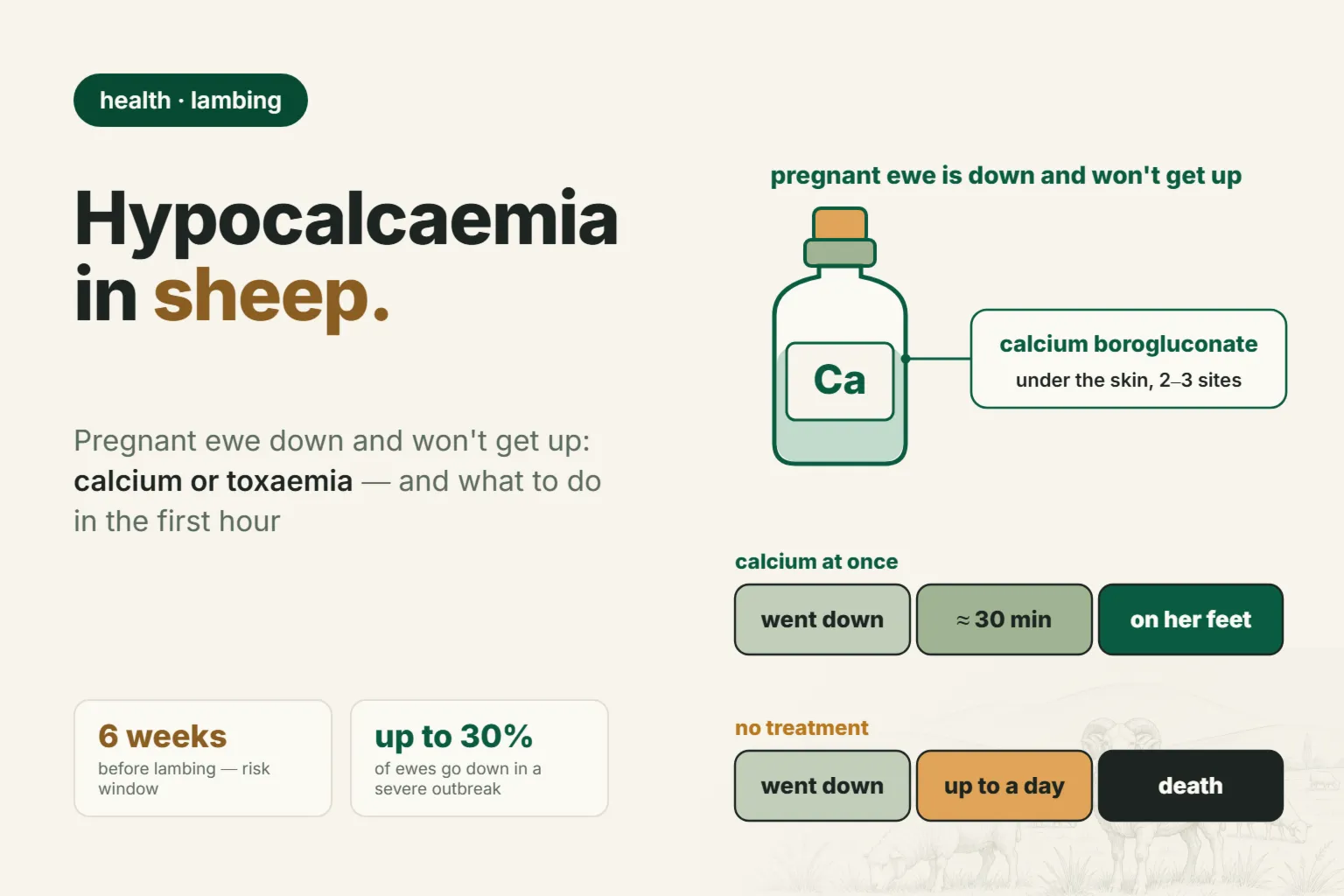
Hypocalcaemia in sheep is a sudden drop in blood calcium. Within a few hours a pregnant or freshly lambed ewe can no longer stay on her feet: first she trembles and staggers, then she lies down on her brisket with her hind legs stretched out behind her and doesn't get up. If a pregnant ewe is down and not getting up, but was eating that same morning, hypocalcaemia is the first thing to suspect. It responds fast to treatment: give a calcium borogluconate solution, and the ewe usually gets back on her feet within 1–2 hours, often within half an hour. Without treatment, according to the Western Australian veterinary service (DPIRD), the ewe dies within a day.
Below: how to tell hypocalcaemia from pregnancy toxaemia, how much calcium to give and where, what triggers the disease before lambing, and what an outbreak costs in a flock of 100 ewes in November 2026. Dollar figures use an exchange rate of 11,973 soum per dollar (Central Bank of Uzbekistan, 13 November 2026).
What is hypocalcaemia in sheep and when does it happen?
Hypocalcaemia (also called milk fever or lambing paralysis in ewes) is a condition where there is so little calcium in the blood that muscles stop contracting normally: the legs, the rumen, the gut and, in the end, the heart. Calcium goes into the lambs' skeletons in the last weeks of pregnancy and into the milk after lambing. The ewe takes it from her feed and from her own bones, but bones release calcium slowly: according to the MSD Veterinary Manual, after a sharp fall in dietary calcium the body needs 24–72 hours to adjust. Any gap in feeding during those days can floor a ewe within hours.
That is why hypocalcaemia in sheep is a disease of a narrow window. According to the MSD Veterinary Manual, it occurs from 6 weeks before lambing to 10 weeks after it, and most often in the last weeks of pregnancy, when the lambs' skeletons grow fastest. The risk is higher in mature and old ewes, in ewes carrying twins and triplets, and on calcium-poor rations: straw, grass hay, maize silage, a lot of grain.
Usually fewer than 5% of the ewes in a flock go down, but in a severe outbreak up to 30% (MSD Veterinary Manual). One ewe down is a signal to check the whole group: her flockmates are probably borderline on calcium too.
Why do pregnant ewes go down after being moved or shorn?
Hypocalcaemia rarely strikes out of the blue. Almost always it is set off by an event after which the flock ate poorly for a day. Australian veterinary services and the MSD Veterinary Manual name these triggers:
- moving, loading and transporting pregnant ewes;
- shearing, dipping or treatments, when the flock is held in a pen without feed for half a day or more;
- a blizzard, snow, icy ground or long bad weather, when the flock can't graze for a day or doesn't get to the feeder;
- a sudden change of feed, especially turning out onto green winter cereals or grass regrowth, which are low in calcium;
- plants containing oxalic acid — sorrel and dock: it binds calcium in the feed and stops it being absorbed;
- dogs attacking the flock.
An example from case write-ups by the Australian vets at Flock & Herd: a flock of 250 pregnant ewes was kept 26 hours without feed — rounding up, crutching (clipping the wool around the tail), drenching for worms and a walk of about 2 km. On the first day of the outbreak 21 ewes fell ill (8.4%). After calcium, 16 of them recovered and 5 died or were put down.
Hence the main rule: whatever can be done with the flock, do it before the last six weeks of pregnancy or after lambing. If moving or treating can't be avoided, feed the ewes before and straight after, and don't let them go a day hungry.
How can you tell a ewe has hypocalcaemia?
Hypocalcaemia develops in hours, not days — that is the first thing that sets it apart from pregnancy toxaemia. The signs, according to the MSD Veterinary Manual and Australian veterinary services:
| When | What you see in the ewe |
|---|---|
| Start | Stiff, "wooden" gait, muscle tremors, staggering, sometimes excited, drooling |
| After a few hours | Lies down on her brisket, hind legs stretched out behind her ("frog position"); no cud chewing, rumen stopped, sometimes bloat and constipation |
| Without treatment | Lies on her side, doesn't respond, slips into a coma; death usually within a day |
Grass tetany (a magnesium shortage) looks similar, but it more often comes 2–8 weeks after lambing in heavy-milking ewes and brings convulsions. Before lambing, a downer ewe most often has low calcium or pregnancy toxaemia.
How is hypocalcaemia different from pregnancy toxaemia?
Hypocalcaemia and pregnancy toxaemia (ketosis) hit the same ewes in the same weeks and look alike from a distance: a pregnant ewe is down and won't get up. This is how to tell them apart (according to the Western Australian veterinary service DPIRD and the Scottish advisory service FAS):
| Sign | Hypocalcaemia | Pregnancy toxaemia |
|---|---|---|
| Cause | Too little calcium in the blood | Too little glucose in the blood |
| How it starts | Fast, in hours: ate in the morning, down by noon | Gradually, over days: lags behind the flock, dull, stops eating |
| What it looks like | Tremors, stiffness, lies on her brisket | Listless, may go "blind" and press against a wall |
| How long she lasts without treatment | Usually up to a day | 3–4 days after going down |
| Response to calcium | Usually gets up in about 30 minutes | Doesn't get up, or only for a short time |
The last sign is the most reliable field test: give calcium and watch. If the ewe is up within 1–2 hours, has urinated and reaches for feed, it was hypocalcaemia. If not, think of pregnancy toxaemia and call the vet. The MSD Veterinary Manual warns that the two diseases often occur together, which is why vets often give calcium and glucose at the same time. For more on pregnancy toxaemia, testing with a glucose meter and feeding ewes carrying twins, see the article pregnancy toxaemia in ewes: signs and treatment.
How much calcium borogluconate should you give a ewe, and where?
The treatment for hypocalcaemia in a ewe is a calcium borogluconate solution. According to the MSD Veterinary Manual, for an adult ewe that is 50–100 ml of a 23% solution into a vein, slowly, over 5–7 minutes, or 30–60 ml under the skin, split between 2–3 sites, if you can't get into a vein. Vet pharmacies sell 20%, 23% and 40% solutions, and different manufacturers give different doses, so always follow the label on your bottle.
- Under the skin is what owners can do themselves. Warm the solution to body temperature (bottle in warm water for 10 minutes), inject behind the shoulder or over the ribs at several sites and massage it in: the solution irritates the tissue.
- Into a vein raises the ewe faster, but calcium given too fast upsets the heart rhythm, and the ewe can die under the needle. That is why a vet gives calcium into a vein, listening to the heart and stopping if it misses beats.
- Repeat. If the ewe got up and then went down again, repeat the calcium: the Western Australian service gives an interval of 4–6 hours, MSD says after a day. If there is no response within a day, the diagnosis is probably something else.
While the ewe is down, keep her upright on her brisket with a sack of straw propped against her side, not lying on her side: on her side the rumen bloats and the ewe can suffocate. Once she is up, give her water and good hay. Calcium borogluconate is sold in vet pharmacies in 100–200 ml bottles; keep 2–3 bottles, syringes and needles in the sheep barn from late winter, so you aren't hunting for them at night with a ewe already down.
What does a missed case of hypocalcaemia cost on 100 ewes?
Losing one pregnant ewe carrying twins costs a farm about 5.4 mln soum (≈ $450). The calculation uses November 2026 prices and the same figures as in our pregnancy toxaemia breakdown:
| Item | Amount |
|---|---|
| Adult ewe, 55 kg live weight at 55,000 soum/kg | ≈ 3.0 mln soum (≈ $253) |
| Two lambs to weaning, net 1.18 mln soum each | ≈ 2.36 mln soum (≈ $197) |
| Total for one ewe with twins | ≈ 5.4 mln soum (≈ $450) |
In a flock of 100 ewes, that means: an ordinary case — up to 5 ewes down — costs up to 27 mln soum (≈ $2,250) untreated, an outbreak like the one in the example above (8 ewes) about 43 mln soum (≈ $3,600), and a severe outbreak (30 ewes) about 162 mln soum (≈ $13,490).
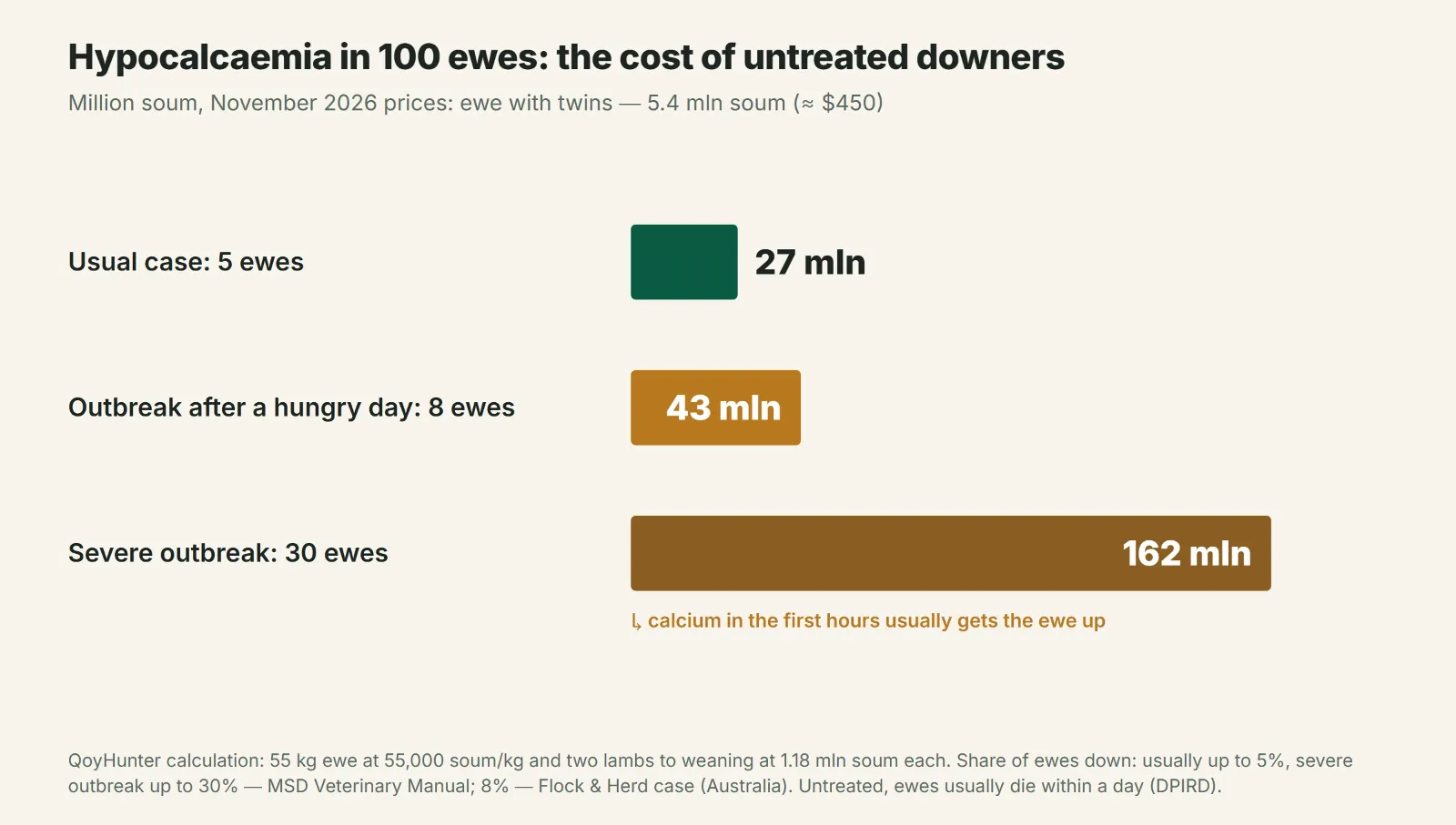
What matters here is hours, not money. A ewe given calcium as soon as she goes down usually gets up. A ewe that lies for a night often dies or loses her lambs. That is why in the last weeks of pregnancy and during lambing, check the flock in the evening as well as in the morning.
How do you prevent hypocalcaemia in a flock?
Preventing hypocalcaemia in sheep comes down to feeding without gaps or sudden changes:
- Feed without breaks in the last 6 weeks of pregnancy. Feed every day at the same time, with enough space at the feeder for everyone so weaker ewes aren't left standing to one side.
- At least one and a half times as much calcium as phosphorus in the ration. The MSD Veterinary Manual recommends a calcium-to-phosphorus ratio above 1.5 : 1. Lucerne hay supplies enough calcium. A ration of straw, barley and cottonseed meal is low in calcium and high in phosphorus: the Western Australian service advises adding 2% ground limestone (feed chalk) to the grain — 20 g per kilogram of grain. For more on the calcium and phosphorus balance, see the article mineral supplements for sheep.
- No sudden feed changes. Introduce new feed gradually, a little at a time, and don't turn hungry ewes out onto green winter cereals.
- A lambing kit. Bottles of calcium, syringes and needles in the sheep barn before lambing starts.
Barley, lucerne and feed chalk for the lambing season are cheaper bought early: compare prices in sheep feed for sale in Uzbekistan listings before lambing starts, not in the middle of it, when feed prices go up.
How can you know in advance when the flock's danger window is?
Hypocalcaemia comes in a predictable window, but the owner usually learns about it when a ewe is already down. If you have recorded the mating dates, the window is known in advance: pregnancy in a ewe lasts about 147–150 days, so the last six weeks begin about 105 days after mating. Don't schedule moving, shearing or treatments for that period, and have bottles of calcium ready in the sheep barn.
It is convenient to keep the mating dates, expected lambing dates and every treatment in a sheep vaccination and health record — it is part of QoyHunter, a CRM for sheep records and the marketplace bazar.qoyhunter.com. It also shows which ewes went down in the previous lambing: they are the first to watch in the danger window.
FAQ
A pregnant ewe is down and won't get up — what do I do first?
Sit her up on her brisket with a sack of straw propped against her side, and think back to how fast it happened. If the ewe ate in the morning and was down by noon, it is most likely hypocalcaemia: give calcium borogluconate under the skin at 2–3 sites following the bottle's label and call the vet. If the ewe isn't up within 1–2 hours, the cause is probably something else — pregnancy toxaemia, an injury or the start of a difficult lambing.
Can I inject calcium into a ewe myself?
Under the skin — yes, owners do that themselves: warm the solution to body temperature, inject at several sites and massage it in. Don't give calcium into a vein yourself: given too fast, it upsets the heart rhythm and can kill the ewe, which is why a vet gives it intravenously, slowly, over 5–7 minutes.
Why did a ewe go down after shearing or being moved?
Because a day without feed in the last weeks of pregnancy is the main trigger of hypocalcaemia. A ewe loses a lot of calcium to her lambs, while her bones release it slowly, over 24–72 hours, and a hungry day makes blood calcium crash within hours. It is better to shear, move and treat ewes before the last six weeks of pregnancy or after lambing.
How is hypocalcaemia different from pregnancy toxaemia in a ewe?
By speed and by the response to calcium. Hypocalcaemia develops in hours, and after calcium the ewe usually gets up within 1–2 hours. Pregnancy toxaemia develops over several days: the ewe lags behind, stops eating, may go "blind", and calcium doesn't get her up. Often the two diseases occur together, so the vet often gives calcium and glucose at once.
Can a ewe get hypocalcaemia after lambing?
Yes. According to the MSD Veterinary Manual the risk window lasts up to 10 weeks after lambing: the ewe gives a lot of calcium in her milk, especially with twins. The signs and treatment are the same as before lambing. If after lambing a ewe trembles and has convulsions, the vet will also check magnesium: grass tetany most often comes 2–8 weeks after lambing.
Manage your flock in QoyHunterCRM for sheep farmers: livestock, health, weighing, finance and analytics — in the app and a Telegram bot.All features →