Mineral Supplements for Sheep: Salt Lick, Selenium, Cobalt — Deficiency Signs, Doses and Cost
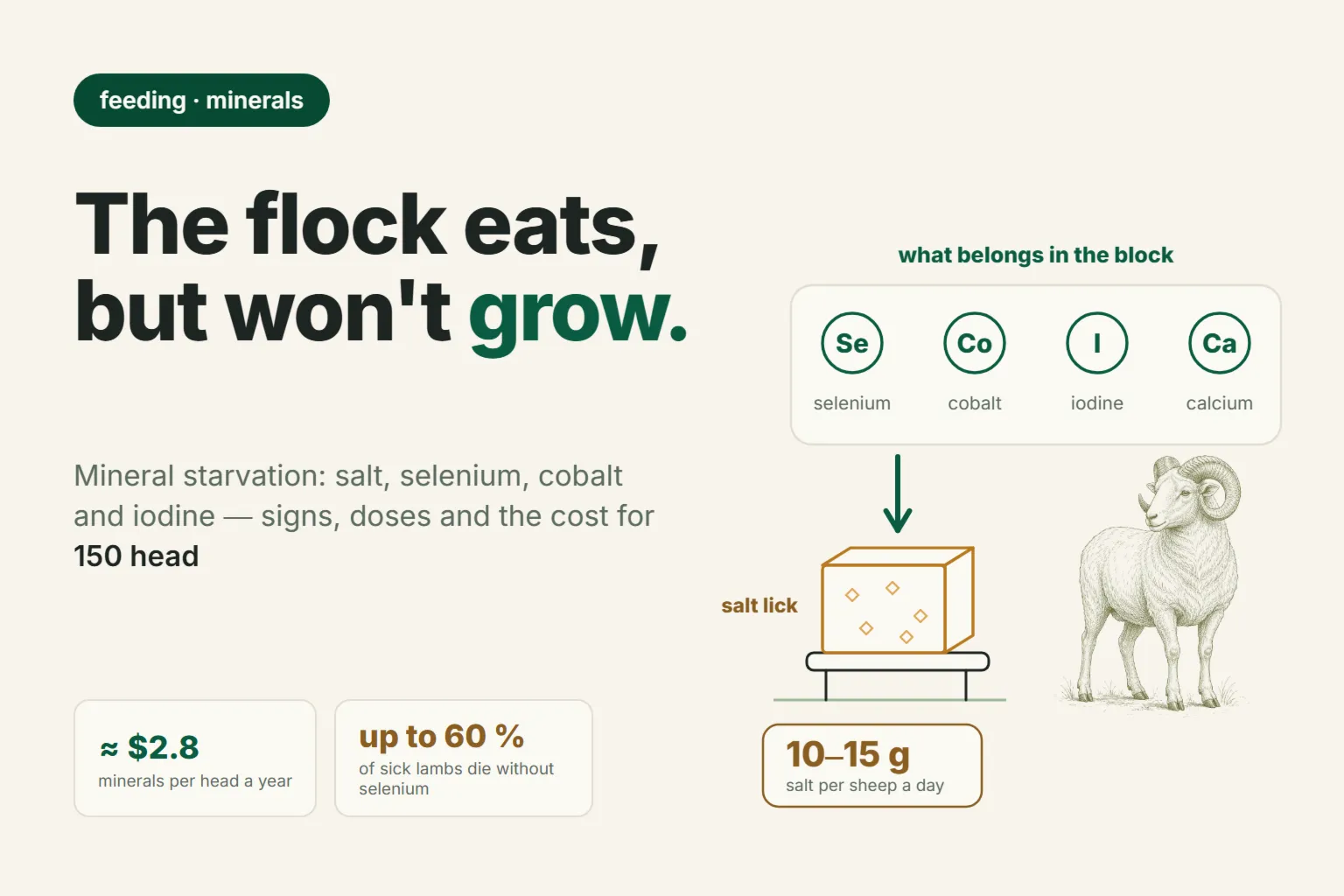
Sheep licking dirt, eating each other's wool, lambs born weak, weight gain stalling on good feed — that's mineral starvation. Salt, selenium, cobalt, iodine and copper norms for a flock in Uzbekistan, a deficiency-signs table, and the math on what mineral feeding costs 150 head and what it pays back.
The hay is good, there's barley, the water in the trough is fresh. And yet the young stock isn't gaining weight, lambs are born weak, and two or three of them can't even stand up. Meanwhile the sheep are licking clay, gnawing the feeder boards and pulling the wool off each other.
The vet won't find an infection, because there isn't one. This is what mineral starvation looks like — the cheapest problem in your flock to fix, and one of the costliest if you leave it. Here's exactly what's missing, how much to feed, and what mineral supplementation costs for a flock of 150 head. Exchange rate used below — about 12,000 soum per dollar, live weight — 55,000 soum/kg (≈ $4.6).
Pica: the flock is telling you what it's missing
Pica isn't a bad habit or boredom. The animal is looking for what it isn't getting from feed, and it tastes everything within reach. This is the first sign, and it's free — all you have to do is watch the flock.
| What you see | What it usually points to |
|---|---|
| Licking soil, clay, walls, drinking urine | Salt (sodium), phosphorus |
| Pulling out and eating each other's wool | Cobalt, copper, sulfur, lack of fiber |
| Losing weight with a full feeder, pale gums | Cobalt (pine/wasting), iron |
| Lamb born weak, can't stand, trembling hindquarters | Selenium and vitamin E |
| Lambs with a swelling on the neck, stillbirths | Iodine |
| Dull, "faded," brittle wool | Copper, zinc |
| Feedlot ram lambs straining, urine dribbling out | Calcium-phosphorus imbalance |
One sign alone doesn't prove anything — a real diagnosis comes from blood work and feed analysis. But if you're seeing two or three items from this table at once, your flock is short on minerals, and it's costing you money every day.
Salt: not a pinch in the feed, but a set ration
Salt is the one mineral a sheep physically cannot get enough of from pasture and hay. Plants store almost no sodium, while the animal keeps losing it through milk, sweat and urine.
- An adult sheep needs 10–15 g of salt a day, a lamb — 5–8 g.
- Over a year that's about 3.7 kg of salt per head of small stock.
- The simplest approach is free-choice access: a salt lick block in the pen and by the water, plus salted concentrates.
Two rules that get broken most often.
Water. Salt without free access to water isn't a supplement, it's poisoning. A sheep on a salted ration drinks more; if the trough sits empty for half a day, you get diarrhea and cramps instead of gains. In summer this is especially critical.
Brackish water. In the lower Amu Darya, in Karakalpakstan and on some of the salinized land, the water itself is already mineralized, so the flock is already getting sodium from it. There, put out lick blocks with caution and actually watch how much the animals eat: if a block disappears in a week for a dozen head, that's a reason to stop.
Calcium and phosphorus: a 2:1 ratio, or you get stones
These two minerals only work as a pair, and what matters isn't the amount of each but the ratio: roughly twice as much calcium as phosphorus (2:1). For feedlot lambs, 1.5:1 is acceptable, and on a farm that's already had stone cases, the ratio is pushed up to 3:1.
Our feeds pull them apart. Alfalfa hay is a generous source of calcium. Barley, corn, bran and cottonseed meal, on the other hand, are rich in phosphorus and poor in calcium. As long as a ram is grazing and eating hay, the balance holds on its own. The moment you switch it to intensive grain feeding, phosphorus tips the scale — and ram lambs come down with urinary calculi: the animal strains, urine dribbles out, and within a day or two the bladder ruptures, costing you the most valuable animal in the flock. This mechanism, and the second danger of grain feeding, are covered in detail in «Why rams die on grain finishing».
What to do during feedlot finishing:
- add chalk or ground limestone to the concentrates — a standard guideline is about 1% of the mix, up to 1.5–2% on a purely grain ration;
- don't strip roughage out of the ration: hay by itself helps keep the balance right;
- keep salt in the ration — it drives water intake up, and plenty of drinking flushes the urinary tract;
- if cases keep recurring, ask your vet about ammonium chloride: it's added to the ration at around 0.5%, it acidifies the urine and keeps stones from forming. The dose and duration are for the vet to decide.
Selenium and vitamin E: the costliest deficiency
White muscle disease is the one you pay for not in lost weight gain, but in dead animals. It hits lambs in their first weeks of life: the muscles degenerate, the lamb trembles, struggles to stand, lies down, and then the heart fails. Of the lambs that get sick, up to 60% or more die.
The cause is a shortage of selenium and vitamin E in the ewe during pregnancy. Selenium comes from feed, and feed comes from soil: soil is considered deficient below 0.5 mg of selenium per kg, and feed below 0.1 mg/kg. Mountain and foothill pastures fall into this zone more often than lowland ones.
Prevention is simple and needs to happen ahead of time:
- pregnant ewes — a selenium-plus-vitamin-E injection 3–8 weeks before lambing (the veterinary reference dose is 4–6 ml of a 0.1% sodium selenite solution intramuscularly, one and a half to two months before lambing);
- lambs — in the first weeks of life, if your farm has already had cases;
- no need to source vitamin E separately: commercial products combine it with selenium, and dosage follows the label on the specific bottle.
⚠️ Selenium is a case where "more" kills faster than "not enough." The gap between a therapeutic dose and a lethal one is small, so the injection has to follow the label exactly, and ideally be given by a vet. Never increase the dose by eye and never repeat the shot early. Everything written here is a starting point for a conversation with your vet, not a substitute for their prescription.
The economics here take one step to work out. One lamb saved is 25–30 kg of live weight by autumn, meaning 1.4–1.6 million soum ($115–140). A course of injections for one ewe costs a few thousand soum.
Cobalt, iodine and copper: three minerals that are easy to get wrong
Cobalt. On its own it isn't needed by the sheep but by the microflora in its rumen: bacteria use cobalt to make vitamin B12. No cobalt — no B12 — the animal loses weight with a full feeder. The disease even has its own name, cobalt deficiency (pine/wasting): appetite drops, the coat dulls, young stock fall behind in growth, and anemia sets in. Deficiency starts once dry-matter feed drops below 0.1–0.2 mg of cobalt per kg, and soil below 2–7 mg/kg. It's closed off with a cheap cobalt chloride or sulfate addition in the premix.
Iodine. Uzbekistan is an iodine-deficient region, and that's not a guess: in 2007 the country passed a dedicated law on preventing iodine-deficiency disorders, and the share of people with endemic goitre fell from 70% in 1998 to 31% in 2016 — thanks to the share of households buying iodized salt rising from 7.6% to 81%. The soil hasn't gotten any richer for it: iodine washes away with water, and the further from the sea and higher into the mountains, the less there is. Nobody has ever required flocks to be iodized. In sheep, the deficiency shows up in the lambs: they're born with an enlarged thyroid (goitre), weak, some stillborn. The basic fix is iodized salt instead of plain salt. One important detail: the iodine in that salt evaporates when stored in open air and sunlight, so buy it fresh and keep the bag closed rather than left open in a corner of the barn for half a year.
You buy iodized salt fresh and in small lots, every two or three months: buy salt licks and premix works out to less than a dollar per head per year.
Copper — the main trap. Of all farm animals, sheep are the worst at excreting copper: the liver stores it up for years, then dumps it into the blood all at once, and the animal dies within a day. The working level for sheep is 8–11 mg of copper per kg of feed, while toxicity starts as low as 20–50 mg/kg. Cattle can tolerate several times more — and that's exactly where the most common, and most painful, mistake comes from:
Never give sheep a compound feed, premix or lick block formulated for cattle, horses or pigs. They carry enough copper to be a slow poison for a sheep. The label needs to say the supplement is for sheep and goats.
What it costs and what it gives back
Let's calculate for a farm of 150 head: 100 ewes and 50 feeder lambs. Prices are a guideline based on local sellers as of August 2026, and they vary noticeably by region.
| Item | Per head, per year | How much |
|---|---|---|
| Feed salt, 3.7 kg | ≈ 4,500 soum | $0.4 |
| Chalk or limestone, 2 kg | ≈ 3,000 soum | $0.25 |
| Sheep and goat premix, ≈ 1 kg | ≈ 20,000 soum | $1.7 |
| Selenium + vitamin E (ewe and lamb) | ≈ 5,500 soum | $0.45 |
| Total | ≈ 33,000 soum | ≈ $2.8 |
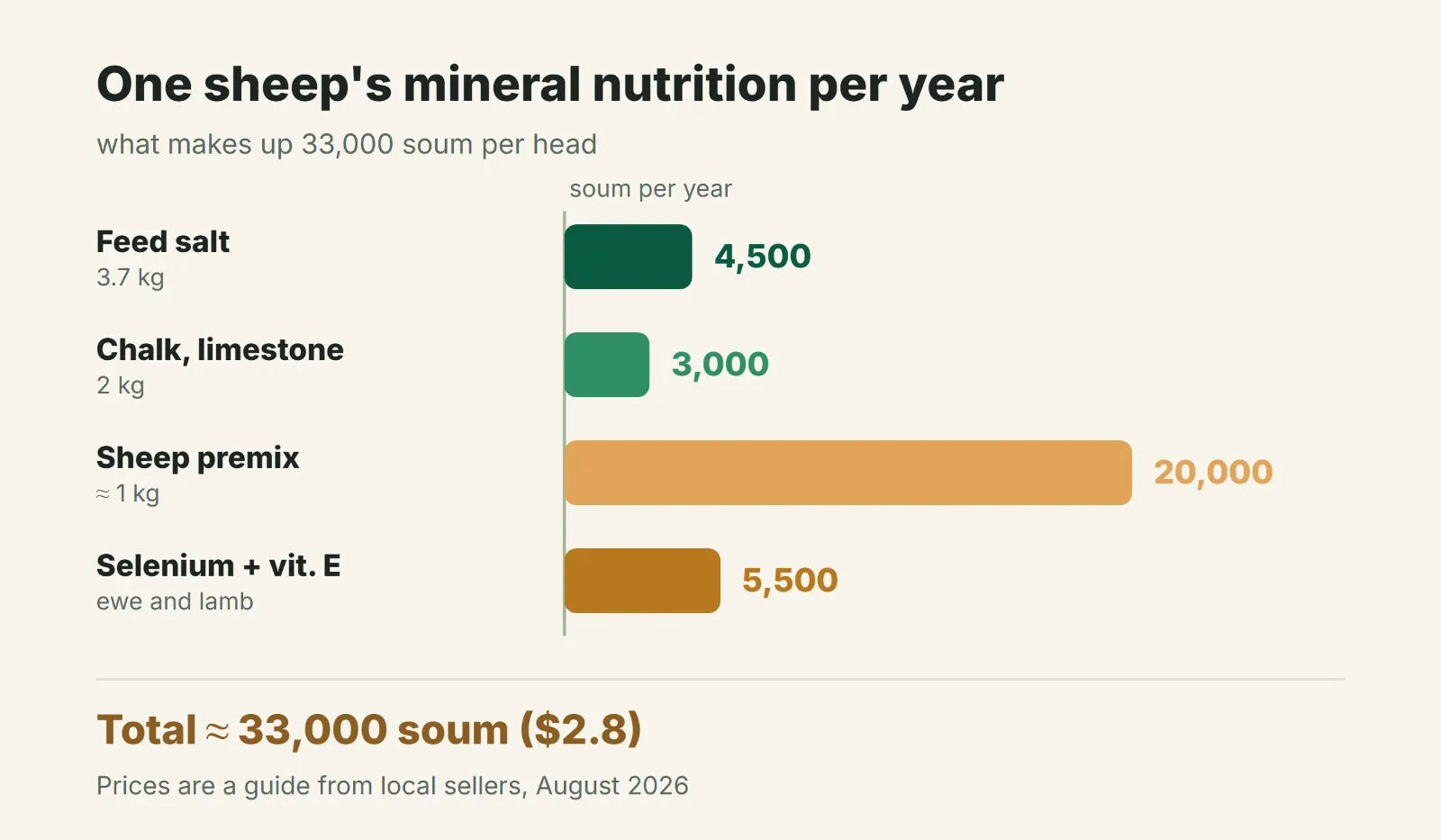
For the whole flock that comes to about 5 million soum (≈ $410) a year. Now for the other side.
Weight gain. In flocks with a genuine trace-element deficiency, young stock growth drops by 10–15%, and in selenium trials average daily gain rose from 89 to 98–110 g. Let's take a conservative 10%: over a 100-day feedlot season at 180 g a day, an animal puts on 18 kg, and ten percent of that is +1.8 kg, about 99,000 soum per head. Across 50 feeder lambs, that's almost 5 million soum.
Lambs saved. If white muscle disease and iodine deficiency cost you even three lambs per lambing season, that's another 4.2 million soum ($350) that simply never made it to autumn.
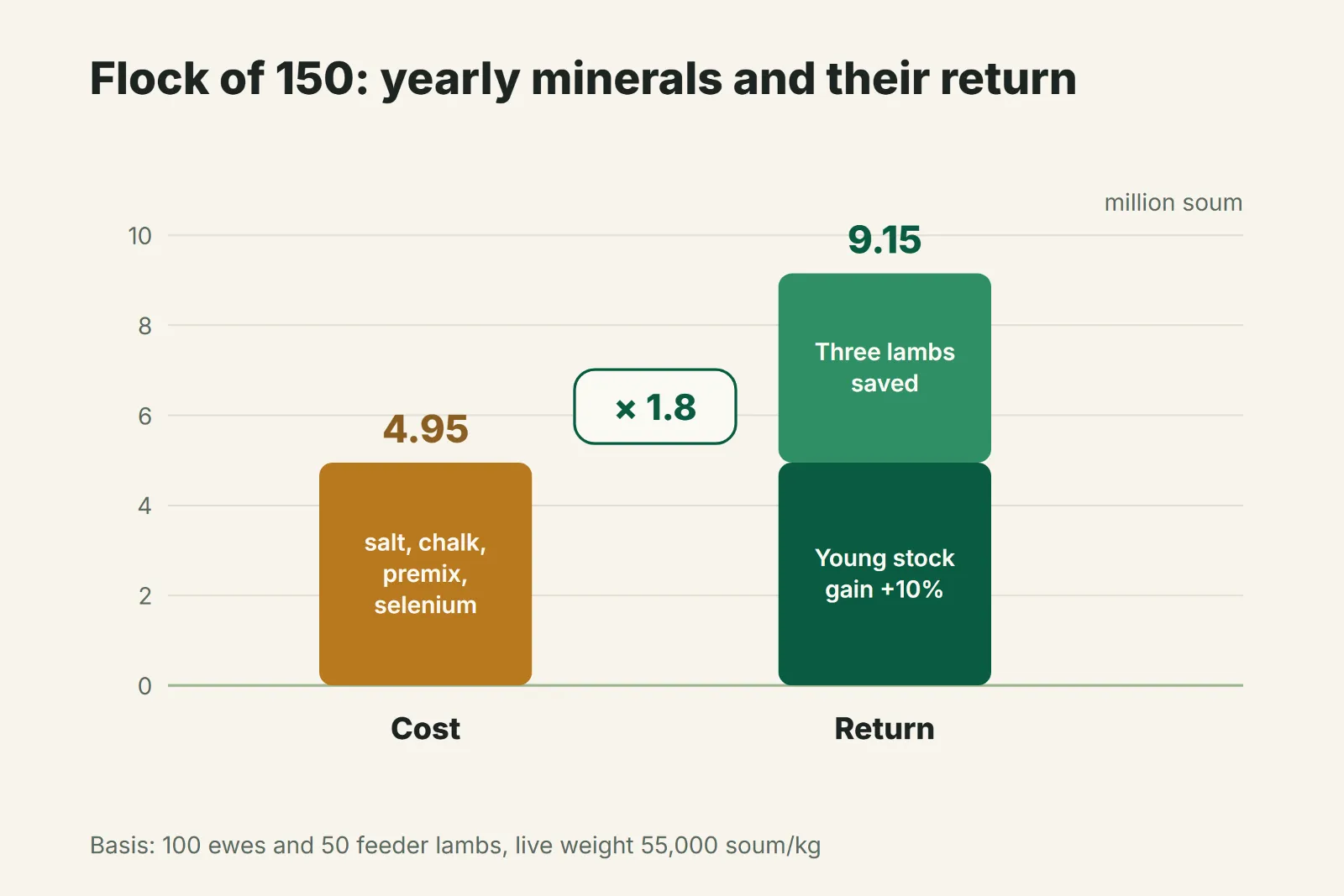
Bottom line: 5 million soum invested returns around 9 million — roughly double. And this is a conservative estimate: it doesn't account for better ewe conception rates, or the fact that a healthy lamb grows faster from day one.
One important caveat, without which these numbers turn into an ad: if there's no deficiency, supplementing gives you nothing. Minerals aren't feed and they aren't a growth stimulant — they fill a gap, and if there's no gap, the money is wasted. So look for the signs and get an analysis first, buy the premix second.
What to do this week
- Look at your flock through the table at the start of this article: are they licking soil, eating wool, how does the young stock look.
- Check whether there's a salt lick block in every pen and whether the water troughs are full. It costs pennies and solves half the problem.
- Read the label on every supplement in the barn: if it doesn't say "for sheep," put it away — especially if it says "for cattle."
- Work out when lambing starts and count back one and a half to two months: that's the date by which you need to arrange the selenium-and-vitamin-E shot with your vet.
- If your farm has more than fifty head, send feed and blood samples from a few animals for analysis — you'll stop guessing and start buying exactly what's missing.
Mineral nutrition is one of the rare cases in sheep farming where the cheapest action brings the most noticeable result. Salt costs less than a dollar per head a year, and going without it costs you kilograms of gain and live lambs.
One last thing. All of this only works when you can actually see your farm's numbers: how many lambs were born and how many made it to weaning, what gain the young stock is putting on, when each ewe got her selenium shot. In a notebook, that gets lost after two lambing seasons. In a flock analytics app, supplement and treatment records live on the animal's card, and losses and weight gains roll up into a clear flock-level summary — so next year you'll be arguing with a table, not with your memory.
Manage your flock in QoyHunterCRM for sheep farmers: livestock, health, weighing, finance and analytics — in the app and a Telegram bot.All features →