A Third of Your Hay Lost Underfoot: Feeder Waste and Whether to Crack Barley
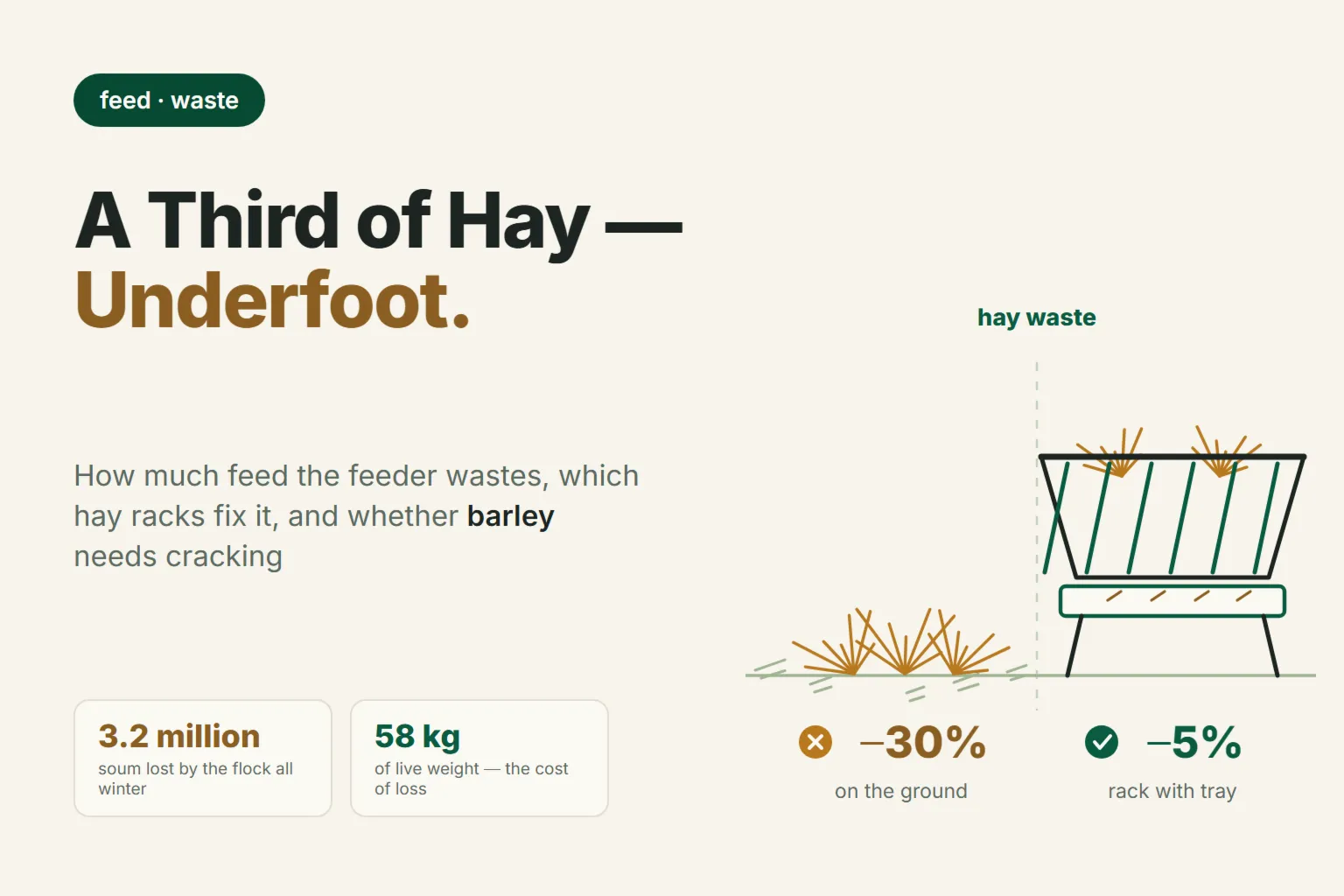
Feed hay on the ground and the flock loses 20–40% of it, and the first thing to go is the most valuable part — alfalfa leaf. We run the numbers for a 31-head flock: what the losses cost over a winter (about 3.2 million soum, ≈ $270), what kind of hay rack earns that money back, and why sheep don't need their barley cracked.
Feed you buy and feed the flock actually eats are two different tonnages. Between the barn and the stomach sits a feeder, and on that short stretch a farm loses anywhere from a tenth to forty percent of its hay. What's lost doesn't just vanish: the sheep eats the tastiest parts and tramples and spoils the rest, and the first thing to go to waste is the alfalfa leaf — the part where the protein sits.
Below are the numbers by feeding method, the loss calculation for a 31-head flock over one winter (about 3.2 million soum, ≈ $270), the hay-rack design that earns that money back, and the answer to the question every farmer asks each autumn: should you crack the barley.
Where the Feed Disappears Between the Barn and the Stomach
A sheep is a picky eater. Out of an armful of alfalfa it will pick out the leaves and soft tips and leave the coarse stems behind. While it's sorting through the feed, part of the hay ends up underfoot, and that's where the arithmetic of loss begins:
- Sorting. Alfalfa leaf holds about 30% crude protein, the stem only 6–8%; leaves account for roughly 70% of a bale's nutritional value. A leaf that falls off isn't "a bit of hay" — it's the most expensive part of it. What you lose is always more nutritious than the feed's average.
- Trampling. Hay that lands on the ground gets trodden into mud and manure by the sheep within a few hours.
- Fouling. Feed soiled with manure and urine — sheep won't eat it, even when hungry. It just sits there and ends up as bedding.
- Wind and rain. Feeding out in the open on a windy day is, quite literally, scattering the feed.
- Parasites. Along with hay and grain picked up off the ground, sheep swallow helminth eggs from the manure. Next comes deworming and a drop in weight gain — another line of expense.
How Much Gets Lost: The Numbers by Feeding Method
The spread in feeding trials is wide — it depends on how much feed is given at once, whether there's a grate and a catch tray, and how crowded the feeder is. But the order of magnitude holds steady:
| How It's Fed Out | Hay Lost | What Happens |
|---|---|---|
| On the ground, on snow, "underfoot" | 20–40% | Trampled, fouled, blown away by wind |
| Simple feeder/trough, no grate | 10–15% | Sheep flick hay out over the side with their heads |
| Hay rack with a slanted grate and catch tray | 3–8% | Spillage falls into the tray and gets eaten |
The low end for ground-feeding happens when hay is given in small portions right away; the high end is when a round bale or a big armful sits unfenced on the ground for a week. In feeder trials the spread is even wider: from 2–3% for enclosed designs with a catch tray up to 40% or more for feed lying unprotected on the ground.
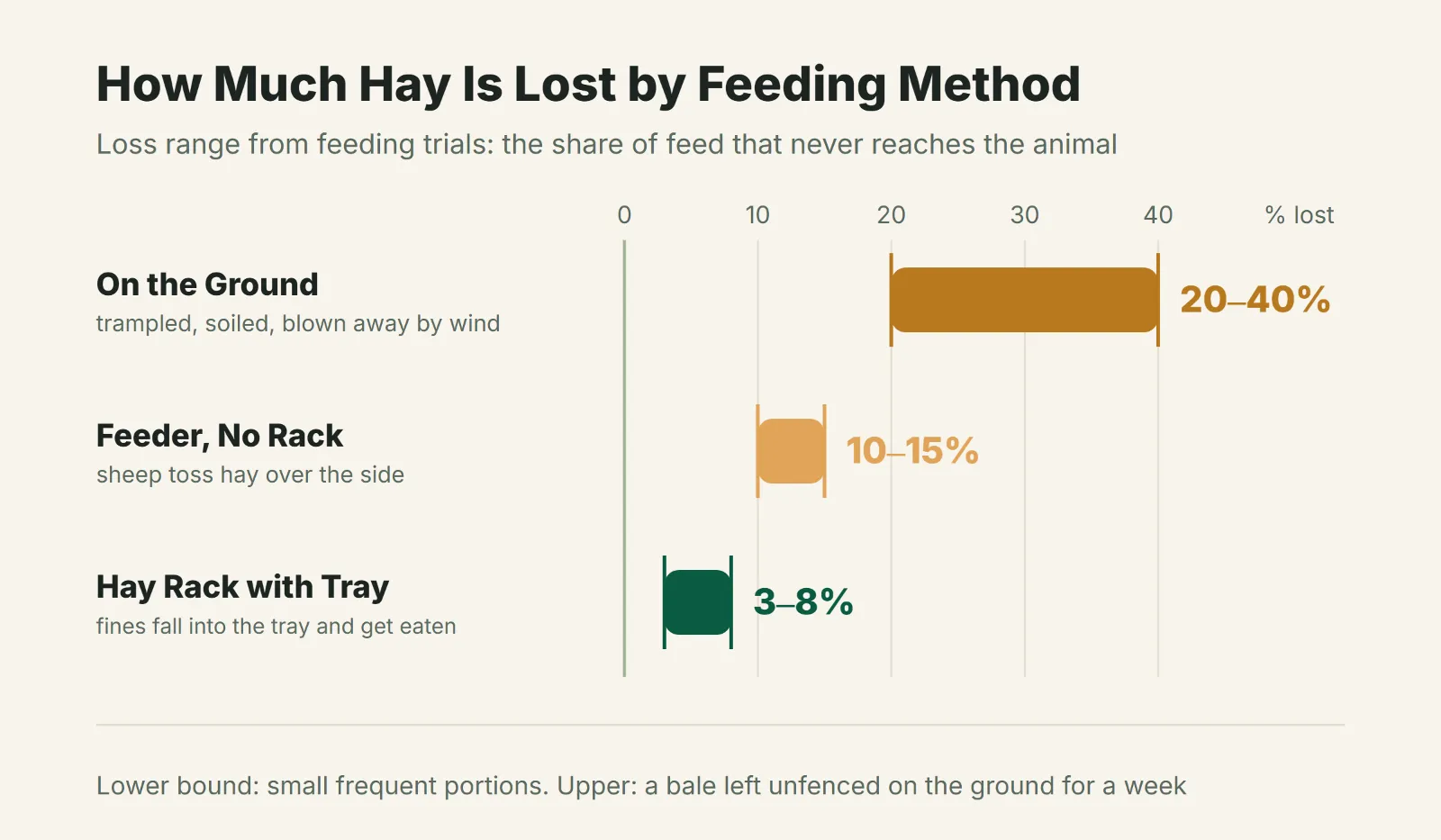
The key detail is the catch tray. The grate stops animals from pulling whole armfuls out, and the tray underneath catches the fallen leaf so the animals can pick it back up later. A hay rack without a tray loses noticeably more: whatever falls off just ends up on the ground.
The second most important factor is how much feed you give at once. When there's far more hay in the feeder than the flock can eat in one sitting, the sheep pick through it for days and ruin half of it. When the portion is sized for a few hours, there's not much left to be picky about, and even the stems get eaten.
Doing the Math for a 31-Head Flock
Let's take a farm with 20 ewes, 10 lambs, and one breeding ram, over a 135-day stall-feeding period — the same inputs as in the article «How Much Hay Does a Sheep Need for Winter». Net requirement — the hay that actually needs to reach the animal:
20 × 240 kg + 10 × 170 kg + 300 kg = about 6.8 tonnes.
And you'll have to buy more than that — exactly as much more as your feeding method wastes. We're using summer prices, during haymaking season: 1,100 soum per kilogram of alfalfa hay (≈ 1.1 million soum per tonne, about $92), at a rate of about 11,900 soum to the dollar.
| Feeding Method | Hay to Buy | Purchase Cost |
|---|---|---|
| On the ground (30% loss) | 9.7 t | 10.7 million soum (≈ $897) |
| Feeder without a tray (12%) | 7.7 t | 8.5 million soum (≈ $714) |
| Hay rack with a grate and tray (5%) | 7.2 t | 7.9 million soum (≈ $664) |
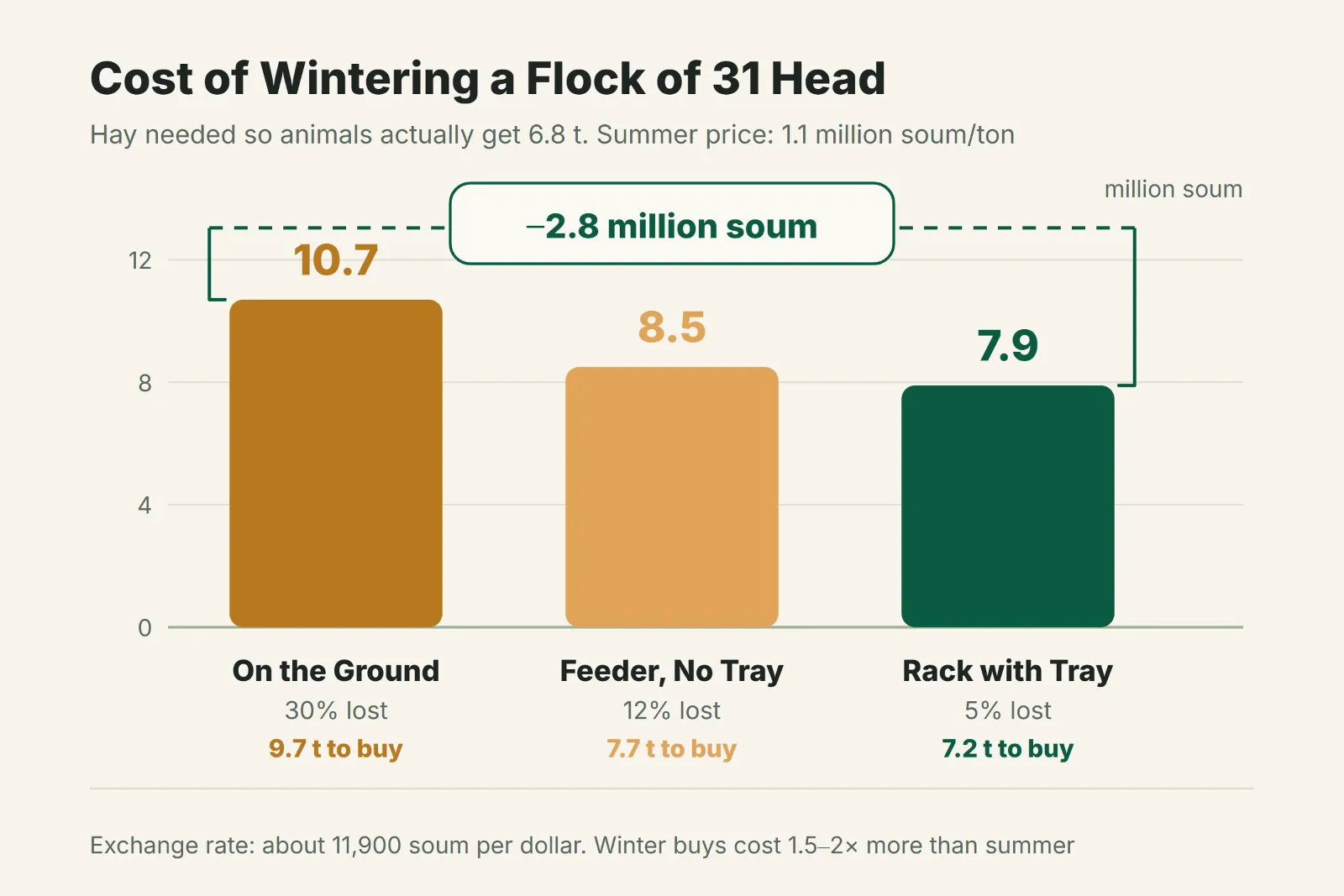
The difference between the worst and best option is 2.8 million soum (≈ $235) for a single winter. Add grain to that: 1.4 tonnes of concentrates for a flock this size. Even taking a conservative estimate of grain loss on the ground — 10% versus 2% in a trough — that's another roughly 450,000 soum (≈ $38).
That's about 3.2 million soum (≈ $270) in total. At a live-weight price of 55,000 soum per kilogram, that's 58 kilograms of live weight — a whole finished sheep that you trample into the mud every single winter. And that's on a flock of just 31 head; on a hundred ewes, the bill runs past ten million.
If the hay was bought not in summer but in January, multiply every figure in the table by one-and-a-half to two. The same armful underfoot then costs twice as much.
The Hay Rack Sheep Need
A sheep feeder isn't just a scaled-down cattle trough. The requirements are simple, and almost all of it can be built from whatever's already on the farm.
Feeder space is the number that matters most. If hay is fed in portions and everyone shows up at once, you need 30–45 cm per adult sheep, 20–30 cm per lamb, and 60–75 cm per ewe with a lamb at her side. If hay sits in the rack all the time and animals come by in turns, 15–20 cm is enough. Not enough space, and the strong push out the weak, there's crowding at the feeder, feed ends up on the ground, and pregnant ewes and lambs go underfed.
A grate instead of an open side. Through an open side, a sheep flicks hay out with a toss of its head — that's exactly how that 10–15% adds up. But the gap between the rails can't be eyeballed: it needs to be either narrow, 8–10 cm, so the head can't fit through at all and the animal eats through the grate, or wide, 18–20 cm or more, so the head goes in and out freely. A gap in between, 12–15 cm, is the most dangerous size: the sheep pushes its head in and can't pull it back out. For horned animals and mixed groups, slanted rails or V-shaped openings are safer: the head goes in at the bottom, where it's wider, and comes back out going up.
A catch tray under the grate. A 25–35 cm wide tray running the length of the feeder catches whatever falls. It's the cheapest part to build and the one that pays for itself fastest.
If you have no time to weld a rack yourself, a ready-made feeder with a tray costs less than a year’s hay losses: buy sheep feeders and hay racks is easy to compare on price and feeding width.
Height. The bottom edge of the grate should sit at chest level, so the animal's neck stays in a natural position. Too low, and animals climb in with their feet and foul the feed; too high, and hay showers down on their heads and gets tangled in the fleece, while lambs can't reach the feeder at all.
Grain gets its own trough. Concentrates should be fed in a trough with a smooth bottom that's easy to clean: leftover grain at the bottom turns sour, especially if the trough gets wet.
The materials for a rack like this cost incomparably less than the 2.8 million soum of wasted hay — it pays for itself within the first winter, often within the first month. Even a halfway measure — simply no longer throwing hay on the ground — captures most of the gain.
Should You Crack Barley: Short Answer — No
In autumn, after buying grain, a farmer heads to the mill — "so it digests better." For sheep, that's just an extra expense.
Sheep chew their feed thoroughly and grind it again during rumination, so they digest whole grain almost as well as cracked grain. Unlike cattle, which genuinely do need their grain processed, adult sheep can be fed barley, corn, and wheat whole — and that's exactly what sheep nutrition specialists recommend.
What you lose if you crack it anyway:
- Milling fees — money spent directly on labor that doesn't buy you any gain.
- Fines and dust. The dust-like fraction sits uneaten in the feeder, cakes together, and spoils. The finer the grind, the bigger that share gets.
- Rumen health. Finely ground grain ferments in the rumen faster than whole grain, raising the risk of acidosis at the same concentrate level. Acidosis costs more than any mill: it means dead animals or animals pulled out of the finishing program.
When processing does pay off: for old sheep with worn, broken, or missing teeth (usually animals over five years old), and, when needed, in lamb rations. The key word is coarse: rolled or coarsely cracked, never ground to flour. For what it's worth, in trials whole grain fed to finishing lambs produced gains no worse than ground grain, and the rumen ran more steadily on it.
And one more rule that has nothing to do with grinding: grain always goes in the trough, never on the ground. Trampled grain costs many times more than trampled hay.
Three Quiet Leaks Around the Feeder
Water. A sheep needs 2–3 liters of water for every kilogram of dry feed: for an adult animal on a dry winter ration that works out to about 4 liters a day, and up to 6 for a nursing ewe. Frozen, dirty, or far-away water cuts down feed intake — the animal simply eats less. And that feed has already been paid for in full. Give free access to water, and in winter watch out for ice forming on top.
One big feeding instead of two or three. Dump a full day's worth at once, and the sheep pick out the best of it and ruin the rest. Feeding two or three times a day, or free-choice hay in a hay rack with a grate, produces noticeably less waste for the same weight of feed.
Storage. Bales left out in the open get wet from above and draw moisture up from below, and animals won't eat musty hay. We covered how to calculate and store your stock in the article «How Much Hay Does a Sheep Need for Winter».
Losses at the feeder are only one of six reasons feed runs ahead of the plan. The other five, the yearly cost of unnoticed overuse and the restock threshold formula are in the article on feed and stock records.
What to Do Before Winter Starts
- Calculate your feeder space: divide the total length of all feeders by head count. Less than 30 cm per adult sheep with portioned feeding — add more sections.
- Fit your feeders with a slanted grate (gap of 8–10 cm, or 18–20 cm and up — never in between) and a catch tray underneath.
- Stop throwing hay and grain on the ground — it's the most expensive habit on the farm.
- Feed in portions sized for a few hours, not a whole day ahead.
- Feed grain whole; crack it coarsely only for toothless old sheep and, if needed, for lambs.
- Check the water: ice-free, clean, and close to the feeder.
One more thing: to see the effect, you have to measure the losses. Track how many bales go out each week and how many head are being fed, and cost per head per day turns into a visible number instead of a feeling. In feed and flock record software, your farm and flock records are free to keep: how many animals are wintering, which ones were weaned or set aside, which ones went into finishing — that's exactly what a feed calculation is built from.
Manage your flock in QoyHunterCRM for sheep farmers: livestock, health, weighing, finance and analytics — in the app and a Telegram bot.All features →