
A ewe lost her lamb: why ewes abort and what to do in the first hours
One or two abortions per hundred ewes is background noise; two ewes aborting within two to three days is already an outbreak, and it will take dozens of lambs. We break down the causes of abortion in ewes by stage of pregnancy, what to do on day one, why brucellosis is dangerous for the family, and what a missed outbreak costs.
A ewe losing her lamb is a warning sign, not bad luck. One or two abortions per hundred ewes over a lambing season is background noise that every farm lives with. Three or more — and especially two ewes aborting within two to three days — is a solid reason to suspect infection: it will take not one lamb, but dozens.
The first thing to do when an abortion happens: put on gloves, isolate the ewe from the flock, collect the fetus and afterbirth in a sealed bag, and take the material to a veterinary laboratory. Do not touch it with bare hands and do not give it to dogs — brucellosis, chlamydial abortion and Q fever pass from sheep to people.
Below: how to tell one cause from another by timing and how the fetus looks, what to do in the first hours, how it threatens the family, and what a missed outbreak costs. Prices as of August 2026: live weight 55,000 sum/kg, exchange rate for conversion ≈ 12,000 sum per dollar.
How many abortions in a flock count as normal?
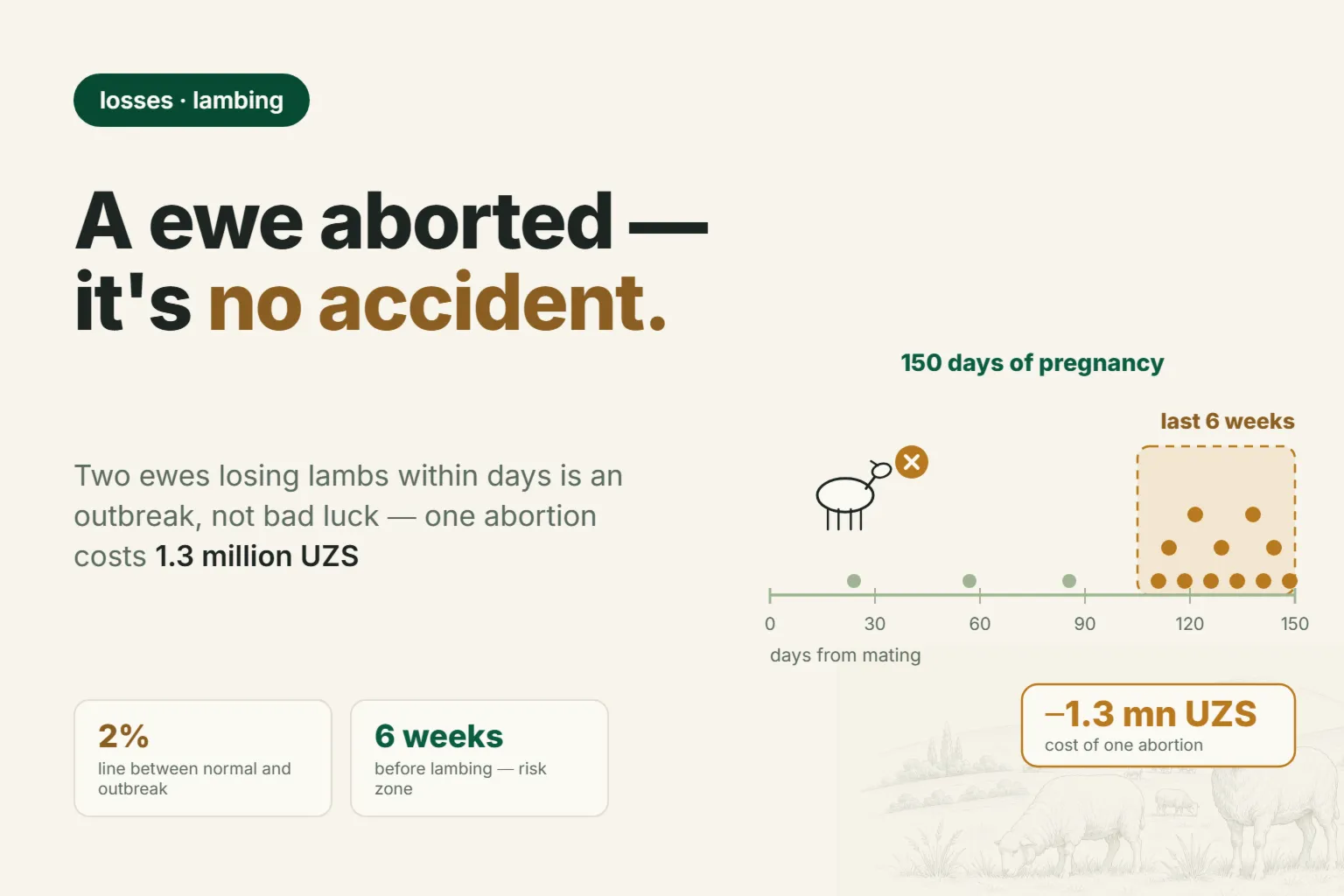
Veterinary guidelines agree on a 2% threshold: as long as no more than two ewes out of a hundred abort per season, it's background loss — an injury, an old ewe, a random glitch. Above that is a reason to look for a pathogen, not an excuse. Veterinary services consider more than five abortions per hundred per season clearly abnormal.
Above that threshold you cannot wait it out: you need a vet on site and samples at a lab — it is easier to line up veterinary services for a flock in advance than on the day of an outbreak.
| Abortions per 100 ewes per season | How to read it | What to do |
|---|---|---|
| 1–2 | background | record the date and ewe number, watch |
| 3–5 | warning | send material from the very first fetus to the lab |
| more than 5, or 2 ewes within 2–3 days | outbreak | isolate the ewes that aborted, call a vet, submit material |
The threshold only works under one condition: if abortions are actually being counted. On a farm with no records, three ewes that abort in different corners of the barn read as three separate mishaps, and the outbreak gets noticed on the fifteenth. Date, ewe number and stage of pregnancy are the three fields that are enough to spot the pattern in time.
How much money does one lost lamb cost the farm?
We use the same arithmetic as in the article on barren ewes. A ewe with a lamb nets the farm about +700,000 sum ($58) a year, a barren one costs minus 590,000 sum ($49) in feed and treatments.
| What is lost | Amount |
|---|---|
| A lamb that didn't survive to weaning (26–31 kg live weight) | 1.4–1.7 million sum ($116–141) |
| Annual difference between a ewe with offspring and a barren ewe | ≈ 1.29 million sum ($107) |
| Laboratory testing of the material | 150,000–300,000 sum ($12–25) |
One abortion means roughly 1.3 million sum ($107) missing from the till. Five abortions cost as much as a pedigree breeding ram. Thirty cost a quarter of the annual revenue of a hundred-ewe flock.
 )
)
The difference between background and an outbreak isn't a multiple — it's an order of magnitude. Chlamydial abortion entering a flock that has never met it before unfolds over two seasons: isolated abortions in the first, then a "storm" in the second where up to 30% of ewes abort, after which the farm keeps losing 5–10% every year. Campylobacteriosis in a naive flock reaches 50% (usually 5–20%). Brucellosis, on first entering a healthy herd, causes 40–80% abortions. With a hundred ewes, even thirty percent means 39 million sum (≈ $3,250) in losses from a single lambing.
Why do ewes abort: which infections are to blame?
You can't identify the pathogen by eye — that's a job for the lab. But the stage of pregnancy, how the fetus looks, and how the rest of the ewes behave narrow the field even before testing.
| Cause | When it causes abortion | How it's recognized | Dangerous to humans |
|---|---|---|---|
| Chlamydial (enzootic) abortion | last 2–3 weeks | thickened, swollen, brownish fetal membranes; dead reddish-brown cotyledons ("buttons"); the ewe herself looks healthy | yes, rare, but severe in pregnant women |
| Campylobacteriosis | last 6 weeks | dead or weak lambs; often, though not always, yellow-orange round lesions 1–2 cm across on the fetal liver | rare, but intestinal infection is possible |
| Toxoplasmosis | depends on when infection occurs: early — the ewe appears barren, late — abortion in the last third of pregnancy | mummified fetuses, white 1–3 mm granules on the cotyledons, stunted "runt" lambs | yes, dangerous for pregnant women |
| Brucellosis | last two months of pregnancy | mass abortions, retained afterbirth, testicular inflammation in rams | yes, especially dangerous |
| Q fever | last 2–4 weeks | thickened placenta, decomposed fetus; the ewe often shows no signs of illness | yes, spreads even through dust |
| Salmonellosis, listeriosis | last month | diarrhea and high fever in the ewe, death of the ewes themselves | yes |
 )
)
Notice the common thread: most infectious abortions happen in the last six weeks of roughly a hundred and fifty days of pregnancy. This is when the fetus grows fastest, the placenta works at its limit, and any pathogen that had been sitting quietly breaks the pregnancy. So a "quiet winter" tells you nothing: check the flock not when it starts, but before mating.
A separate note on brucellosis. This is not an ordinary infection but a disease on the list of especially dangerous ones: it passes to humans, and measures against it are handled by the state veterinary service, not by the farmer alone. The World Organisation for Animal Health classes small-ruminant brucellosis among the diseases a country is obligated to report. The practical conclusion is simple: during mass abortions, you don't treat the flock yourself and you don't sell it off to neighbors — you call the state veterinary service. Selling animals from an infected yard is exactly how the disease spreads across the district.
How to test a flock for brucellosis, when to vaccinate sheep with Rev-1 and what to do with positive animals is covered separately: brucellosis in sheep — testing before mating and vaccination.
Can a ewe abort from feed or stress?
Not every abortion is infectious: underfeeding, moldy feed, injury and stress account for a noticeable share of losses — especially where it's a handful of cases, not dozens. But where the lab does reach a diagnosis, infection turns out to be the cause four times out of five. So "probably just got spooked" is a theory to be checked, not an answer that closes the question.
Underfeeding in the last third. A lamb gains about 70% of its weight in the last six weeks. If during this time the ewe gets only straw and leftovers, her body starts burning its own fat and pregnancy toxaemia develops — and the farm loses both lambs and the ewes themselves. Ewes carrying twins have it hardest of all.
Moldy hay. A stack left standing in the rain grows mold. The mold fungi themselves, primarily Aspergillus, cause fungal abortion — they account for most such cases; mycotoxins on top of that lower fertility and appetite. Musty hay is not fed to pregnant ewes at all, not even "just a little, so it doesn't go to waste."
Sudden feed changes. Switching to grain or young alfalfa in a single day causes acidosis and bloat, and in a pregnant ewe it adds the risk of abortion. Any new feed is introduced gradually over 2–3 weeks.
Lack of selenium, iodine and vitamin A. Iodine deficiency produces weak and stillborn lambs, selenium deficiency causes white muscle disease in newborns. It's covered with a mineral supplement, but with mineral licks made for sheep, not cattle: sheep are exceptionally sensitive to copper.
Stress and crowding. Driving to a distant pasture, dogs among the flock, narrow barn doors where ewes get squeezed, transport in a truck bed in the last month, treatments and shearing late in pregnancy — each item takes its own toll. Don't drive or disturb a pregnant flock in the last six weeks.
What to do in the first hours after an abortion?
- Put on gloves. Not rubber kitchen gloves — thick, disposable ones. After the work, wash your hands with soap and put your clothes in the wash.
- Isolate the ewe in a separate pen, away from the pregnant ones. She keeps shedding the pathogen for another two to four weeks after the abortion.
- Collect the fetus and afterbirth in a heavy-duty bag or a closed bucket. Don't leave them on the ground, don't give them to dogs — that's how disease spreads across the whole farm.
- Take the material to the veterinary lab the same day, kept cold. A fresh fetus yields a diagnosis; a decomposed one doesn't.
- Disinfect the spot: remove the bedding, burn or bury it, treat the floor and walls with disinfectant.
- Keep pregnant women and children away from a ewe that has aborted. This isn't overcaution: human infection with ovine chlamydiosis is rare, but almost all documented cases were in pregnant women, and they were severe — up to and including miscarriage and a threat to the mother's life.
- Write it down: date, ewe number, stage of pregnancy, what the fetus looked like. These records let the vet tell a single case from an outbreak, and let you see a year from now which ewes to cull.
Keeping a ewe that has aborted twice in a row is not worth it: a year of feeding her costs 590,000 sum ($49), and a second consecutive abortion is no longer a coincidence but a trait of that particular ewe. This is easiest to see when each ewe's history lives not in the shepherd's memory but in the animal's record — in an electronic flock health log, abortions, treatments and lambings all go into one feed, so repeat cases show up without re-counting a notebook.
If you have culled two or three, plan the replacements the same summer: it is cheaper to buy replacement ewes before mating than to go into lambing short of ewes.
Why is a ewe's abortion dangerous for people?
Human brucellosis starts like a lingering flu: wave-like fever, heavy sweating, aching joints and lower back, weeks of weakness. Left untreated, it turns into a chronic form affecting the joints and spine. It's caught two ways: through contact with the aborted fetus, afterbirth and discharge — and through raw milk, fresh kaymak, and young homemade cheese made from unboiled milk.
Q fever spreads even without direct contact — through dust from the barn where the abortion happened. Toxoplasmosis is dangerous for pregnant women. From this follow three household rules that cost nothing: boil sheep's milk, keep pregnant women and children away from abortions, wash your hands with soap after the barn.
What to do before mating so you don't lose lambs in winter?
September mating gives a February lambing, and infectious abortions fall in the last six weeks — that is, in January. Everything that can be done should be done now, before the ram is turned in with the flock.
- Don't bring disease into the flock. Put purchased ewes into 30 days of quarantine, and if you're buying breeding stock, have their blood tested before adding them to the flock. The first question for the seller: has the farm had any abortions.
- Vaccinations — follow the state veterinary service's schedule. Mandatory vaccinations against especially dangerous diseases are given by the district veterinary unit's vaccination team, the vaccines are paid for from the state budget, and the Veterinary Committee approves the list of diseases separately each year. Your part is to get on the schedule and check with your local veterinary station exactly what it covers — not to remember it in December. The schedule for other treatments is in the vaccination calendar.
- Bring ewes to good working condition before mating and don't let it slip over winter: the ribs should be felt under a thin layer of fat. This also improves conception rates.
- Keep cats away from feed. Toxoplasma enters the flock through cat feces in hay and grain. The storage shed should be kept closed.
- Check hay for mold before storing it for winter, and don't stack it directly on the ground without bedding underneath.
- Separate a lambing pen from the general area: where everyone lambs together, one sick ewe infects the next ones.
In short
- Background — up to 2 abortions per 100 ewes per season; two ewes within 2–3 days is already a reason to call the vet and take material to the lab.
- One abortion costs the farm about 1.3 million sum ($107); chlamydial abortion entering a naive flock costs up to 30% of ewes in the second season and 39 million sum (≈ $3,250) per hundred head.
- Most infectious abortions happen in the last 6 weeks of pregnancy, but they are prevented before mating.
- Fetus and afterbirth — gloves only, into a sealed bag; take the material to the lab the same day; keep pregnant women and children away.
- Always boil sheep's milk: brucellosis more often enters a family through fresh kaymak than through the barn.
FAQ
A ewe lost one lamb — should I worry?
One abortion in a small flock falls within the background level: up to two cases per hundred ewes per season happens to everyone. But the fetus and afterbirth are still collected with gloves, the ewe is separated for a couple of weeks, and the date and number are recorded. If a second ewe aborts within the next two to three days, that's no longer a coincidence, and the material needs to go to the lab.
Can you eat the meat of a ewe that has aborted?
The decision is made by a veterinarian after examination and, if brucellosis is suspected, after testing. You should not slaughter and hand out such meat to relatives and neighbors on your own: with brucellosis, it's exactly the people butchering the carcass who get infected. Until there's a diagnosis, the animal is kept separate.
How soon after an abortion can a ewe be bred again?
For a non-infectious cause — not before a month to a month and a half: the ewe herself returns to normal in three to four weeks, but restoring body condition takes longer. There's no point rushing — an underfed ewe won't carry a pregnancy to term again. If the abortion was infectious, the vet decides the timing and the ewe's fate: with some diseases she remains a source of infection for the whole flock.
Is it dangerous to drink milk from a ewe that has aborted?
Raw — yes, it's dangerous: brucellosis enters a family primarily through unboiled milk, fresh kaymak, and young homemade cheese. Boiling kills the pathogen. This rule is worth keeping all the time, not just after an abortion: an outwardly healthy ewe can shed the pathogen too.
Why do abortions happen mostly at the end of pregnancy?
In the last six weeks, a lamb gains about 70% of its weight, and the load on the placenta is at its peak. Infection, underfeeding or stress that the body had tolerated earlier now breaks the pregnancy. That's why both feeding and rest for a pregnant flock matter more in the last month to a month and a half than at the start.
Manage your flock in QoyHunterCRM for sheep farmers: livestock, health, weighing, finance and analytics — in the app and a Telegram bot.All features →