White muscle disease in lambs: signs and selenium treatment
A lamb that cannot stand, walks stiff-legged and will not nurse lacks selenium and vitamin E. Forms by age, E-Selen dose by weight, when to inject ewes.
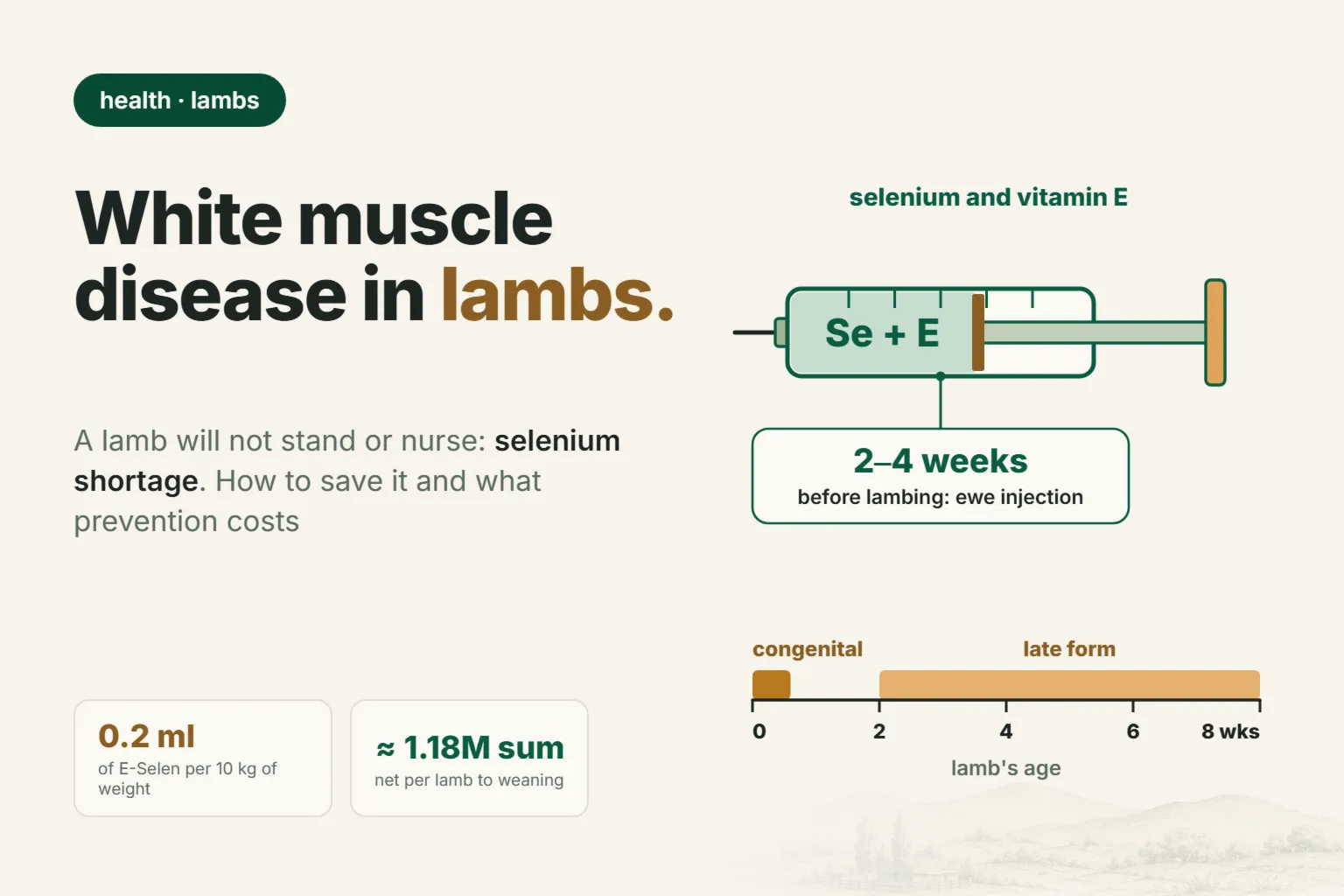
White muscle disease in lambs is damage to the muscles and heart caused by a lack of selenium and vitamin E. A lamb is born weak and cannot stand, or at 2–8 weeks it suddenly walks stiff-legged, hunches up and stops nursing. It is treated with an injection of a selenium and vitamin E product, and prevented with the same injection given to a pregnant ewe 2–4 weeks before lambing.
What is white muscle disease and where does it come from?
White muscle disease (nutritional myodystrophy) is a disease of young stock in which the muscles of the legs, back and heart degenerate and, at post-mortem, look pale with white streaks. That is where the name comes from.
The cause is a lack of selenium and vitamin E. Both protect muscle cells, and a lamb gets them from its ewe: first in the womb, then through colostrum and milk. If the ewe ate feed poor in selenium throughout pregnancy, the lamb has no reserve.
- Selenium comes from feed, and feed gets it from the soil. Feed is considered deficient if it has less than 0.1 mg of selenium per 1 kg of dry matter.
- Vitamin E is present in fresh grass, but in hay and straw it breaks down quickly: according to Michigan State University, stored feed loses up to half of its vitamin E in a month. That is why the disease hits more often after a winter on hay.
According to New Mexico State University, the risk is higher where ewes are fed a lot of alfalfa hay and grazed on irrigated legume pastures. For Uzbekistan, where alfalfa is the base of the winter ration, this is an important caveat. There are no direct measurements of selenium in Uzbek soils and feed in published sources, so you have to check your own flock: through a post-mortem on dead lambs or a blood test from your vet.
How do you recognize white muscle disease in a lamb?
White muscle disease in lambs comes in two forms, and they are easy to tell apart by age.
| Form | Lamb's age | Signs | Outcome |
|---|---|---|---|
| Congenital | from birth to a few days | weak, cannot stand, cannot nurse, trembles | without treatment often dies of hunger and cold |
| Late, skeletal | usually 2–8 weeks | walks stiff-legged, hunches, trembles when standing, spreads its front legs, lies down | after an injection most stand up within 3–5 days |
| Late, cardiac | the same 2–8 weeks, often after running or being herded | rapid, labored breathing, foam from the nose, sudden death | death usually in under a day even with treatment |
The source for timing and outcomes is the MSD Veterinary Manual and New Mexico State University. The skeletal and cardiac forms often occur together: one lamb has the legs affected, its neighbor the heart.
An important clue: the late form often hits fast-growing, well-fed lambs, not only the runts. A lamb that ran better than all the others yesterday, and today stands hunched and will not go to its mother, is the first suspect for white muscle disease.
What is white muscle disease in lambs mistaken for?
The cardiac form is mistaken for pneumonia: the same rapid breathing and foam from the nose. The congenital form is mistaken for chilling and starvation, which kill lambs in the first three days (more on them in why newborn lambs die).
Three things help tell them apart:
- Temperature. In chilling it is low. In the cardiac form, as in pneumonia, there can be a fever, so a thermometer cannot tell these two diseases apart.
- Who gets sick. The late form of white muscle disease is more common in fast-growing, active lambs; chilling in weak lambs and twins.
- Post-mortem. White or pale streaks in the muscles of the thighs and back and in the heart are the main sign. A dead lamb is worth showing to a vet: one post-mortem decides whether to give selenium to the whole flock.
How do you treat white muscle disease in lambs?
It is treated with a product containing selenium and vitamin E. In Uzbekistan and neighboring countries, the most common product is E-Selen: 1 ml of solution contains 0.5 mg of selenium (sodium selenite) and 50 mg of vitamin E.
According to the manufacturer's instructions, young stock get 0.2 ml per 10 kg of live weight, adults 1 ml per 50 kg, which is the same amount per kilogram, given into the muscle or under the skin. For treatment the injection is repeated after 7–10 days, 2–3 times in total. A single dose for a sheep is no more than 5 ml.
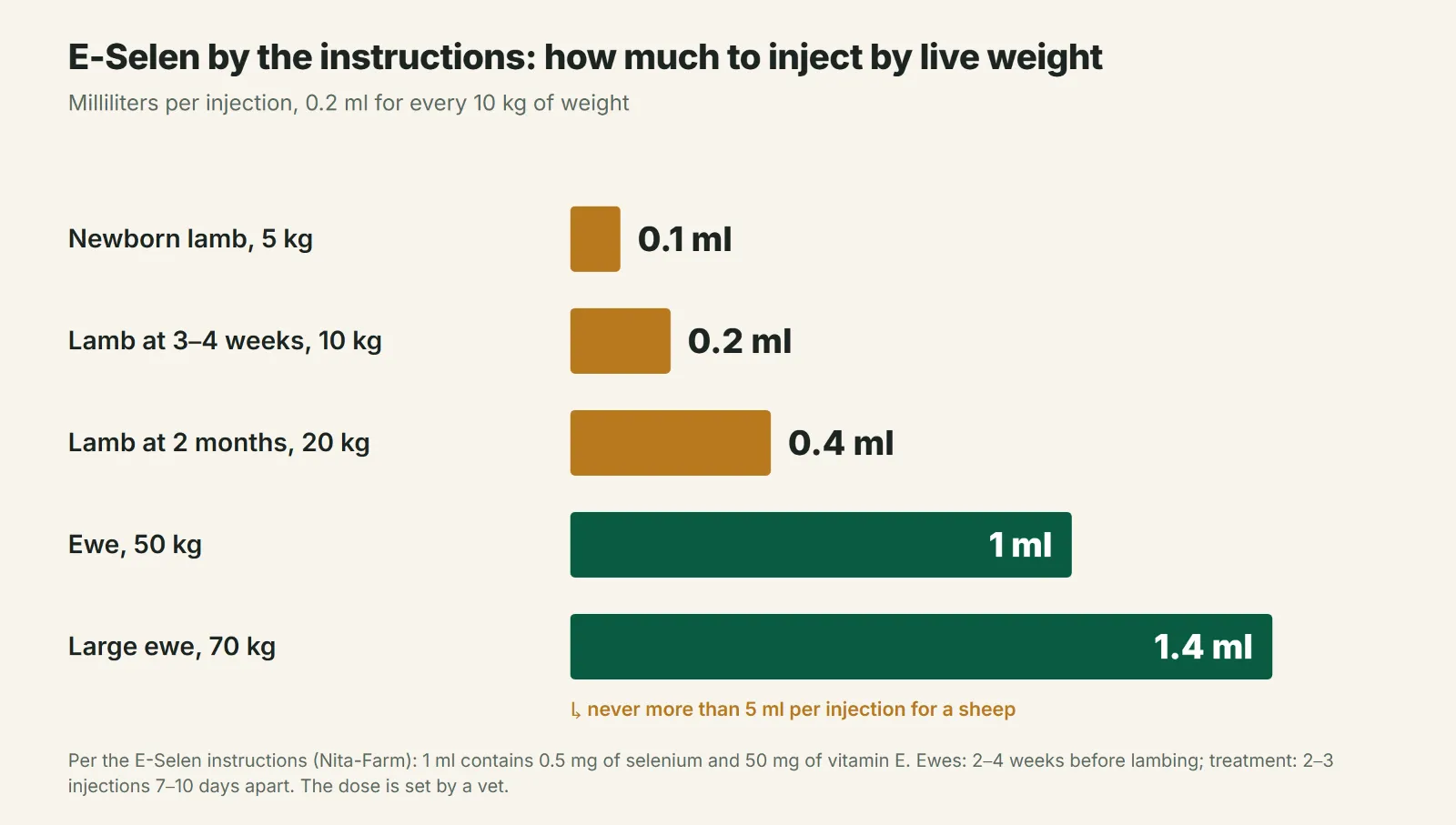
| Animal | Live weight | E-Selen dose |
|---|---|---|
| Newborn lamb | 4–5 kg | 0.08–0.1 ml |
| Lamb at 3–4 weeks | 10 kg | 0.2 ml |
| Lamb at 2 months | 20 kg | 0.4 ml |
| Ewe | 50 kg | 1 ml |
| Large ewe | 70 kg | 1.4 ml |
For a newborn, a dose under 0.1 ml is drawn up with a 1 ml insulin syringe; an ordinary syringe cannot measure it. Besides the injection, a lamb needs warmth and food: if it does not nurse, feed it colostrum or milk from a bottle until it stands. A lamb with rapid breathing is usually given an antibiotic by the vet as well: pneumonia easily takes hold in a lamb with damaged muscles.
Selenium is toxic in overdose. The gap between a therapeutic and a dangerous dose is small, so do not raise the dose "just in case", do not repeat the injection ahead of schedule, and do not inject animals that already get a premix or a lick block with selenium without consulting a vet. Do not slaughter for meat until at least 14 days after the injection. The table above is a guideline from the instructions, not a substitute for a vet's prescription.
When should you give selenium to pregnant ewes?
Prevention is cheaper and more reliable than treatment: the cardiac form is almost impossible to treat and can only be prevented.
- Ewes: an E-Selen injection by weight (1 ml per 50 kg) 2–4 weeks before lambing starts. New Mexico State University advises giving selenium 1–4 weeks before lambing in flocks where the disease returns every year. For winter lambing in January–February, ewes should be injected in December–January.
- Lambs: an injection at birth if the flock has already had cases of white muscle disease. For prevention, the instructions call for one injection every 2–4 months.
- Mineral salt with selenium: according to the MSD Veterinary Manual, it is given as the only salt, without ordinary salt next to it, otherwise the sheep will choose the ordinary one.
- Good hay: vitamin E is lost during long storage, so in spring the risk on old hay is higher than in autumn on fresh hay.
Combining injections with a premix is a common cause of overdose. Choose one approach: either a mineral supplement with selenium all year round, or injections before lambing. We covered how mineral feeding of sheep works in general in the article on mineral feeding for sheep. You can find lick blocks, premixes and veterinary products in the listings of mineral supplements and veterinary products for sheep.
How much does prevention cost for a flock of 100 ewes?
Here is how much product a flock of 100 ewes of about 60 kg each and their 110 lambs needs.
| Who | Calculation | E-Selen |
|---|---|---|
| Ewes | 100 × 1.2 ml | 120 ml |
| Lambs at birth | 110 × 0.1 ml | 11 ml |
| Total | ≈ 131 ml, about three 50 ml vials |
We found no price for veterinary E-Selen in olx.uz listings as of November 15, 2026, so check the price of a vial at a vet pharmacy in your district. For comparison, another figure matters more: one lamb that survives to weaning brings the farm about 1.18 million UZS (≈ $98) net, by our calculation of a sheep's annual upkeep at autumn 2026 prices and the Central Bank of Uzbekistan rate of 12,014 sum (UZS) per dollar.
| Lambs lost | Loss in sum | In dollars |
|---|---|---|
| 3 | 3.54 million sum | ≈ $295 |
| 5 | 5.9 million sum | ≈ $491 |
| 10 | 11.8 million sum | ≈ $982 |
Three vials pay for themselves if they save even one lamb. The main thing is not to miss the window: an injection a week after lambing starts will no longer protect the lambs born first. So that injection dates do not get lost and no repeat dose is given too early, record them in a sheep vaccination and treatment log. In QoyHunter, a CRM for sheep records and the bazar.qoyhunter.com marketplace, it is a separate section with reminders.
FAQ
Why does a lamb not stand up or nurse in the first days?
Most often the cause is chilling, hunger, or the congenital form of white muscle disease from a lack of selenium and vitamin E in the ewe. If a lamb is warm and has had colostrum but still cannot stay on its feet, a vet usually gives a selenium and vitamin E product: 0.2 ml of E-Selen per 10 kg of weight, about 0.1 ml for a newborn.
How quickly does a lamb stand up after a selenium injection?
With the skeletal form of white muscle disease, most lambs stand up in 3–5 days, and the first improvement can come within a day. If the heart is affected, a lamb often dies in under a day even with treatment, which is why in flocks where the disease has already occurred, selenium is given to ewes before lambing.
How long before lambing should a pregnant ewe get E-Selen?
2–4 weeks before lambing starts, at 1 ml per 50 kg of live weight (0.2 ml per 10 kg). For lambing in January–February, that is December–January. For prevention, the instructions call for one injection every 2–4 months; do not inject more often without a vet.
Can you give selenium to all lambs just in case?
Only if the flock has already had cases of white muscle disease or a vet has confirmed a selenium deficiency. Selenium is toxic in overdose, and if the sheep already get a premix or lick block with selenium, an extra injection can do more harm than the disease.
Can you eat mutton after an E-Selen injection?
Yes, but no sooner than 14 days after the injection: that is the withdrawal period for sheep given in the E-Selen manufacturer's instructions. A sheep being raised for sale or for Qurban Hayit should be injected well ahead of time.
Manage your flock in QoyHunterCRM for sheep farmers: livestock, health, weighing, finance and analytics — in the app and a Telegram bot.All features →