Arashan sheep breed: ram weight, price and whether it pays back in Uzbekistan in 2026
Arashan is a Kyrgyz fat-tailed breed from Gissar rams: ram 140–210 kg, ewe 90–150 kg. In Uzbekistan listings in October 2026 an "Arashan" ram costs 9.5–20 million sum, elite from Kyrgyzstan from $5,000. Payback calculation, export rules and what to check before buying.
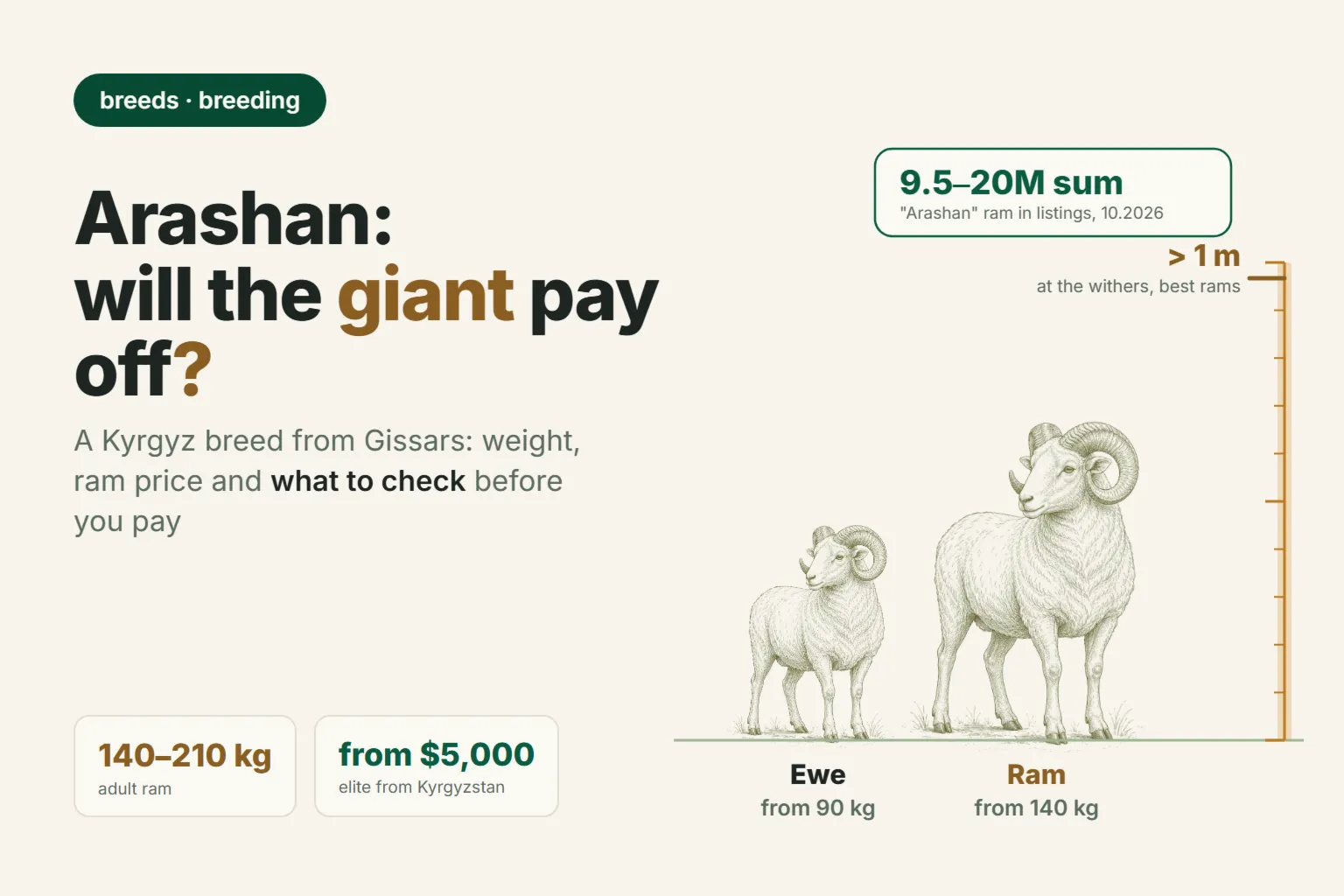
The Arashan breed of sheep is a Kyrgyz meat-and-fat fat-tailed breed developed from Gissar rams and local ewes and officially registered in 2021. An adult Arashan ram weighs 140–210 kg, an ewe 90–150 kg, and the best rams stand over a meter at the withers. In Uzbekistan in October 2026, a ram listed as "Arashan" usually costs 9.5–20 million sum (≈ $800–1,680), while a breeding Arashan of elite class from Kyrgyzstan starts at $5,000. On a commercial flock such a ram pays back only if each of his lambs is 1–1.5 kg heavier at sale than a lamb from a Gissar ram; an elite sire for thousands of dollars is already a breeding business, not fattening.
Below: what the Arashan breed is, how much it weighs and costs, whether you can bring it in from Kyrgyzstan, and how to calculate the payback of a ram on your own flock. The conversion rate is 11,898 sum per dollar (Central Bank of Uzbekistan, October 10, 2026).
What kind of breed is Arashan?
Arashan is a young sheep breed from Kyrgyzstan. It has been developed since Soviet times in the Chui region: Gissar rams brought from Tajikistan in 1977 were crossed with local coarse-wool fat-tailed ewes, and the largest offspring were selected (according to 24.kg). The breed was approved by an order of the Kyrgyz Ministry of Agriculture on April 15, 2021, and the patent for the breeding achievement was issued in 2023.
The main thing a farmer in Uzbekistan needs to know: Arashan is a relative of our Gissar. Tajik scientists consider Arashan a type of the Gissar breed; the Kyrgyz side disagrees and cites a genomic assessment. For a farm, the takeaway from this dispute is simple: do not expect anything fundamentally different from Arashan than from a good Gissar. It is the same large fat-tailed meat-and-fat type, just selected for an even bigger size.
The breed is fat-tailed, coarse-wool and polled, meaning hornless. According to Kyrgyz media, in 2026 there are about 48 thousand Arashan sheep, the country has 9 breeding farms, and the Kyrgyz authorities plan to increase the population 4–5 times by 2030.
How much does an Arashan weigh: ram, ewe, ewe lamb
The weight requirements by class are published by the breeders themselves (the arashan.org website). These are minimums: an animal lighter than the figure does not make the class.
| Category | Elite, kg | Class 1, kg | Class 2, kg |
|---|---|---|---|
| Rams from 3 years | 140 | 130 | 120 |
| Ewes from 3 years | 90 | 80 | 70 |
| Ewe lambs at 1.5 years | 70 | 60 | 50 |
Record rams are heavier: Kyrgyz media in 2026 named sires weighing 220 and 236 kg, and the best stand over 1 meter at the withers (the ram "Atilla" is 104 cm). Lambs, according to the Kyrgyz veterinary service, weigh 40–50 kg at 4–5 months, and yearlings up to 80 kg. An ewe has one or two lambs a year.
For comparison: an adult Gissar ram weighs 130–140 kg. So an elite-class Arashan is roughly a good Gissar ram, and a difference of tens of kilograms appears only in record holders.
An honest caveat: there is little published scientific data on Arashan. We found no figures on average daily gain, dressing percentage or fat-tail weight in open sources, and the figures above come from breeders and the veterinary service. You will have to test the breed on your own flock, with your own scales.
How much does an Arashan cost in 2026?
Arashan prices are more scattered than for any other sheep breed in the region: from a few hundred dollars to hundreds of thousands.
| What is sold | Price | ≈ in sum |
|---|---|---|
| Ram for meat (Kyrgyzstan) | a few hundred $ | a few million sum |
| "Arashan" ram by listing in Tashkent and the region, OLX.uz, September — October 2026 | usually 9.5–20 million sum | 9.5–20 million sum |
| Class 1 breeding animal (Kyrgyzstan) | 100–200 thousand som, ≈ $1,100–2,300 | 13–27 million sum |
| Elite (Kyrgyzstan) | from $5,000 | from 59.5 million sum |
| Top-level sires | $100,000–200,000 | 1.2–2.4 billion sum |
| Ram Khanzada, show valuation, April 2026 | $500,000 | ≈ 5.9 billion sum |
Kyrgyzstan prices are from 24.kg and Azattyk for 2026; Uzbekistan prices are from OLX.uz listings from September 12 to October 10, 2026. We wrote about record sales in more detail in the article on the most expensive rams in Central Asia.
Kyrgyz journalists themselves compare the hype around Arashan to a pyramid scheme: animals are bought on credit in the hope of reselling at a higher price, and the prices announced at shows do not always mean real deals. For a farmer in Uzbekistan this means one thing: the price of an Arashan is the price of a brand and a pedigree, not of meat. Meat is counted in kilograms, and a fat-tailed ram's meat costs the same whatever the breed is called.
Can you bring an Arashan from Kyrgyzstan to Uzbekistan?
You can, but only as a breeding animal and with documents. Kyrgyzstan bans the export of live livestock; on September 10, 2026 this ban was extended for another six months. Breeding sheep have been exempted from the ban since May 29, 2026 by Resolution No. 361 of the Cabinet of Ministers of Kyrgyzstan. In the text of that resolution the exemption for breeding sheep sits next to export through the state operator, Kyrgyz Agroholding OJSC, so check the export procedure with the seller in advance.
According to industry representatives quoted by Azattyk and time.kg, 215 breeding Arashan sheep went to Uzbekistan in the first two months. Every exported animal gets a chip in the right ear and a breeding card, a passport with its origin.
Hence the practical conclusion: an Arashan brought in legally in 2026 has a chip and a breeding card. An "Arashan" ram without documents is most likely a large local or crossbred ram. It may be a good sire, but you should pay for it as for a good Gissar, not as for a breeding rarity. Check the veterinary requirements for import with the veterinary service of your region before buying, not at the border.
Will an Arashan ram pay back on your flock: the calculation
The price of a ram means nothing by itself. What matters is how many lambs he gives and how much heavier they are. We calculate it the same way as in the review of the Dorper breed:
- in free mating a ram covers about 35 ewes per season;
- the lambing rate is 105 lambs per 100 ewes, about 37 lambs per season;
- the ram works 4 seasons, for a total of about 147 lambs;
- the baseline for comparison is a breeding Gissar ram for 8 million sum;
- the live weight of a lamb is 55,000 sum per kg (autumn 2026);
- we do not count selling the ram for meat at the end; that is a safety margin.
| Ram | Price, sum | Extra cost over Gissar per lamb | Gain needed per lamb |
|---|---|---|---|
| Gissar breeding | 8 million | — | — |
| "Arashan" by listing | 15 million | 47,600 sum | 0.9 kg |
| "Arashan" by listing, top of the price range | 20 million | 81,600 sum | 1.5 kg |
| Elite from Kyrgyzstan, $5,000 | 59.5 million | 350,300 sum | 6.4 kg |
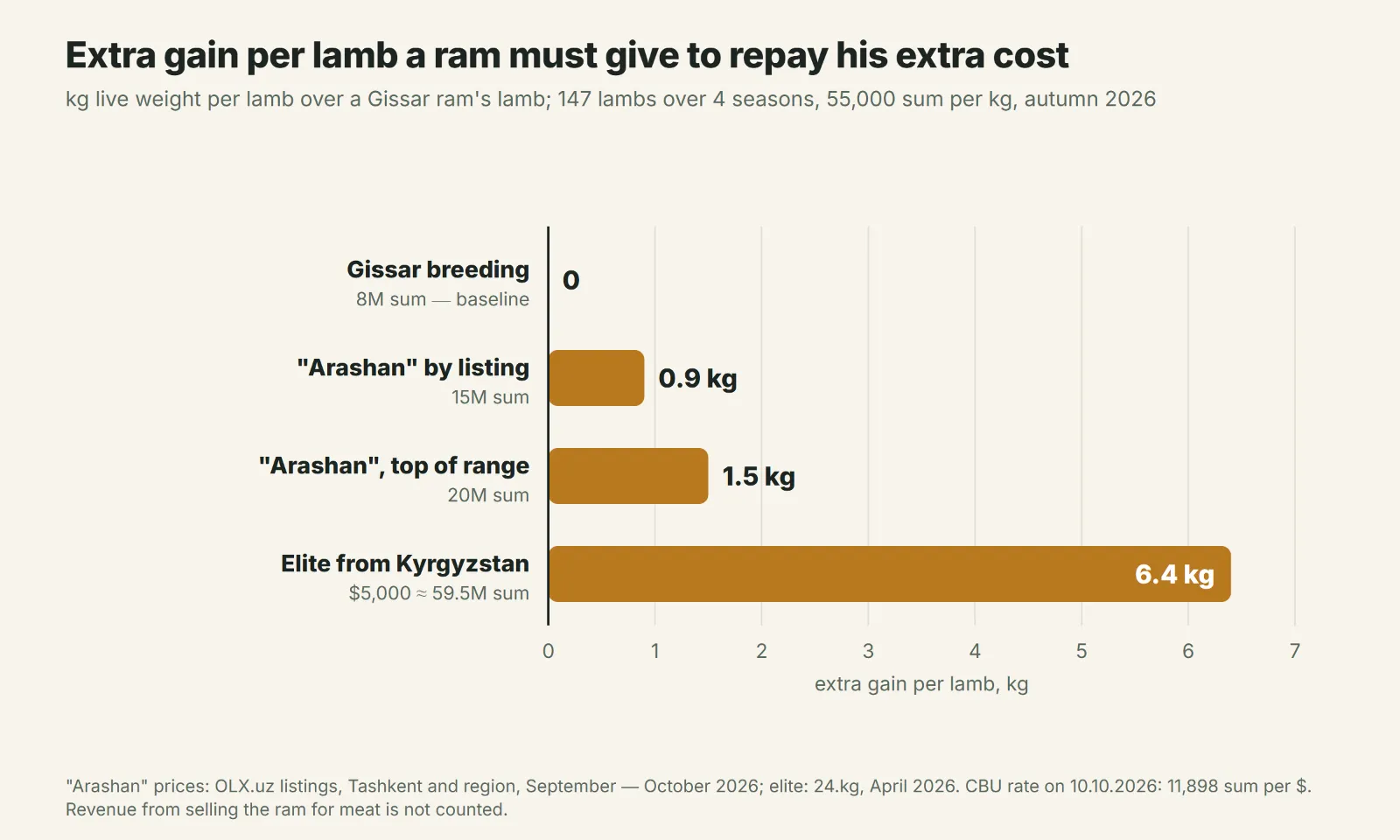
One and a half kilograms more at sale after 6–7 months is a realistic figure for a large ram if the ewes are fed. But 6.4 kg on each of 147 lambs from an elite ram on a commercial flock will not be achieved by anyone: that is 15–20% of the lamb's sale weight. An elite ram for thousands of dollars is not bought to sell lambs for meat, but to sell breeding stock at breeding prices. If you are not ready to raise and sell breeding stock with documents, such a ram will not pay back.
There is also a risk that the calculation does not include: a large ram on small ewes. A lamb from a very large ram is born bigger, and for a small ewe or a first-time lambing ewe this means a difficult lambing. There is no data specifically on Arashan with local ewes, so in the first season put adult large ewes under him, not ewe lambs.
How not to make a mistake buying an "Arashan" ram from a listing
Five checks before handing over the money:
- Chip and breeding card. An Arashan legally exported from Kyrgyzstan in 2026 has them. No documents means you bargain as for an ordinary large ram.
- Weight against class. A ram over three years old that weighs less than 120 kg does not make even the second class of the breed. Weigh it, do not trust your eye.
- Age by teeth. A young two-tooth ram will work four seasons for you, a broken-mouth one will work one. We covered how to read age in the article on sheep age by teeth.
- Parents. Ask for the weight of the sire and dam, and ask to see them if the seller is local. The words "Kyrgyz" and "Tajik" in a listing do not guarantee a pure breed.
- Quarantine. A new ram is kept apart from the flock for at least 30 days, even with documents.
Before paying for a rare name, compare the prices of sires of familiar breeds. You can view breeding Gissar rams and ewe lambs for sale separately, and the general list is in the sheep and breeding rams for sale listings. Posting there is free: it is a section of QoyHunter, a CRM for sheep records and the bazar.qoyhunter.com marketplace.
Who should buy an Arashan ram?
| Your situation | Arashan? | Why |
|---|---|---|
| Fattening and selling at the livestock market and for Qurban Hayit | yes, if the price is like a good Gissar | the large fat-tailed type is valued, but paying extra for the name does not pay |
| You want to sell breeding stock | yes, but only with documents | without a chip and breeding card the buyer will not take it as breeding stock |
| Flock of up to 30 ewes | rather no | an expensive ram cannot spread his price over the lambs |
| Small ewes (jaydara, karakul) | with caution | risk of difficult lambing from a large fetus |
| Grazing on poor pasture | rather no | a large animal needs feed, otherwise its size will not show |
You can check whether Arashan works for you in a single season. Put some ewes under the Arashan and some under your own ram, and weigh the lambs of both groups at weaning and before sale. For this you need to know each lamb's sire. A notebook handles this while there are a few dozen lambs; after that it is more convenient when every animal has a sheep profile with pedigree and weighing history, where the lamb's sire is recorded at birth.
FAQ
How much does an Arashan ram weigh?
An adult Arashan ram over three years old weighs 140–210 kg; according to breeders' requirements, an elite-class ram must weigh at least 140 kg, a first-class ram 130 kg, and a second-class ram 120 kg. Record rams in Kyrgyzstan weighed 220–236 kg in 2026. Ewes weigh 90–150 kg.
How much does an Arashan ram cost in Uzbekistan?
In OLX.uz listings for Tashkent and the region in September — October 2026, a ram marked "Arashan" usually costs 9.5–20 million sum (≈ $800–1,680). A breeding Arashan of elite class from Kyrgyzstan costs from $5,000 (about 59.5 million sum), and top-level sires cost $100,000 and more.
How is Arashan different from the Gissar breed?
Arashan was developed in Kyrgyzstan from Gissar rams and local fat-tailed ewes and selected for an even larger size. It is the same meat-and-fat fat-tailed type: Tajik scientists consider Arashan a type of the Gissar breed, Kyrgyz scientists a separate breed. An adult Gissar ram weighs 130–140 kg, an elite-class Arashan ram from 140 kg.
Can you buy an Arashan in Kyrgyzstan and bring it to Uzbekistan?
Yes, as a breeding animal. Kyrgyzstan bans the export of livestock, but breeding sheep have been exempted from the ban since May 29, 2026. On export the animal gets a chip in the ear and a breeding card. Check the veterinary documents for import with the veterinary service of your region before buying.
Will an Arashan pay back on an ordinary flock?
An "Arashan" ram for 15–20 million sum pays back if each of his lambs is 0.9–1.5 kg heavier at sale than a lamb from a Gissar ram costing 8 million sum. An elite ram for $5,000 and more does not pay back on a commercial flock: he needs +6.4 kg on every lamb. Such a ram is bought to sell breeding stock.
Manage your flock in QoyHunterCRM for sheep farmers: livestock, health, weighing, finance and analytics — in the app and a Telegram bot.All features →