The Most Expensive Rams in Central Asia: From Hissar to Arashan
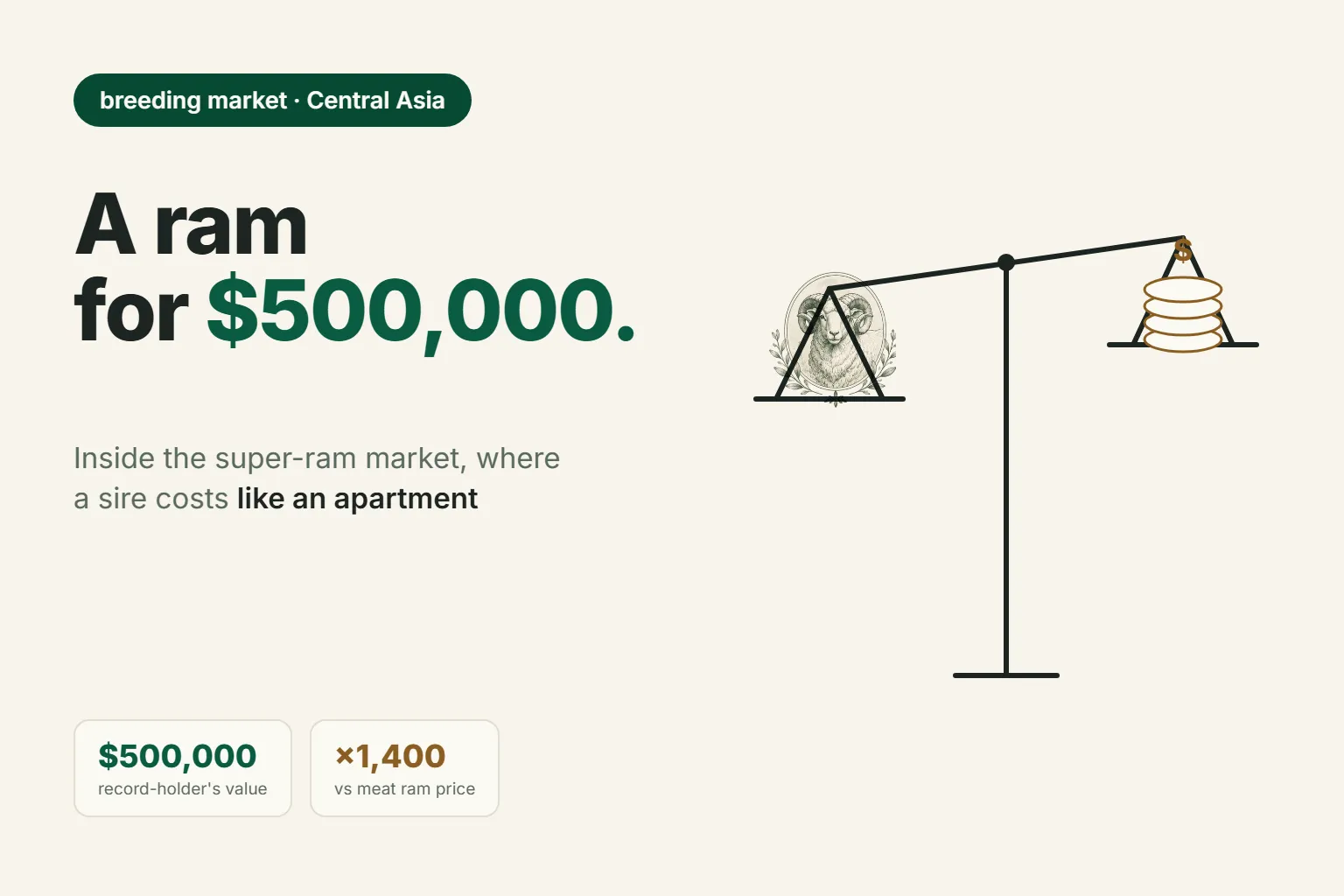
A ram named Khanzada was valued at $500,000 in Kyrgyzstan — more than an apartment in the capital would cost. What elite pedigree rams are really worth in Central Asia, how a genuine breeding sire differs from an "Arashan" from a classified ad, and when expensive genetics actually pays off on a farm.
In April 2026, at a livestock show in Sokuluk, Kyrgyzstan, one ram was valued at $500,000. His name is Khanzada, an Arashan by breed, standing 1.08 meters at the withers. That kind of money buys more than one apartment in Tashkent. Here, it buys a ram.
Behind that number is an entire market for breeding sires that has been picking up speed across Central Asia in recent years — and since 2026 it has moved right up to Uzbekistan's doorstep. Who pays these sums, and why — and what it means for your farm.
Record prices: from Scotland to the Chuy region
| Ram / breed | Valuation / price | Year | Location | What it was |
|---|---|---|---|---|
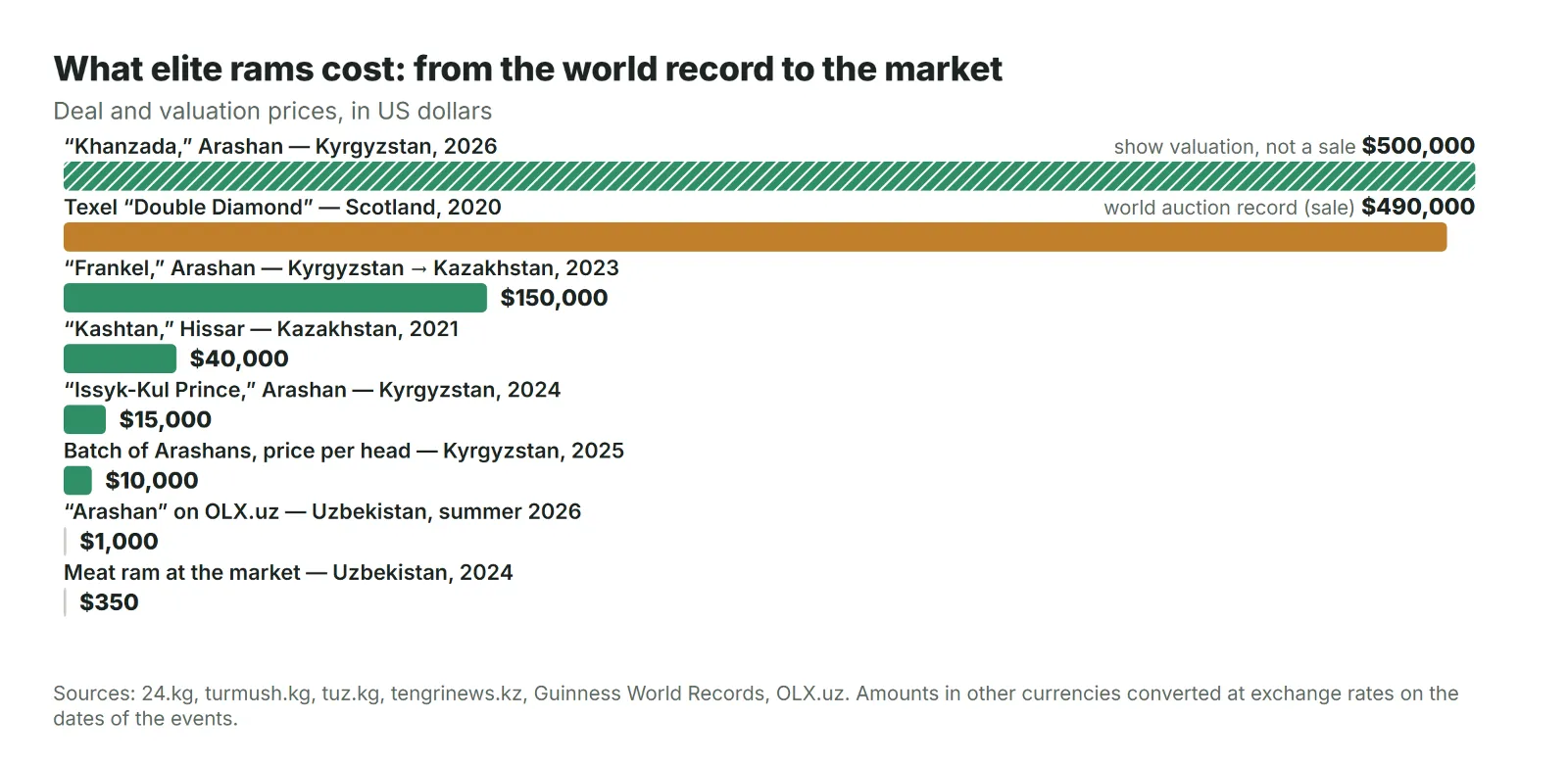
| Khanzada, Arashan | valuation ≈ $500,000 | 2026 | Sokuluk, Kyrgyzstan | show valuation |
| "Sportsmans Double Diamond," Texel | £367,500 (≈ $490,000) | 2020 | Lanark, Scotland | world auction record |
| "Frankel," Arashan | ≈ $150,000 | 2023 | Talas (Kyrgyzstan) → Kazakhstan | sale (per tuz.kg) |
| "Kashtan," Hissar | 18 million tenge (≈ $40,000) | 2021 | Turkistan Region, Kazakhstan | sale |
| Batch of 20 Arashan rams | ≈ $200,000 (≈ $10,000/head) | 2025 | Chuy Region, Kyrgyzstan | sale (per turmush.kg) |
| "Issyk-Kul Prince," Arashan, 194 kg | ≈ $15,000 | 2024 | Issyk-Kul, Kyrgyzstan | sale (per akipress) |
For context, the world auction record: a Scottish Texel ram named "Sportsmans Double Diamond" sold in 2020 for £367,500 (about $490,000), according to Guinness World Records. Kyrgyzstan's Khanzada is technically "more expensive," but with an important caveat: $500,000 is an expert valuation from a show, not the amount of an actual sale. Confirmed sales in the region are more modest — but still run into the tens and hundreds of thousands of dollars.
Why a breeding sire costs hundreds of times more than a meat ram
An ordinary ram raised "for meat" in Uzbekistan costs 2.5–5 million sums (≈ $210–415) — that's 2024 data, but the price range is still roughly the same. The gap with an elite sire runs into the hundreds, even thousands, of times over. Where does that gap come from? The price of an expensive sire is payment for genetics that work for the whole flock.
- Offspring. A single breeding ram sires hundreds of lambs directly over its lifetime, and through artificial insemination — thousands. If each one inherits a large frame and fast weight gain, the investment in the sire pays off across the entire flock.
- Weight gain across the flock. A good sire lifts average daily weight gain and dressing percentage in all of its offspring. Over time, that adds up to tens of tons of extra live weight.
- Breeding-farm status. Registered breeding farms receive state support and sell young stock at higher prices. Genetics becomes a farm asset.
A meat ram is slaughtered once; a breeding sire produces improved offspring for years — that's where the price difference comes from.
For more on the breed most valuable to the region, see our article "The Hissar Sheep Breed".
Record prices happen where two or more buyers compete for the same animal — in other words, at auction. Uzbekistan has this format too: an online auction where the starting price sets the floor and the closing time shifts if a bid lands just before the close. How it works and which animals make it worthwhile is covered in when an auction beats the market.
Arashans and Uzbekistan: what's happening in 2026
Arashan is a young Kyrgyz breed. It was developed from Hissar sheep brought in back in 1977, officially registered in 2021, and patented in 2023. Today the population is around 48,000 head, and Kyrgyzstan plans to grow it 4–5 times by 2030.
The big news for Uzbek farmers: in spring 2026, Kyrgyzstan opened up the export of breeding sheep. According to 24.kg, on May 21, 2026, the Kyrgyz Cabinet of Ministers lifted breeding sheep, including Arashans, from the export ban. The agriculture minister had already said back in April that exports to Kazakhstan, Uzbekistan, and Russia were being prepared.
Demand from Uzbekistan is already visible: Uzbek entrepreneurs attended the Arashan show in Bishkek in May 2026 as interested buyers (24.kg). The Kyrgyz Sheep Breeders Association says cooperation with farms in Uzbekistan and Kazakhstan is already taking shape.
Meanwhile, listings are appearing on OLX.uz. In summer 2026, rams labeled "Arashan" and Hissar sheep near Samarkand were listed at 5–12 million sums (≈ $415–1,000). That's an order of magnitude, or even two, cheaper than Kyrgyz breeding stock, which is valued in the tens and hundreds of thousands of dollars.
An "Arashan" from a classified ad ≠ a documented breeding animal
And this is exactly where a farmer needs to avoid being fooled. Between a ram for 12 million sums (≈ $1,000) on OLX and a Kyrgyz breeding Arashan for tens of thousands of dollars lies a chasm. A cheap "Arashan" listing usually just means a large crossbred ram with no confirmed pedigree. A genuine breeding sire is, first and foremost, paperwork and measurable traits.
What to look at if you're seriously considering an expensive sire:
- Pedigree and line. A breeding animal has a pedigree certificate stating its line (for Arashans, for example, the Sharpey line is well known — Khanzada himself descends from it). No document, no "breeding" status, no matter how nicely the ram is described in the ad.
- Parents' weight and measurements. Ask for data on the sire and dam: live weight, height at the withers, chest girth. Top Arashans reach up to 1.08 meters at the withers, and standard Hissars weigh up to 191 kg. The numbers should be documented, not eyeballed.
- Your own measurements and weight-gain history. Weigh and measure the animal yourself, and ask for its weight-gain history. A ram that looks big but has no weight-gain data is a pig in a poke.
- Health and veterinary records. Being purebred doesn't exempt an animal from quarantine and inspection.
These points are easier to check where the data is stated in the listing itself: to buy a documented breeding ram is best judged by weight and measurements, not by adjectives in the headline.
We covered how ram prices generally form in Uzbekistan in the article "How Much Does a Ram Cost in Uzbekistan in 2026".
How much Arashan rams and ewes weigh by class, how breeding sheep are exported from Kyrgyzstan after May 2026, and at what price an Arashan pays back on a commercial flock — in a separate review of the Arashan sheep breed.
Who needs an expensive sire — and who doesn't
An elite breeding ram costing tens of thousands of dollars isn't justified for everyone.
It makes sense if:
- you have a large enough breeding flock to spread the sire's cost across hundreds of lambs;
- you're in the breeding business and sell young stock, not just meat;
- you're willing to keep records: without data on pedigree and weight gain, expensive genetics won't prove its value to a buyer.
Without it, expensive genetics will not sell for more than ordinary stock: pedigree and gains on the animal card is the only way to show a buyer you did not pay for a pretty name.
And it's not needed if:
- you run a small operation with a dozen or two ewes "for meat" — the premium for a pedigree won't pay off;
- you don't keep records: then even an excellent sire will dissolve into the flock without a trace within a generation.
For most small farms, the sensible middle ground isn't a $500,000 record-holder or a nameless "Arashan" from OLX, but a verifiable, mid-tier breeding ram with paperwork and a clear line. Expensive genetics is an investment, and any investment requires you to calculate its return.
Manage your flock in QoyHunterCRM for sheep farmers: livestock, health, weighing, finance and analytics — in the app and a Telegram bot.All features →