
ستاسو په ژبه ترجمه تر اوسه نشته — متن په بله ژبه ښودل شوی.
Vaginal and uterine prolapse in a ewe: what to do before the vet arrives and what it costs to miss it
Vaginal and uterine prolapse in a ewe: how to tell them apart, what to do in the first minutes, what holds the prolapse until lambing, when to cull, and what losing a ewe and her lamb costs in 2026.
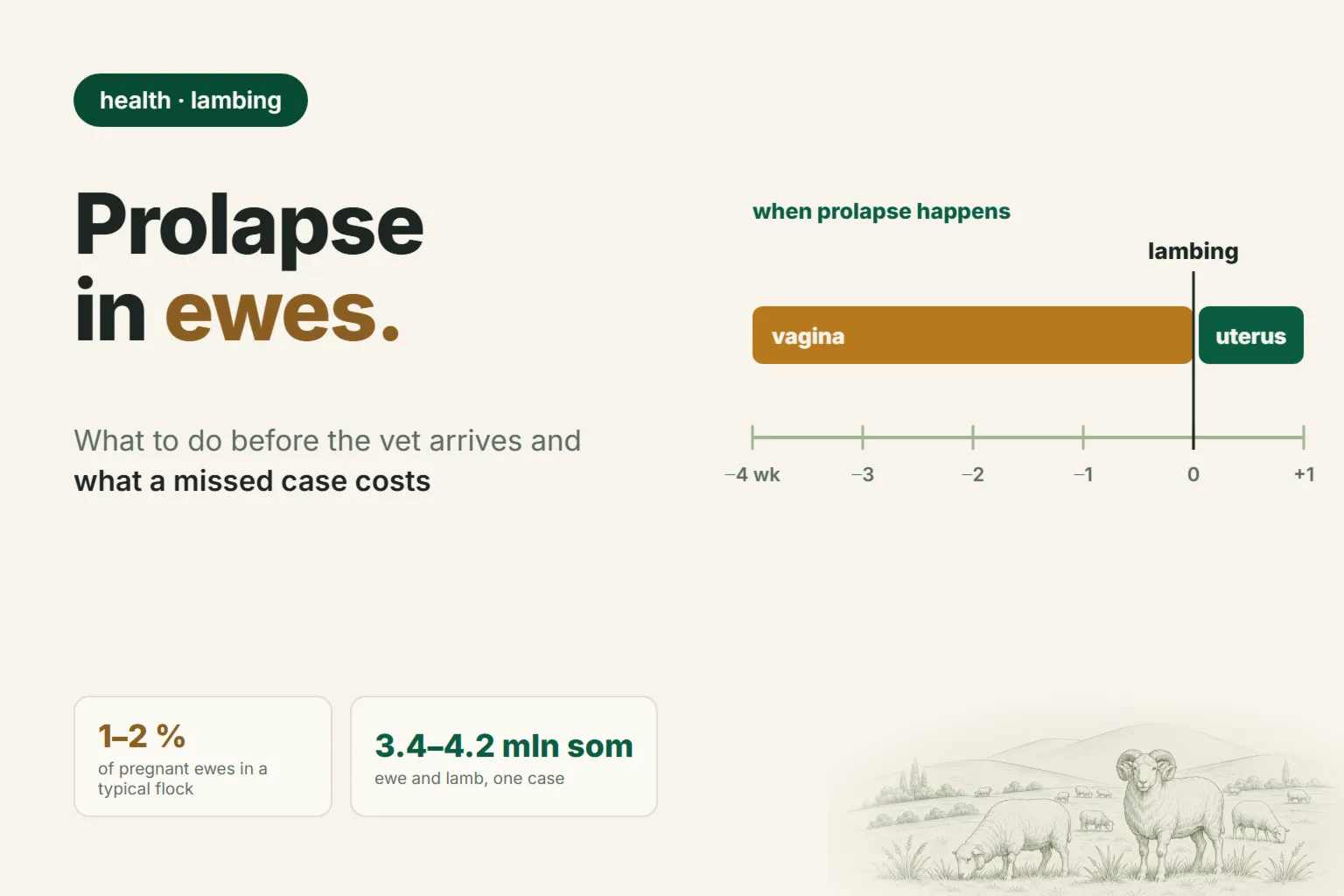
A vaginal prolapse in a ewe most often happens in the last month of pregnancy, and it can usually be put back if you do not delay: the clean tissue is returned, then held in place with a harness or a stitch that a vet puts in. A uterine prolapse happens right after lambing or within the first 12–48 hours, and it is an urgent case for a vet. Losing one ewe together with her lamb costs about 3.4–4.2 million som (≈ $285–349) in Uzbekistan at autumn 2026 prices.
It is not common: according to the British veterinary service NADIS, a vaginal prolapse occurs in about 1% of pregnant ewes, and a uterine prolapse in about 0.1%. But if lambing is in February–March, the dangerous month starts already in January, so it is worth knowing the order of action in advance. This article does not replace a vet: when a prolapse happens, it is better to call the vet at once, and the steps below are there to save the ewe while the vet is on the way.
The conversion rate is 12,055.90 som per dollar (Central Bank of Uzbekistan, 17 October 2026).
How do you tell a vaginal prolapse from a uterine prolapse?
A vaginal prolapse is when the vaginal wall comes out through the vulva. A uterine prolapse is when the uterus itself turns inside out and comes out after lambing. You can tell them apart by timing and by how the tissue looks.
| Sign | Vaginal prolapse | Uterine prolapse |
|---|---|---|
| When | Last month of pregnancy, most often the last days and weeks | Right after lambing or within 12–48 hours, while the ewe keeps straining |
| What it looks like | A smooth red mass, from the size of a tennis ball to a melon | A large mass covered with rounded bumps (caruncles, the places where the afterbirth was attached) |
| Urgency | Fast: the tissue dries out and gets injured | Urgent: the longer the uterus is outside, the worse the outlook |
| Who puts it back | An experienced owner or a vet | Better a vet |
If a ewe leaves the flock before her time, paws at the bedding, bleats and strains, look at her from behind: these signs resemble the start of labour but may turn out to be a prolapse. In the early stage the tissue is visible while the ewe lies down and goes back in when she stands up. At that moment you can still manage with a harness, so it is worth separating such a ewe and showing her to a vet.
How many ewes are affected and what is at stake?
A vaginal prolapse most often occurs in 1–2% of pregnant ewes. NADIS gives about 1%, and in some flocks up to 15%. In a survey of British sheep farmers (Farmers Weekly, 2026, 127 responses) the median was 1.7%, half of the farms fell within 0.7–3.6%, and the unluckiest reached 20%. We found no data for Uzbekistan or fat-tailed breeds, so these figures are a rough guide.
Let us count what one missed case costs. In the worst case the farm loses two animals at once:
- the lamb: a weaned lamb of 26–31 kg at 55,000 som/kg live weight is 1.43–1.71 million som (≈ $119–141);
- the ewe, who could have been sold as a cull: 2.0 million som if thin, or 2.5 million som net of the cost of fattening (≈ $166–207).
In total 3.4–4.2 million som (≈ $285–349) per case. The cost of the vet and medicines is not included: we found no prices for them in Uzbekistan, so ask your vet in advance. A simple comparison is enough for the decision: if a call-out with treatment costs noticeably less than 3.4 million som, it pays for itself with one saved ewe and lamb.
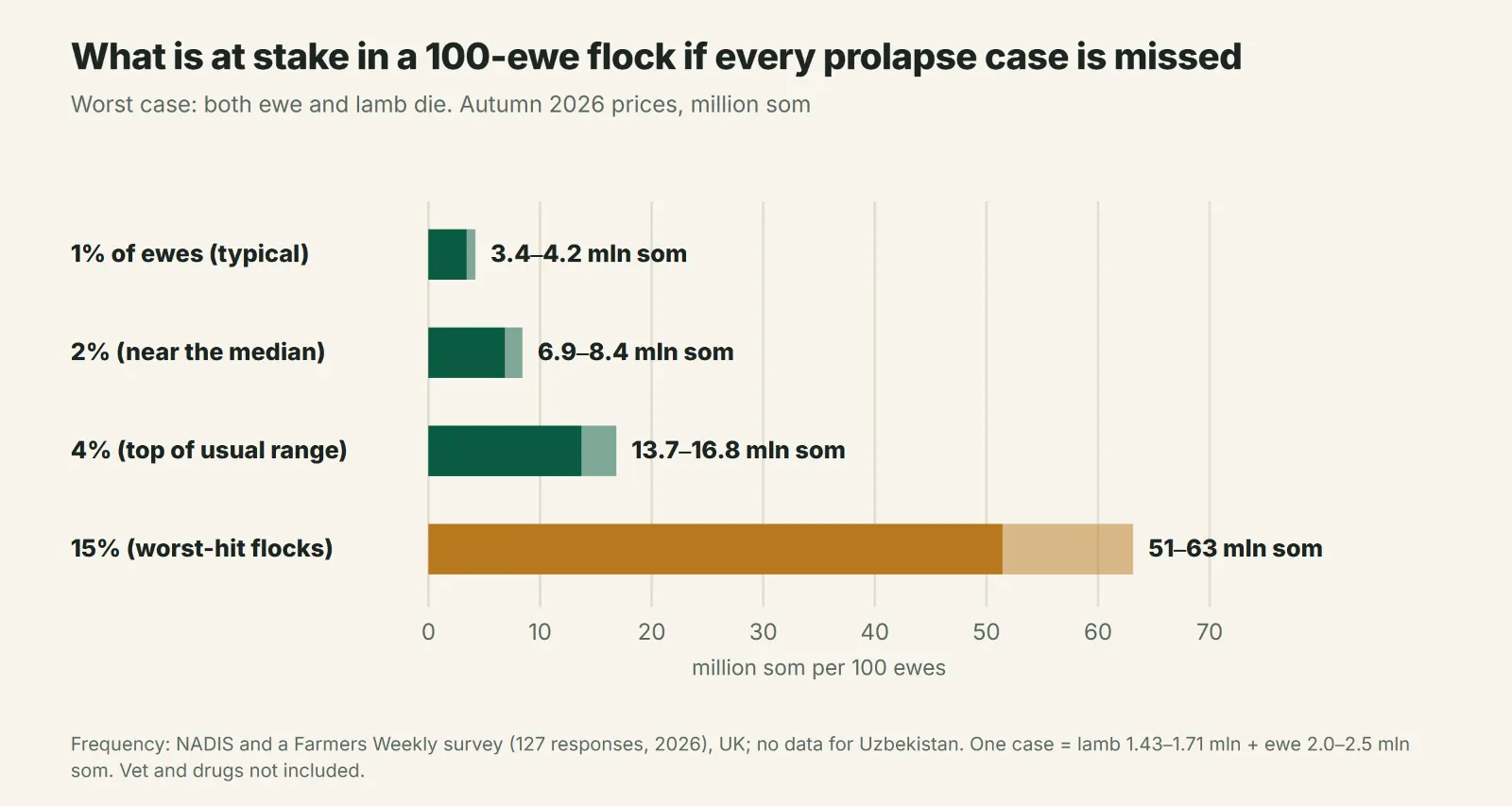
The table below shows the worst case, when all affected ewes and their lambs die. In practice some cases can be saved, so real losses are smaller.
| Share of ewes with prolapse, 100 ewes | Cases | At stake, million som | At stake, $ |
|---|---|---|---|
| 1% (usual, NADIS) | 1 | 3.4–4.2 | 285–349 |
| 2% (near the survey median) | 2 | 6.9–8.4 | 570–700 |
| 4% (top of the usual range) | 4 | 13.7–16.8 | 1,140–1,395 |
| 15% (top of the NADIS range) | 15 | 51–63 | 4,270–5,230 |
What should you do about a vaginal prolapse in a pregnant ewe?
You have to hurry before the tissue dries out and turns dark. Call the vet, and if the vet is far away or you have already put a prolapse back under veterinary guidance, act in order:
- Separate the ewe and get a helper to hold her calm.
- Rinse the tissue with plenty of clean warm water. Remove dirt and straw. Add an antiseptic only on the vet's advice.
- Check the tissue for tears. If there is a tear and intestines are visible through it, do nothing yourself: the decision is the vet's, and the ewe will most likely have to be put down.
- Let the ewe urinate. The prolapsed tissue kinks the bladder. Gently lift the mass up toward the tail: often the ewe urinates at once and putting it back becomes easier.
- Lubricate the tissue with obstetric lubricant (gel).
- Return it with a flat palm or a fist. Press gently and between contractions. Do not poke with your fingers, so you do not puncture the tissue, and do not fight the ewe with force.
- Secure it. Without holding it in place, the prolapse often comes back at the next strain.
If several gentle attempts fail, the tissue is dark or damaged, the ewe is weak, the lambs are dead, or the ewe has gone into labour (a water bag or feet are visible), this is a job for a vet.
What holds the prolapse in place until lambing?
You can hold a prolapse with a harness, a plastic retainer or a stitch. Each method has a required condition: by the start of lambing it must be loosened or removed, otherwise the ewe cannot give birth.
| Method | How it works | Who fits it | What matters |
|---|---|---|---|
| Harness (prolapse harness) | Presses around the vulva | Owner | Loosen or remove it by lambing |
| Plastic T-shaped retainer | Inserted inside, fixed with a cord | Owner | Remove at the start of lambing |
| Buhner stitch (tape around the vulva) | Narrows the opening, leaving a small gap | Only a vet, with pain relief | Undo it ahead of lambing |
You must not stitch a ewe without pain relief: it is agonising for the animal. The stitch is put in by a vet, and only under local anaesthesia. Stitches that pass right through into the vagina should be avoided: they irritate the tissue and cause straining.
After putting it back, check the ewe several times a day and keep her separate. She needs a painkiller and an anti-inflammatory: the vet prescribes them. An antibiotic is not always needed, usually only when the tissue was dirty or damaged. For the dose and the withdrawal period before slaughter, follow the vet's prescription and the drug's instructions. The meat of a ewe that received an antibiotic cannot be sold until the withdrawal period is over.
You need to watch such a ewe at lambing: help with the birth is often needed, sometimes even a caesarean. After a prolapse the cervix sometimes does not open, and without a vet both the ewe and the lamb can die. We covered what to do when a lamb is coming wrongly in the article on difficult lambing in sheep.
What should you do about a uterine prolapse in a ewe after lambing?
A uterine prolapse in a ewe is an urgent case: call the vet at once. The longer the uterus is outside, the more it suffers from damage and dirt, and the worse the outlook for the ewe. While the vet is on the way:
- do not cut off or tie off the uterus yourself: this is dangerous for the ewe;
- keep the ewe calm so that she does not drag the uterus on the ground;
- lay the uterus on a clean damp cloth and keep it moist, washing off straw and dirt with clean water.
A vet is best placed to put the uterus back: the vet will give the ewe pain relief and prescribe medicines. If there is no vet and you have to do it yourself, the Ohio State University service advises, when there is severe swelling, to sprinkle sugar on the uterus, cover it with a towel, wait a few minutes, rinse and lubricate: this makes it smaller.
The causes are often linked to hard, drawn-out births and strong straining after them. If the ewe dies but the lamb is alive, the lamb can still be saved: how to do it is covered in the article how to raise a lamb without its mother.
How do you prevent prolapse in sheep?
There is no single reliable way to prevent a prolapse: the NADIS guidance says plainly that there are no specific preventive measures, and Ohio State University researchers write that they could not induce it deliberately. But you can reduce the risk by removing what is most often linked with prolapse:
- Do not overfeed toward the end of pregnancy. According to NADIS, the risk is higher at a body condition score of 4 and above out of 5, although some studies found no link with condition.
- Do not give root vegetables in the last month. NADIS advises not to feed pregnant ewes root crops late in pregnancy. Agree the feeding plan with a vet or an animal scientist.
- Make the ewes move. Daily exercise is useful, especially for housed sheep.
- Treat lameness at once. Both NADIS and Ohio State University name lameness as a risk factor.
- Give everyone room at the feeder. If there is little room, the ewes shove and press on each other with their bellies.
- Do not keep ewes on steep slopes in the last month if you can avoid it, although the data here are contradictory.
- Do not dock the tail too short. In the British survey, with a tail docked too short, prolapse occurred in almost 4% of ewes versus 1.6%.
Should you cull a ewe after a prolapse?
Yes, a ewe after a vaginal prolapse is best culled after the lambs are weaned: a repeat prolapse in the next pregnancy is common. Ohio State University, NADIS and Farmers Weekly agree on this advice. The heritability of prolapse has not been proven yet.
Mark her right away so you do not forget after weaning. You can write it in a notebook: tag, date, what happened, what was done. In QoyHunter, a CRM for sheep records, and the bazar.qoyhunter.com marketplace, the sheep health log with veterinary events does this: the entry stays with the specific ewe, and when culling you do not have to recall it from memory. As a replacement you can buy a breeding ewe through a listing, but always keep a new purchase in quarantine.
FAQ
Why did something red come out of my ewe before lambing?
Most often this is a vaginal prolapse, which occurs in the last month of pregnancy in about 1–2% of ewes. It is a smooth red mass, from the size of a tennis ball to a melon. It is rinsed with clean warm water and put back, then held with a harness, a retainer or a stitch that a vet puts in.
Can I put a prolapse back in a ewe myself?
An experienced owner can put a vaginal prolapse back without a vet: rinse it, let the ewe urinate, lubricate it and gently return it with the palm. If you have no experience, the tissue is dark or damaged, the ewe is weak, or it is a uterine prolapse after lambing, call a vet. A stitch must not be put in without pain relief.
Can a ewe lamb after a prolapse?
She can, but only if the harness, retainer or stitch is loosened or removed in time. Help with the birth is often needed, sometimes even a caesarean. In such ewes the cervix may open poorly, and without help both the ewe and the lamb can die.
How much does losing a ewe with a prolapse cost?
At autumn 2026 prices about 3.4–4.2 million som (≈ $285–349) if both the ewe and the lamb die: that is a weaned lamb of 26–31 kg at 55,000 som/kg live weight plus a culled ewe at 2.0–2.5 million som. The cost of the vet and medicines is not included in this sum.
Can I keep such a ewe for next year?
It is better not to: a repeat prolapse in the next pregnancy is common. Ohio State University and the British service NADIS advise culling the ewe after the lambs are weaned. Mark her with a tag or a note right away so you do not forget after weaning.