
Difficult Lambing in Sheep: How Long to Wait After the Water Bag, How to Correct the Lamb and When to Call a Vet
If a ewe strains for 30 minutes and the lamb is not progressing, it is time to help. Normal lambing timings by stage, a table of abnormal lamb positions and what to do for each, a lambing kit, ewe prices on olx.uz in October 2026, and what delay costs.
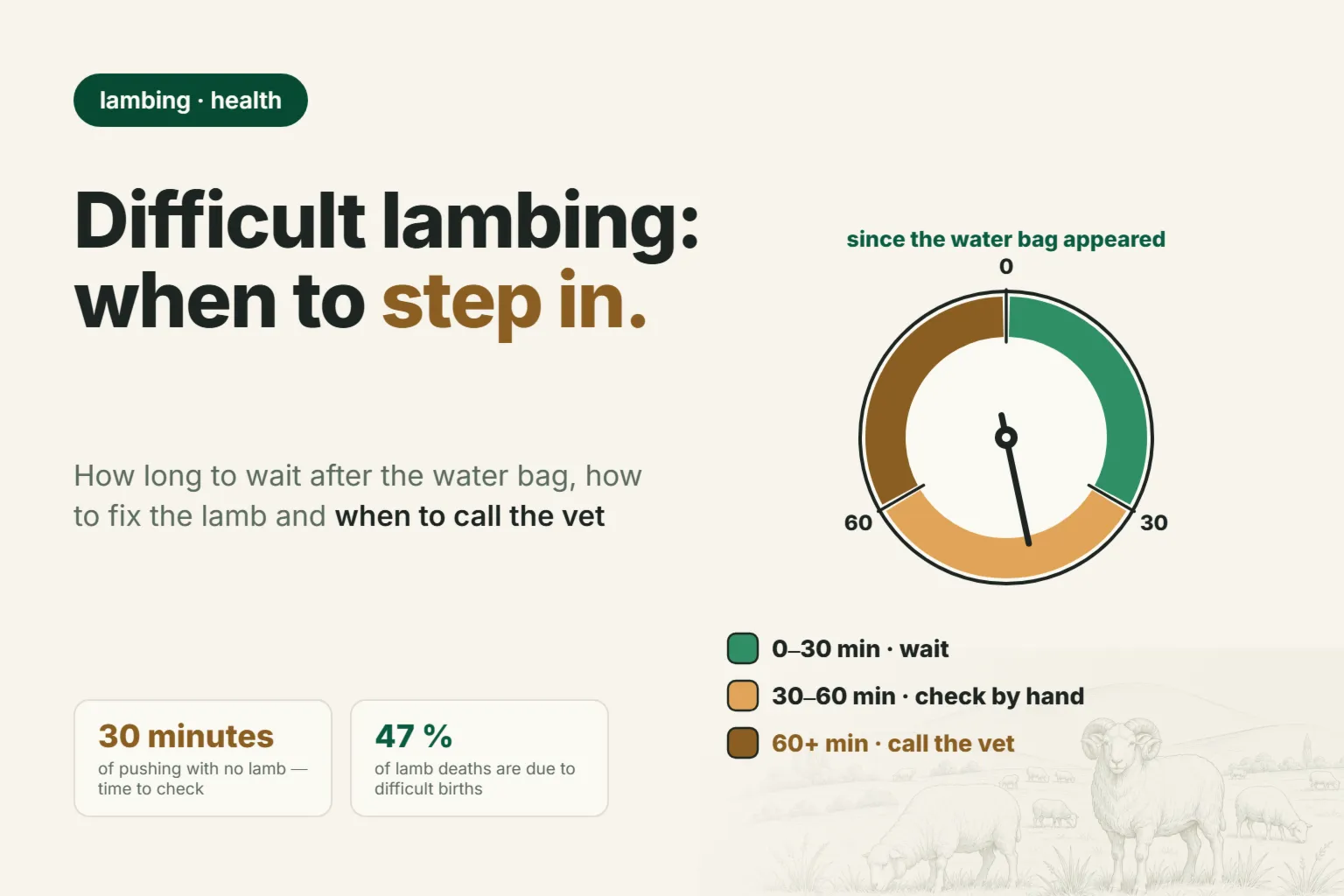
Difficult lambing in a ewe is a birth where the ewe strains but the lamb does not come out: normally it is born within an hour of the first water bag bursting. If the ewe strains hard for 30 minutes without progress, or only the head or one leg shows outside, it is time to check by hand. If the lamb has not moved after 10–15 minutes of your own help, call a vet. Below: how to tell normal from trouble, how to correct the lamb's position, and what a delay costs.
What does a normal lambing look like in a ewe?
Lambing goes through three stages, each with its own timing.
| Stage | What you see | How long it lasts normally |
|---|---|---|
| 1. Preparation | the ewe is restless, leaves the flock, paws the bedding, lies down and gets up; the cervix opens | 3–6 hours, faster in mature ewes |
| 2. Delivery | the water bag appears, strong contractions begin, the lamb is born | about an hour from the moment the first bag bursts; strong contractions deliver the lamb in 5–10 minutes |
| 3. Afterbirth | the placenta comes out | 2–3 hours after the last lamb |
A correctly presented lamb comes like a diver: first two front hooves, soles down, with the nose resting on them. The second twin is usually born 10–60 minutes after the first; if more than an hour has passed and the second is not coming, check (per the British veterinary service NADIS).
The main rule of the first stage is not to interfere. A ewe that is constantly touched and moved slows her labor: she stops pushing.
When does a ewe need help with lambing?
Help is needed if you see at least one of these signs:
- the ewe strains hard for 30 minutes and the lamb makes no progress;
- the water bag burst more than an hour ago and there is no lamb;
- you see only a head with no legs, only one leg, or legs with the soles up;
- you see a tail with no legs;
- the ewe strained, then gave up and stands limp;
- more than an hour has passed since the first lamb, and you can tell there is a second one inside.
Nobody has counted how many lambings in Uzbekistan need assistance. But the price of delay is known: according to the meta-analysis by Bruce et al. (2021, 11 studies, 14,413 post-mortems), difficult births account for 47% of lamb deaths, and 59% among singles. Help is most often needed for ewe lambs at their first lambing, ewes older than 4.5 years, and with a large single lamb (per the Australian industry body MLA).
How do you help a ewe lamb: what to prepare in advance?
The lambing kit is assembled before the season starts, not on the night a ewe is already down. Everything fits in one bucket.
| What you need | Why |
|---|---|
| Long disposable gloves (shoulder length) | to avoid introducing infection into the uterus and to protect yourself: brucellosis is transmitted through birth fluids |
| Lubricant: obstetric gel or petroleum jelly, soapy solution as a last resort | the hand and the lamb slide, the mucous membrane does not tear |
| Warm water, soap, antiseptic | to wash the ewe's external genitals and your hands |
| Iodine solution | to treat the lamb's navel |
| A soft thin rope or obstetric loop | to hold the lamb's leg while you correct the head |
| Clean rags, a flashlight | to wipe the lamb and see what you are doing at night |
| A tube and a feeding bottle | to give colostrum to a weak lamb |
| The vet's phone number written down | so you are not searching for it when minutes count |
Fingernails are trimmed short before helping. The ewe's external genitals are washed with warm soapy water or antiseptic solution, and the gloved hand is generously lubricated. Without lubricant the walls of the birth canal dry out, and every movement tears the mucous membrane.
How do you correct a lamb that is coming wrong?
First work out exactly what is inside: how many legs, front or hind, where the head is. A front leg bends at the knee "forward", like a person's arm; a hind leg bends at the hock, at a sharp angle backward. Until you understand what you are holding, pull nothing.
| What you see or feel | What it is | What to do |
|---|---|---|
| head and one leg | the other leg is folded back | push the lamb back in between contractions, find the second leg, bend it and bring it out hoof first, covering the hoof with your palm |
| two legs, no head | the head is turned back or down | push back, find the head, bring it into the pelvis nose first, holding by the lower jaw, not the neck |
| only the head, badly swollen | both legs are folded back, the lamb has been stuck for a long time | lubricate generously; do not force the head back in; feel along the head and bring out the legs one at a time. If the head is already outside and swollen, call the vet at once |
| two hind legs (bend at the hock), soles up | the lamb is coming backward | do not turn it; pull without delay, but smoothly and with a contraction: first straight back, and once the hips are out, downward. The cord is pinched, so you cannot dawdle, but you must not yank either: hard traction tears the lamb's liver |
| tail, no legs | breech presentation | push back, bring out the hind legs one at a time, covering each hoof with your palm so it does not tear the uterus; then proceed as for a backward presentation |
| legs of different lambs | twins are tangled | trace the leg back to the body, assemble the pair belonging to one lamb, push the other back |
| cervix open 3–5 cm and not stretching | incomplete cervical dilation | do not pull or tear; if there is no progress after 10 minutes of gentle stretching, call the vet, a cesarean is often needed |
You may pull only with a contraction: first back, then downward, in an arc toward the udder, not straight toward yourself. When the chest is out, the lamb is turned about 30° so the hips do not jam in the pelvis.
If the lamb has not moved after 10–15 minutes of your own attempts, stop and call the vet; if you are not sure what you have felt, call at once. A tired uterus with torn passages is more likely to die after another hour of "help" than with an early call to the vet.
What should you do right after a difficult lambing?
- Clear the lamb's nose and mouth of mucus. If it is not breathing, lay it on its chest with its legs tucked under, rub it vigorously with straw or cloth, tickle a nostril with a straw, and splash cold water in its ear. Do not hang it or swing it by the hind legs: the internal organs press on the diaphragm and breathing gets harder. Do not give mouth-to-nose breathing: you can catch chlamydia or Q fever from the lamb.
- Check by hand that there is no other lamb left in the uterus.
- Treat the navel with iodine.
- Make sure the lamb stands up and sucks. A strong lamb suckles on its own in the first hour. In the first 6 hours it needs at least 50 ml of colostrum per kilogram of weight, and about 200 ml/kg per day (a recommendation of the Irish institute Teagasc): for a 4 kg lamb, 200 ml in the first 6 hours. A weak lamb or one stuck for a long time is tube-fed in the first 2 hours.
- Wait for the afterbirth. Normally it comes out 2–3 hours after the last lamb. Do not let the ewe eat the afterbirth. Do not pull on a hanging afterbirth: you can tear it off with bleeding.
- After manual assistance an antibiotic is often prescribed: infection has been introduced into the birth canal. Whether it is needed, which one and at what dose is for the vet to decide; the withdrawal period for meat and milk is as stated in the drug's instructions.
A prolapsed uterus after lambing, a large dark-red bag with bumps behind the ewe, cannot wait. Lay the ewe on clean bedding and keep her calm, away from dogs. Wrap the uterus in a clean damp cloth or plastic sheeting and support it at the level of the vulva. Call the vet immediately.
How much does a difficult lambing cost if you lose time?
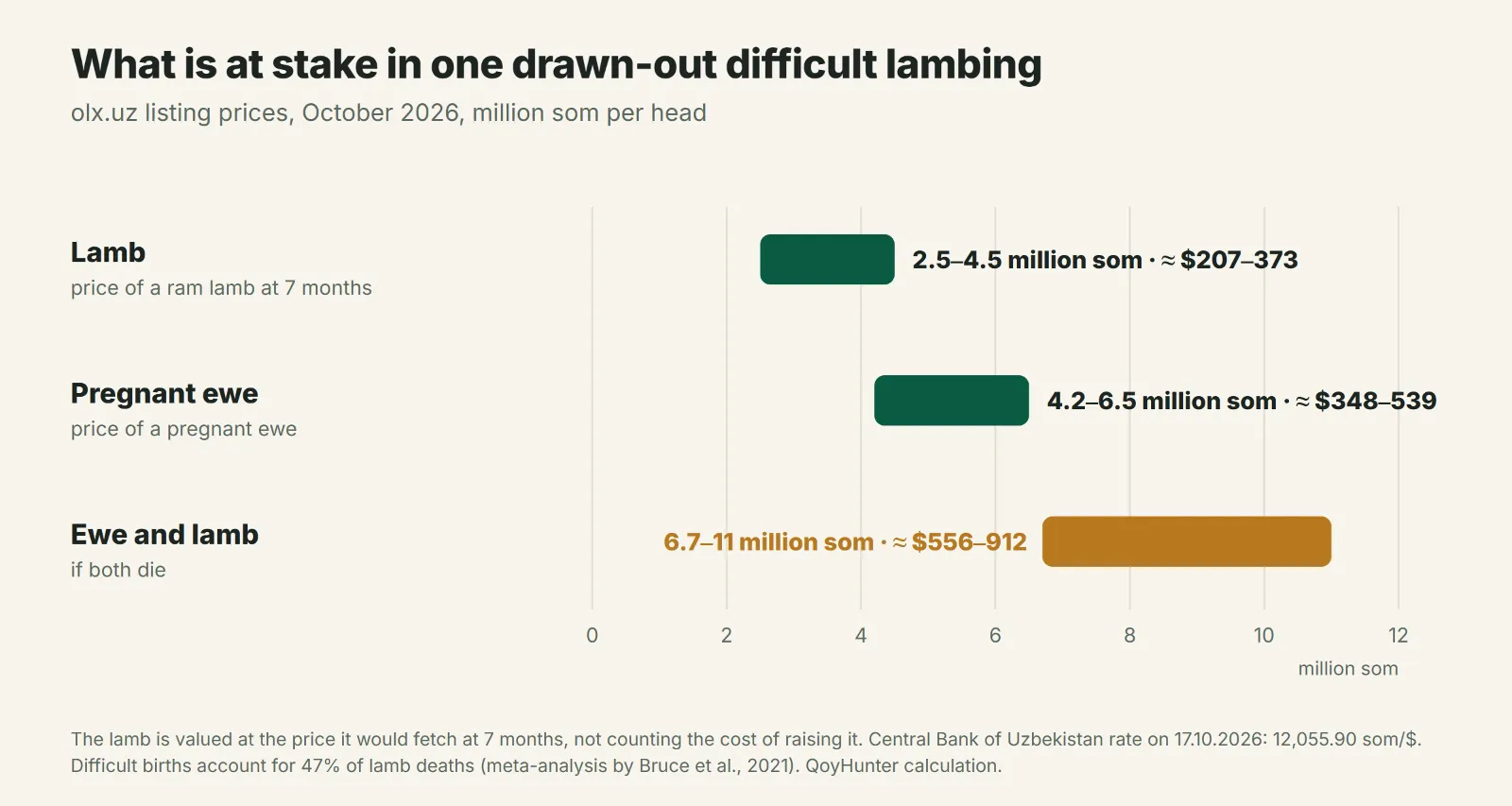
The price of delay is real money. On olx.uz in October 2026 a pregnant ewe costs 4.2–6.5 million som (≈ $348–539), and a 7-month-old ram lamb costs 2.5–4.5 million som (≈ $207–373). A drawn-out difficult lambing most often kills the lamb, and with tears and infection the ewe as well. Per head, 6.7–11 million som (≈ $556–912) is at stake: what the ewe and a raised lamb would cost, not counting the cost of feeding it. The rate is 12,055.90 som per dollar by the Central Bank of Uzbekistan on 17.10.2026.
A lambing kit from the pharmacy (gloves, petroleum jelly, iodine) costs incomparably less than one lamb. A vet's call-out in listings is usually "by agreement": find out the price and phone number before the season, not at two in the morning.
A lambing that ended in intervention is worth recording. If the cause lies in the ewe (a narrow cervix, vaginal prolapse before lambing, repeated difficult lambing), such a ewe is culled. If the cause is a large lamb, the ram should be changed, not the ewe. Recording the help, the drug and the vet's price in a sheep treatment and vet records log will show which ewes not to keep for the next breeding.
How can you reduce the number of difficult lambings in the flock?
- Match the ram to the ewes. A large meat-breed ram on small local ewe lambs produces a heavy single lamb, the main cause of difficult lambings in first-time mothers. For ewe lambs choose a ram of the same or a smaller breed; which ram to use on mature ewes and how much a crossbreed adds is covered in the article on crossbreeding sheep breeds. If you are changing the ram, it is convenient to browse rams for sale in Uzbekistan ahead of time, before the autumn breeding.
- Do not overfeed or starve the ewes. A fat ewe carries a large lamb and pushes worse; an emaciated one tires quickly in labor.
- Keep pregnant ewes moving. Grazing and walking until the last weeks keep the muscles toned.
- Breed ewe lambs by weight, not by age. An undersized ewe lamb has a harder birth.
- Keep lambing under watch. Night rounds every 2–3 hours at the peak of lambing save more lambs than any medicine. Why newborns die in the first three days even after a successful birth, we covered separately in the article why lambs die.
QoyHunter, a CRM for sheep record-keeping, and the marketplace bazar.qoyhunter.com, keep each ewe's lambing and treatment history, which shows whose difficult births keep repeating.
FAQ
How long should you wait if the water bag has come out but there is no lamb?
Normally the lamb is born within an hour of the first water bag bursting, and strong contractions usually deliver the lamb in 5–10 minutes. If the ewe strains for 30 minutes and the lamb does not progress, or an hour has passed after the bag, the ewe is examined by a gloved hand. If the lamb has not moved after 10–15 minutes of your own help, call a vet.
Can you pull a lamb by the legs?
Yes, but only when the lamb is positioned correctly, with two front legs and the head resting on them, or two hind legs, and only together with a uterine contraction. Pull first back, then downward in an arc toward the udder, not straight toward yourself; a lamb coming backward is pulled smoothly, without jerks. You must not pull a lamb with its head turned back or a leg folded: it is corrected first.
When should you call a vet during lambing?
Call a vet if the lamb has not come out after 10–15 minutes of your own help, if the cervix is open only 3–5 cm and not stretching, if the lamb does not fit through the pelvis, if the uterus has prolapsed or the ewe is bleeding after lambing, and also if the afterbirth has not come out within a day. Waiting longer risks both the lamb and the ewe.
Does a ewe need an antibiotic after a difficult lambing?
Often yes, but the vet decides: manual help introduces infection into the birth canal, and without treatment the ewe can develop uterine inflammation (metritis). Whether it is needed, which drug and for how many days is the vet's call. Meat and milk cannot be used after an antibiotic until the end of the withdrawal period in the drug's instructions.
Should you keep a ewe after a difficult lambing?
It depends on the cause. If the lamb was large or badly positioned, the ewe is kept: next time the birth may go normally. If the ewe's cervix did not open, she had a vaginal or uterine prolapse, or the difficult lambing repeated, such a ewe is culled after the lambs are weaned.
Manage your flock in QoyHunterCRM for sheep farmers: livestock, health, weighing, finance and analytics — in the app and a Telegram bot.All features →