Bloat in Sheep: Why Rams Bloat on Alfalfa, and What to Do in the First 30 Minutes
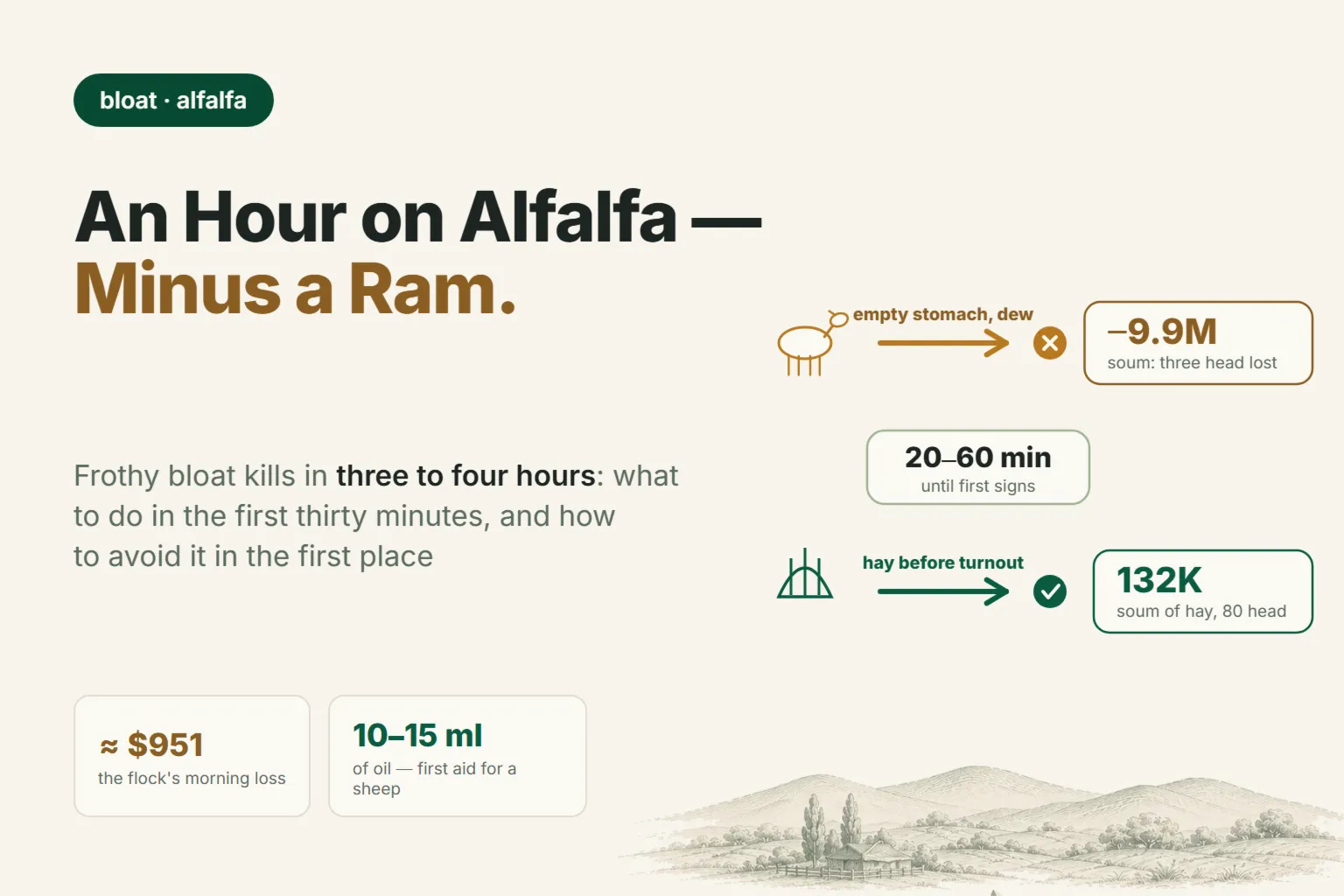
Frothy bloat on alfalfa can kill in three to four hours: one morning on regrowth on an empty stomach can cost 11.4 million soum on a flock of 80 head. We cover the warning signs, first aid for the first thirty minutes, a schedule for introducing green feed, and a first-aid kit for 200 thousand soum.
The flock went out onto alfalfa regrowth in the morning, in the dew, on empty stomachs — the way it had been done for ten years running. Forty minutes later the first ewe stopped chewing and started glancing back at her left side. Half an hour after that, nine were bloated, and by noon the farm was down three head.
Tympany — bloat of the rumen — kills faster than any infection. The first signs appear within 20–60 minutes of turning out onto alfalfa, and death usually follows three to four hours after the first signs, in severe cases under an hour. A vet most often can't get there in time. And it's not the weakest animals that die — it's the greediest eaters, which means the best animals in the flock. Here's why the rumen bloats, what to do in the first thirty minutes, and how to structure grazing so it doesn't happen. Prices are reference points for August 2026, live weight at 55,000 soum/kg, exchange rate ≈ 11,990 soum per dollar.
What one morning on alfalfa costs
Let's run the numbers on the episode from the opening: a flock of 80 head, turned out hungry onto regrowth after rain.
| What happened | Head | Money |
|---|---|---|
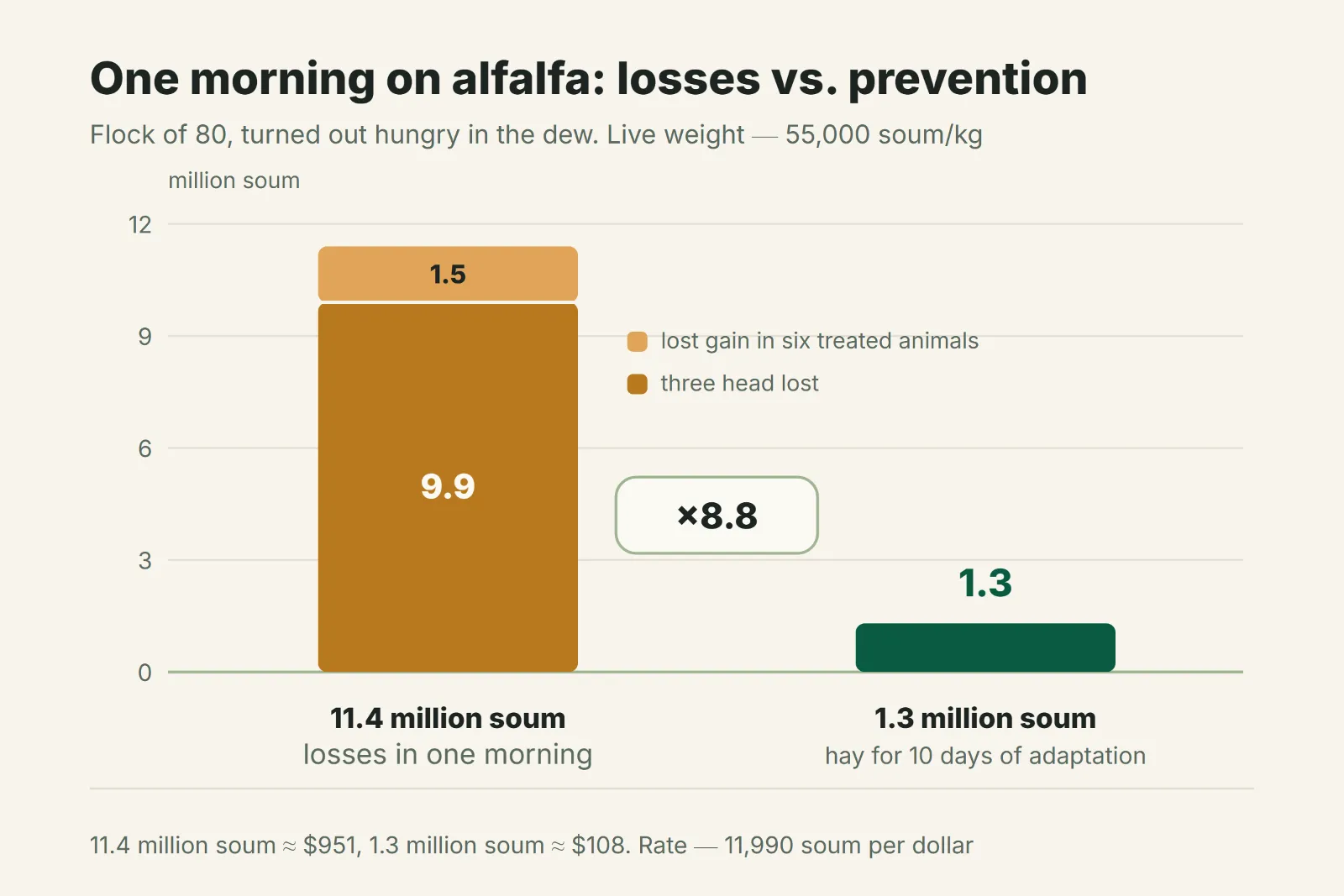
| Died on the spot | 3 (at ~60 kg each) | 9.9 million soum (≈ $826) |
| Bloated, treated in time | 6 | lost weight gain and milk, ~1.5 million soum (≈ $125) |
| Total for one morning | ≈ 11.4 million soum (≈ $951) |
Now the cost of preventing all that: 1–1.5 kg of hay or straw per head before turnout. For 80 head that's 120 kg of hay — about 132 thousand soum (≈ $11) per morning, and 1.3 million soum (≈ $108) for ten days of adaptation to green feed.
One dead ram costs more than the entire adaptation program for the whole flock. That's the whole arithmetic of the question.
Why the rumen bloats
Feed ferments continuously in a sheep's rumen, producing roughly five liters of gas an hour — about a liter every twelve minutes. Normally it escapes through belching, and there's no bloat at all. Tympany starts when the gas can't get out. That happens in two ways.
Frothy bloat (on legumes). Young alfalfa, sainfoin and clover are rich in rapidly soluble protein. It whips the rumen contents into foam the way soap whips water: instead of collecting as a single bubble on top, the gas stays trapped in thousands of tiny bubbles throughout the mass. The animal physically cannot belch out foam — the belch reflex simply doesn't trigger on it. The rumen swells, presses on the diaphragm, and the animal suffocates. This is the case that kills flocks on alfalfa.
Gas (free-gas) bloat. The gas is there, but it can't escape because of an obstruction: a chunk of root vegetable or a corncob stuck in the esophagus, or, less often, rumen paralysis after chilling or poisonous plants. Here the gas forms a single bubble and can be released with a stomach tube.
The distinction matters in practice: a stomach tube resolves gas bloat, but not frothy bloat — almost nothing will come out of the tube, because what needs releasing isn't gas but foam. What works against foam is oil, which collapses it.
Five situations that lead to bloat
Young alfalfa and regrowth. The most dangerous feed is green alfalfa before flowering and regrowth after cutting or rain. It has the highest soluble protein and the lowest fiber. Once at least a quarter of the alfalfa has bloomed, the risk drops noticeably.
Dew, rain, fog. Animals eat wet grass faster, it digests faster, and the plant holds more soluble protein in the morning. Grazing legumes in the dew is the classic setup for a group outbreak.
A hungry flock. An animal that hasn't eaten since the evening fills its rumen in the first twenty minutes as much as it normally would in two hours. It's the hungriest ones that push to the front — and die first.
An abrupt switch to green feed. The rumen microflora needs two to three weeks to adjust to a new feed. A flock that was on hay yesterday and turned out onto alfalfa for a full day today is asking for losses.
Finely ground grain and mealy feeds. Fine grinding, bran and flour produce the same kind of froth in the rumen as legumes do. That overlaps with acidosis, which we covered separately in "Why rams die on grain fattening".
What it looks like, and how much time you have
The first signs appear within 20–60 minutes of turning out to graze. After that, there's little time left.
| What you see | What's happening | What to do |
|---|---|---|
| Stopped chewing, glancing at its left side, restless | the rumen has started to bloat | move it off pasture immediately, and the rest of the flock too |
| Left flank swollen level with the spine, side taut as a drum | gas and foam pressing on the diaphragm | raise the front end, give a foam-breaker, call the vet |
| Breathing fast with an open mouth, neck stretched out, drooling | suffocation has begun | minutes count, the vet is needed right now |
| Groaning, staggering, mucous membranes turning blue, lying down and not getting up | shock and respiratory arrest | last resort — trocar puncture, after this it's almost always too late |
Check the left flank: the hollow in front of the hip bone. With tympany it's not just filled in but bulging, and flicking it with a finger produces a drum-like sound.
A similar picture — drooling, labored breathing, an unsteady gait — also shows up with poisoning on pasture, except there it knocks down a whole group of animals at once and the color of the mucous membranes changes sharply. We covered how to tell the two apart and what to do in the first hour in "Sheep Poisoning on Pasture".
What to do in the first thirty minutes
Here's the order of steps, and it shouldn't be rearranged.
1. Get the whole flock off the pasture. While you're dealing with the first ewe, the rest keep eating. That's almost always how group outbreaks happen: the owner is busy with one animal while eight more are bloating.
2. Raise the front half of the body. Front legs up on a doorstep, the side of a trailer, a slope — whatever's nearby. Head higher than the rump takes the load off the diaphragm and opens a path for the gas.
3. Keep it moving and massage the flank. Slow walking uphill and kneading the left flank with your fist help the gas escape. Never drive the animal at a run.
4. Give a foam-breaker. The most accessible one is vegetable oil: veterinary references give a sheep 10–15 ml (sunflower, soybean or peanut oil). Pour it in slowly, in small portions, keeping the head level: if the animal coughs, the oil goes into the lungs and you get pneumonia instead of bloat. A larger dose should only be prescribed by a vet. A pharmacy option is a product like timpanol, strictly per the manufacturer's instructions, diluted in water.
5. Stomach tube — for the gas form. A soft hose 1–1.5 cm in diameter (the right size for an adult sheep), passed through the mouth into the rumen, releases free gas and can push through a lodged piece of feed. It barely helps with frothy bloat, but it's still worth trying: it will also tell you which form you're dealing with.
6. Trocar puncture — only when the animal is going down. Use a small-livestock trocar, entering on the left in the center of the flank hollow. This is a surgical procedure, not first aid: the wrong spot, a dirty instrument, or releasing the gas too fast can cause peritonitis and death within a day — practitioners who've had to puncture an animal talk about infection and death even after a technically successful puncture. Do this only if the vet can't get there in time and the animal is already going down and turning blue, and call the vet immediately afterward — it will need antibiotics and wound care.
What not to do: give feed or water (it will only make the foam worse), lay the animal on its back (that pinches the diaphragm completely shut), chase it at a run, or wait for it to "pass on its own."
Everything above is first aid, not treatment. Call the vet the moment you see a bloated flank — from there, it's their call.
How to prevent it: two weeks instead of one morning
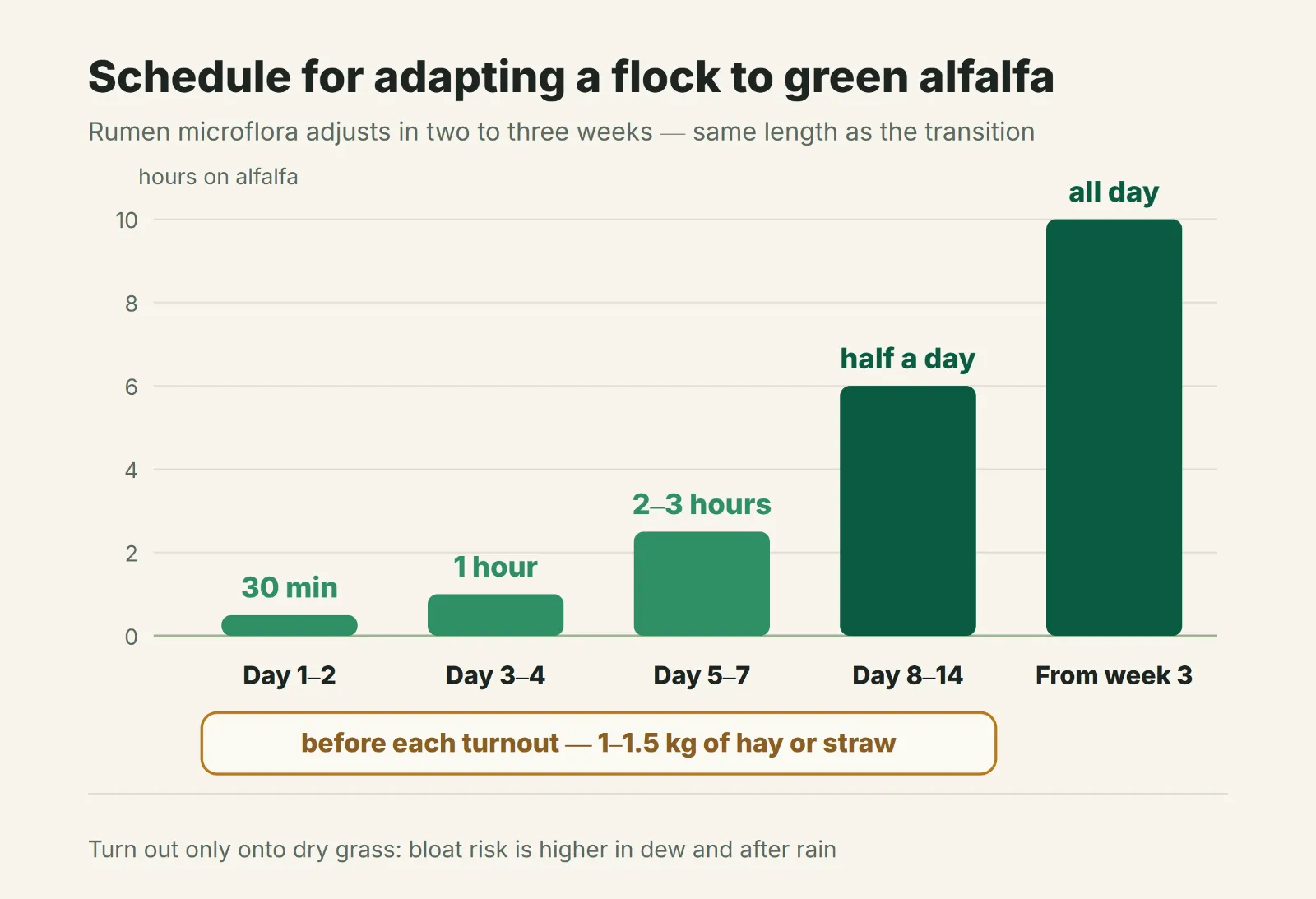
Switching to green feed is a schedule, not a weather-based decision.
| Day on alfalfa | Grazing time | Before turnout |
|---|---|---|
| 1–2 | 20–30 minutes | 1–1.5 kg hay or straw |
| 3–4 | 1 hour | 1 kg hay |
| 5–7 | 2–3 hours | 0.5–1 kg hay |
| 8–14 | half a day | hay overnight |
| from week 2–3 on | full day | roughage in the pen |
Four rules go with this schedule, and all of them cost less than treatment.
Never turn out on an empty stomach. Hay before turnout isn't wasted feed, it's insurance: a full animal eats green feed slowly and eats far less of it in the first few minutes.
Don't graze legumes in the dew or right after rain. Wait for the grass to dry off; the best time for a first pass onto alfalfa is midday, not early morning. It's best to skip grazing altogether the first time after rain.
Keep grasses in the stand. Pure alfalfa is more dangerous than a mix with grasses: fiber suppresses foam formation. If the field is pure alfalfa, cut it and feed it wilted rather than grazing it directly.
Don't feed freshly cut green mass left in piles. Alfalfa that's heated up in a pile carries the same risk plus the risk of poisoning. Cut only as much as the flock will eat in one go.
Roughage before turnout has to be on hand at all times — 15–20 kg of hay per head over the two-week transition: it is cheaper to buy hay and straw for supplementing in advance than to lose a ram on the third morning.
First-aid kit for the pen
A kit that pays for itself the first time you need it:
| Item | Reference price | Purpose |
|---|---|---|
| Vegetable oil, 1 L | 25 thousand soum (≈ $2) | foam-breaker, always on hand |
| Stomach tube, 1–1.5 cm, 2 m | 20 thousand soum (≈ $1.7) | release gas in the gas form |
| Trocar for small livestock | 100–150 thousand soum (≈ $8–12) | last resort, until the vet arrives |
| Timpanol or equivalent, bottle | 30–50 thousand soum (≈ $2.5–4) | commercial foam-breaker |
All together, about 200 thousand soum (≈ $17) — against a single animal's value of 3.3 million soum (≈ $275). Prices for the tools and products are reference points: veterinary pharmacies charge differently from region to region.
What to keep track of
Tympany almost always repeats on the same field, in the same week of the year. So after every episode it's worth writing down: the date, the field, the weather the day before, how many head bloated, and what helped. After two seasons you'll have your own map of dangerous days — and you'll know not "alfalfa is dangerous in general," but "this field is dangerous after rain, and the upper one isn't."
In an electronic flock disease log these notes go straight into the animal's card and the flock log: you can see which animals bloated more than once, how many episodes happened in a season, and what you did about it. This is a case where a notebook would work just as well — except notebooks get lost, and a card doesn't.
Flag separately any animal that bloats repeatedly on ground where the rest of the flock grazes without trouble. A tendency to bloat in individual animals recurs from year to year and, according to research, is partly heritable — those animals shouldn't be kept for breeding.
In short
- Frothy bloat on alfalfa kills within one to four hours of the first signs; it's the strongest, greediest eaters that die.
- One morning on regrowth on an empty stomach can cost 11.4 million soum (≈ $951) on a flock of 80 head.
- Prevention — hay before turnout, dry grass and a 2–3 week adaptation schedule — costs about 1.3 million soum (≈ $108), which is less than a single animal.
- In the first minutes: get the flock off the field, raise the front end, walk it slowly, give 10–15 ml of vegetable oil, call the vet.
- A trocar puncture isn't first aid — it's the last resort before death; a vet visit and antibiotics are mandatory afterward.
- Animals that have bloated twice shouldn't be kept for breeding.