Sheep Poisoning on Pasture: What Poisons Them Near Cotton Fields and What to Do in the First Hour
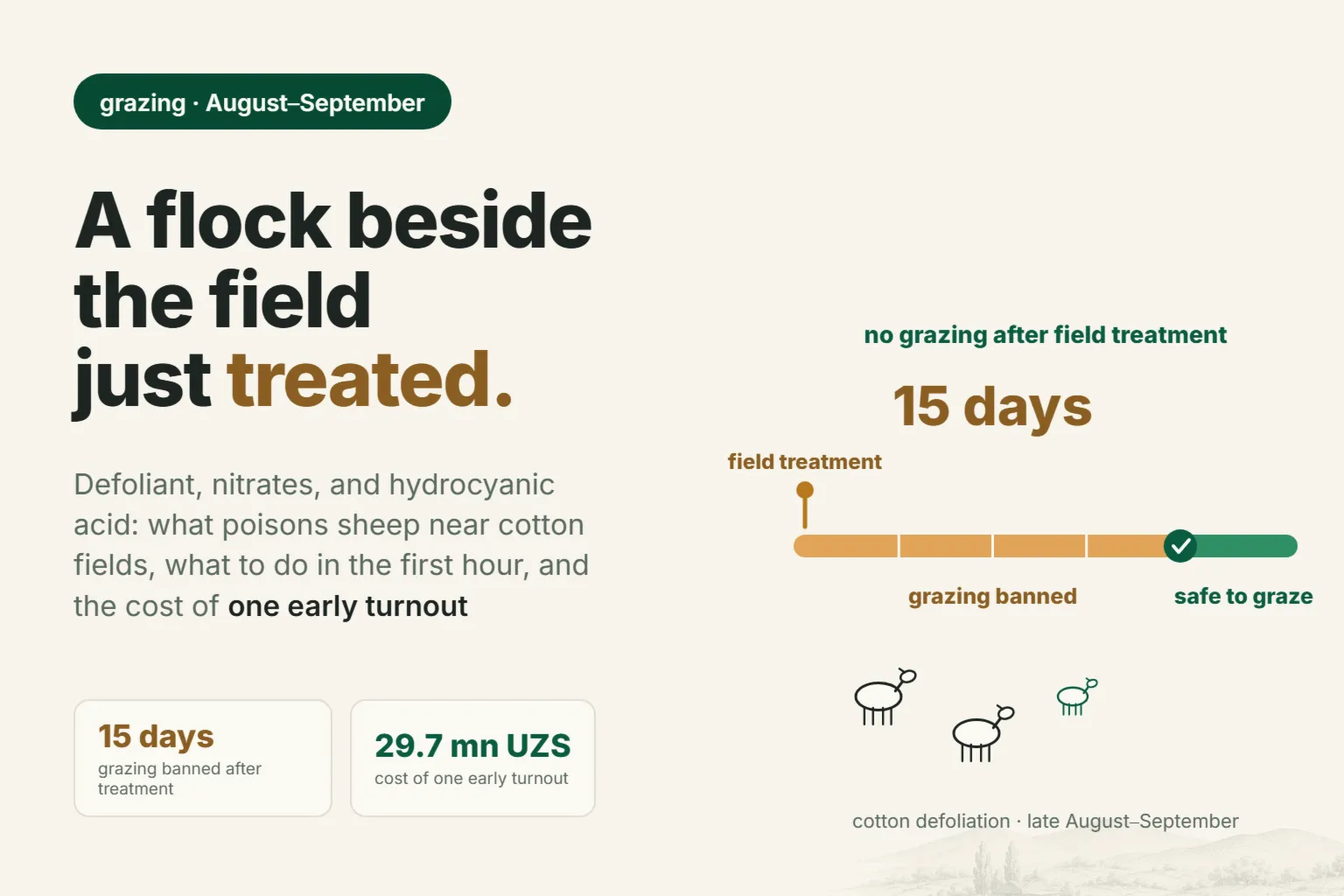
Sheep get poisoned by defoliant from treated fields, nitrates in green forage, and hydrocyanic acid in sudangrass. Signs for each poison, what to do in the first hour before the vet arrives, the 15-day no-grazing rule, and the cost of losses for a 100-head flock.
Sheep on pasture in Uzbekistan are poisoned mainly by three things: defoliant and pesticide residue on treated fields, nitrates in green forage from fertilized plots, and hydrocyanic acid in wilted or drought-regrown sudangrass and sorghum. The signs are similar: labored breathing, an unsteady gait, muscle tremors, and often heavy drooling. The color of the mouth and eyelid mucous membranes gives away the poison — with nitrates and chlorates they turn brown or bluish, while with hydrocyanic acid they go bright red instead. What to do: move the flock off the plot immediately, give clean water, don't drive the animals at a run, and call a vet — you're counting hours, and with some poisons, tens of minutes.
Below we look at why the end of August and September are the most dangerous months for grazing, exactly what poisons sheep near cotton fields, what to get done in the first hour, and what one such mistake costs a flock of 100 head. Prices are guidelines as of August 2026; the exchange rate used for conversion is 11,850 so'm to the dollar (the Central Bank's rate on August 23, 2026), and live weight is 55,000 so'm/kg (≈ $4.6), the low end of the market.
Why are the end of August and September the most dangerous months for grazing?
Before harvest, cotton plants are treated so the leaves drop and the picker takes in clean fiber.
A defoliant is a chemical used before cotton harvest to strip the leaves. Defoliation is timed not by the calendar but by the plant: once 40–55% of the bolls have opened. In the south, in Surkhandarya, that's the end of August; in the rest of the country, it's the first and second ten-day spans of September. Harvest starts 6–15 days after treatment.
Uzbekistan allows two main groups of defoliants. Chlorates — magnesium chlorate, calcium-magnesium chlorate blends — are produced domestically and applied heavily, at 6–13 liters per hectare. The second group has more brand names — thidiazuron and its mix with diuron (Dropp, Avguron, and a couple dozen other names) — but its application rate is tens of times lower.
For a flock, a treated field means three sources of poison where yesterday there was just ordinary ground:
- the plot itself — the chemical settles on the leaves, on weeds between the rows, and on grass along the edge;
- irrigation-ditch water flowing off the treated field after watering or rain;
- cotton stalks (goʻzapoya) left in the field after harvest. Turning a flock onto a harvested field is a common, almost free practice, but if too little time has passed between treatment and grazing, that free stubble becomes the most expensive feed of the year.
Chlorates are classified as low-toxicity, and that's exactly what lulls people into complacency. The lethal dose of chlorates for a sheep is 1.5–2.9 grams per kilogram of body weight (a cow is more vulnerable — 1.1 g/kg is enough), meaning a 45 kg ram needs 70–130 grams of the chemical. They don't act like a caustic burn: they convert hemoglobin into methemoglobin, which stops blood from carrying oxygen, destroy red blood cells, and damage the kidneys. Signs appear once methemoglobin reaches 30–40% of the blood, and death occurs once it passes 80%.
Pest-control spraying goes on all summer, and its residue lingers on the field for its own set periods. Here the chemicals at work are organophosphates, and they act fast and are easy to recognize.
What poisons sheep near treated fields?
| Source | What it is | First signs | How soon |
|---|---|---|---|
| Defoliant on the field, on stalks, or on weeds | Chlorates (magnesium chlorate) | Bluish and brownish mucous membranes, labored breathing, weakness, brown urine | Hours, sometimes a full day |
| Pest-control spraying | Organophosphates | Drooling in streams, constricted pupils, tremors, convulsions, diarrhea | From a few minutes to a few hours |
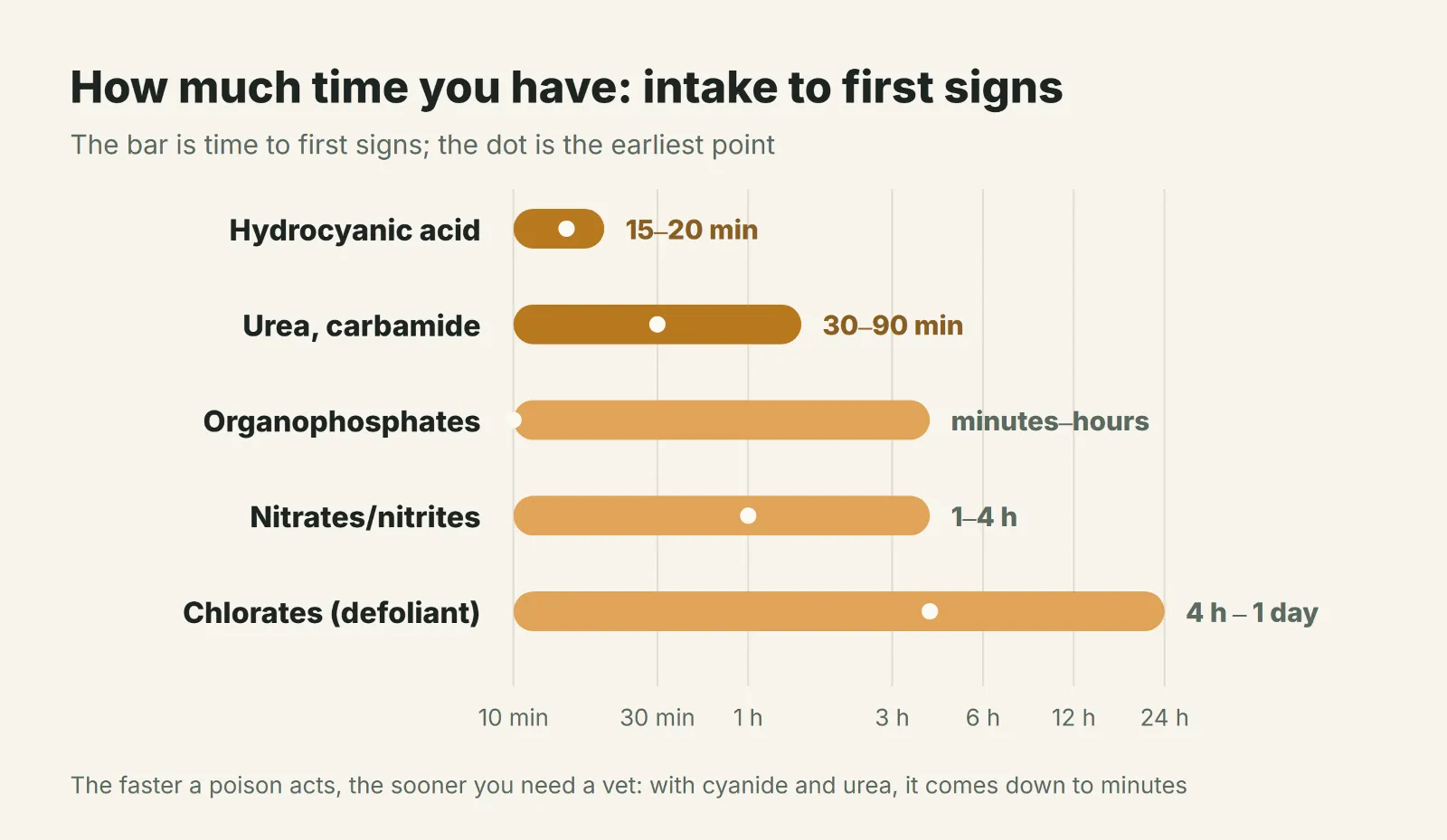
| Green forage from a fertilized plot, tops, weeds after drought | Nitrates and nitrites | Chocolate-brown mucous membranes, rapid breathing, unsteady gait, tremors | 1–4 hours |
| Sudangrass or sorghum regrowth after drought, frost, or trampling | Hydrocyanic acid (cyanide) | Sudden severe breathing distress, bright red mucous membranes, convulsions, rapid death | 15–20 minutes, sometimes a few hours |
| A bag of urea or nitrate fertilizer the animals got into | Ammonia from carbamide | Restlessness, teeth grinding, bloating, convulsions | 30–90 minutes |
Urea deserves its own line on this list because it's the most frustrating loss of all: the chemical doesn't come from someone else's field — it comes from the farm's own storeroom. The lethal dose of carbamide is 1–1.5 g per kilogram of body weight: 45–70 grams is enough for a 45 kg ram, half that for a lamb. Trouble starts noticeably earlier, at just 15–20 grams per head. Signs appear within 30–90 minutes, death within four hours. A fertilizer bag left in the pen or under a shed next to the feed isn't thrift — it's a landmine.
How do you tell poisoning apart from bloat and from infection?
This fork in the road is where the most costly time gets lost. Three questions almost always give you the answer.
How many head got sick at once? If five to ten animals turn sick within an hour, that's almost always feed or pasture, not an infectious disease that spreads through the flock over days. Almost — because there's one exception: enterotoxemia after an abrupt feed change also knocks down a group all at once. That's one more reason to call the vet instead of deciding it yourself.
What color are the mucous membranes? Check inside the mouth and under the eyelid. A brown, chocolate, or bluish tint points to nitrates or chlorates. Bright red with severe breathing distress points to cyanide. With infection, the color usually doesn't shift that sharply.
Is the belly bloated? If the left flank is drum-tight but there's no drooling or pupil constriction, it's more likely alfalfa bloat than poison — that has its own first aid and its own half-hour clock, which we covered separately in "Bloat in Sheep". But urea poisoning also causes bloating, and what sets it apart is drooling, tremors, and teeth grinding.
What to do in the first hour while the vet is on the way
The steps are the same regardless of the poison, because nobody's going to nail down the exact cause out in the field.
- Move the flock off the plot. Slowly, at a walk. Don't drive them at a run: a poisoned animal's heart and lungs are already at their limit.
- Switch the water. If they were watered from an irrigation ditch below the treated field, that source is off-limits now — bring clean water.
- Pull all suspect feed from the ration and don't throw it out. An armful of grass, a bag of greenfeed, leftover compound feed — that's what will later identify the poison.
- Separate the ones already down. Shade, quiet, access to water. No walking them around to "loosen up."
- Call the vet and tell them three things: how many head, what they ate and where they grazed over the last day, and what the signs are. That determines which antidote the vet brings.
- Go around to the neighbors and ask what was sprayed and when. Knowing the chemical's name saves the vet an hour.
What not to do. First: don't pour milk, oil, or vodka down the animal's throat just in case — with some poisons, fat speeds up absorption, and force-drenching a downed animal usually ends with fluid in the lungs. Second: don't slaughter animals that are down "before they die." Meat from an animal poisoned by a pesticide or defoliant doesn't go on the table: emergency slaughter on suspicion of poisoning is only done together with a vet, and the carcass's fate is decided based on lab test results.
What the vet treats with: antidotes by poison type
This isn't a self-treatment guide — doses are calculated by body weight, and some drugs are given intravenously only. But it's worth knowing what exists: then you can ask the right questions and not waste time.
| Poisoning | What the vet uses |
|---|---|
| Nitrates and nitrites | Methylene blue, 4–15 mg per kg of body weight as a 1–2% solution, given slowly IV — these doses are safe only for ruminants |
| Chlorates (defoliants) | The same methylene blue, but it works less well for chlorates than for nitrates and has to be repeated every 6 hours; plus a saline IV drip and supportive care |
| Organophosphates | Atropine plus cholinesterase reactivators; the reactivators only work in the first day or two — after that the enzyme "ages" and they become useless |
| Hydrocyanic acid | Sodium nitrite and sodium thiosulfate |
| Urea, carbamide | Rumen lavage, 5% table vinegar given orally — 0.5–2 liters per sheep — and cold water |
One rule applies to all five lines: the antidote works better the sooner it's given. With cyanide and urea, the animal doesn't have until tomorrow morning.
When your own greenfeed turns into poison
Two plant-based poisons live not on someone else's field, but on your own.
Nitrates. A plant stockpiles them when the soil was heavily fed with nitrogen and then drought hit and growth stalled. Sorghum, corn, beet tops, pigweed, and ordinary weeds from a rich plot are all risky in this sense. Ruminants are more vulnerable to nitrates than horses and pigs: nitrate turns into far more toxic nitrite right inside the rumen. But sheep tolerate it better than cattle — they need roughly double the dose. And the key difference from hydrocyanic acid: nitrates don't go away when dried. Hay made from nitrate-laden greenery is just as dangerous as fresh grass, and ensiling only cuts nitrate levels in half. It builds up in the lower part of the stem, which is why corn and sorghum for silage are cut higher than usual.
Hydrocyanic acid. Sorghum and sudangrass contain cyanogenic glycosides — harmless on their own until enzymes in a damaged plant activate them. The danger spikes sharply after drought, frost, trampling, and vigorous regrowth after cutting. Regrowth should only be fed as hay or silage: drying and fermentation remove most of the poison, but not all of it — if the standing grass was very toxic, a dangerous residue can remain. And silage shouldn't be opened sooner than three weeks after it's put up; it's safer to let it sit for 6–8 weeks.
There's a simpler practical yardstick than the growth stage: don't give sheep sudangrass until the plant reaches 30–38 cm, or sorghum-sudangrass hybrids until 60 cm. After a hard frost, wait 5–7 days and until the leaves turn brown; if the frost was light and the plant survived, wait at least two weeks, because new shoots are more toxic than old ones.
The cheap insurance against both is the same: never turn a hungry flock onto a new plot. Half an hour of coarse feed before turnout, and the animal won't eat, in one sitting, the portion that decides the outcome.
What one mistake like this costs, and what prevention costs
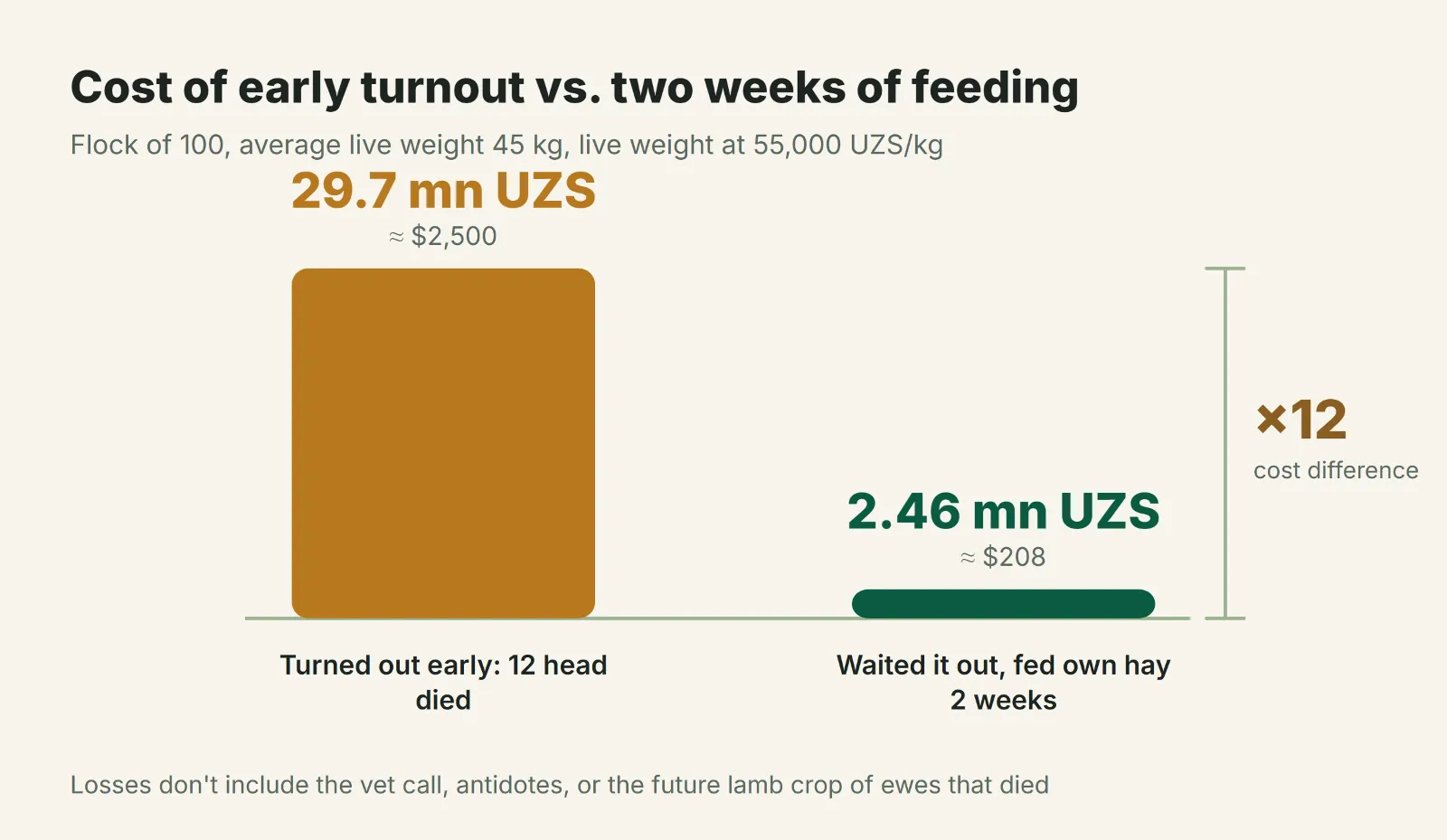
We're calculating for a flock of 100 head averaging 45 kg live weight. At 55,000 so'm per kilogram of live weight, one head is worth about 2.5 million so'm (≈ $209).
| Scenario | What happens | Cost |
|---|---|---|
| The flock was turned out onto the field too early | 12 head died, another twenty stalled in weight for a week | 29.7 million so'm in losses (≈ $2,500), plus lost weight gain |
| Waited out the withdrawal period and fed their own hay for two weeks | 100 head × 1.6 kg hay × 14 days = 2,240 kg at 1,100 so'm | 2.46 million so'm (≈ $208) |
The difference is 12 times, and that's without counting the vet call, antidotes, or dead ewes who would have taken their entire future lamb crop with them. A two-week reserve of coarse feed is the cheapest insurance a farm can buy; buy hay and compound feed in Tashkent region is cheapest right at the end of summer, and we covered how to calculate a year's supply in "How Much Hay a Sheep Needs for Winter".
How to work things out with neighboring fields
Poisoning on pasture is one of those rare risks where almost all the prevention is free and comes down to conversations.
- Find out the spraying schedule from neighbors and from whoever farms the field next door. One phone call a week in September is cheaper than any loss.
- Keep to 15 days. After a plot is treated with pesticides, you can't mow grass or graze livestock for fifteen days — not on the field itself, not on adjacent plots, road shoulders, or along irrigation ditches; that's set out in the Occupational Safety Rules for Agricultural Work on Pesticide-Treated Plots (registered with the Ministry of Justice on December 18, 2014, No. 2637). Warning signs are required to be posted on the treated field. Don't confuse this period with the "withdrawal period" — that one is counted up to harvest, and for cotton defoliants it's only 6–15 days. If you couldn't find out which product was used, build in a buffer: two to three weeks instead of fifteen days.
- Don't cut grass along the edges of treated fields or irrigation ditches — that's the same plot, just gathered by hand and carried to the feeder.
- Check where the water comes from. After irrigation or rain, a ditch below a treated field isn't a water source.
- Keep fertilizers and chemicals under lock, away from feed, and never pour compound feed into an empty nitrate-fertilizer bag.
- Write it down. Keep the date the neighboring field was sprayed, the day the plot is clear again, and where the flock grazed — even just in your phone's calendar: nobody remembers this a month later, and these entries are what settle things when you talk it through with the vet. Keeping vaccinations, deworming, and treatment of your own animals on record is exactly why we built the sheep vaccination and treatment log app. QoyHunter is a CRM for sheep record-keeping and the bazar.qoyhunter.com marketplace, where farmers sell livestock and buy feed.
FAQ
How many days after spraying can sheep graze a field?
After a plot is treated with pesticides, you can't mow grass or graze livestock for fifteen days — not on the field itself, not on adjacent plots, road shoulders, or along irrigation ditches. That's set by the Occupational Safety Rules for Agricultural Work on Pesticide-Treated Plots (Ministry of Justice, December 18, 2014, No. 2637). It's often confused with the "withdrawal period," but that one is counted up to harvest: for cotton defoliants it's only 6–15 days. If you couldn't find out which product was used, it's safer to build in a buffer and wait two to three weeks.
Can sheep graze a cotton field after harvest?
Yes — cotton stalks (goʻzapoya) are a common source of grazing in Uzbekistan, but only under two conditions. First, at least fifteen days have to have passed since the field was treated. Second, the flock goes in not hungry and not for the whole day at once, but starting with just one or two hours. If the field's owner can't say what was sprayed and when, it's better to skip that field.
How can you tell sheep were poisoned rather than sick?
The main sign is how many, how fast. Poisoning drops a group of animals within one to two hours, and it's specifically the ones that grazed the same plot that go down. An infectious disease spreads through a flock over days and usually starts with one or two head. The second sign is the color of the mucous membranes in the mouth and under the eyelid: a brown, chocolate, or bluish tint is common with poisoning and rare with infection. There's one exception: enterotoxemia after an abrupt feed change also knocks down a group at once, so the diagnosis is still up to the vet.
Can you slaughter a poisoned animal for meat?
No, not on your own call. Meat from an animal poisoned by a pesticide, defoliant, or fertilizer doesn't go on the table. Emergency slaughter on suspicion of poisoning is only done together with a veterinarian, and the carcass's fate is decided based on lab test results. Trying to "slaughter it before it dies" turns a livestock death into a risk for your family and your buyers.
Is it true that sudangrass and sorghum are dangerous for sheep?
It's not the crop itself that's dangerous, it's its condition. Sorghum and sudangrass accumulate cyanogenic glycosides, and the risk spikes sharply during drought, after frost, from trampling, and in young regrowth after cutting. Don't give sheep sudangrass until the plant reaches 30–38 cm, or sorghum-sudangrass hybrids until 60 cm. Feed the regrowth as hay or silage: drying and fermentation remove most of the poison, but silage shouldn't be opened sooner than three weeks after it's put up.
Manage your flock in QoyHunterCRM for sheep farmers: livestock, health, weighing, finance and analytics — in the app and a Telegram bot.All features →