Nasal bot in sheep (oestrosis): why sheep sneeze, how not to confuse it with pneumonia and what to treat the flock with
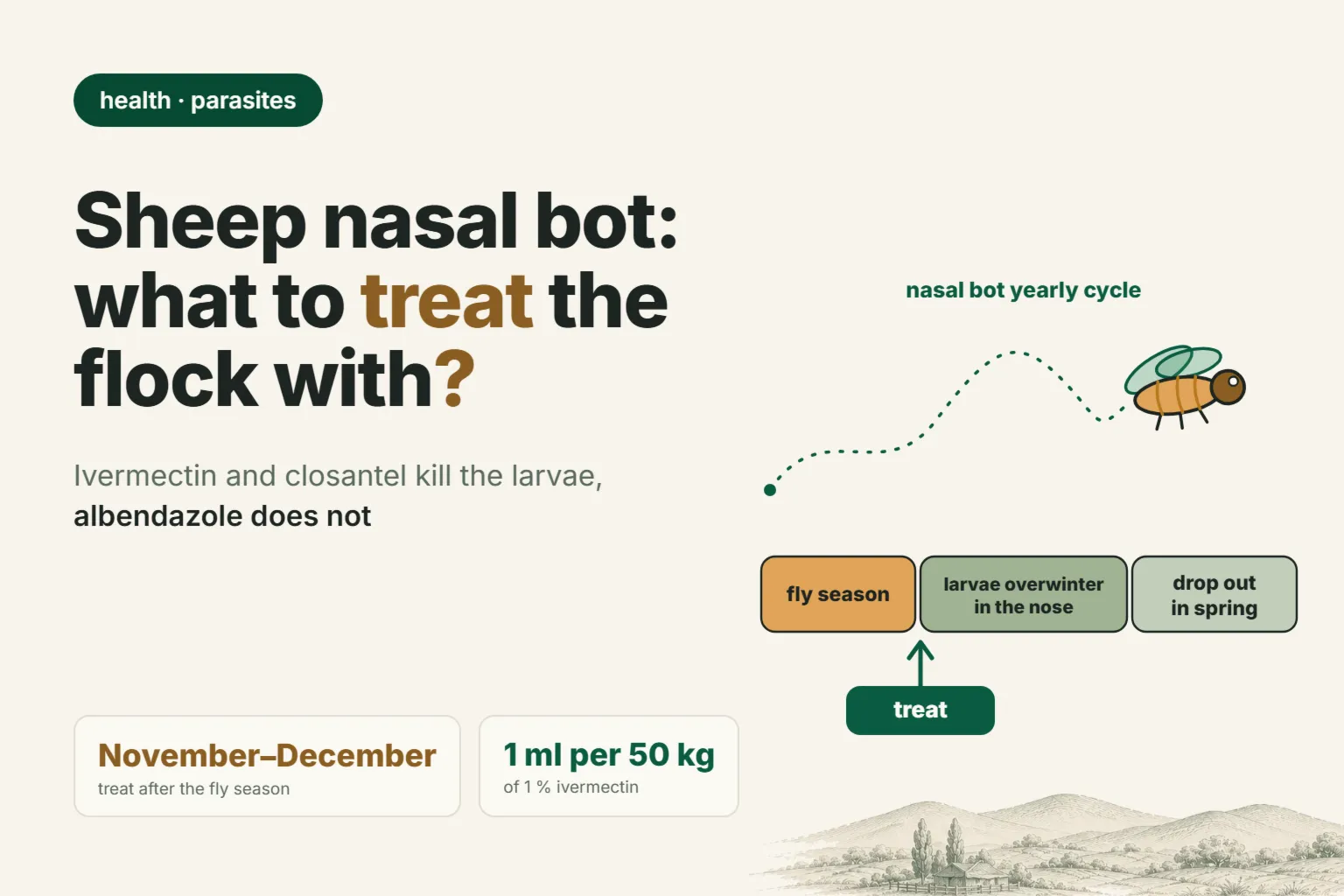
Sheep sneeze, shake their heads and have a runny nose, but their temperature is normal — most often these are nasal bot larvae. Ivermectin and closantel kill them, albendazole does not. When to treat the flock in Uzbekistan and what an antibiotic mistake costs — a calculation for October 2026.
Nasal bot in sheep (oestrosis) is caused by the larvae of the sheep nasal bot fly, Oestrus ovis, which live in a sheep's nasal passages and frontal sinuses. If sheep in your flock sneeze, shake their heads and have a runny nose in autumn, while their temperature is normal and they are still eating, it is most often nasal bot, not pneumonia. It is treated not with an antibiotic but with an antiparasitic: ivermectin and closantel kill the larvae, albendazole does not. In Uzbekistan the best time to treat the flock is after the fly season ends, usually in November–December, and you can combine it with the autumn deworming.
Below: how the bot's cycle works, how to tell it from pneumonia and false gid in five minutes, which drug to choose, and how much money a wrong diagnosis costs.
What is nasal bot in sheep and how does it infect a flock?
Oestrosis is a parasitic disease of sheep and goats in which the larvae of the sheep (nasopharyngeal) bot fly live in the nasal cavity and sinuses. The adult fly is a grey fly about 12 mm long. It does not bite or feed: it lives for about two weeks and during that time deposits live larvae straight into the sheep's nostrils.
The nasal bot's development cycle goes like this:
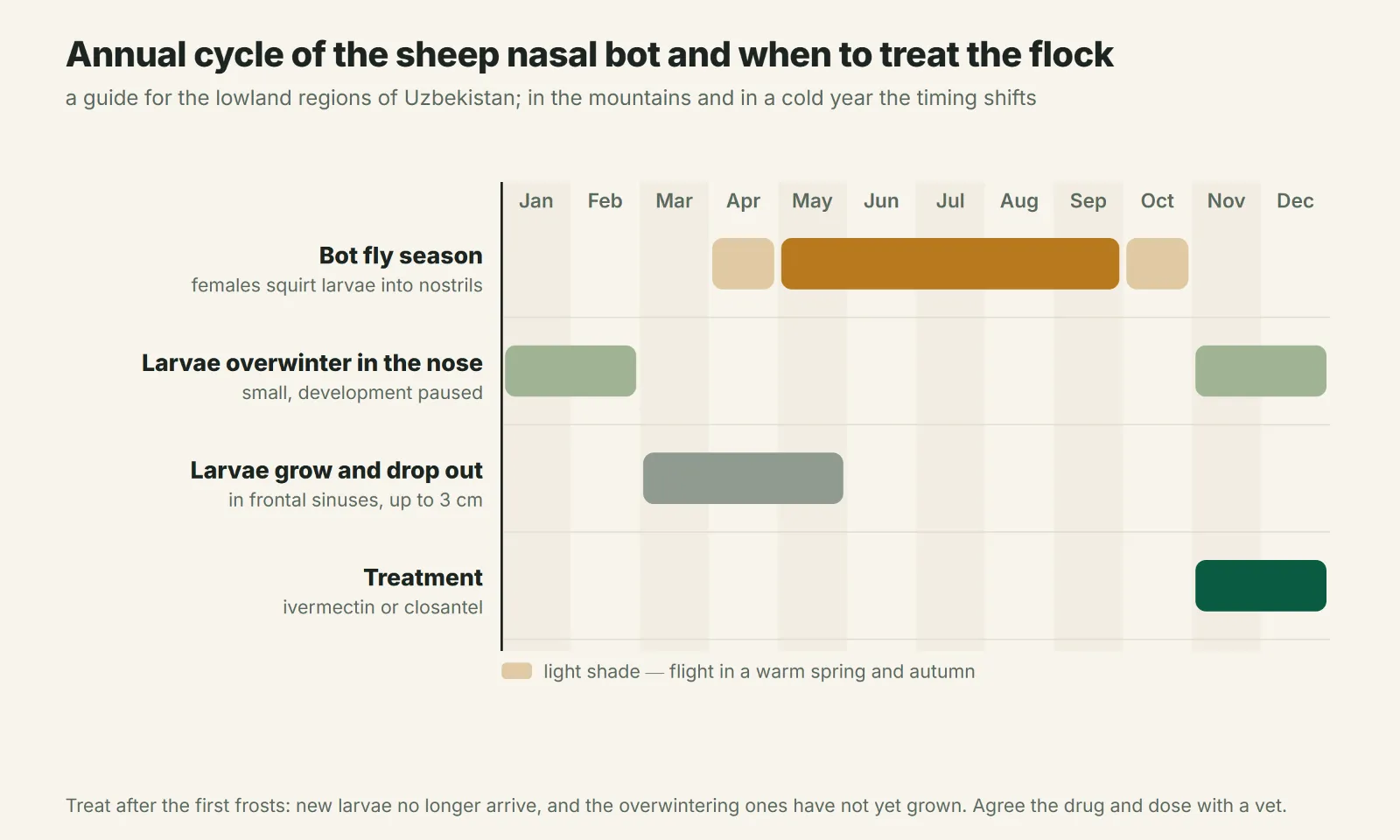
- In the warm season the female flies up to a sheep's muzzle and, in flight, sprays a batch of small larvae into the nostril — about 25 at a time, according to the University of Saskatchewan's veterinary college.
- First-stage larvae first stay on the mucous membrane of the nasal passages. In autumn their development can pause for 1 to 9 months — this is how the larvae overwinter in the sheep's nose (data from Australia's WormBoss programme).
- In spring the larvae move into the frontal sinuses, grow up to 3 cm, moult and mature.
- The sheep sneezes the mature larvae out onto the ground. They burrow into the soil and pupate; after 3–9 weeks, depending on temperature, a new fly emerges.
In a hot climate the fly goes through 2–3 generations a year. For Uzbekistan this means that infection goes on all through the warm season, and by the end of October, as the weather cools, new larvae stop arriving, and only the ones that settled in for the winter remain in the flock's noses.
What are the signs of nasal bot in sheep?
The signs of oestrosis show up in two different seasons.
In summer, during the fly season, the flock is restless: sheep bunch up, hide their muzzles in the ground, under their bellies and between their neighbours' legs, snort, shake their heads and stop grazing in the hot hours. This is a defence against the fly that is aiming at their nostrils.
In autumn and winter, when the larvae sit in the nose, you see something different:
- sneezing and snorting, sometimes in fits;
- nasal discharge — clear at first, then mucopurulent, with dried crusts around the nostrils;
- the sheep rubs its nose on the feeder, the ground, other sheep's legs;
- temperature is usually normal — 38.3–39.9 °C — and appetite is intact.
Occasionally, with a large number of larvae, a bacterial infection of the sinuses joins in, and then you can see an unsteady gait and walking in circles — so-called false gid. This is rare, not the rule.
How do you tell nasal bot from pneumonia and gid?
A thermometer and five minutes of watching in the pen help you tell oestrosis in a sheep from pneumonia and gid. A mistake here costs money: each disease is treated with its own drug.
| Sign | Nasal bot | Pneumonia | Gid (coenurosis) |
|---|---|---|---|
| Temperature | normal, 38.3–39.9 °C | above 40.5 °C | usually normal |
| Appetite | intact | lost | falls gradually |
| Nose | sneezing, discharge, crusts | discharge may occur, the main thing is frequent laboured breathing | clean |
| Behaviour | shakes head, rubs nose | stands with neck stretched out, lags behind | walks in circles in one direction, presses head against things |
| Treatment | ivermectin or closantel | antibiotic prescribed by a veterinarian | no drug treatment |
The cheapest way to check whether bot is present on your farm is to look at the head at slaughter. Saw a ram's head in half along the midline: nasal bot larvae — whitish or with dark cross-stripes, up to 3 cm long — are visible in the nasal passages and frontal sinuses. If you find them in one or two slaughtered animals, the whole flock that grazed together is infested.
What real autumn pneumonia in young stock looks like and how it is treated, we covered in detail in the article on pneumonia in lambs.
How dangerous is nasal bot and what does it cost a farmer?
The honest answer: at low infestation, nasal bot costs a flock less money than worms or liver fluke, and studies on its effect on weight gain disagree.
| Study | What was found |
|---|---|
| Brazil, finishing lambs (Bello et al., Frontiers in Veterinary Science, 2022) | larvae in 7 of 10 lambs given only albendazole and levamisole, but average daily gain was the same: 193 g versus 192 g in those treated with ivermectin or closantel |
| Niger, field trial of closantel (Tibayrenc et al., 1999) | the group given closantel twice, 2 months apart, gained significantly more weight than the group given only mebendazole |
| Australia, WormBoss programme | the bot is more of a nuisance than a cause of serious disease; treating for it alone is rarely needed |
The practical conclusion: a separate treatment for bot alone, when signs are mild, is an unnecessary expense. The money on oestrosis is lost elsewhere — on a wrong diagnosis.
Calculation for 100 weaned lambs weighing 35 kg, October 2026. The lambs sneeze and have a runny nose. The owner decides it is a cold and injects the whole group with an antibiotic:
| Item | Calculation | Amount |
|---|---|---|
| Antibiotic course with an anti-inflammatory | 100 head × 6,000–10,000 sum | 0.6–1.0 million sum (≈ $50–84) |
| Meat withdrawal period | long-acting oxytetracycline — 28–35 days | the sale is delayed, though the bot has not gone anywhere |
| Result | the antibiotic does not act on the larvae | the bot stays in the nose |
Meanwhile the correct treatment with 1% ivermectin at a dose of 1 ml per 50 kg of live weight is 0.7 ml per 35 kg lamb, about 70 ml for the whole hundred, that is, less than two 50 ml bottles. Ivermectin also has a meat withdrawal period — from three weeks to two months depending on the label, so check the instructions before selling. The same injection also clears gastrointestinal roundworms and lungworms. The antibiotic course prices are taken from our article on pneumonia, at a rate of 11,898 sum per dollar (Central Bank of Uzbekistan, 10 October 2026).
What should you treat sheep with for nasal bot?
Macrocyclic lactones (ivermectin and its relatives) and closantel work against nasal bot larvae; nitroxynil does too, but at a higher dose than against liver fluke. Ordinary benzimidazoles, which most cheap dewormers rely on, do not act on insect larvae.
| Active ingredient | Works on the bot | What else it clears | What matters |
|---|---|---|---|
| Ivermectin (1% injection, 0.2 mg/kg) | yes, 93–100% of larvae in trials | stomach and intestinal roundworms, lungworms | 1 ml per 50 kg; does not kill liver fluke |
| Other macrocyclic lactones: abamectin, doramectin, moxidectin | yes | roundworms | long-acting moxidectin cleared 90% of first-stage larvae in one trial |
| Closantel (10 mg/kg) | yes, 100% in the 2022 Brazilian trial | liver fluke older than 6–7 weeks, barber's pole worm | convenient to combine with fluke treatment; long meat withdrawal period |
| Albendazole, fenbendazole, triclabendazole | no | roundworms, liver fluke — depending on the drug | do not count on it for the bot |
| Levamisole | no | roundworms | do not count on it for the bot |
Calculate the dose by the weight of the heaviest sheep in the group, and check the withdrawal period before slaughter and the ban for milking ewes on the label of the specific drug: for closantel it is among the longest of the antiparasitic products. If you are preparing rams for sale within the next month, choose the drug with that in mind.
Nasal flushing with solutions, which old manuals recommend, does not reach the larvae in the frontal sinuses: the drug has to reach them through the blood.
When should you treat the flock for nasal bot in Uzbekistan?
The main treatment for nasal bot is after the fly season ends, when new larvae no longer arrive. In Uzbekistan's lowlands this is usually November–December, after the first frosts. Treating in September leaves the flock open to new larvae, and in spring, when the larvae have grown, some of them have already dropped out and pupated.
The most convenient approach is not to give a separate injection for the bot, but to pick the drug for the treatment that is already in your calendar anyway:
| Your flock | What to use in November–January | What it covers |
|---|---|---|
| Grazes on dry foothills, no liver fluke | ivermectin when housing for winter | bot, roundworms, lungworms |
| Grazed by irrigation ditches and collector drains in summer and autumn | closantel in the second fluke treatment, in December–January | bot and liver fluke older than 6–7 weeks (nitroxynil at the fluke dose may not be enough for the bot) |
| Both problems plus severe haemonchosis anaemia | scheme based on a faecal test, with a veterinarian | — |
Why a single autumn treatment with triclabendazole is not enough for grazing near water, and why you need a second one with closantel, we covered in the article on liver fluke in sheep.
Treat purchased sheep in quarantine: that way neither bot larvae nor another farm's worms enter the flock. When buying a ram or ewe lambs, ask the seller what and when the flock was treated with; you can calmly compare several offers among the rams and sheep for sale.
So that you do not have to guess a year later what you injected and when, write down the date, drug, dose and meat withdrawal period. In QoyHunter, a CRM for sheep records and the bazar.qoyhunter.com marketplace, you enter the treatment in the health log for the whole flock or for a single sheep, and the app reminds you about the next one in advance — how it works is shown on the page about the log of vaccinations and antiparasitic treatments.
Is nasal bot dangerous to humans?
Yes, but rarely. In summer the fly can squirt larvae into the eye, nose or lips of a shepherd working near the flock. The larvae do not develop fully in a person, but they cause acute conjunctivitis — stinging, watering, a feeling of sand in the eye. If something "hit" your eye near the flock in summer and a few hours later it is red and sore, do not rub it and see an eye doctor: a doctor removes the larvae.
FAQ
Why do sheep sneeze and shake their heads in autumn?
Most often it is nasal bot: the larvae of the sheep bot fly lie in the nasal passages and sinuses and irritate the mucous membrane. The sheep sneezes, shakes its head, rubs its nose, mucous discharge comes from the nostrils, but the temperature stays normal — 38.3–39.9 °C — and appetite is intact. If the temperature is above 40.5 °C and breathing is fast and laboured, it is already pneumonia, and you need a veterinarian.
What should I inject sheep with for nasal bot?
Ivermectin (1% injection — 1 ml per 50 kg of live weight) and closantel (10 mg/kg) act against nasal bot larvae. In trials they killed 93–100% of larvae. Albendazole, fenbendazole, triclabendazole and levamisole do not act on the bot. Check the meat withdrawal period and the ban for milking ewes on the drug label.
When should I treat sheep for the bot?
The main treatment is after the fly season ends, when new larvae no longer arrive: in Uzbekistan's lowlands usually in November–December, after the first frosts. It is convenient to combine it with housing for winter and the autumn deworming, and for grazing near water — with the second fluke treatment with closantel in December–January.
Can nasal bot cause gid in sheep?
True gid is caused by a different parasite — the coenurus, the larva of a dog tapeworm, in the brain. With a very heavy infestation and secondary sinus infection, the nasal bot occasionally produces a similar picture — unsteadiness and walking in circles, called false gid. The difference: with the bot there is nasal discharge and sneezing. A veterinarian makes the exact diagnosis, and you can check your farm by sawing open the head of a slaughtered ram.
Do I need to treat sheep if they only sneeze a little?
A separate injection for the bot alone, when signs are mild, usually does not pay off: in the 2022 Brazilian trial infested lambs gained the same 192–193 g a day as the treated ones. It is wiser to choose, for the planned autumn deworming, a drug that also gets the bot — ivermectin or closantel — and not spend money on an antibiotic that does not act on the larvae.
Manage your flock in QoyHunterCRM for sheep farmers: livestock, health, weighing, finance and analytics — in the app and a Telegram bot.All features →