How to Store Hay in Winter: How Much You Lose in the Open and Whether a Tarp Pays Off
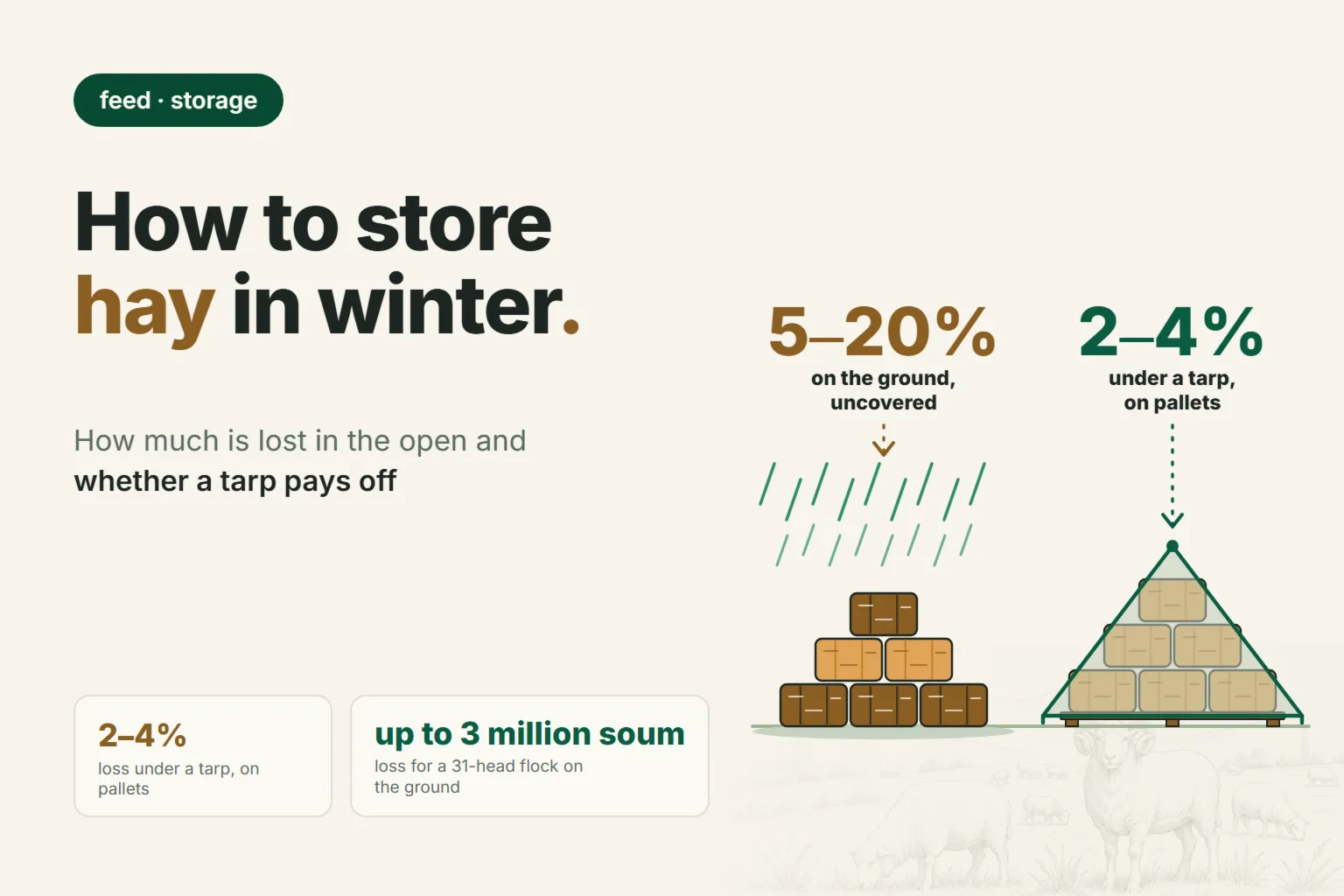
Hay on bare ground in the open loses 5–20% of its weight over the winter, under a tarp on pallets 2–4%. A calculation in soum for a flock of 31 head, the price of a tarp in October 2026, and the temperature at which a stack should be taken apart.
How to store hay in winter so you don't lose it before spring: keep the bales under a roof or a tarp, lift the bottom row off the ground on pallets, and stack only dry hay with moisture no higher than 18%. According to the farmer advisory service of Oklahoma State University (OSU Extension), hay left in the open on bare ground loses 5–20% of its dry matter over the winter, while hay under cover and on a base loses 2–4%. For a flock of 31 head with 8.4 t in store, that is a difference of 250 to 1,340 kg of hay, or 0.45–2.4 million soum (≈ $38–203) of extra buying at the winter price.
Below: where the losses come from, what each storage method costs in soum, and how not to set fire to a stack that was built damp. Prices are for October 2026, at the Central Bank of Uzbekistan rate of October 13, 2026: 11,899 soum per dollar.
Why does hay spoil specifically in winter in Uzbekistan?
Because in most of Uzbekistan the rain and snow fall exactly in the storage months. For example, by the 1991–2020 climate norms, Tashkent gets about 470 mm of precipitation a year, and about 310 mm of it falls from November to March, two thirds of the annual total. In summer hay dries on its own, but from November until spring a stack in the open stays wet for weeks.
Hay storage losses come in two kinds:
- Weight loss (dry matter). Wet hay is home to bacteria and mold: they "eat" the sugars in the feed and give off heat, water and carbon dioxide. The bale gets lighter, and that part of the feed is gone for good. Whatever mice and rats carry off counts here too.
- Quality loss. Soaked tops and rotted bottoms get eaten worse: sheep pick through them and drop the rest underfoot. According to Kansas State University (K-State Research and Extension), the loss of feed value in rained-on hay is usually larger than the loss of weight, and together they can exceed 50%.
Hay that has lain through the winter in the rain looks familiar: a gray-brown top layer, a matted bottom, a smell of rot. That is lost money.
How much hay is lost with different storage methods?
The most detailed table of losses was published by Oklahoma State University for round bales of hay. Small pressed bales, which are sold in Uzbekistan at 20 kg, shed rain worse than round bales, so the same recommendation says to keep them under a roof altogether. There is no exact table for small bales; most likely, outdoors they lose no less than round bales.
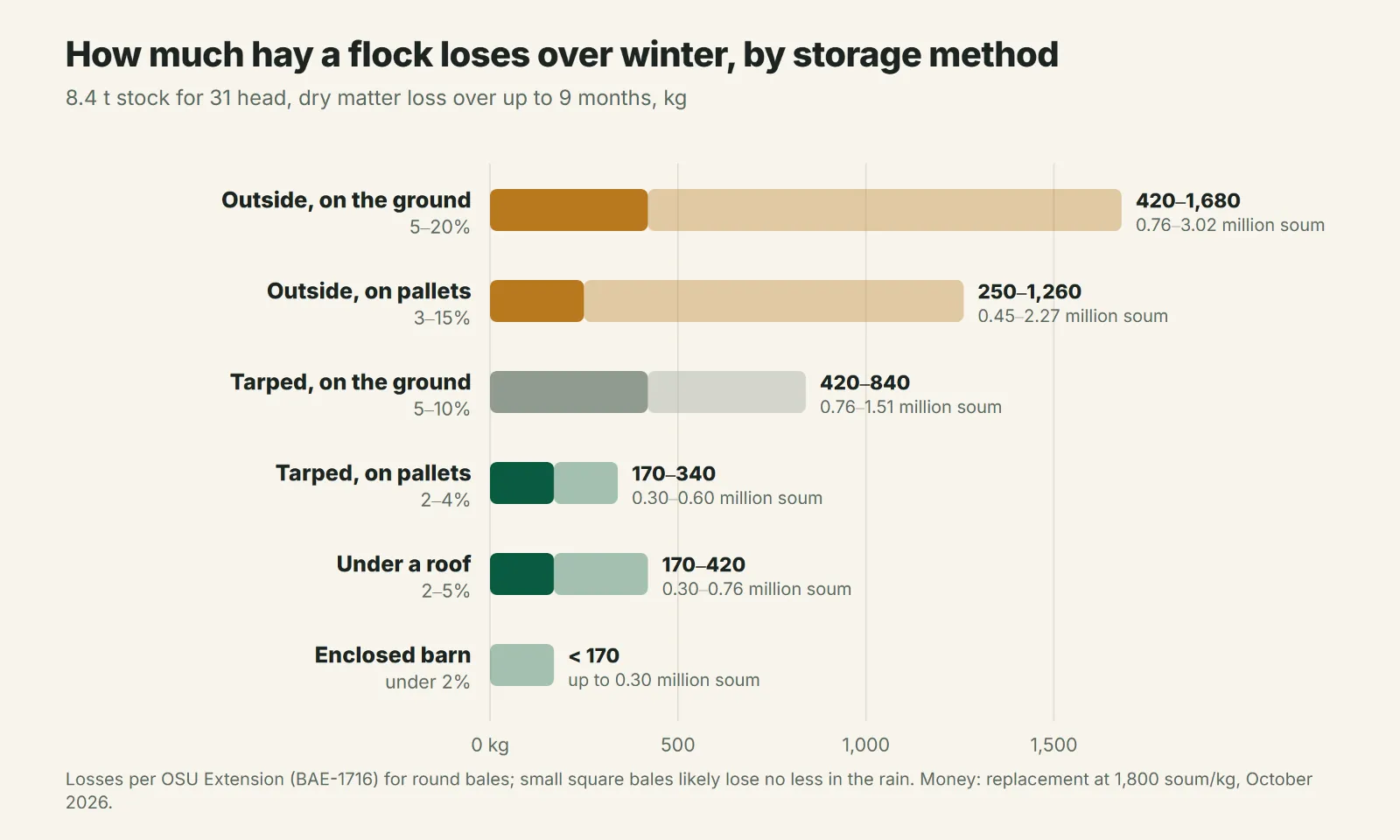
| Storage method | Dry matter loss up to 9 months | What that means for a flock with 8.4 t in store | Extra buying at 1,800 soum/kg |
|---|---|---|---|
| Outdoors, directly on the ground | 5–20% | 420–1,680 kg | 0.76–3.02 million soum (≈ $64–254) |
| Outdoors, on pallets | 3–15% | 250–1,260 kg | 0.45–2.27 million soum (≈ $38–191) |
| Under a tarp, on the ground | 5–10% | 420–840 kg | 0.76–1.51 million soum (≈ $64–127) |
| Under a tarp, on pallets | 2–4% | 170–340 kg | 0.30–0.60 million soum (≈ $25–51) |
| Under a shed (roof without walls) | 2–5% | 170–420 kg | 0.30–0.76 million soum (≈ $25–64) |
| Closed barn | less than 2% | less than 170 kg | less than 0.30 million soum (≈ $25) |
Losses are from OSU Extension (Round Bale Hay Storage, BAE-1716). The wetter the winter, the closer the losses get to the upper limit. The table counts losses over the whole storage period of up to 9 months: hay fed out earlier loses less, so for a store used up over the whole winter this is an upper estimate. The extra-buying price of 1,800 soum/kg is the January price of alfalfa hay from our article on choosing hay.
The calculation is for the same flock as in the article “How much hay does a sheep need for winter”: 20 ewes, 10 young animals and a breeding ram, a store of 8.4 t of hay, or about 420 bales of 20 kg. In autumn 2026 such a store costs about 10.9 million soum (≈ $918) at 26,000 soum per bale. Hay lost over the winter has to be bought back at 1,800 soum per kilogram, which is more than it cost in autumn.
Why can't you put hay straight on the ground?
The bottom row of bales on bare ground draws moisture up from below like a wick. According to OSU Extension, up to 30 cm of the bottom of a round bale can rot this way, and contact with the ground accounts for more than half of all losses in outdoor storage. Compare the rows of the table: an open stack on pallets loses 3–15%, on the ground 5–20%.
What to put under the bottom row:
- wooden pallets are the handiest option, the bottom row gets airflow;
- poles, old railroad ties or logs with gaps between them;
- a layer of crushed stone about 15 cm thick where the stack will stand, so that water drains downward.
Pick a spot on high ground where water doesn't stand after rain, and not under trees: according to Kansas State University, shade and still air keep hay from drying after rain, and the harm from shade outweighs the shelter of the canopy. Mow the dry grass and weeds around the stack, since they hold dampness and are a fire hazard.
Does a tarp for the stack pay off?
Yes, if the stack stands in the open. A tarp together with pallets pays for itself in one winter when losses are large and in three to four winters when they are small, and a dense tarp lasts more than three years, so over its service life it almost always pays off. A new waterproof tarpaulin of 7 × 8.5 m (about 60 m²) costs 1.45–1.53 million soum (≈ $122–129) according to OLX.uz listings in October 2026. Used PVC banners and tarps sell for several times less, but they need to be checked for holes.
Let's count for the same flock. Moving from an open stack on the ground (5–20% losses) to a stack under a tarp on pallets (2–4%) saves from 250 to 1,340 kg of hay, which is 0.45 to 2.42 million soum (≈ $38–203) over the winter. A dense reinforced tarp, by OSU Extension's estimate, lasts more than three years with careful storage.
Rules for the tarp:
- Dry hay only. A tarp doesn't breathe: if you cover hay with moisture above 18–20% under it, it heats up and molds faster than in the open.
- Don't tie it down tight. Weights are hung at the edges so the tarp can move a little in the wind, which makes it tear less. Patch a hole right away: water runs through it into the middle of the stack.
- A stack with a ridge. The top row of bales is laid like a "roof" so puddles and snow don't sit on the tarp.
- Open at the bottom. Leave a gap between the tarp and the ground for ventilation.
The flat roof of an outbuilding, where hay is often piled in villages, protects the hay from below but not from above: the top rows on the roof get wet just as in an open stack. Cover them with a tarp from above as well.
How do you tell a stack is heating up, and prevent a fire?
Hay pressed wet heats up from inside, which is the work of bacteria. According to the Alabama Cooperative Extension System, the safe moisture of hay at baling is 10–15%; at 16–20% hay can mold, at 21–25% the fire risk is moderate, above 25% it is high. Heating can build for several weeks after the bales are stacked, so a new stack is checked for the first six weeks.
| Temperature inside the stack | What to do |
|---|---|
| up to 49 °C | normal, good hay can heat up to this level after baling |
| 49–54 °C | measure every day |
| 55–60 °C | get ready to take the stack apart, measure constantly |
| 66–71 °C | dangerous: call the fire brigade (101) and don't open the stack until they arrive |
| above 71 °C | there are smoldering pockets inside, and with air access the hay will burst into flame |
From the Alabama Cooperative Extension System, converted from °F.
You can check a stack with a probe with a thermometer or a long metal rod: push it into the middle of the stack for 15–20 minutes. If the rod is too hot to hold in your hand when you pull it out, the heat inside is already dangerous, so measure with a thermometer from then on. Don't take a hot stack apart yourself at a temperature above 66 °C: fresh air sets smoldering hay on fire.
To keep it from getting that far, check moisture already when you buy: break a bale and put your hand inside; a warm or damp core is a sign the hay is heating. The other checks of a lot, which are bale weight, color, smell and mold, are covered in the article on how to choose hay for sheep when buying.
In what order should you feed out the hay store?
The worst-kept first. Hay from the open stack is fed first, before spring: according to OSU Extension, losses in open storage rise sharply when it warms up and rains in spring. In Uzbekistan March is one of the rainiest months of the year, so it is better to finish the open stack by the end of February and leave the hay from under the roof for March and April.
Three more feeding rules:
- Don't mix the wet top layer with good hay. Set it apart and look at it: hay that merely got wet and dried can go to adult sheep being fattened, moldy hay to none.
- Mold is not feed for pregnant ewes. Moldy hay can cause fungal (mycotic) abortions and listeriosis in them; if there are abortions in the flock, call a vet right away. One aborted lamb costs about 1.93 million soum in October 2026, more than a tarp.
- Recount what is left once a month. Hay that goes to waste quietly shrinks the store: at 15% losses a flock of 31 head loses about 1.3 t, almost the whole 20% "just in case" reserve built into the calculation. If the winter drags on, the hay will run out.
If the store still falls short, it is better to buy more hay in December than in February, when good alfalfa runs out for everyone. It is handy to compare the latest hay and alfalfa bales for sale by price per kilogram, not per bale.
To notice that hay is going faster than planned, you need the stock in the warehouse, not an eyeball guess. In QoyHunter, a CRM for sheep record-keeping and the marketplace bazar.qoyhunter.com, feed stock tracking in the warehouse is kept from your phone: a purchase is booked into the warehouse, and write-offs at feeding show how many days the remainder will last.
FAQ
Can you store hay outdoors without a shed?
You can, but in winter in Uzbekistan it is expensive: on bare ground with no cover, hay loses 5–20% of its weight over the winter (per OSU Extension), and small 20 kg bales hold up to rain worse than round bales. For a flock of 31 head with 8.4 t of hay, that is up to 1.68 t, or up to 3 million soum of extra buying at the winter price of 1,800 soum/kg. If there is no shed, lift the bottom row onto pallets and cover the stack with a tarp, and losses drop to 2–4%.
What moisture should hay have to be stacked?
Hay is stacked at a moisture no higher than 18%. According to the Alabama Cooperative Extension System, at 10–15% the fire risk is lowest, at 16–20% hay can mold, and above 25% the risk of spontaneous combustion is high. Without a moisture meter, check by hand: there should be no warmth or dampness inside the bale, and a twisted wisp of dry hay snaps with a crack.
Why does hay heat up in a stack?
Bacteria and mold work inside damp hay: they break down the sugars in the feed and give off heat. Heating to 49 °C in the first days after baling happens even with good hay. If the temperature inside the stack climbs to 55–60 °C and above, get ready to take the stack apart, and at 66–71 °C call the fire brigade (101) and don't open it until they arrive: fresh air sets smoldering hay on fire.
Do you need to cover hay with plastic film or a tarp?
If the hay isn't under a roof, yes. A stack under a tarp on pallets loses 2–4% of dry matter over the winter instead of the 5–20% of an open stack on the ground (OSU Extension). A new 7 × 8.5 m tarp costs about 1.5 million soum (≈ $125) in October 2026, and on a flock with 8.4 t of hay together with the pallets it pays for itself in one rainy winter or in three to four dry ones. Only dry hay goes under a tarp, and it is not tied down tight.
Can you feed sheep hay that got wet?
Hay that got wet and dried again without mold can be fed to adult sheep, but sheep eat it worse, and part of it goes to waste. Moldy hay is fed to no one, and especially not to pregnant ewes: mold can cause fungal abortions and listeriosis, and if there are abortions in the flock, a vet is needed. A gray coating, dust when shaken and a musty smell are signs of mold.
Manage your flock in QoyHunterCRM for sheep farmers: livestock, health, weighing, finance and analytics — in the app and a Telegram bot.All features →